
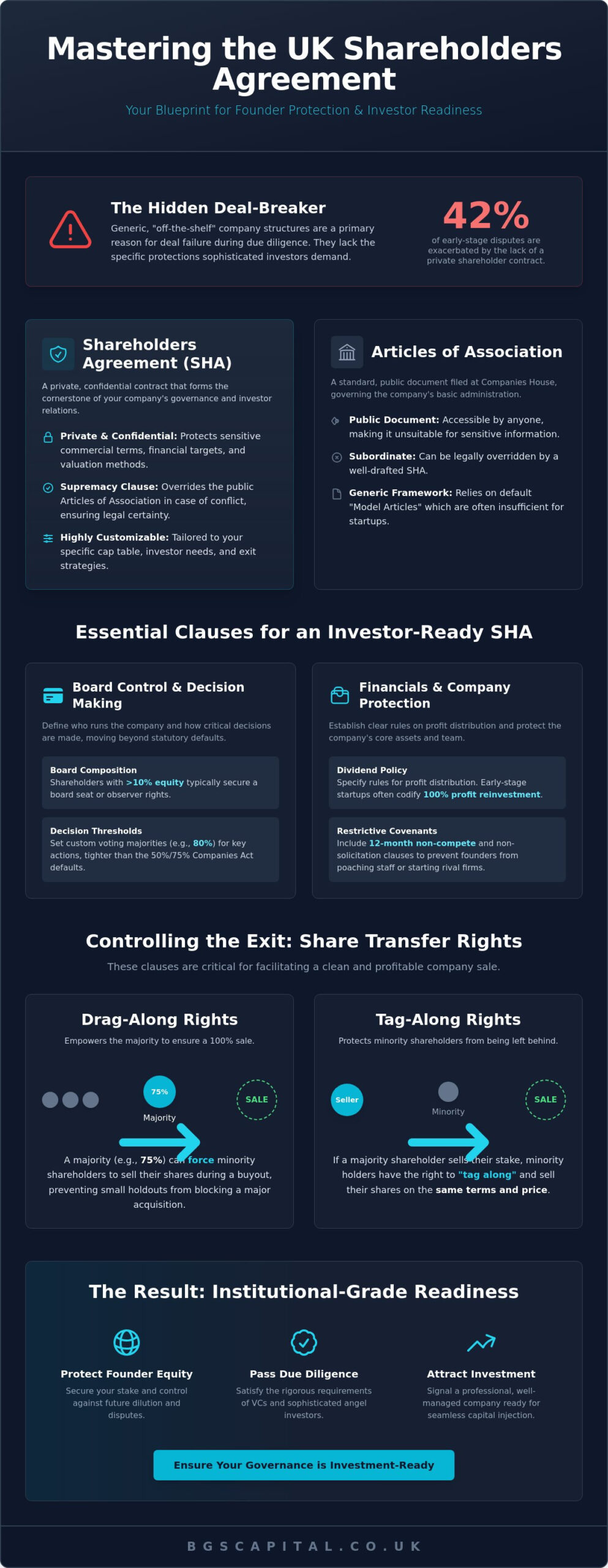
A generic “off-the-shelf” company structure is often the primary reason for deal failure when sophisticated investors conduct due diligence. While many founders rely on standard Articles of Association, these public documents lack the confidentiality and specific protections required for a complex cap table. Utilizing a professional shareholders agreement template uk is a baseline requirement; however, the execution determines whether you attract or alienate venture capital. Data from UK legal specialists indicates that 42% of early-stage disputes are exacerbated by the absence of a private contract that overrides default statutory provisions.
You likely recognize that your current governance must evolve before your next funding round to prevent friction between co-founders and early backers. This guide provides the strategic framework to master the essential components of a UK shareholders agreement, ensuring you protect your equity while signaling institutional-grade readiness to high net worth individuals. We will analyze the critical mechanics of board control, minority protections, and the specific clauses that facilitate seamless capital raising in the 2026 investment landscape.
Key Takeaways
- Define the shareholders agreement’s role as the private contractual cornerstone for UK corporate governance and founder equity protection.
- Identify critical clauses for board composition and decision-making thresholds that ensure operational control and professional transparency.
- Assess the strategic use of a shareholders agreement template uk versus the necessity for bespoke legal advice during complex investment rounds.
- Understand how robust governance frameworks satisfy the rigorous due diligence requirements of sophisticated angel investors and institutional funds.
- Execute the agreement correctly as a deed to ensure legal validity and maintain stringent compliance as the company scales toward 2026.
Understanding the Shareholders Agreement in the UK Legal Framework
A Shareholders’ agreement functions as a private contract executed between the members of a company. It establishes a bespoke governance framework that dictates how the business operates, how decisions are made, and how disputes are resolved. In the UK, this document serves as the cornerstone of private company governance. It moves beyond the generic provisions of the Companies Act 2006 to provide specific protections for minority shareholders and founders alike. While the Act offers a baseline of statutory protection, it’s often insufficient for entities managing complex cap tables or preparing for institutional investment.
Founders must view this document as a strategic asset rather than a mere administrative requirement. It’s the primary mechanism for aligning the interests of different stakeholders. It ensures that every party understands their obligations and rights from the outset. By implementing a professional shareholders agreement template uk, founders can codify exit strategies and dividend policies that aren’t adequately covered by standard legislation. This level of preparation is vital for maintaining a clean cap table and ensuring the company remains attractive to sophisticated investors.
SHA vs. Articles of Association: Key Differences
The Articles of Association are public documents. They’re filed at Companies House and are accessible to any third party. This lack of privacy makes them an inappropriate venue for sensitive commercial arrangements. In contrast, the SHA is a confidential contract. It allows shareholders to keep internal financial targets, restrictive covenants, and specific valuation methodologies away from the public eye. If a conflict occurs between these two documents, a well-drafted SHA includes a supremacy clause. This ensures the private agreement overrides the public Articles, providing a superior layer of legal certainty for the signatories.
Who Needs a Shareholders Agreement?
Any business with more than one shareholder requires a formal agreement to mitigate risk. Multi-founder startups, family-run enterprises, and companies navigating the startup funding lifecycle are particularly vulnerable without one. Relying solely on “Model Articles” is a common mistake that leads to “deadlock” where decision-making grinds to a halt. In 2023, industry data indicated that internal shareholder disputes remain a leading cause of early-stage business failure in the UK. A shareholders agreement template uk provides the necessary framework to handle “bad leaver” scenarios and forced share transfers. It’s an essential tool for any founder who prioritizes long-term stability and investment readiness.
Essential Clauses for a UK Shareholders Agreement Template
A robust shareholders agreement template uk serves as the operational backbone for any venture-backed firm. It defines board composition. Typically, any shareholder holding over 10% of equity expects a board seat or observer rights. Decision-making relies on specific thresholds. While the Companies Act 2006 sets defaults for ordinary (50%) and special (75%) resolutions, a custom agreement often tightens these for critical actions. Dividend policies must be explicit. Startups often reinvest 100% of profits, but the agreement should outline when and how distributions occur once the company matures. Restrictive covenants protect the entity. These usually include 12-month non-compete and non-solicitation clauses to prevent founders from launching rival firms or poaching staff.
Reserved Matters: Controlling Key Decisions
Reserved matters act as a veto right for minority shareholders. They prevent the majority from making fundamental changes without broad consent. Standard lists include taking on debt exceeding £100,000, altering the company’s articles, or issuing new equity. As a firm approaches a 2026 IPO, these matters often shift. They become more streamlined to satisfy public market governance requirements and institutional investor expectations.
Share Transfer Provisions: Drag-Along and Tag-Along Rights
Exit strategies rely on transfer rights. Drag-along clauses enable a majority, usually 75%, to force minority holders to sell during a total buyout. This prevents small holdouts from blocking a £50 million acquisition. Tag-along rights protect the minority. If a majority sells, the minority can tag along on the same terms. A comprehensive shareholders agreement template uk also includes pre-emption rights. These ensure existing investors get the first refusal on new shares, preventing unwanted dilution. Before finalizing your equity structure, check if you are eligible for high-growth investment support to ensure your cap table remains attractive to venture capital.
Dispute Resolution and Deadlock Clauses
Deadlocks can freeze operations. Russian Roulette clauses allow one party to offer to buy the other out at a specific price; the recipient must either sell or buy the offeror out at that same price. Texas Shoot-out mechanisms involve sealed bids where the highest bidder buys the other’s shares. UK courts are slow and expensive. Most agreements mandate mediation or arbitration under LCIA rules to maintain business continuity during founder disagreements. This legalistic approach prioritizes transparency and risk mitigation.
How a Robust Agreement Attracts Sophisticated Investors
Sophisticated capital follows structure. A well-drafted shareholders agreement template uk acts as a primary signal to the market that a founder understands corporate governance. It moves the business from a casual venture to a professional entity. During due diligence, angel investors look for specific protections. They want to see how decisions are made and how their capital is shielded from founder disputes.
Governance serves as a proxy for risk management. Industry data indicates that roughly 20% of startups fail due to team or founder issues. A robust SHA mitigates this risk by establishing clear protocols. It aligns founder interests with the expectations of high-net-worth individuals by codifying exit strategies and drag-along rights. This preparation is vital for the cap table. It ensures that early-stage equity allocations don’t block future rounds or complicate secondary placings as the company scales toward a liquidity event or IPO.
Signaling Investment Readiness
Legal friction kills deals. Using a standardized, high-quality shareholders agreement template uk accelerates the closing process. It demonstrates that the company is ready for venture capital scrutiny. VCs prioritize a clear path to exit. If the SHA doesn’t define how a sale or IPO is triggered, professional firms will often walk away. Additionally, the agreement must solidify ownership of intellectual property. Without explicit clauses assigning IP to the company, the business’s valuation is fundamentally compromised. Investors won’t fund a company that doesn’t legally own its core assets.
Balancing Control and Capital
Founders must secure startup funding without surrendering operational autonomy. The SHA defines this balance. It uses reserved matters to give investors a say on major shifts while leaving day-to-day decisions to the management team. Adopting UK legal standards makes the company attractive to international investors. These standards provide a familiar framework for reporting and information rights. Investors receive regular financial updates, which builds the trust necessary for follow-on investment. Clear information rights ensure that stakeholders are never surprised by the company’s financial position.
- Professionalism: Demonstrates a commitment to transparent management.
- Risk Mitigation: Protects the company from internal deadlock.
- Scalability: Prepares the cap table for institutional rounds.
- Asset Protection: Ensures all IP is owned by the legal entity.
Drafting Your Agreement: Template vs. Bespoke Legal Advice
Utilising a shareholders agreement template uk provides a structured baseline for early-stage companies. It identifies the commercial levers founders must align on before external capital is committed. Treat the template as a rigorous discussion document. It surfaces misalignments regarding exit strategies or board control early. This process reduces billable hours when you eventually engage a solicitor to formalise the document. A template acts as a bridge between a verbal handshake and a legally binding contract.
Identify red flags that necessitate immediate legal intervention. These include asymmetrical capital contributions, intellectual property disputes, or the involvement of corporate shareholders. If a founder holds more than 50% of the voting rights, minority protection clauses become critical. Standard templates may not sufficiently protect a minority shareholder from being squeezed out during a secondary funding round.
Professional legal fees for a standard agreement range from £3,000 to £7,500. While this is a significant upfront cost, the alternative is financially draining. High Court data indicates that shareholder litigation costs often exceed £100,000 per party. A robust agreement functions as a risk-mitigation asset. It prevents the deadlock that causes roughly 25% of startup failures within the first three years of operation.
Common Mistakes in DIY Shareholders Agreements
Founders often fail to synchronise their agreement with the Articles of Association. This creates legal conflict. Missing updates after a secondary share issuance dilutes existing protections. Overlooking the capital gains tax implications of share transfers leads to unexpected HMRC liabilities. Professional review ensures tax efficiency during future exits and prevents the loss of Business Asset Disposal Relief.
When to Move Beyond a Basic Template
Complexity triggers require bespoke drafting. If your company seeks EIS eligibility, the agreement must comply with strict HMRC “risk to capital” requirements. Standard templates rarely cover the nuances of “good leaver” versus “bad leaver” provisions or complex vesting schedules. These are essential for maintaining cap table integrity. Sophisticated structures are required when preparing for a pre-IPO feature on a capital-raising platform to ensure the business is attractive to institutional investors.
Ensure your business meets the requirements for high-level investment. Check your eligibility to join our network of sophisticated investors and founders.
Implementation and Governance: Moving Toward Investment
A shareholders agreement template uk provides the framework; however, its effectiveness depends entirely on correct execution and ongoing maintenance. By 2026, the UK regulatory environment will demand even higher standards of corporate transparency. Founders must treat their governance documents as active assets rather than static filings. Proper implementation ensures the company remains “investment-ready” for sophisticated capital sources.
Executing the Agreement Correctly
Under English law, the SHA should be executed as a deed. This format is preferred because it removes any legal arguments regarding “consideration” or the value exchanged between parties. For a document to qualify as a deed under the Law of Property (Miscellaneous Provisions) Act 1989, it must be in writing, clear on its face that it’s intended to be a deed, and validly executed. Every signature requires an independent witness who is not a party to the agreement or a family member. Failure to follow these formalities can render specific clauses, such as powers of attorney, entirely unenforceable.
As the company grows, the cap table will evolve. You don’t need to rewrite the entire SHA every time a new person joins. Instead, all new shareholders must sign a “Deed of Adherence.” This short document legally binds the newcomer to the existing SHA terms. Version control is critical here. Maintain one definitive, digital “source of truth” in a secure data room. This prevents the confusion of multiple conflicting drafts during a high-stakes funding round.
Preparing to Feature Your Business
Professional governance documentation significantly reduces friction during the investor introduction process. Institutional firms and high-net-worth individuals prioritize companies that demonstrate legal maturity. A clean, well-maintained legal structure is a prerequisite for any successful pre-IPO investment. If your cap table is messy or your SHA is poorly executed, you risk losing momentum during due diligence. Industry data suggests that 65% of investment delays in the UK tech sector stem from incomplete or disorganized corporate records.
Before approaching accredited investment firms, run a final audit on your documentation. Sophisticated investors will scrutinize your SHA for clear exit strategies and drag-along rights. Use this checklist to confirm your readiness:
- Execution: Is the SHA signed by all parties and executed as a deed?
- Witnessing: Are all signatures properly witnessed by independent third parties?
- Adherence: Have all current shareholders signed the SHA or a Deed of Adherence?
- Cap Table: Does your cap table match the share register held at Companies House?
- Review: Has the document been reviewed within the last 12 months to reflect current scaling needs?
Transitioning from legal setup to active capital raising requires a shift in focus. Once your shareholders agreement template uk is fully implemented, the focus moves to business valuation and investor outreach. Governance is no longer a hurdle; it’s a competitive advantage that signals your company is ready for professional capital.
Securing Your Path to Institutional Investment
A precise governance structure is mandatory for any UK founder seeking external capital. Utilizing a professional shareholders agreement template uk ensures that critical mechanisms like pre-emption rights and board control are established before you engage with sophisticated funders. Data from the 2024 British Business Bank reports indicates that structured equity remains vital for the UK’s high-growth ecosystem. Well-drafted documentation signals to the market that your company’s ready for the rigours of institutional due diligence. It’s the difference between a stalled deal and a successful funding round.
RAISING CAPITAL? FEATURE YOUR BUSINESS. We facilitate connections between qualified UK companies and a curated network of high-net-worth and sophisticated investors. Our platform positions your business for exclusive pre-IPO and IPO opportunities through professional introduction services. We focus on companies that have moved beyond the seed stage and are ready for professional-grade facilitation.
Your business deserves a foundation that supports its highest ambitions. Start refining your corporate framework today to ensure you’re eligible for the next tier of growth.
Frequently Asked Questions
Is a shareholders agreement legally binding in the UK?
Yes, a shareholders agreement is a legally binding contract in the UK. It operates under standard contract law principles and the Companies Act 2006. If a party fails to meet their obligations, the courts can enforce the terms through damages or injunctions. It’s a private arrangement between shareholders that sits alongside the Articles of Association. This dual structure ensures that internal governance remains enforceable and clear for all investors.
What is the difference between a shareholders agreement and a partnership agreement?
A shareholders agreement governs a limited company, whereas a partnership agreement applies to traditional partnerships or LLPs. Shareholders own equity in a separate legal entity with limited liability. Partners often share direct liability for business debts. The shareholders agreement focuses on share transfers and board control. Partnership agreements focus on profit sharing and individual partner contributions. These documents serve different legal structures under UK law and provide distinct protections.
Can I change a shareholders agreement after it is signed?
You can change a shareholders agreement after it’s signed if 100% of the parties provide written consent. Most agreements include a variation clause that specifies the process for amendments. This typically requires a formal Deed of Variation or an entirely new agreement to supersede the old one. It’s vital to document every change to avoid future disputes. Verbal agreements won’t hold up in court if the original contract requires written variations.
Does a shareholders agreement need to be filed with Companies House?
You don’t need to file a shareholders agreement with Companies House. It’s a private contract, unlike the Articles of Association which are public documents. This confidentiality is why many founders use a shareholders agreement template uk to protect sensitive commercial details. Keeping these terms private prevents competitors or the public from seeing your internal dividend policies or specific exit strategies. It remains a confidential record between the signing parties.
What happens if a shareholder breaches the agreement?
If a shareholder breaches the agreement, the other parties can sue for breach of contract. Remedies often include financial damages or a court order for specific performance. Many agreements also include “bad leaver” clauses. These force the breaching shareholder to sell their shares back to the company at a discounted price. This protection is a standard risk management tool for investment-ready companies in the UK to ensure stability.
Is a witness required for a shareholders agreement in the UK?
A witness is required if the shareholders agreement is executed as a deed. Most professional legal advisors recommend this format to ensure the document is enforceable even if there’s no “consideration” or payment involved. Each party must sign in the presence of an independent adult witness who isn’t a family member or another shareholder. This process adds a layer of formal verification to the signing process and is standard practice.
How much does it cost to have a bespoke shareholders agreement drafted?
Bespoke drafting for a shareholders agreement typically costs between £1,500 and £5,000 plus VAT. Prices vary based on the complexity of the share classes and the number of investors involved. High-growth firms with complex vesting schedules often face higher fees. Utilizing a professional shareholders agreement template uk can streamline the process, but you should always have a solicitor review the final version to ensure it meets your specific regulatory requirements.
Should a shareholders agreement include a valuation of the company?
A shareholders agreement shouldn’t include a fixed valuation because company values fluctuate constantly. Instead, it should outline the specific formula or process used to determine the value during a share transfer. Common methods include using an independent accountant’s assessment or a “Fair Value” calculation. This approach ensures the document remains relevant as the company scales. It’s a practical way to manage expectations during future investment rounds and exits.