
Securing early-stage capital is a critical inflection point for any high-growth UK business. The landscape, however, is complex. Founders often face uncertainty when distinguishing between venture capitalists and angel investors, leading to hesitation in fundraising strategy and concerns over equity dilution. This ambiguity can stall momentum at the most crucial stage of development.
This guide provides a definitive framework for navigating the world of angel investment. We deliver a comprehensive overview for both founders seeking capital and sophisticated investors targeting high-potential opportunities. It explains precisely who angel investors are, the mechanisms of their investment process, and what they require from a pitch before committing funds.
For founders, this is a strategic tool to determine if angel funding is the correct path, how to prepare a business for scrutiny, and how to connect with the right individuals. For investors, it offers critical insight into evaluating and securing early-stage deals. The objective is to equip you with the knowledge to secure capital and fuel sustainable business growth.
Key Takeaways
- Angel investors prioritise the strength and credibility of the founding team, often weighing it more heavily than the initial business idea.
- Success in securing funding depends on a meticulously prepared, step-by-step approach to the entire investment lifecycle.
- Discover targeted strategies to identify and connect with the right angel investors, increasing your chances of securing early-stage capital.
- Understand the specific financial and professional criteria required to qualify as an angel investor under UK financial regulations.
What is an Angel Investor? Defining the Key Player in Startup Funding
An angel investor is a high-net-worth individual (HNWI) who provides capital for a business start-up, usually in exchange for convertible debt or ownership equity. These individuals operate using their personal disposable funds, making them distinct from venture capitalists who manage pooled money from third-party investors. The primary motivation for angel investors is a combination of potentially high financial returns, a passion for innovation, and the opportunity to mentor the next generation of entrepreneurs.
Often successful entrepreneurs or senior industry executives themselves, angels provide more than just capital. They offer invaluable strategic guidance, industry contacts, and operational expertise. This ‘smart money’ is crucial for startups navigating the perilous early stages of growth, bridging the critical funding gap that often exists between initial ‘friends and family’ rounds and the larger, more structured investments from venture capital funds.
Angel Investors vs. Venture Capital (VCs): The Core Differences
Understanding the distinction between angels and VCs is fundamental for any founder seeking capital. While both provide funding, their structure, focus, and engagement model differ significantly.
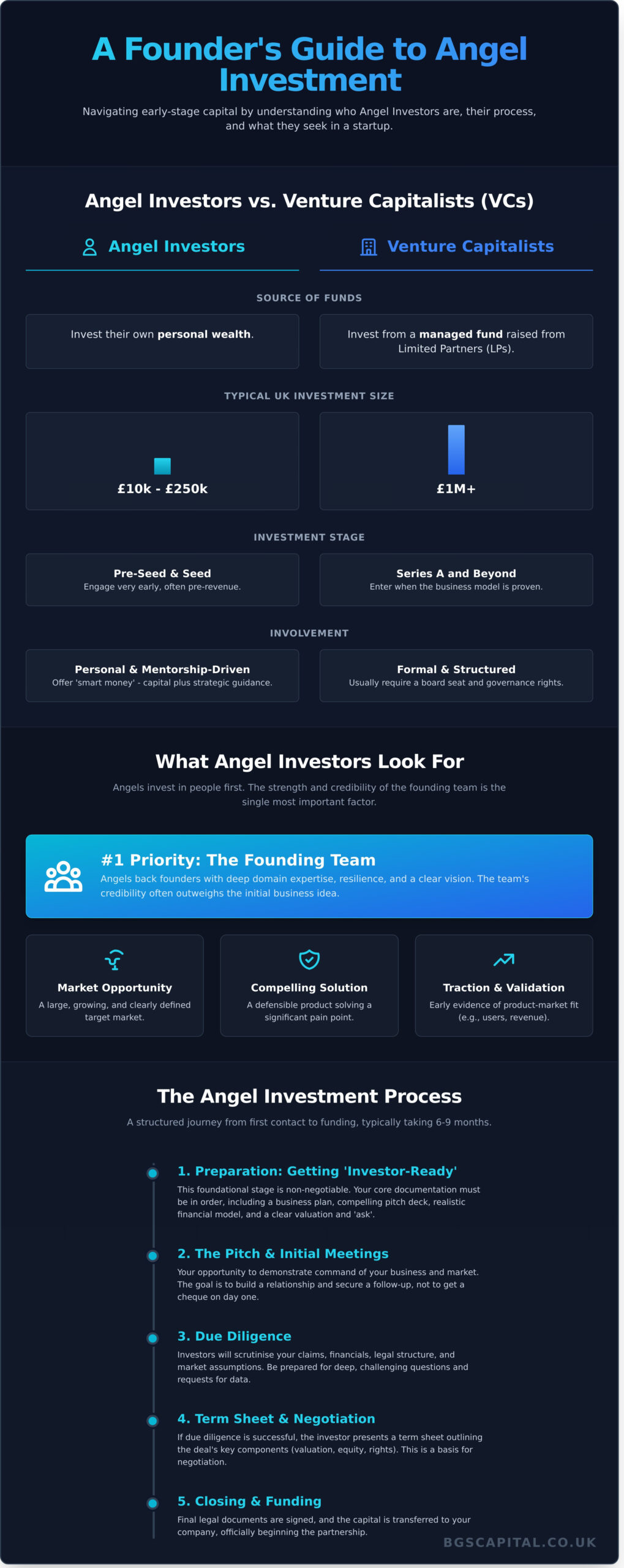
- Source of Funds: Angels invest their own personal wealth. VCs invest capital from a managed fund, raised from limited partners (LPs) such as pension funds or endowments.
- Investment Stage: Angels typically engage at the pre-seed and seed stages. VCs usually enter at later stages, such as Series A and beyond, when the business model is more proven.
- Investment Size: In the UK, an angel investment might range from £10,000 to £250,000. VCs operate on a much larger scale, with investments typically starting in the millions.
- Involvement: An angel’s involvement is often personal and mentorship-driven. A VC’s involvement is more formal, usually requiring a board seat and structured governance.
Types of Angel Investors
The UK landscape for angel investors is diverse, with individuals and groups bringing different objectives and expertise to the table. Key profiles include:
- The Super Angel: A high-volume, professional investor who may operate like a micro-VC, often with their own small fund and support team.
- The Industry Expert: An investor with deep domain knowledge in a specific sector (e.g., FinTech, SaaS, biotech) who provides targeted strategic value alongside capital.
- The Philanthropist Angel: An individual motivated by a dual objective of financial return and positive social or environmental impact.
- Angel Groups/Syndicates: A formal or informal collective of investors who pool their capital and resources to co-invest in startups, sharing the workload of due diligence and post-investment support. For a comprehensive overview, Wikipedia details what is an angel investor and the evolution of these groups.
The Angel Investment Process: A Step-by-Step Guide for Founders
Securing capital from angel investors is a structured, multi-stage process, not a single transaction. Founders must approach fundraising with professional discipline, recognising that the journey from initial contact to receiving funds typically takes between six and nine months. This process is fundamentally about building a relationship based on trust and a shared vision for the company’s future. Success is contingent on meticulous preparation and identifying an investor whose expertise and network align with your business objectives.
Preparation: Getting Your Business ‘Investor-Ready’
This foundational stage is non-negotiable. Before engaging with any potential investors, your business must have its core documentation in order. This includes:
- A concise business plan and executive summary: Clearly articulating your mission, market opportunity, and strategy.
- A compelling pitch deck: A visual narrative that outlines the problem, your solution, the team, and market traction.
- A realistic financial model: Detailed projections for at least three years, with transparent assumptions.
- A clear valuation: A defensible calculation of your company’s worth and a precise ‘ask’ detailing how much capital you are raising and for what purpose.
The Pitch and Initial Meetings
The pitch is your opportunity to demonstrate command of your business and market. Be prepared to confidently answer challenging questions regarding your team’s experience, competitive landscape, and customer acquisition strategy. The primary goal of a first meeting is not to secure a cheque, but to generate enough interest to secure a second meeting. Professional, timely follow-up is essential to maintain momentum and demonstrate your seriousness as a founder.
Term Sheets and Due Diligence
If an investor is serious, they will issue a term sheet. This non-binding document outlines the proposed terms of the investment, including pre-money valuation, the equity stake, investor rights, and board seats. Upon acceptance, the investor will commence due diligence-a rigorous examination of your company’s legal, financial, and commercial standing. Prepare a comprehensive data room with all relevant documents organised. Engaging experienced legal counsel is critical during this phase to protect your interests and navigate the complexities of the investment agreements.
What Angel Investors Look For: Key Criteria for Investment
Securing capital requires a comprehensive understanding of the investor’s perspective. While every investor maintains a unique thesis, a common principle holds true: angel investors back founders first and ideas second. They are fundamentally betting on a team’s ability to execute, adapt, and overcome inevitable challenges. Although individual priorities vary, most evaluate opportunities across three core pillars. This framework allows founders to self-assess their proposition and identify areas for improvement before approaching potential backers.
The Founding Team
The team is the most critical asset of any early-stage venture. Investors scrutinise founders for specific qualities that correlate with success, seeking evidence of deep commitment and the resilience required to navigate the startup journey.
- Founder DNA: Demonstrable passion for the problem being solved, along with coachability and an unwavering drive, are non-negotiable traits.
- Relevant Expertise: The team must possess direct industry experience or a unique insight that provides a tangible competitive edge.
- Complementary Skills: A balanced team covering key functions-such as technical development, commercial strategy, and operations-is significantly more investable.
- ‘Skin in the Game’: A material personal investment of time or capital (e.g., bootstrapping with personal funds of £10,000+) signals profound belief and commitment.
Market Opportunity and Business Model
A formidable team requires a significant market opportunity to pursue. The business must operate in a sector large enough to generate the venture-scale returns that angel investors require to offset the high risk of early-stage investment.
- Market Size: A large, growing, and clearly defined total addressable market (TAM) is essential.
- Scalability: The business model must present a clear and credible path to exponential growth with strong unit economics.
- Competitive Advantage: Investors look for a defensible moat or ‘unfair’ edge, such as proprietary technology, exclusive partnerships, or powerful network effects.
- Go-to-Market Strategy: A coherent and well-researched plan for acquiring customers and capturing market share is mandatory.
Traction and Product
An idea alone is insufficient; investors require proof of concept and market validation. Early evidence demonstrates that the target market wants and is willing to pay for what you are building.
- Product-Market Fit: Initial, quantifiable signs that customers value your product, even in its earliest form.
- Traction Metrics: Tangible progress such as early revenue, consistent user growth, successful pilot programmes, or signed letters of intent (LOIs).
- Minimum Viable Product (MVP): A working prototype or MVP that validates core assumptions is now a standard expectation.
- Intellectual Property (IP): A clear strategy for protecting IP through patents or trademarks, where applicable, adds significant value.
For a more detailed analysis of investor requirements, please see our complete guide on preparing your startup for angel investment.
Becoming an Angel Investor in the UK
While startups focus on securing funding, it is equally important to understand the landscape from the investor’s perspective. Becoming an angel investor in the UK is a regulated activity, accessible to individuals who meet specific financial criteria and possess the acumen to navigate high-risk, high-reward opportunities. The role extends beyond capital provision; it often involves mentorship, strategic guidance, and leveraging personal networks to help a startup succeed. This is a commitment of time and expertise as much as it is a financial one.
Who Can Be an Angel Investor?
To invest in unlisted companies, UK regulations require individuals to be classified as either a ‘High-Net-Worth Individual’ (with an annual income over £100,000 or net assets exceeding £250,000) or a ‘Certified Sophisticated Investor’. This status acknowledges an individual’s experience and understanding of the risks. Prudent angel investors build a diversified portfolio to mitigate the high failure rate of early-stage businesses. The cardinal rule is clear: only invest capital you can afford to lose entirely.
Tax Incentives for UK Angel Investors
The UK government actively encourages early-stage investment through highly attractive tax relief schemes. The Seed Enterprise Investment Scheme (SEIS) and the Enterprise Investment Scheme (EIS) are designed to significantly de-risk angel investing. These schemes offer benefits such as upfront income tax relief, exemption from Capital Gains Tax (CGT) on profits from successful investments, and loss relief on failed investments. These incentives can substantially enhance the potential returns for qualified investors.
Deal Flow and Due Diligence for Investors
Sourcing quality investment opportunities, known as deal flow, is a critical challenge. Investors find startups through industry networks, events, and specialised platforms. Evaluating these opportunities requires rigorous due diligence into the startup’s team, market, product, and financial projections. Joining an angel network or syndicate is an effective strategy, providing access to collective expertise and a pipeline of curated deals. For those looking to streamline this process, BGS Capital can help. Discover pre-vetted investment opportunities for sophisticated investors.
Where to Find Angel Investors for Your Startup
Securing investment requires a strategic and targeted approach, not a high-volume ‘spray and pray’ method. The most effective connections are almost always made through warm introductions, which carry implicit validation. While cold outreach has a low probability of success, several structured channels exist to connect founders with qualified angel investors in the UK.
Angel Networks and Syndicates
Angel networks are formal groups of investors who pool their capital and deal flow to invest in early-stage companies. Pitching to a network provides access to a room of qualified investors simultaneously, increasing efficiency and the potential for a larger funding round. Key UK-based organisations include the UK Business Angels Association (UKBAA), which serves as the national trade association, and specialist groups like Angel Academe, which focuses on female-founded tech businesses.
Online Investment Platforms
Platforms such as AngelList, Seedrs, and Crowdcube have digitised the fundraising process, allowing startups to create a public profile and attract investment from a wide audience. While these platforms offer significant exposure, they differ from direct introductions. The process is often more transactional, can be highly competitive, and may result in a fragmented cap table with many small shareholders. They serve as a valid route to market but lack the curated nature of a direct introduction.
Introducer Services and Personal Networks
Your existing professional network is the primary source for warm introductions. Leverage connections on platforms like LinkedIn and engage with mentors, advisors, and industry contacts who may have access to capital. For a more direct and efficient route, professional introducer services provide a critical function. These services vet opportunities and connect investment-ready businesses directly with a curated network of active investors, saving founders valuable time and resources. Platforms like BGS Capital specialise in creating these high-value connections, ensuring your proposition is seen by the right people. Feature Your Business to connect directly with our network of investors.
Angel Investors: The Catalyst for Growth
Navigating the world of angel investment is a critical step for both pioneering founders and discerning investors within the UK’s dynamic startup landscape. The key takeaway is clear: for a business, this is about securing not just capital, but strategic expertise. For an investor, it’s a calculated risk on innovation. A successful partnership hinges on a mutual understanding of goals, criteria, and the process involved. Understanding the motivations of angel investors is the foundational step towards securing a transformative collaboration.
For founders whose businesses are positioned for significant growth, accessing the right network is paramount. BGS Capital provides a direct conduit to a curated network of UK-based sophisticated investors. We specialise in pre-IPO and growth-stage opportunities, enabling you to connect directly with investor relations teams to accelerate your capital raise.
RAISING CAPITAL? FEATURE YOUR BUSINESS
With a clear strategy and the right connections, your business is well-positioned to achieve its next milestone and unlock its full potential.
Frequently Asked Questions About Angel Investors
How much equity do angel investors typically take?
Angel investors in the UK typically acquire an equity stake of between 10% and 25%. The final percentage is a direct result of the company’s pre-money valuation and the total capital invested. Key factors influencing this negotiation include the startup’s market traction, the experience of the founding team, and the strategic value the investor provides beyond capital. A higher valuation generally results in a smaller equity percentage for a given investment amount.
What is the average size of an angel investment in the UK?
The average size of an individual angel investment in the UK typically ranges from £10,000 to £100,000. However, it is common for investors to operate as part of a syndicate, pooling resources to make larger investments that can exceed £250,000. The precise amount depends on the startup’s funding requirements, its stage of development, and the sector in which it operates. Seed-stage investments are generally smaller than subsequent funding rounds.
How long does the angel investment process usually take from start to finish?
The angel investment process, from the initial introduction to the final transfer of funds, typically takes between three and six months. This timeline includes critical stages such as initial screening, pitching, in-depth due diligence, negotiation of the term sheet, and the completion of legal documentation. The efficiency of this process is often dependent on the preparedness of the startup and the complexity of the deal structure.
What is the difference between a loan and an angel investment?
A loan is a form of debt which must be repaid with interest, regardless of the company’s financial performance. An angel investment is equity financing, where an investor provides capital in exchange for a share of ownership in the business. The investor’s return is contingent on the company’s success, realised through a future exit event like an acquisition or IPO. Unlike a loan, an angel investment does not require regular repayments.
Do I need to pay back an angel investor if my business fails?
No, there is no obligation to pay back an angel investor if the business fails. Angel investment is high-risk capital, and the investor accepts that their entire investment could be lost. As part-owners, they share in the financial risk of the venture. This is a fundamental difference between equity financing and debt financing, where a loan must be repaid even if the business is unsuccessful. The investor’s capital is at risk alongside the founder’s.
Can a startup have more than one angel investor?
Yes, it is common for a startup to secure funding from multiple angel investors. This is often achieved through a syndicate, where a group of investors pool their capital and expertise to fund a single company. Having a syndicate of angel investors can be highly advantageous, providing a larger capital injection, access to a wider professional network, and a broader base of strategic guidance for the founding team.
What are the most active sectors for angel investment in the UK?
In the UK, the most active sectors for angel investment are consistently technology-driven. These include Software as a Service (SaaS), FinTech, Artificial Intelligence (AI), and Life Sciences, which encompasses digital health and biotechnology. There is also significant and growing investor activity in impact-focused sectors such as GreenTech and CleanTech. These industries are favoured for their high-growth potential and scalable business models, which are attractive to early-stage investors.