
For founders of high-growth UK businesses, the decision to pursue venture capital is a critical inflection point. The process can appear opaque-a complex landscape of term sheets, due diligence, and negotiations that raises valid concerns over equity dilution and loss of control. Many leaders question if it is the correct path for their company or how to effectively engage with investment firms when the stakes are so high.
This guide demystifies the entire funding lifecycle. We provide a complete framework for founders, detailing precisely how the venture capital process works from initial contact to closing the deal. You will gain a clear understanding of the specific metrics, market indicators, and qualitative signals that professional investors evaluate, enabling you to build a compelling investment case and pitch with authority.
Our objective is to equip you with the strategic knowledge required not only to secure capital but to find a long-term partner who can help scale your business. By the end of this guide, you will be positioned to confidently navigate the VC ecosystem and secure the right investment for your company’s future.
What is Venture Capital (VC)? The Fundamentals for Founders
Venture capital is a specialised form of private equity financing provided to startups and early-stage companies demonstrating high-growth potential. The core transaction involves an exchange of capital for an equity stake, meaning the venture capital firm becomes a part-owner of the business. However, the value proposition extends beyond funding. A strategic VC partner provides invaluable access to industry networks, operational expertise, and board-level guidance designed to accelerate growth and navigate market challenges. The ecosystem’s key players are the VC firm’s managers (General Partners), their investors (Limited Partners), and the startups they fund (portfolio companies). The objective is to scale these companies toward a significant exit event, such as an Initial Public Offering (IPO) or a strategic acquisition.
How Venture Capital Firms are Structured
A Venture Capital fund is structured as a partnership between its managers and its investors. The key roles are:
- Limited Partners (LPs): Institutional investors, such as pension funds or endowments, and high-net-worth individuals who commit capital to the fund. They have limited liability and are not involved in day-to-day management.
- General Partners (GPs): The fund managers who source, vet, and invest in companies. GPs actively manage the portfolio, often taking board seats, and are responsible for generating returns.
The fund operates on a finite lifecycle, typically 10 years, which includes raising the fund, deploying capital into portfolio companies, managing and growing those investments, and ultimately exiting to return capital to LPs.
Venture Capital vs. Other Funding Types
For founders in the United Kingdom, it is critical to distinguish VC from other capital sources:
- Angel Investors: These are typically wealthy individuals investing their personal funds. They invest at an earlier stage (pre-seed/seed) and in smaller sums than institutional VC funds.
- Private Equity (PE): PE firms target mature, profitable companies. They often use significant debt to acquire controlling stakes, focusing on operational improvements rather than funding high-risk growth.
- Alternative Financing: Options like debt financing or bootstrapping (self-funding through revenue) are non-dilutive but do not offer the strategic partnership and network access that venture capital provides.
The Venture Capital Funding Process: A Step-by-Step Walkthrough
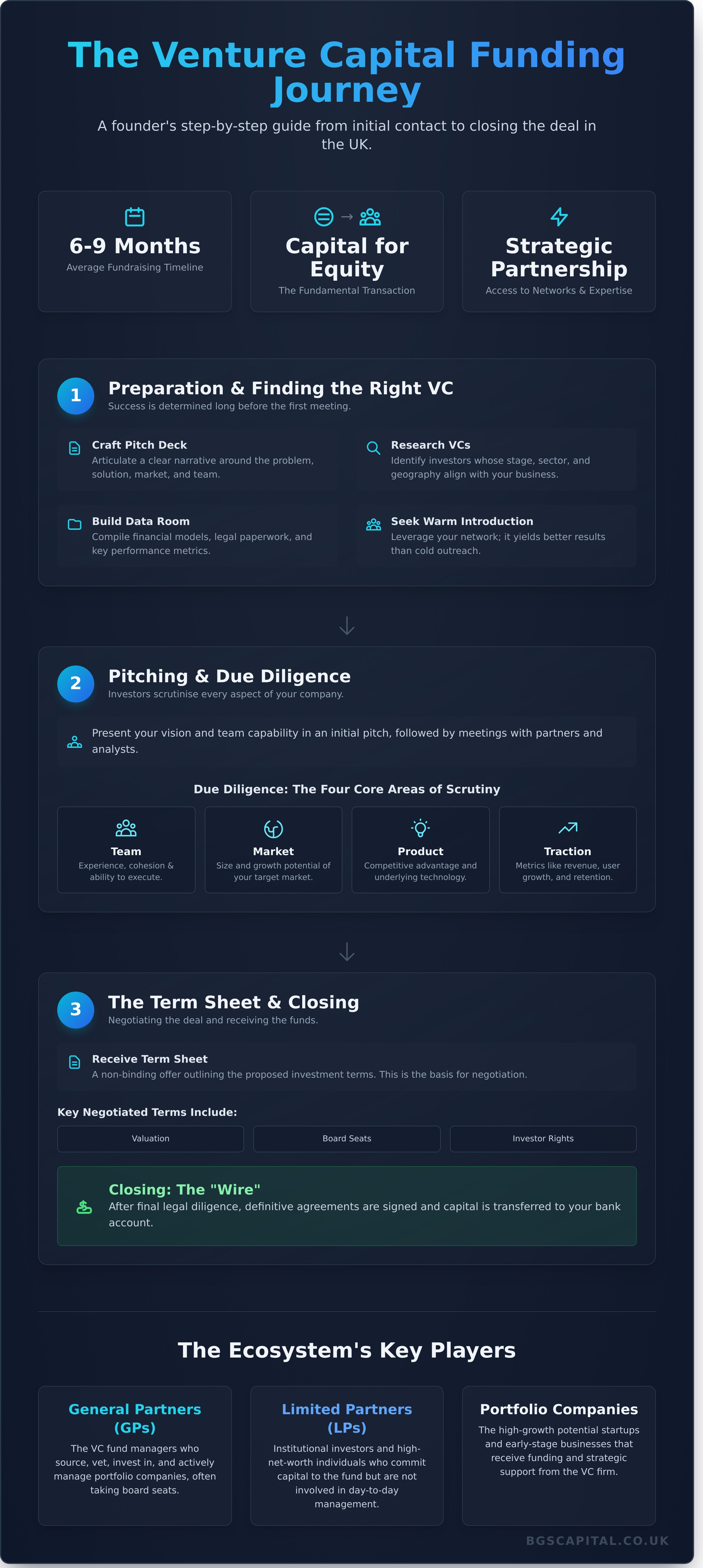
Securing venture capital is a structured, intensive process that demands significant preparation and resilience. For most founders in the UK, the timeline from initial contact to receiving funds averages between six and nine months. This journey is a marathon, not a sprint, and is characterised by rigorous evaluation from potential investors. It is critical to understand that rejection is a standard part of this process; each ‘no’ provides a learning opportunity to refine your pitch and strategy for the next engagement.
Step 1: Preparation and Finding the Right VC
Success in fundraising is determined long before the first meeting. Preparation is non-negotiable and starts with crafting a compelling pitch deck that articulates a clear narrative around the problem, solution, market size, and team. Concurrently, you must build a comprehensive data room containing all essential documents: financial models, legal paperwork, and key performance metrics. Researching VC firms is equally critical; identify investors whose stage, sector focus, and geographical preference align with your business. While exploring the various ways to fund your business, remember that a warm introduction from a trusted contact in your network will almost always yield better results than a cold email.
Step 2: Pitching and Due Diligence
The initial pitch meeting is your opportunity to present your vision and demonstrate your team’s capability. If the VCs are interested, a series of follow-up meetings with partners, analysts, and associates will commence. This is the start of the due diligence phase, where investors scrutinise every aspect of your company. Expect deep dives into four core areas:
- Team: Assessing the founding team’s experience, cohesion, and ability to execute.
- Market: Validating the size and growth potential of your target market.
- Product: Analysing your product’s competitive advantage and technology.
- Traction: Reviewing metrics like revenue, user growth, and customer retention.
Be prepared for extensive reference checks with customers, partners, and even former colleagues.
Step 3: The Term Sheet and Closing
If due diligence is successful, the venture capital firm will present a term sheet. This is a non-binding offer that outlines the proposed terms of the investment. It is the basis for negotiation, not the final agreement. Key terms that are typically negotiated include the company’s valuation, the size of the investment, board seats, and specific investor rights like liquidation preferences and anti-dilution provisions. Once terms are agreed upon, the final phase involves extensive legal diligence by the VC’s counsel and the drafting of definitive legal agreements. The process concludes when these documents are signed and the investment capital-the ‘wire’-is transferred to your company’s bank account.
Decoding the Deal: Key Terms in a VC Term Sheet
Once a venture capital firm expresses serious interest, they will present a term sheet. This document outlines the proposed terms and conditions of their investment. While typically non-binding, it serves as the foundational blueprint for the final, legally binding investment agreements. It is critical to understand that the terms agreed upon here will dictate the economic and governance dynamics between you and your new partners for years to come. For a deeper overview of the mechanics, authoritative sources like Forbes offer a clear guide on What Is Venture Capital?, which can provide additional context.
Before signing any term sheet, it is imperative to seek experienced legal counsel. An expert can help navigate the complexities and ensure the terms are aligned with your company’s long-term interests.
Economic Terms: Valuation and Equity
These terms directly impact the financial outcomes for founders, employees, and investors. The most critical components include:
- Pre-money vs. Post-money Valuation: Pre-money valuation is the company’s value before the investment, while post-money is the value after. For example, if a VC invests £2 million at an £8 million pre-money valuation, the post-money valuation becomes £10 million, and the VC owns 20% of the company.
- Employee Stock Option Pool (ESOP): Investors will require you to set aside a pool of equity (often 10-20%) for future hires. This pool is typically created before the investment, diluting existing shareholders, including the founders.
- Liquidation Preferences: This clause determines who gets paid first in an exit event, such as a sale or merger. A standard “1x non-participating” preference means investors receive their initial investment back before any other shareholders see a return.
- Pro-Rata Rights: This gives investors the right, but not the obligation, to invest in subsequent funding rounds to maintain their percentage ownership in the company.
Control Terms: Governance and Investor Rights
Beyond the economics, a term sheet for a venture capital deal will specify the level of influence and control an investor has over company operations.
- Board Composition: Investors will almost always require a seat on your company’s Board of Directors, giving them a direct role in major strategic decisions.
- Protective Provisions: These are veto rights that grant investors control over key corporate actions, even if they don’t have a majority on the board. Common provisions include requiring investor approval to sell the company, issue new senior shares, or take on significant debt.
- Information Rights: This provision obligates the company to provide investors with regular financial statements and operational updates, ensuring they remain informed on business performance.
Seeking capital? Feature your business to connect with qualified investors.
The Stages of VC Funding: From Seed to Growth
Securing venture capital is not a single transaction but a structured journey comprised of distinct funding rounds. Each round corresponds to a specific stage of a company’s maturity, with defined objectives, capital requirements, and investor expectations. While the path is sequential, it is important to note that not every startup will progress through each stage; many find an exit or cease operations at an earlier point.
Early Stage: Pre-Seed and Seed Funding
This initial phase is focused on validating the business concept and developing a minimum viable product (MVP). Investors at this stage, typically angel investors and specialised early-stage VCs, are betting on the vision. Capital raised generally ranges from £150,000 to £2 million. Key evaluation metrics are less about revenue and more about the calibre of the founding team, the potential market size, and early user feedback or traction.
Growth Stage: Series A, B, and C
Once a company has a proven concept, it enters the growth stage to scale its operations. This is where institutional venture capital firms become the primary source of funding.
- Series A: The focus is on optimising the business model and achieving product-market fit. Capital, typically £2 million to £15 million, is used to scale the team and marketing efforts. Investors require concrete metrics like revenue growth and customer acquisition cost (CAC).
- Series B: With a proven model, the objective is aggressive expansion. Funds, often in the £15 million to £50 million range, are deployed to grow the team, expand market share, and develop new product features.
- Series C: This stage is about cementing market leadership and preparing for an exit. Capital is used to achieve profitability, make strategic acquisitions, or expand internationally. Funding often exceeds £50 million.
Later Stage and Exit
For highly successful companies, later stages may involve growth equity or pre-IPO rounds to fuel final expansion before a liquidity event. The ultimate goal for any VC investor is to realise a significant return on their investment. This is achieved through a successful exit, most commonly via one of two routes: an Initial Public Offering (IPO) on an exchange like the LSE, or a strategic acquisition by a larger corporation. Navigating these later stages requires specialist knowledge, connecting founders with the right capital partners for pre-IPO rounds and exit planning.
Is Venture Capital Right for Your Business? Pros and Cons
Deciding whether to pursue venture capital is one of the most critical strategic decisions a founder will make. There is no universal answer; the suitability of VC funding is entirely dependent on your business model, market opportunity, and long-term ambitions. It is crucial to understand that this funding path is not designed for most businesses. Venture capital is a specialised instrument intended for a small subset of companies with the potential for exponential growth, technological disruption, and the ability to generate outsized returns for investors.
This section provides a balanced assessment to help you determine if the VC model aligns with your company’s trajectory.
The Advantages of Securing VC Funding
For the right company, a partnership with a VC firm provides far more than just money. The strategic benefits are substantial and designed to accelerate growth at a pace that would be impossible through bootstrapping or traditional debt financing.
- Significant Capital Injection: Access to millions of pounds enables rapid scaling of operations, aggressive market entry, accelerated product development, and the hiring of key personnel.
- Expertise and Network Access: VCs provide an experienced board member and open doors to a deep network of potential customers, strategic partners, and seasoned executives. This strategic guidance is often as valuable as the capital itself.
- Market Validation and Credibility: Securing funding from a reputable VC firm acts as a powerful endorsement. This credibility helps attract top-tier talent, secure major clients, and gain positive press coverage.
- Structured Support: Experienced investors provide a clear framework for governance, financial discipline, and preparation for subsequent funding rounds (e.g., Series A, B, C) and an eventual high-value exit, such as an IPO or strategic acquisition.
The Disadvantages and Risks Involved
The high-growth potential of VC funding comes with significant trade-offs and risks that founders must carefully weigh. Accepting this capital fundamentally changes the structure and direction of your business.
- Equity Dilution: Founders will sell a substantial portion of their company in exchange for investment. With each funding round, your ownership stake will decrease, a necessary consequence of this growth strategy.
- Loss of Control: Investors will take board seats and hold specific rights (protective provisions) that give them influence over major company decisions. The founder’s autonomy is significantly reduced in favour of a board-led governance model.
- Intense Pressure for a Large Exit: The core objective of a VC is to achieve a 10x or greater return on their investment within a 5-10 year timeframe. This creates immense pressure to prioritise rapid growth above all else, often leading to a “go big or go home” culture.
- Increased Administrative Burden: The company must adhere to formal reporting requirements, regular board meetings, and heightened legal and financial scrutiny. This adds a layer of administrative complexity that diverts founder time from core operations.
Ultimately, the decision rests on a clear-eyed evaluation of your goals. If your vision is to build a high-growth, market-defining company and you are prepared for the dilution and pressure involved, venture capital can be an unmatched catalyst. Founders who determine this path aligns with their objectives can explore networks connecting them with qualified investors to begin the process.
Securing Venture Capital: Your Next Step to Growth
The journey to securing high-growth finance is a complex but manageable process. The key takeaways are clear: a founder must understand this is a strategic partnership, not just a transaction; they must be prepared for rigorous due diligence and term sheet negotiations; and they must confirm that the rapid-growth trajectory of venture capital aligns with their company’s vision. This strategic preparation is fundamental to success.
For qualified companies ready to engage with the market, accessing a curated network is the critical next step. As an introducer service, BGS Capital connects high-potential businesses with our network of sophisticated and high-net-worth investors actively seeking pre-IPO and IPO opportunities.
Raising Capital? Feature Your Business to Our Investor Network.
With the right introduction, your business can achieve its next stage of significant growth.
Frequently Asked Questions About Venture Capital
What do venture capitalists look for in a startup?
Venture capitalists assess several core pillars. The management team is paramount; they seek experienced founders with domain expertise and resilience. The market opportunity must be substantial, typically a multi-billion pound Total Addressable Market (TAM). A differentiated product with clear evidence of traction, such as early revenue or strong user engagement, is critical. Finally, the business model must demonstrate a clear path to high-growth scalability and a profitable exit within a 5-10 year timeframe.
How much equity do you typically give up for venture capital?
Equity dilution is stage-dependent. For a Seed or Series A round in the UK, founders can expect to sell between 15% and 25% of their company. This percentage is a function of the company’s pre-money valuation and the amount of capital raised. Later-stage rounds may involve smaller equity stakes as the business valuation increases and risk decreases. The final figure is subject to extensive negotiation and due diligence, reflecting the perceived risk and growth potential.
How long does it take to get funding from a VC?
The fundraising process is lengthy and resource-intensive. From initial contact to receiving funds, the timeline typically ranges from three to six months, though it can be longer. This period includes multiple stages: initial meetings, submitting a detailed pitch deck, a rigorous due diligence process covering financials and legalities, term sheet negotiation, and final closing. Founders should initiate the process well in advance of needing the capital to ensure operational continuity.
What is the main difference between an angel investor and a venture capitalist?
The primary distinction lies in the source and scale of capital. Angel investors are typically high-net-worth individuals investing their own money, often at the pre-seed or seed stage, and may be motivated by tax incentives like the UK’s SEIS/EIS schemes. Venture capitalists manage a fund of institutional money and invest larger sums, typically from Series A onwards. VCs also take a more formal role, often requiring a board seat and imposing stricter governance.
Can I get VC funding if my company is not yet profitable?
Yes. The majority of companies that receive venture capital are pre-profitability. VCs invest in high-growth potential, not immediate profits. The focus is on metrics demonstrating rapid scalability, market penetration, and a clear path to future profitability. Investors expect their capital to be used to accelerate growth and capture market share, with the understanding that achieving profitability will follow once the company reaches a significant scale.
What are the most active sectors for VC investment in the UK?
In the UK, certain sectors consistently attract significant VC investment. Fintech remains a dominant force, particularly in London. Other highly active areas include Healthtech and life sciences, driven by innovation in biotech and digital health. Enterprise software (SaaS), artificial intelligence (AI), and deep tech are also key focus areas for UK venture capital firms, reflecting the country’s strong position in technology research and development.
What happens if a VC-backed company fails?
If a VC-backed company fails, it typically undergoes a liquidation process where assets are sold to pay creditors. Venture capital investors hold preference shares, meaning they are paid back their investment before founders and employees (common shareholders) receive any proceeds. In most cases, common shareholders receive nothing. This outcome is an accepted part of the high-risk, high-reward venture capital model, where successful exits are expected to cover the losses from failed investments.