
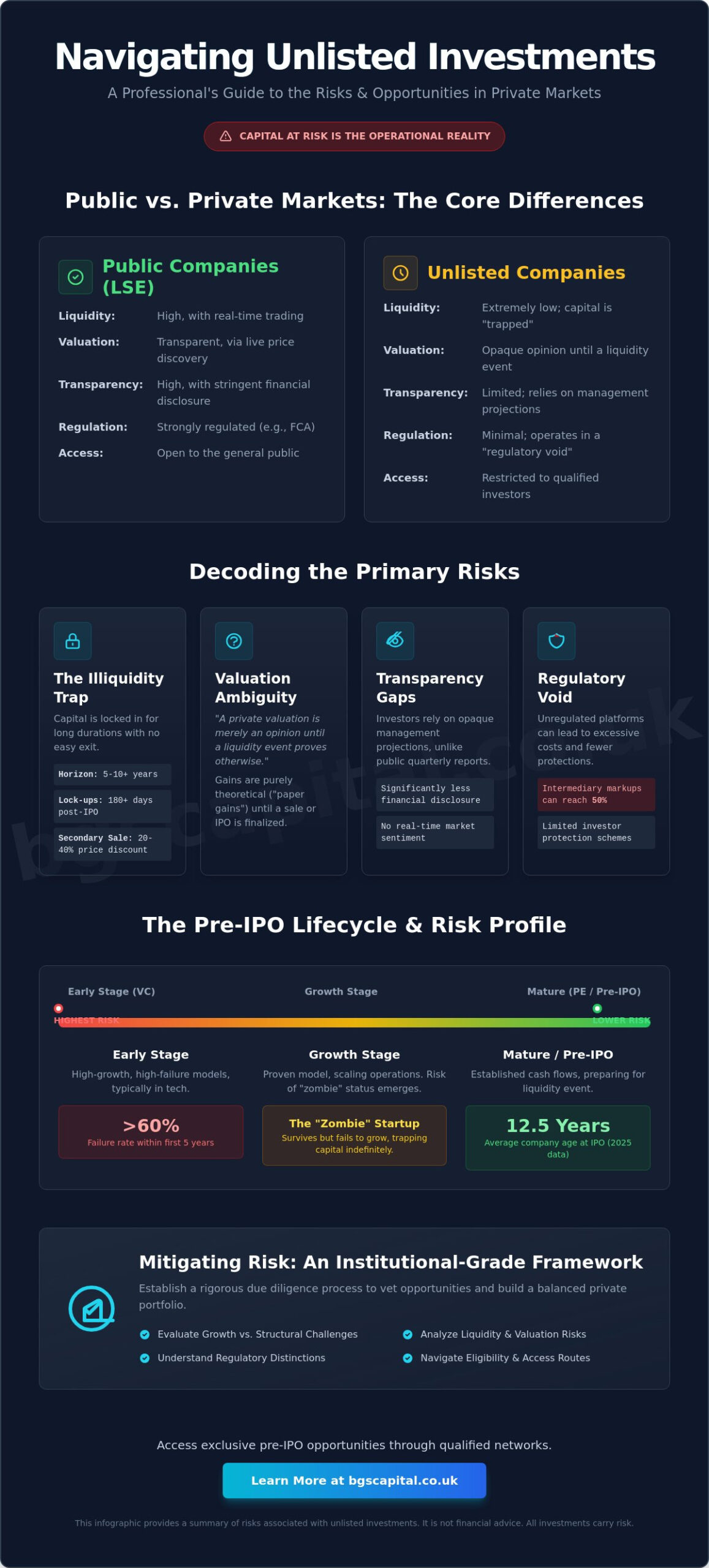
High net worth individuals often overlook the fact that a private valuation is merely an opinion until a liquidity event proves otherwise. The risks of investing in unlisted companies are fundamentally different from those found on the London Stock Exchange, primarily because you’re operating without the safety net of real-time price discovery. Industry reports from 2025 indicate that private firms provide significantly less financial disclosure than their PLC counterparts, leaving investors to rely on opaque management projections. CAPITAL AT RISK is not just a formal disclaimer; it’s the operational reality of the private equity landscape in 2026.
You’re likely aware that the potential for high returns comes with the trade-off of extreme illiquidity and restricted exit routes. This analysis provides a professional breakdown of the structural, financial, and regulatory risks you must account for when building a private portfolio. We’ll examine the specific red flags currently appearing in pre-IPO pitches and establish a rigorous framework for evaluating unlisted opportunities before you commit capital. This guide ensures you understand the regulatory protections, or the lack thereof, that define this exclusive investment class.
Key Takeaways
- Evaluate the trade-off between targeting high-growth “alpha” and the structural challenges of investing in entities not traded on public exchanges like the LSE.
- Analyze the primary risks of investing in unlisted companies, specifically regarding capital illiquidity and the inherent ambiguity of private market valuations.
- Recognize the regulatory distinctions between FCA-regulated exchanges and private platforms to avoid excessive intermediary markups that can reach 50%.
- Establish an institutional-grade due diligence framework to vet private equity opportunities and maintain a balanced, diversified portfolio where capital is at risk.
- Learn how to navigate the “Am I Eligible?” gatekeeping process to access exclusive pre-IPO opportunities through qualified introducers and networks.
Understanding Unlisted Investments: The Trade-off Between Growth and Risk
Unlisted companies are corporate entities whose shares aren’t traded on public exchanges such as the London Stock Exchange (LSE). For high-net-worth individuals and sophisticated investors, these assets represent a primary vehicle for capturing “alpha”—returns that significantly exceed standard market benchmarks. Accessing firms before they reach public markets allows for entry at lower valuations, but this potential is inextricably linked to the risks of investing in unlisted companies.
The fundamental reality of this asset class is that CAPITAL AT RISK. Unlike public equities, private shares lack the same level of immediate liquidity and stringent reporting requirements. In the 2026 market, a distinct trend has solidified; companies are staying private for much longer durations. Data from 2025 indicates that the average age of a company at its IPO has extended to 12.5 years. This shift means more value is created—and more risk is concentrated—within the private sphere before a liquidity event occurs.
The Pre-IPO Lifecycle and Risk Profile
Risk levels fluctuate across a company’s development lifecycle. While the “early stage” premium offers the highest potential upside, it’s frequently offset by a failure rate exceeding 60% within the first five years of operation. As a firm matures and nears an IPO, the risk of total failure typically diminishes, yet it never disappears. A specific danger in the current climate is the “zombie” startup. These are businesses that maintain enough cash flow to survive but fail to achieve the growth necessary for a public listing or acquisition, effectively trapping investor capital in an illiquid state for years.
Distinguishing Between Private Equity and Venture Capital
Sophisticated investors must distinguish between the different pillars of Understanding Unlisted Investments to manage their exposure. Venture Capital (VC) focuses on high-growth, high-failure models, predominantly in tech and innovation. Success in VC often depends on a single “unicorn” offsetting multiple total losses within a portfolio.
Private Equity (PE) typically involves more mature unlisted firms with established cash flows and proven business models. While PE carries lower operational risk than early-stage VC, it presents unique risks of investing in unlisted companies regarding limited exit routes and higher debt leverage. Identifying which asset class aligns with your specific risk tolerance and liquidity needs is a prerequisite for any capital allocation. The 2026 landscape requires a disciplined approach to due diligence, as the gap between top-tier performers and failing private firms continues to widen.
Primary Risks: Liquidity, Valuation Ambiguity, and Transparency Gaps
Investing in private firms involves a set of structural hazards that don’t exist within the FTSE 100 or other public indices. The most significant risks of investing in unlisted companies stem from the fact that these assets aren’t traded on a central exchange. Investors must accept that their capital is effectively “trapped” until a specific corporate event occurs. This lack of a safety valve means that even a high-performing company can be a poor investment if the timing of the exit doesn’t align with your liquidity needs.
The Illiquidity Trap: When Can You Actually Exit?
Private equity is a long-term commitment, often requiring a horizon of 5 to 10 years. In the UK, investors participating in Enterprise Investment Schemes (EIS) are mandated to hold shares for at least 3 years to retain tax reliefs, but the actual path to liquidity usually takes much longer. Secondary markets for private UK shares remain fragmented and thin. You can’t simply liquidate a position to cover a margin call or a sudden capital requirement.
- Lock-up periods: Pre-IPO investors often face restrictive covenants that prevent share sales for 180 days or longer after a listing.
- Paper Gains: A 300% increase in share value is purely theoretical until a trade sale, IPO, or share buyback occurs.
- Price Haircuts: Attempting to sell private holdings on a secondary platform often results in a 20% to 40% discount compared to the last funding round valuation.
Subjective Valuations: DCF vs. Market Multiples
Public markets benefit from “price discovery,” where millions of trades set a transparent value every second. Unlisted companies rely on periodic valuations that are often subjective. Discounted Cash Flow (DCF) models are easily manipulated by optimistic founders who project aggressive 25% year-on-year growth without accounting for market saturation. By 2026, sophisticated investors must scrutinize EBITDA and sustainable margins rather than “vanity metrics” like gross merchandise value.
The risk of a “down round” is a constant threat. In 2022, several high-profile fintech firms saw their private valuations slashed by over 70% during subsequent funding cycles. This dilutes early investors and can wipe out equity value entirely. While UK companies are subject to Companies House filings, they often operate in The Regulatory Void compared to PLCs, meaning you might not learn about a valuation drop until months after it happens.
Information asymmetry remains a critical hurdle. Private firms aren’t required to issue quarterly earnings reports or disclose executive compensation. This transparency gap, combined with smaller management teams and less robust corporate governance, increases operational risk. Before committing funds, sophisticated individuals should check their eligibility to access institutional-grade research that mitigates these blind spots.
The Regulatory Void: Unregulated Platforms and Pricing Markups
The UK regulatory landscape creates a sharp divide between public exchanges and private secondary markets. While the London Stock Exchange operates under stringent FCA oversight, many private equity platforms operate in a regulatory grey area. One of the primary risks of investing in unlisted companies is the total lack of price transparency. Intermediaries often acquire blocks of shares from early employees or founders and add a 30% to 50% markup before offering them to sophisticated investors. This hidden “spread” stays concealed from the buyer, meaning the investment must grow by half its value just to reach a break-even point.
Investors frequently assume they have the same protections as they do with retail stocks. This is a dangerous misconception. Many unregulated private investments fall outside the jurisdiction of the Financial Ombudsman Service (FOS). If a platform fails or misrepresents an asset, you typically have no recourse for compensation through the Financial Services Compensation Scheme (FSCS). It’s vital to verify a firm’s status on the Financial Services Register. If they aren’t listed as having the specific permissions for the activity they’re conducting, your capital is at a significantly higher risk than it would be with a regulated broker.
The Danger of Opaque Intermediaries
The “introducer” model differs fundamentally from a traditional brokerage. Introducers simply connect parties and often avoid the fiduciary duties required of regulated entities. They often aggregate supply into “special purpose vehicles” (SPVs), layering management fees on top of the initial share price markup. You must watch for specific red flags that indicate a high-risk intermediary:
- High-pressure sales tactics or “limited time” offers.
- Claims of “guaranteed” IPO dates or exit windows.
- Refusal to provide a clear breakdown of the entry price versus the intermediary commission.
- Platforms that don’t require high-net-worth or sophisticated investor self-certification.
Capital Gains Tax and Exit Scenarios
Exiting an unlisted position requires precise tax planning. In 2026, the disposal of unlisted shares is subject to specific HMRC rules that can significantly impact your net IRR. You should consult this guide on Capital Gains Tax UK: A Guide for Investors & Founders to understand how these disposals are treated. While the risks of investing in unlisted companies are high, certain UK tax wrappers can provide a safety net. Enterprise Investment Schemes (EIS) and Seed Enterprise Investment Schemes (SEIS) offer up to 50% upfront income tax relief and capital gains exemptions. These schemes are designed to mitigate the inherent volatility of the sector, but they require the company to maintain qualifying status for at least three years. If the company loses its qualifying status, HMRC may claw back your tax relief, adding a secondary layer of regulatory risk to the investment.
Mitigating Risk: A Due Diligence Framework for Private Equity
Mitigating the inherent risks of investing in unlisted companies requires a shift from speculative interest to institutional-grade vetting. Capital commitment shouldn’t occur without a rigorous audit of the target’s operational and financial health. In the UK market, diversification remains the primary defence against total loss. Most wealth managers suggest that unlisted shares shouldn’t exceed 10% to 15% of a total investment portfolio. This allocation ensures that the high-growth potential of private equity doesn’t compromise overall liquidity or solvency.
Access to these opportunities is restricted by regulatory barriers. Under the Financial Conduct Authority (FCA) guidelines, individuals must typically qualify as “Sophisticated Investors” or “High Net Worth Individuals” (HNWIs). These certifications aren’t mere formalities. They serve as a legal acknowledgement that the investor possesses the capital or the experience to absorb the risks of investing in unlisted companies. HNWIs generally require an annual income exceeding £100,000 or net assets of at least £250,000, excluding their primary residence and pension rights.
The 5-Step Due Diligence Checklist
Investors should adopt a systematic approach to evaluation. This process moves beyond the pitch deck to verify underlying value.
- Step 1: Audit the cap table. Look for restrictive clauses, anti-dilution rights, or liquidation preferences that might disadvantage new equity holders.
- Step 2: Verify the management team’s track record. Evaluate previous exits. A team that has successfully delivered a 3x or 5x return in prior ventures is statistically more likely to repeat that performance.
- Step 3: Scrutinise the use of funds. Growth capital should be allocated to scaling operations or entering new markets. Be cautious if more than 20% of the raise is earmarked for servicing existing debt.
- Step 4: Request full financials. Review the most recent filed accounts and management accounts from the last 12 months. Ensure the burn rate is sustainable against the projected runway.
- Step 5: Confirm the exit strategy. A clear path to an IPO or trade sale within a 3 to 7-year window is essential for achieving liquidity.
Leveraging Professional Networks
Reducing individual risk is often achieved by following institutional leads. Investing alongside established venture capital firms provides a layer of professional oversight. These firms conduct their own deep-dive audits and often take board seats to steer the company’s direction. Engaging with angel investors allows for early-stage oversight and shared expertise. Professional introducers can also streamline the process by providing access to pre-vetted opportunities that have already passed initial compliance hurdles.
Accessing Pre-IPO Opportunities via BGS Capital
BGS Capital operates as a specialist introducer within the UK private equity landscape. We bridge the gap between high-growth firms and a curated network of qualified investors. Our primary function is to provide a professional conduit for those seeking exposure to companies before they reach public markets. We don’t act as a broker or a direct facilitator of capital raises; instead, we provide the infrastructure for direct engagement between investors and company leadership.
The “Am I Eligible?” gatekeeping process is the foundation of our network. This ensures every participant meets the stringent regulatory requirements set out for sophisticated and high-net-worth investors in the UK. By maintaining these high standards, we protect the integrity of the investment ecosystem and ensure that featured businesses are connecting with individuals who understand the risks of investing in unlisted companies.
Our Role in the Investment Ecosystem
We don’t facilitate raises ourselves. Our value lies in the direct connection we provide to internal Investor Relations (IR) teams. Through our database, businesses can find investors who possess the capital and sector expertise required for pre-IPO growth stages. This direct-to-IR model removes unnecessary layers, allowing for transparent communication regarding the firm’s roadmap and financial health.
Every investor must secure independent financial advice before committing funds to any business featured on our platform. While we provide the connection, we don’t provide recommendations. The risks of investing in unlisted companies are substantial, and professional guidance is vital to ensure these high-risk, high-reward opportunities align with your broader portfolio strategy and risk tolerance.
Next Steps for Eligible Investors
Gaining access to our private network follows a structured, compliant path. Once you’ve confirmed your status, you can download our comprehensive database of current pre-IPO and IPO opportunities. This database provides a snapshot of firms currently seeking capital, including their sector, growth stage, and contact details for their IR departments.
- Complete the eligibility assessment to verify your investor status.
- Access the secure portal to view the current deal flow.
- Review the available pre-IPO and secondary placing opportunities.
- Connect directly with company representatives to conduct your own due diligence.
To begin the verification process and view our exclusive opportunities, follow this link: Am I Eligible? Check your status to access our private network.
FINAL WARNING: CAPITAL IS ALWAYS AT RISK. Investing in unlisted securities involves a high degree of risk. These investments are highly illiquid, and there is no guarantee of a secondary market or a future IPO. You should be prepared to lose your entire investment. The Financial Services Compensation Scheme (FSCS) does not cover losses from poor investment performance in this sector.
Securing Your Position in the 2026 Private Market
Managing the risks of investing in unlisted companies requires a disciplined approach to due diligence and a clear understanding of liquidity constraints. Investors shouldn’t overlook the 5 to 10 year lock-in periods common in private equity, nor the valuation ambiguity that persists without public market pricing. By 2026, the distinction between unregulated platforms and professional networks has become the primary factor in capital preservation. Success depends on accessing accurate data and maintaining direct lines of communication with the entities you’re backing.
BGS Capital serves as an expert introducer, providing a specialised network for High Net Worth and Sophisticated Investors. Our members gain exclusive access to pre-vetted pre-IPO and IPO opportunities, alongside direct connections to company investor relations teams. This institutional-grade transparency allows you to navigate the private market with confidence. It’s the most efficient way to align your portfolio with high-growth opportunities while adhering to strict UK regulatory standards.
Am I Eligible? Check your investor status and access our pre-IPO database.
The right opportunities are available for those who meet the criteria and understand the landscape.
Frequently Asked Questions
Is investing in unlisted companies legal for retail investors in the UK?
It’s legal, but the Financial Conduct Authority (FCA) restricts these opportunities to specific categories like High Net Worth or Sophisticated Investors under COBS 4.12. You must typically sign a declaration confirming an annual income over £100,000 or net assets exceeding £250,000. These regulations exist because the risks of investing in unlisted companies include the potential for total capital loss. Most retail investors can’t access these deals without meeting these strict eligibility criteria.
What is the minimum investment typically required for unlisted shares?
Minimums vary based on the platform or firm facilitating the deal. Equity crowdfunding platforms might allow entry from £10, but professional private equity rounds or pre-IPO placements usually require £10,000 to £50,000 per transaction. For institutional-grade opportunities, minimums often exceed £100,000. You should check the specific requirements of the accredited investment firm or introducer before attempting to participate in a funding round.
How do I sell my shares if the company does not go through an IPO?
You can sell through secondary market platforms or private sales if a public listing doesn’t occur. Platforms like Seedrs or specific secondary brokerages facilitate these trades, though liquidity remains extremely low. Alternatively, the company might initiate a share buyback or be acquired by a larger corporation. Without a clear exit event, your capital remains locked, as there’s no guaranteed market for private equity holdings.
What happens to my investment if an unlisted company goes bust?
You’ll likely lose your entire investment if the company enters insolvency. Equity holders sit at the bottom of the creditor hierarchy, meaning secured lenders and employees get paid first. In 2023, UK company insolvencies reached a 30-year high of over 25,000 cases. If the business fails, there’s rarely any residual value left for shareholders. This total loss scenario is one of the primary risks of investing in unlisted companies.
Are unlisted shares eligible for ISA or SIPP wrappers?
Most unlisted shares don’t qualify for an ISA because they aren’t traded on a recognised stock exchange. However, you can often hold them within a Self-Invested Personal Pension (SIPP) if the provider allows non-standard assets. You must ensure the investment meets HMRC’s tax-advantaged criteria to avoid heavy penalties. Consult with a qualified SIPP administrator to verify if a specific pre-IPO opportunity is eligible for your pension wrapper.
How can I verify the valuation of a pre-IPO company?
Review the company’s latest audited accounts on Companies House and examine the post-money valuation from the most recent funding round. Professional investors use metrics like Price-to-Earnings (P/E) or Enterprise Value-to-Revenue ratios compared against listed peers. You should also request the current cap table to see the share price paid by institutional VC firms. Independent valuations are rare, so you must rely on hard financial data.
What is the difference between an introducer and a financial advisor?
An introducer connects you with investment opportunities but doesn’t provide financial advice or manage your portfolio. They operate as a network or gateway. A financial advisor is regulated by the FCA to provide personalised recommendations based on your specific financial situation. BGS Capital operates as an introducer. We don’t facilitate raises ourselves or offer advice; we simply provide a conduit to accredited investment firms and exclusive deals.
How long do I typically have to hold unlisted shares before an exit?
Expect a holding period of 5 to 10 years before a liquidity event like an IPO or trade sale occurs. Early-stage ventures often require a decade to mature and provide a return. Data from the British Business Bank shows that venture capital cycles typically last 10 years. You shouldn’t invest capital that you might need to access quickly, as these assets are illiquid and difficult to trade.