
With just two IPOs on the London Stock Exchange during the first quarter of 2026, public markets are currently failing to capture the most significant growth phases of emerging UK leaders. This scarcity forces sophisticated investors to evaluate how to add pre-ipo investments to your portfolio uk to secure early-entry advantages. You recognize that the most lucrative equity positions are often consolidated long before a company reaches a primary trading facility, yet accessing these deals remains restricted to those who meet specific eligibility criteria.
Accessing private networks requires more than just capital. It demands a clear understanding of the Public Offer Platform (POP) regime and the January 2026 prospectus reforms. This guide details the regulatory frameworks, entry methods, and due diligence protocols necessary for accessing private equity. You’ll discover how to manage the 2026 tax changes, including the increased 10.75% basic dividend rate, while positioning your portfolio for non-correlated alpha generation through exclusive private company exposure. We will outline the specific steps required to qualify as an eligible investor and navigate the transition from private equity to public markets.
Key Takeaways
- Identify why mature UK companies are deferring public listings and how this creates specific entry points for late-stage private equity.
- Navigate the mandatory FCA investor classifications and self-certification protocols required to access restricted deal documentation.
- Evaluate how to add pre-ipo investments to your portfolio uk by comparing direct equity introductions against indirect collective investment structures.
- Execute rigorous due diligence by requesting specific performance data, including revenue growth trajectories and operational burn rates.
- Access a centralized database of private opportunities to facilitate direct connections with company representatives and investor relations teams.
The Landscape of Pre-IPO Investing in the UK for 2026
A Pre-IPO investment refers to the acquisition of equity in a mature private company during its final funding rounds before a public listing. In 2026, the UK market environment has shifted. Companies now stay private for longer durations to achieve operational scale away from the scrutiny of public markets. Only two IPOs were recorded on the London Stock Exchange in Q1 2026, raising a total of £12.8 million. This trend highlights a fundamental change in capital management, and understanding how to add pre-ipo investments to your portfolio uk is now a priority for those seeking non-correlated assets.
Institutional investors prioritize this stage to capture alpha potential. Entering a company’s capital structure before a public debut often allows for entry at valuations that don’t yet include the “public market premium.” Investors must acknowledge the illiquidity premium associated with these assets. You’re trading immediate exit capabilities for the prospect of significant long-term gains. This requires a strategic outlook focused on the 12 to 36 months preceding a liquidity event. It’s a calculated trade-off where patience is a prerequisite for access.
The Evolution of the Private-to-Public Journey
The “Unicorn” era redefined the timing of public listings. Companies now reach multi-billion pound valuations while remaining private. Secondary markets have become essential, providing liquidity for early employees and seed investors. This creates entry points for new qualified participants. In 2026, we’re seeing a resurgence in UK fintech and AI sectors. These firms are utilizing private capital to strengthen balance sheets before navigating the new Public Offer Platform (POP) regime requirements. The Public Offers and Admissions to Trading Regulations 2024, which took full effect in January 2026, have further formalized this transition period.
Why Traditional Brokerages Often Miss Pre-IPO Deals
Standard retail brokerages focus on secondary trading of already-listed shares. They lack the infrastructure for private equity introductions. Companies nearing an IPO prefer a “curated” cap table. They seek sophisticated investors who understand the long-term vision rather than high-frequency retail traders. Standard ISAs and SIPPs generally can’t hold unlisted shares, which limits traditional routes. Determining how to add pre-ipo investments to your portfolio uk requires looking beyond retail platforms toward specialized networks that facilitate direct introductions to company issuers. This exclusivity ensures the company maintains control over its shareholder base during the critical months before admission to trading.
Regulatory Requirements: Qualifying for Private Equity Access
Accessing unlisted equity in the UK is governed by strict Financial Conduct Authority (FCA) classifications. These rules ensure that high-risk, illiquid assets are only marketed to individuals with the financial resilience or expertise to evaluate them. Understanding how to add pre-ipo investments to your portfolio uk starts with a formal self-certification process. This is a mandatory prerequisite before any sensitive deal documentation, such as an Information Memorandum (IM) or term sheet, can be shared. Unlike public markets where information is disseminated freely, private placements operate under exemptions that require the investor to “opt-in” to a less regulated environment. This gatekeeping function is essential for maintaining market integrity and ensuring that participants are fully aware of the restricted liquidity and higher risk profiles of late-stage private companies.
Retail investors are generally excluded from direct private placements unless through a Public Offer Platform (POP) authorized by the FCA. For offerings of £5 million or more, the 2026 POP regime has standardized how to add pre-ipo investments to your portfolio uk for a broader range of participants. However, for exclusive late-stage rounds, professional or certified status remains the standard. For those looking to invest in UK private companies, tax efficiency is often managed through the Enterprise Investment Scheme (EIS). While upfront VCT income tax relief was reduced to 20% in April 2026, direct EIS investments continue to provide a framework for capital gains deferral and loss relief for eligible UK taxpayers. These vehicles are particularly valuable for offsetting the increased 24% CGT rate for higher-rate taxpayers that came into effect this year.
High-Net-Worth Individual (HNWI) Criteria
To qualify as an HNWI in 2026, an individual must confirm they meet specific financial thresholds, typically an annual income exceeding £170,000 or net assets of at least £430,000. Your primary residence, pension rights, and insurance-based benefits are excluded from this calculation. Signing this declaration is a legal commitment. It confirms you understand the risk of total capital loss and the absence of access to the Financial Ombudsman Service for private placement disputes.
Sophisticated Investor Certification
Experience provides an alternative pathway. You qualify as a “Self-Certified Sophisticated Investor” by being a member of an angel network for six months or serving as a director of a firm with a £1.6 million turnover. Professional experience in private equity also qualifies you. This certification ensures you possess the technical literacy to interpret EBITDA and burn rates. If you’re ready to verify your eligibility, you can view current business listings to see which opportunities match your profile.
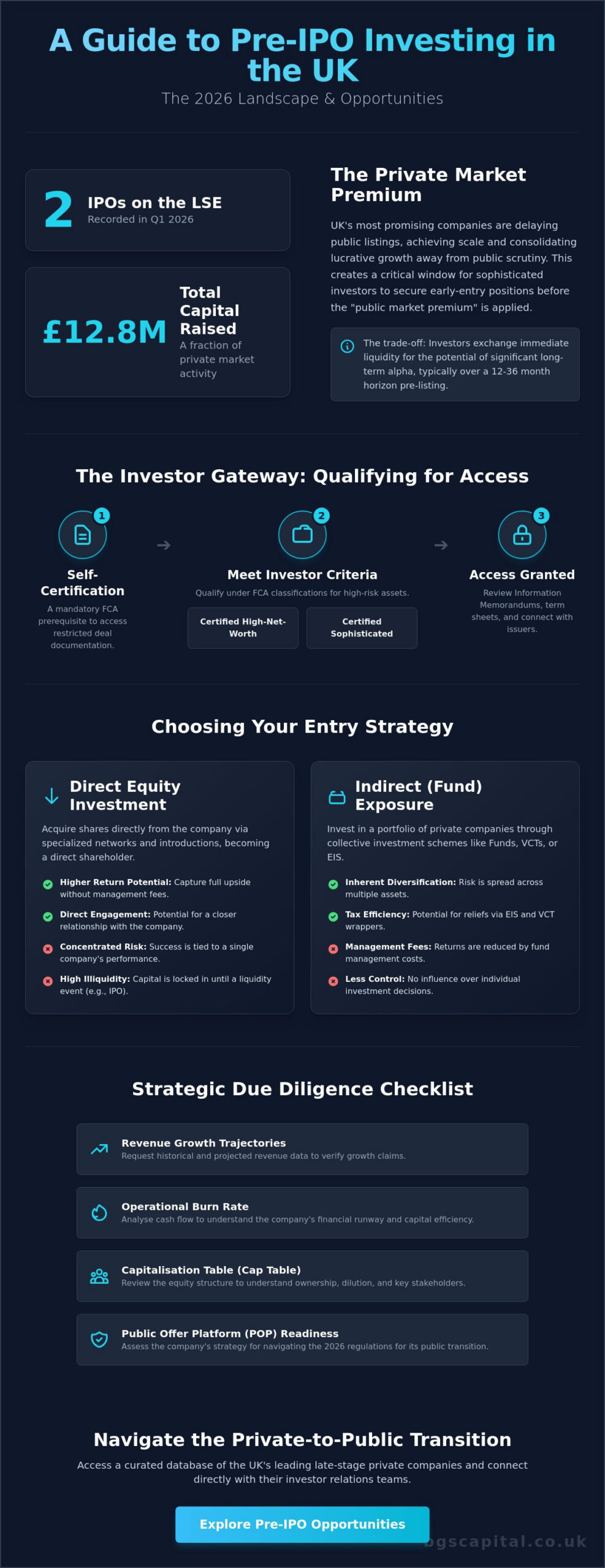
Direct Equity vs. Indirect Exposure: Comparing Entry Strategies
High-Net-Worth Individuals evaluating how to add pre-ipo investments to your portfolio uk must distinguish between synthetic exposure and legal share ownership. Direct equity acquisition involves purchasing shares directly from the issuing company or through a structured secondary sale. This contrast with indirect exposure, often achieved through publicly traded investment trusts or private equity funds, is fundamental to your capital allocation strategy. While indirect vehicles offer diversification across multiple holdings, they often carry annual management fees and performance carries that can erode net returns over a multi-year holding period. Direct introductions bypass these ongoing costs, focusing instead on a transactional entry into a specific, high-conviction company.
Direct communication with investor relations teams is a primary advantage of the direct entry model. It allows for a level of transparency regarding the company’s path to liquidity that is rarely available to fund investors. This relationship is vital for understanding high-risk investments and the specific operational milestones required before a 2026 or 2027 listing. Conversely, the “Grey Market” offers a method for trading derivatives based on a company’s predicted valuation. This approach is speculative and does not grant the investor actual equity or voting rights. For those seeking long-term alpha generation, direct equity remains the standard for institutional-grade portfolio construction.
Direct Introductions and Private Placements
Direct introductions provide the framework for deeper due diligence. Owning a specific percentage of a high-growth company allows you to benefit from the full trajectory of its valuation increase without the dilution of a pooled fund. In 2026, many angel investors are migrating from early-stage seed rounds into late-stage pre-IPO rounds. This shift is driven by the desire for shorter paths to liquidity and more predictable exit timelines. By participating in these curated rounds, you ensure your capital is deployed in companies that have already achieved significant scale and revenue milestones.
Investment Trusts and Collective Funds
Investment trusts such as Chrysalis or Schroders Capital provide a liquid route to private equity exposure. These “blind pool” investments allow you to buy shares on the London Stock Exchange that represent a portfolio of private companies. However, this convenience comes with trade-offs. You have no control over which companies are added to the portfolio, and the trust’s share price may trade at a significant discount or premium to its Net Asset Value (NAV). HNWIs seeking specific sector exposure, such as AI or fintech, often find that direct access provides a more precise tool for how to add pre-ipo investments to your portfolio uk compared to the broad-brush approach of collective funds.
Strategic Due Diligence: Evaluating Pre-IPO Opportunities
Private companies operate with a level of information asymmetry that public markets don’t tolerate. You can’t rely on news feeds or public filings to assess value. Instead, you must request direct access to the management’s financial disclosures through a secure data room. Key metrics include year-on-year revenue growth and EBITDA margins. In the 2026 climate, the “burn rate” is a decisive factor; companies must prove they have the runway to reach an IPO without further dilutive rounds. Tier-one venture capital backing acts as a proxy for quality, indicating that professional analysts have already verified the operational model. This rigorous approach is the only way to determine how to add pre-ipo investments to your portfolio uk while mitigating the risk of capital loss.
Evaluating the path to liquidity requires a realistic assessment of the 2026-2027 IPO window. A company’s timeline must align with current market conditions and regulatory requirements, such as the new MTF admission prospectus rules. If a firm lacks a clear roadmap to a primary trading facility or a secondary sale, your capital could remain illiquid for longer than anticipated. Diligence isn’t just about financials; it’s about verifying the company’s readiness for the transition to a regulated public environment.
Analyzing the Management Team and Cap Table
Management’s experience is as critical as the product. Assess whether the leadership team has previously led a company through a successful exit or a listing on a primary Multilateral Trading Facility (MTF). The cap table reveals the distribution of power. You should identify the presence of preference shares, which often include anti-dilution clauses and liquidation priorities. Ordinary shares, which are typical for later-stage entrants, may sit lower in the capital waterfall. Understanding these hierarchies is vital for accurate valuation and risk assessment.
Tax Implications and Exit Strategies
The April 2026 tax changes have significant implications for your net returns. Gains are now subject to a 24% Capital Gains Tax for higher-rate taxpayers. Strategic use of the Enterprise Investment Scheme (EIS) can mitigate these liabilities if the company qualifies. Planning your exit requires understanding the startup funding lifecycle. Most IPOs involve a lock-up period, often 90 to 180 days, during which you can’t liquidate your position. This delay must be factored into your 2026-2027 liquidity requirements. To begin your due diligence on active deals, view our latest business listings for direct access to issuer information.
Navigating the Private-to-Public Transition with BGS Capital
BGS Capital operates as a specialist facilitator within the UK’s private equity ecosystem. We act as a professional conduit, bridging the gap between qualified investors and the investor relations (IR) teams of mature, late-stage companies. Unlike informal networking or speculative derivatives trading, our framework provides a structured, compliant environment for capital introduction. For those determining how to add pre-ipo investments to your portfolio uk, the primary hurdle is often access to high-conviction deal flow. Our platform addresses this by hosting a centralized, searchable database of business listings where sophisticated participants can evaluate opportunities based on their specific sector interests and risk appetite.
The 2026 regulatory landscape, defined by the Public Offer Platform (POP) regime, requires a higher standard of transparency and investor qualification. BGS Capital maintains this standard by ensuring all participants have verified their status before accessing sensitive company data. We don’t offer financial advice or manage investment funds. Instead, we provide the infrastructure for direct introductions. This allows you to build a diversified portfolio of non-correlated assets without the ongoing management fees associated with traditional private equity trusts. By facilitating these direct connections, we ensure that both the company and the investor maintain control over the terms of the engagement.
A Streamlined Process for Qualified Investors
Gaining access to the BGS Capital database begins with a rigorous verification of your investor status. As detailed in earlier sections, you must self-certify as a High-Net-Worth Individual or a Sophisticated Investor to meet FCA requirements. Once verified, you can view detailed business listings in sectors such as AI, fintech, and renewable energy. This direct introduction model is the most efficient method for how to add pre-ipo investments to your portfolio uk. It removes the traditional “middleman” fee structure, allowing for a transparent exchange of information between you and the company’s founders or IR representatives. Are you currently certified to view these exclusive opportunities?
For Businesses: Featuring Your Opportunity
Late-stage companies nearing a public listing require a curated cap table of professional backers. By featuring an opportunity on our platform, businesses can find investors who possess the capital and the sophistication to support a transition to public markets. Visibility to our network of HNWIs and professional investors is essential for companies looking to bypass the noise of retail crowdfunding. This visibility is particularly valuable for firms navigating the 2026 MTF admission prospectus requirements. If your company is preparing for a liquidity event in 2026 or 2027, registering to list your opportunity is the first step toward securing the necessary institutional-grade support. Take the next step by verifying your eligibility or registering your business interest today.
Executing Your 2026 Private Equity Strategy
The 2026 investment landscape confirms that the most significant valuation increases occur well before a company lists on a primary exchange. Success in this exclusive sector requires more than capital; it demands strict adherence to FCA qualification standards and a commitment to rigorous, data-driven due diligence. You now understand how to add pre-ipo investments to your portfolio uk by prioritizing direct introductions and evaluating key metrics like burn rates and VC backing signals. This strategic approach ensures your portfolio is positioned to capture non-correlated alpha while navigating the 2026 tax and regulatory shifts.
BGS Capital serves as your professional conduit to these high-growth opportunities. We provide a compliant framework for sophisticated investors to engage directly with the IR teams of emerging market leaders. Our searchable database offers a transparent view of the private market without the burden of intermediary management fees. Are you ready to verify your eligibility?
Access Exclusive Pre-IPO Opportunities – Verify Your Eligibility with BGS Capital for free access to our comprehensive database of UK and international growth opportunities. Securing early-stage entry into the next generation of UK leaders is a structured process that begins with your qualification today.
Frequently Asked Questions
Can a retail investor buy pre-IPO shares in the UK?
Retail access is restricted. Most late-stage private equity rounds are available only to individuals meeting FCA classifications for HNWIs or sophisticated investors. While the 2026 Public Offer Platform (POP) regime allows for wider participation in offers over £5 million, these are distinct from the exclusive private placements typically found in the pre-IPO space. Retail investors generally lack the direct introductions required for these high-growth rounds.
How do I prove I am a “Sophisticated Investor” to access private deals?
You prove your status through a formal self-certification process. This requires meeting specific criteria such as being a member of an angel network for at least six months or serving as a director of a firm with an annual turnover of £1.6 million or more. Professional experience in the private equity or venture capital sectors also qualifies you. This certification is a legal prerequisite before you can view sensitive deal documents or participate in private rounds.
What are the main risks associated with pre-IPO investing?
Total loss of capital and prolonged illiquidity are the primary risks. Unlike listed stocks, private shares have no secondary market for immediate liquidation. You must also account for information asymmetry; private firms are not required to provide the same level of public disclosure as listed entities. Evaluating how to add pre-ipo investments to your portfolio uk requires a high tolerance for risk and a long-term capital commitment.
Is there a minimum investment amount for pre-IPO opportunities?
Minimums vary by issuer but are typically higher than retail trading thresholds. Direct placements often require five-figure commitments to maintain a manageable cap table for the company. While Public Offer Platforms may facilitate smaller entries for certain deals, late-stage rounds usually target professional or high-net-worth backers capable of providing significant capital. You should verify the specific requirements within each business listing before requesting an introduction.
How long do I typically have to hold pre-IPO shares before I can sell?
Holding periods typically range from 12 to 36 months. This timeline depends on the company’s progress toward a liquidity event, such as an IPO or trade sale. Post-listing, you must also navigate lock-up periods; these frequently restrict share sales for 90 to 180 days after the initial admission to trading. Investors must ensure their capital allocation strategy accounts for these multi-year illiquidity windows.
Are pre-IPO investments eligible for EIS or SEIS tax relief?
Eligible companies may offer Enterprise Investment Scheme (EIS) relief to UK taxpayers. This provides 30% income tax relief and capital gains deferral, though the 2026 tax changes have adjusted the landscape for other vehicles like VCTs. Qualification depends on the company’s size, age, and trade type. You should confirm if a specific opportunity meets the current HMRC requirements for how to add pre-ipo investments to your portfolio uk using tax-efficient structures.
What happens to my shares if the company cancels its IPO plans?
If an IPO is canceled, you remain a shareholder in a private entity. Your path to liquidity then shifts toward alternative exits, such as a trade acquisition by a larger corporation or a secondary sale to a private equity firm. The absence of a public listing means your shares remain illiquid until another corporate event occurs. This highlights why assessing the management’s fallback strategies is a critical component of due diligence.
How does the “Grey Market” differ from direct pre-IPO equity ownership?
Direct equity ownership grants you legal title to shares and associated voting rights. In contrast, the “Grey Market” involves trading derivatives or spread bets on a company’s potential market capitalization upon listing. Grey market participants don’t own the underlying asset and cannot benefit from tax-efficient structures like EIS. Direct introductions are the standard method for those seeking genuine equity exposure and long-term alpha generation.