
For the serious investor, the public markets are often where the growth story ends rather than where it begins. You’ve likely felt the frustration of watching early-stage companies achieve massive valuations before they ever reach the London Stock Exchange. Retail platforms offer convenience, but they rarely provide a seat at the table for high-alpha private placements or exclusive pre-IPO opportunities. Understanding the benefits of being a sophisticated investor is the first step toward bypassing these limitations and accessing institutional-grade deal flow.
We recognize that the complexity of UK financial regulations often deters participation in the private sector. This article provides clarity on how sophisticated status transforms your investment profile from a passive spectator to a recognized participant in exclusive deal flow. You’ll learn how to leverage this designation to secure higher potential returns and advanced portfolio diversification. We also provide an overview of the 2024 regulatory changes, including the £1.6 million turnover requirement for directors and the updated high net worth thresholds. This information helps you determine your current standing before asking: Am I Eligible? CAPITAL AT RISK.
Key Takeaways
- Define the regulatory distinctions between Certified and Self-Certified status under the UK FCA COBS 4.7 framework.
- Identify the core benefits of being a sophisticated investor, including exclusive access to secondary placings and pre-IPO deal flow.
- Reduce reliance on volatile public indices by diversifying into high-alpha, non-correlated private market opportunities.
- Review the 2026 qualification criteria regarding professional financial experience and private equity investment history.
- Leverage the BGS Capital introducer model to establish direct connections with the investor relations teams of high-growth companies.
What is a Sophisticated Investor? Defining the UK Regulatory Framework
The UK Financial Conduct Authority (FCA) defines a sophisticated investor under the COBS 4.7 rules as someone with the knowledge and experience to evaluate the risks of non-mainstream pooled investments. This classification is a vital component of the UK Regulatory Framework, designed to ensure that complex financial products are only marketed to those who understand them. One of the core benefits of being a sophisticated investor is the ability to access private market opportunities that remain legally off-limits to the general retail public. This status exists to maintain market liquidity while preventing inexperienced investors from entering high-risk, illiquid positions they don’t fully comprehend.
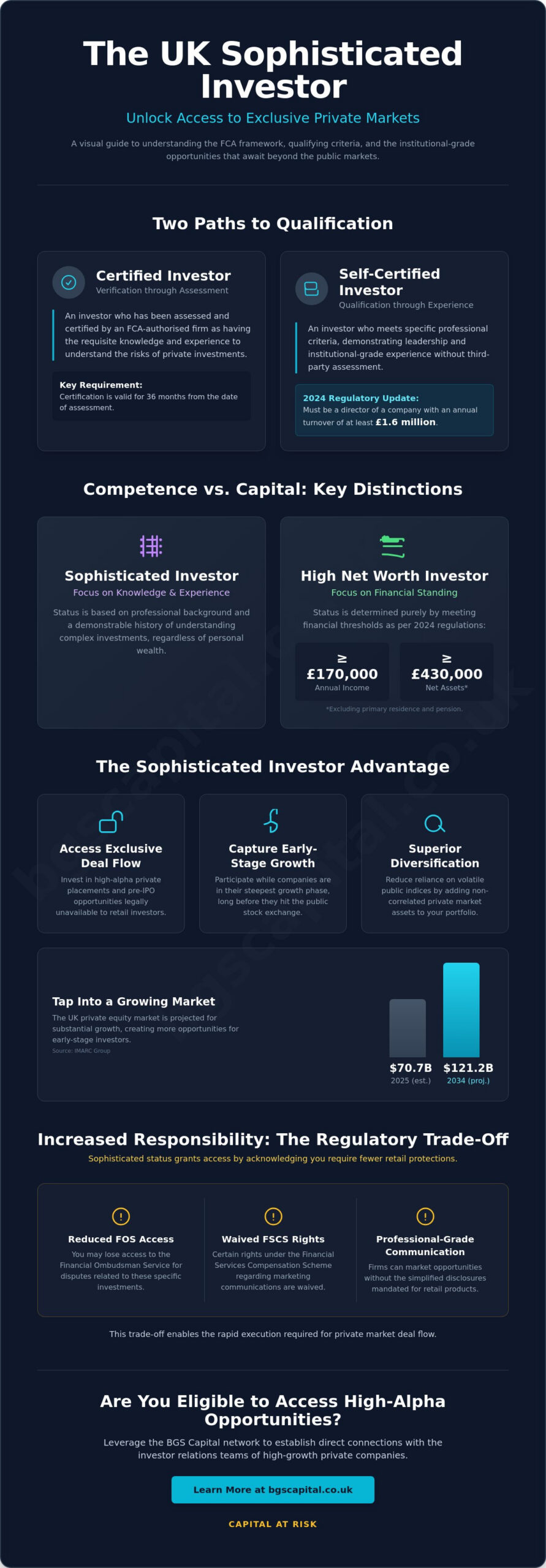
There are two primary ways to achieve this status: “Certified” and “Self-Certified.” A certified sophisticated investor has been assessed by an FCA-authorised firm within the last 36 months as having the expertise to understand the risks involved. Conversely, self-certification requires the investor to meet specific professional criteria. As of January 31, 2024, the threshold for self-certification as a company director increased. You must now be a director of a company with an annual turnover of at least £1.6 million. Notably, the FCA removed the previous criterion regarding having made more than one investment in an unlisted company within the last two years. This shift emphasizes professional leadership and institutional-grade experience over simple transaction volume. CAPITAL AT RISK.
Sophisticated vs. High Net Worth (HNW): Key Differences
While both statuses grant access to private equity circles, they rely on different metrics. HNW status is purely financial. Following 2024 regulatory updates, an individual must have an annual income of £170,000 or net assets of at least £430,000, excluding their home and pension. Sophisticated status ignores these specific wealth totals, focusing instead on professional background and investment history. Many investors meet both sets of criteria, but the sophisticated designation is specifically about competence. It proves you can judge a deal’s merits independently of your bank balance. Am I Eligible?
The Legal Reality: What Protections Do You Waive?
Stepping into the professional investment tier requires a trade-off in regulatory protection. By signing a sophisticated investor statement, you acknowledge that you’re no longer treated as a retail client. This means you lose access to certain Financial Ombudsman Service (FOS) protections. You also waive some rights under the Financial Services Compensation Scheme (FSCS) regarding marketing communications. Firms can communicate “professional-only” opportunities to you without the simplified, standardized disclosures mandated for retail products. This reduction in red tape is what allows for the rapid execution of secondary placings and pre-IPO rounds. The benefits of being a sophisticated investor are tied directly to this increased responsibility and the institutional-grade access it facilitates.
Exclusive Access to Pre-IPO and IPO Investment Opportunities
Public markets like the London Stock Exchange (LSE) represent the final stage of a company’s growth cycle. For the average retail participant, this is often the only point of entry. However, one of the significant benefits of being a sophisticated investor is the ability to bypass these public gateways and secure equity during the private phase. Accessing companies before they reach a public listing allows for participation in secondary placings and private equity rounds that are typically closed to the general public. These opportunities often come with lower entry costs compared to institutional-only vehicles like large-scale venture capital funds, which frequently require multi-million pound commitments.
The Pre-IPO Advantage: Capturing Early-Stage Growth
The most substantial valuation jumps frequently occur while a company is still private. In 2025, the UK private equity market reached a size of USD 70.7 billion. Projections from IMARC Group suggest this will grow to USD 121.2 billion by 2034. By the time a firm reaches its Initial Public Offering (IPO), much of the “alpha” has been captured by early-stage backers. Integrating startup funding into a long-term strategy requires identifying these opportunities during Seed or Series B rounds. While post-IPO performance can be volatile, private market entries provide a direct connection to the firm’s investor relations team. This allows for a deeper understanding of the business model before public market sentiment begins to dictate the share price.
Participation in IPO Allocations and Secondary Placings
Sophisticated status grants you access to the “bookbuilding” process. This is the period where institutional and qualified investors determine the final offer price of a new listing. Retail investors usually experience a lag. They only gain access after the stock begins trading on the secondary market, often after an initial price spike. By participating in secondary placings, you can acquire shares at a fixed price, often at a discount to the current market value. This is particularly relevant given the new UK prospectus rules effective January 19, 2026, which increased the threshold for secondary issuances without a prospectus to 75% of share capital.
The role of an introducer is vital here. Because these deals move quickly and require specific qualifications, having a network that connects you directly to high-growth firms is essential. You can find new IPO investments through established networks that act as a bridge to exclusive financial opportunities. This model ensures you are notified of secondary fundraisings and private placements before they are widely publicized. This early notification is one of the practical benefits of being a sophisticated investor in an increasingly competitive market. CAPITAL AT RISK.
Portfolio Diversification and Strategic Risk Management
Traditional portfolios often suffer from over-exposure to public market volatility. When the FTSE 100 or S&P 500 fluctuates, retail investors typically have few places to hide. One of the primary benefits of being a sophisticated investor is the ability to mirror institutional strategies by allocating capital to non-correlated asset classes. Recent data from 2026 indicates a clear shift away from the standard 60/40 stock and bond model. Investors are increasingly seeking “Alpha” through private equity and venture capital to enhance overall portfolio resilience. These alternative assets don’t always move in lockstep with public indices, providing a vital buffer during economic resets.
Sophisticated status allows you to enter niche sectors like Biotech, Green Energy, and Artificial Intelligence before they reach maturity. A 2026 survey showed that 65% of investors believe technology and AI will remain the top-performing sectors. Accessing these high-growth areas through venture capital serves as a strategic hedge against inflation. Private firms often maintain greater operational flexibility than public companies, allowing them to navigate inflationary pressures without the immediate scrutiny of daily share price movements. CAPITAL AT RISK.
Tax Efficiency: EIS and SEIS Benefits for UK Investors
Qualified investors in the UK can significantly improve their net returns by leveraging the EIS scheme. This framework provides 30% income tax relief and full exemptions from Capital Gains Tax (CGT) on any profits made from the investment. Integrating these deals with your broader capital gains tax planning is essential for long-term wealth preservation. In 2025, private capital investment in UK businesses reached £25.0 billion, with 9 out of 10 supported companies being SMEs. These tax-efficient schemes are designed specifically to facilitate this flow of capital into the UK’s most promising early-stage businesses.
Mitigating Private Market Risks
Private placements require a higher level of due diligence than buying shares on a public exchange. As a sophisticated participant, you’re responsible for evaluating the business model and the management team’s track record. It’s also critical to understand liquidity constraints. Unlike public stocks, private equity is often a long-term commitment where capital may be locked for five to ten years. To manage this, a diversified private portfolio is necessary to offset the risk of individual company failures. Am I Eligible?
How to Qualify as a Sophisticated Investor in 2026
Qualifying as a sophisticated investor is a procedural requirement that validates your ability to assess complex risk. Unlike high net worth status, which is purely asset-based, sophistication is measured through professional experience and institutional involvement. To unlock the benefits of being a sophisticated investor, you must complete a formal self-certification or receive certification from a regulated firm. This process ensures you understand the illiquidity and potential for total loss associated with private placements. Access isn’t granted automatically; it requires an active declaration of expertise.
- Professional Experience: Assess whether you work in a professional capacity in the private equity sector or provide finance for small and medium-sized enterprises (SMEs).
- Director Thresholds: Verify if you’ve been a director of a company with an annual turnover of at least £1.6 million within the last two years.
- Angel Network Membership: Determine if you’ve been a member of a recognized network of business angels for at least six months.
- Formal Certification: In specific scenarios, a regulated financial firm must formally certify your expertise after an assessment.
- Annual Compliance: Certification isn’t permanent. You must renew your statement annually to remain eligible for private deal flow and secondary placings.
Self-Certification Criteria for UK Investors
The “Director” rule is now the primary path for many business leaders seeking private market access. As of January 31, 2024, the company turnover required to satisfy this criterion increased to £1.6 million. The “Professional” rule remains applicable for those currently employed in the financial sector, specifically in private equity or SME finance. It’s important to note that the FCA removed the “Angel” rule that previously allowed individuals to qualify by making more than one investment in an unlisted company over a two-year period. This highlights a regulatory shift toward professional-grade experience over transaction frequency.
Am I Eligible? The Importance of Documentation
Firms are legally required to verify your status before providing access to pre-IPO or secondary offers. Keeping a detailed record of your investment history and professional credentials isn’t just a formality; it’s a prerequisite for participation. While the paperwork might seem extensive, it’s the only way to bridge the gap to high-alpha opportunities. Documentation ensures compliance with the Public Offers and Admissions to Trading Regulations 2024. You can check your eligibility today to begin the qualification process and secure your status. CAPITAL AT RISK.
Leveraging the BGS Capital Introducer Network
Securing institutional-grade deal flow requires more than just capital; it requires a structured network. BGS Capital operates as a specialist facilitator. We bridge the gap between private companies and qualified individuals. This introducer model is one of the primary benefits of being a sophisticated investor. It provides a direct conduit to investor relations teams without the complexity or fees associated with traditional brokerage. Our network is designed for efficiency. It allows for quick scanning of opportunities including pre-IPOs, secondary placings, and private equity rounds. We don’t facilitate the raises ourselves; we operate strictly as an introducer to ensure legal transparency and regulatory compliance.
In 2025, total private capital investment in UK businesses reached £25.0 billion. This capital supported over 1,400 companies. Data shows that 9 out of 10 of these firms were SMEs. Within our network, angel investors play a critical role in supporting these high-growth firms. We provide a curated database of these opportunities. Access is free for those who meet the qualification criteria. This access is vital given that 70% of UK private equity firms plan to increase their investment levels throughout 2026. By using our network, you position yourself at the forefront of this capital deployment.
Connecting with Qualified Companies
Our process involves featuring businesses that are actively seeking capital. We vet these listings to ensure they meet the standards of our network. You can use the BGS Capital platform to find your next opportunity by browsing specific, self-contained investment blocks. This method is superior to blind brokerage. It offers direct introductions to the companies. It’s a transactional, functional approach that prioritizes clarity. You get the facts you need to perform your own due diligence without the distraction of emotional marketing language. This direct connection is a hallmark of the sophisticated investment experience.
Next Steps: Checking Your Eligibility
The gateway to our network is the “Am I Eligible?” process. This is a quick but serious assessment. It confirms your status under the current FCA COBS 4.7 rules and the updated 2024 thresholds for directors and high net worth individuals. After you qualify, you’ll get access to our full deal flow. This includes secondary fundraisings that often bypass the retail public due to the 2026 Public Offers and Admissions to Trading Regulations. It’s a cyclical and insistent rhythm: qualify, connect, and evaluate.
CAPITAL AT RISK. All investments carry risk. The value of your investment can go down as well as up. You may lose all the capital you invest. Private market investments are illiquid and should be viewed as long-term commitments. BGS Capital does not provide financial advice or direct brokerage services. Always consult with a professional advisor before committing capital to private placements.
Secure Your Position in the Private Market
Sophisticated status is the regulatory key to institutional-grade deal flow. It allows you to move beyond the constraints of retail platforms and access the £25 billion UK private capital market directly. By understanding the 2024 threshold updates and the 2026 prospectus rules, you can position your portfolio for non-correlated growth. These are the tangible benefits of being a sophisticated investor in a shifting financial landscape. It’s about securing a seat at the table before a company reaches the public exchange.
BGS Capital operates as a specialist introducer. We provide direct introductions to pre-IPO investor relations teams. Our network of accredited investment firms offers a free service for qualified investors seeking secondary placings and private equity rounds. This professional gateway is designed for those who prioritize legal transparency and exclusive access. Take the next step to verify your credentials and join a network built for high-alpha results. We look forward to connecting you with the UK’s most promising high-growth opportunities.
Am I Eligible? Check your status and access pre-IPO opportunities today.
CAPITAL AT RISK. All investments carry risk. Private market placements are illiquid and may result in the loss of all invested capital. BGS Capital is an introducer and does not provide financial advice.
Frequently Asked Questions
What is the primary benefit of being a sophisticated investor in the UK?
The primary advantage is gaining access to institutional-grade deal flow that isn’t available to retail participants. This includes participation in secondary placings and pre-IPO rounds before a company lists on the London Stock Exchange. One of the key benefits of being a sophisticated investor is the ability to secure equity at a private valuation, potentially capturing growth before public market volatility affects the share price.
How much money do I need to be a sophisticated investor?
You don’t need a specific level of personal wealth to qualify as a sophisticated investor, as this status is based on experience rather than assets. However, to self-certify as a company director, your firm must have had an annual turnover of at least £1.6 million within the last two years. This differs from High Net Worth status, which requires an annual income of £170,000 or net assets of at least £430,000.
Can I become a sophisticated investor without a finance degree?
A finance degree isn’t a requirement for this status. Qualification is determined by professional experience, such as serving as a director for a company with a £1.6 million turnover or being a member of a recognized angel investor network for at least six months. The FCA focuses on your practical ability to understand and evaluate the risks associated with non-mainstream pooled investments.
What are the main risks of private equity for sophisticated investors?
The main risks include total capital loss and significant illiquidity. Private equity investments don’t have a secondary market, meaning your capital may be locked for five to ten years. You must also conduct your own due diligence, as these opportunities don’t come with the simplified, standardized disclosures found in retail prospectuses. CAPITAL AT RISK.
Is a sophisticated investor the same as an accredited investor?
They are similar in function but belong to different regulatory jurisdictions. “Accredited investor” is a term used by the US Securities and Exchange Commission (SEC), whereas “Sophisticated investor” is the classification used by the UK Financial Conduct Authority (FCA). Both statuses serve as a gateway for experienced individuals to access private placements and pre-IPO deals.
How long does a sophisticated investor certificate last in the UK?
A self-certified sophisticated investor statement is valid for 12 months from the date of signing. You must renew your certification annually to ensure you still meet the criteria and understand the current risks. This yearly check is a mandatory part of the regulatory framework to maintain your access to exclusive deal flow and secondary placings.
Can I invest in pre-IPO companies through my SIPP or ISA?
You can often hold pre-IPO shares in a SIPP, but ISAs are generally restricted to companies listed on recognized exchanges. Most SIPP providers allow for unlisted assets, provided the investment meets HMRC’s tax-advantaged rules. This allows you to leverage the benefits of being a sophisticated investor while maintaining the tax-efficient structure of a pension.
What happens if I self-certify as sophisticated but do not meet the criteria?
If you self-certify without meeting the criteria, you waive your right to certain regulatory protections without having the expertise to manage the associated risks. You won’t have access to the Financial Ombudsman Service or the Financial Services Compensation Scheme for these investments. Firms are also legally required to verify your status and may refuse to facilitate introductions if your credentials are found to be inaccurate.