
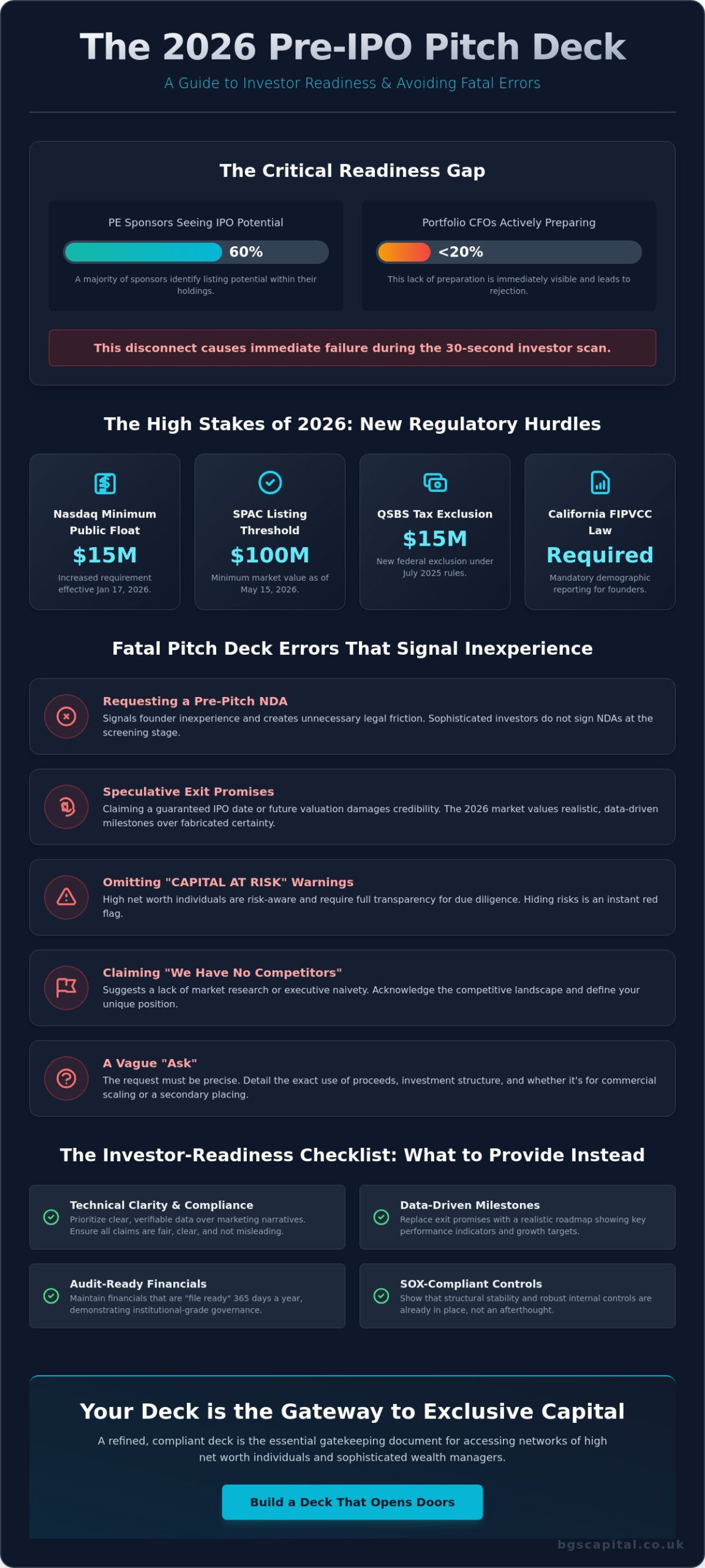
Fewer than 20% of portfolio company CFOs are actively preparing for an IPO, despite 60% of private equity sponsors identifying listing potential within their holdings according to 2026 Accordion data. This lack of readiness often leads to immediate rejection during the initial 30-second investor scan. Avoiding common pitch deck mistakes is now a matter of regulatory survival, especially since the Nasdaq minimum public float requirement increased to $15 million on January 17, 2026.
You’re likely aware that sophisticated wealth managers face significant pitch fatigue and prioritize technical clarity over marketing narratives. This guide promises to help you master the investor presentation by correcting the fatal errors that prevent high net worth individuals from engaging with your business. We’ll examine how to align your materials with the latest standards, including the $100 million SPAC listing threshold and California’s FIPVCC reporting requirements. By the end of this article, you’ll have a roadmap for creating a compliant, professional deck that functions as a serious gateway to exclusive capital networks.
Key Takeaways
- Understand why sophisticated wealth managers reject non-disclosure agreements and how to provide transparency without compromising sensitive intellectual property.
- Master the visual hierarchy required to pass the 30-second investor scan by avoiding common pitch deck mistakes that signal a lack of executive clarity.
- Align your presentation with 2026 regulatory expectations, ensuring all claims meet the “fair, clear, and not misleading” standards required for professional introductions.
- Eliminate speculative exit promises that damage credibility with accredited investment firms and replace them with data-driven milestones.
- Learn how a refined, compliant deck serves as the essential gatekeeping document for accessing exclusive networks of high net worth individuals.
The High Stakes of Pre-IPO Pitching in 2026
Capital markets in early 2026 require surgical precision. The era of speculative “growth at any cost” has been replaced by a rigorous institutional standard. As of May 15, 2026, Nasdaq listing standards for SPACs increased to a minimum market value of $100 million. Simultaneously, the minimum public float for IPOs rose to $15 million. These shifts mean that avoiding common pitch deck mistakes is no longer just about aesthetics; it’s a mandatory step in regulatory and financial survival. For founders, the goal is transitioning from a “Seed” mindset, which relies on narrative potential, to a “Pre-IPO” institutional mindset that prioritizes governance and audit-readiness.
The 2026 Accordion survey reveals a startling disconnect: while 60% of private equity sponsors see IPO potential in their portfolios, fewer than 20% of their CFOs are actively preparing for a listing. This lack of preparation is immediately visible in a pitch deck. Professional introducers and wealth managers use a 30-second rule when scanning materials. If your deck doesn’t communicate structural stability, SOX-compliant controls, and a clear path to liquidity within that window, it won’t pass the initial screening. Sophisticated capital doesn’t have the bandwidth for complexity; it seeks clarity and compliance.
The Sophisticated Investor Mandate
High net worth individuals and wealth managers in 2026 prioritize risk mitigation over marketing hype. They expect a pitch deck to serve as a concise executive summary of a comprehensive business plan. In this tier of investing, the “CAPITAL AT RISK” warning isn’t a footnote; it’s a core component of a transparent presentation. Investors are looking for specific data points, such as your Qualified Small Business Stock (QSBS) eligibility under the July 2025 rules, which now allow for a $15 million federal tax exclusion. If you obscure risks or use vague qualifiers, you’ll lose credibility with accredited investment firms that are legally bound to prioritize transparency.
The Introducer Perspective
As a specialist introducer, BGS Capital evaluates business features based on their suitability for an exclusive network of sophisticated investors. We distinguish between a “good idea” and a “qualified opportunity.” A qualified opportunity is one where the founder has already addressed the technical barriers to entry, including demographic reporting for California’s FIPVCC law or maintaining audited financials that are “file ready” 365 days a year. When you’re learning how to find investors for your business, you must realize that your deck is a qualification gate. It’s the primary tool we use to determine if a business is ready to be featured to wealth managers who demand institutional-grade materials. Avoiding common pitch deck mistakes at this stage is the difference between securing a direct introduction and being permanently filtered out of the deal flow.
Strategic Blunders: Misaligning with Investor Mandates
Sophisticated investment firms frequently review hundreds of proposals annually. Requesting a pre-pitch non-disclosure agreement is a primary signal of founder inexperience. Professional investors don’t sign NDAs at the initial screening stage because it creates unnecessary legal entanglement over generic concepts. Avoiding common pitch deck mistakes starts with recognizing that your intellectual property is protected by your execution, not a legal gatekeeper. If your business model is so fragile that a 30-second scan compromises its value, it’s likely not ready for pre-IPO capital.
Exit promises represent another significant strategic error. Claiming a guaranteed IPO date or a specific future valuation is speculative and often misleading. The 2026 market remains volatile; despite 226 IPOs in 2025, mid-March 2026 saw a period of zero scheduled listings. Wealth managers value realistic milestones over fabricated certainty. Your “Ask” must be equally precise. A structured request should mirror the essential pitch deck slides found in institutional-grade presentations, detailing the exact use of proceeds and the investment structure. Specify whether the capital scales the commercial engine or facilitates a secondary placing.
Transparency and Risk Management
Institutional interest often derails when founders omit “CAPITAL AT RISK” warnings. High net worth individuals are risk-aware, not risk-averse; they require transparency to perform due diligence. Claiming “we have no competitors” is a red flag that suggests a lack of market research rather than a unique position. Investor transparency in UK secondary placings refers to the comprehensive disclosure of existing shareholder rights, historical valuation benchmarks, and the specific regulatory exemptions governing the private equity transfer. If you’re unsure where your business fits, you can check your eligibility for professional introductions.
The Team and Governance Gap
Founder-only decks struggle in pre-IPO rounds. By 2026, investors expect a professional board and a network of specialist advisors to be in place. Hiding the Cap Table or current equity structure is a mistake that suggests future governance issues. Sophisticated capital needs to see who else is on the journey and how much “skin in the game” the leadership team retains. Understanding these requirements is a vital part of understanding startup funding stages. A transparent, well-governed structure is the only way to secure introductions to accredited investment firms.
Narrative and Data Pitfalls: The Cost of Complexity
Complexity acts as a primary deterrent for sophisticated capital. Wealth managers scan for executive clarity, using a deck’s visual hierarchy as a proxy for leadership capability. A “Wall of Text” indicates a founder who cannot prioritize information. In the 2026 market, where IPO readiness is scrutinized, your deck must demonstrate “File Ready” transparency. Avoiding common pitch deck mistakes means stripping away the “Subway Map Syndrome” where product roadmaps resemble tangled transit lines rather than clear commercial milestones. If your narrative is too dense, you’ll fail the initial 30-second scan.
Investors in 2026 ignore market size hyperbole. Generic “Trillion Dollar Market” claims are discarded. Accredited investment firms look for Serviceable Obtainable Market (SOM) data backed by 2025 or 2026 research. Using data from 2023 or earlier signals a lack of market awareness. Unrealistic hockey-stick graphs without unit economic justification are equally damaging. Since fewer than 20% of portfolio company CFOs are currently preparing for IPOs, your financials must prove you’re in the minority who understand post-listing durability. You can check if you are eligible for our network to see how your data measures up.
Structuring the Pre-IPO Narrative
Institutional-grade decks follow a strict 12-slide framework. This structure ensures every critical data point, from governance to use of proceeds, is addressed. When presenting secondary placings, the narrative must focus on capital structure optimization rather than founder exit. A strategic roadmap should highlight the transition from private to public markets, including SOX-compliance milestones. This level of detail is essential when pitching a business idea to high net worth individuals who prioritize long-term stability over short-term hype.
Data Integrity and Validation
Data integrity is the foundation of institutional trust. Vanity metrics, such as app downloads or user registrations, are secondary to revenue quality and customer acquisition cost (CAC) efficiency. In 2026, the SEC is moving toward rulemaking for a regulated secondary market for private securities, increasing the demand for audited, transparent data. Ensure your traction is validated by recent, third-party audits. Founders seeking more than just capital often explore Venture capital for founders to build the necessary infrastructure for a successful listing. Validating your commercial engine with concrete unit economics is the only way to pass the gatekeepers of sophisticated capital.
The Investor-Readiness Checklist: Compliance and Transparency
Compliance is the final gatekeeping mechanism for sophisticated capital. While earlier sections focused on narrative and strategic alignment, avoiding common pitch deck mistakes at this stage requires a transition into formal regulatory standards. Every claim in a pre-IPO deck must be verifiable and meet the “fair, clear, and not misleading” standards enforced by the FCA. Sophisticated investors don’t just buy into a vision; they audit the underlying structure. This audit begins the moment they move from your deck to your virtual data room (VDR). If your VDR lacks professional organization or audited financials, the initial interest will evaporate immediately.
The “Am I Eligible?” test serves as a critical pre-qualification step. Before a business is featured to an introducer network, it must prove it’s ready for institutional scrutiny. This means having a clear “Next Steps” slide that outlines the exact path for wealth managers to engage. Directness is a virtue in high-level investing. Ensure your deck provides a transactional roadmap rather than a vague invitation to “get in touch.” Complexity kills deals. Clarity closes them.
UK Regulatory Specifics
UK founders must integrate mandatory risk warnings into their deck structure. Foregrounding that CAPITAL AT RISK is a requirement, not a suggestion. Correctly positioning tax relief is also vital. You should provide a clear status update on your qualifying position within A guide to the EIS scheme to attract high net worth individuals seeking tax efficiency. Founders also need to understand the implications of Capital gains tax for founders when structuring their rounds. Misrepresenting these schemes is a fatal error that signals a lack of professional governance.
The Final Polish: Professionalism and Tone
The tone of your presentation must match the seriousness of the capital you seek. Remove colloquialisms and “startup jargon” that might alienate sophisticated pension investors. Many high net worth individuals utilize SIPP or SSAS structures for their investments. These investors require a deck that speaks the language of wealth management: diversification, risk mitigation, and structural transparency. A polished deck functions as a professional gateway. It proves the company is a qualified opportunity rather than a speculative venture. To begin the process of professional introduction, you should pre-qualify your business against our network standards.
Beyond the Deck: Navigating the Investor Introduction Process
A technically perfect deck remains a static document without access to a curated network. While avoiding common pitch deck mistakes ensures your business isn’t rejected instantly, the document itself doesn’t generate liquidity. In the early 2026 market, where IPO volume has fluctuated significantly, the competition for the attention of wealth managers is intense. Sophisticated capital is accessed through restricted channels, not public solicitation. The deck serves as your professional credential, but the introduction process is what converts interest into a direct investor relations meeting.
Transitioning from a presentation to a meeting requires a shift in focus. The deck establishes the commercial engine and governance; the meeting validates the team’s ability to handle institutional-grade scrutiny. Professional introducers like BGS Capital facilitate this transition by positioning qualified opportunities before high net worth individuals. This process bypasses the noise of retail markets, focusing instead on accredited investment firms that understand the complexities of pre-IPO structures and secondary placings.
Leveraging the BGS Capital Network
Applying for a feature on the BGS Capital database is a strategic move for founders who have already refined their materials. This platform serves as a conduit to a specialized audience of wealth managers and sophisticated pension investors. It’s particularly effective for those finding angel investors in the UK who are seeking pre-IPO opportunities with clear paths to liquidity. By featuring your business, you gain exposure to a network that prioritizes regulatory compliance and “file ready” transparency. This exposure is restricted to companies that have successfully passed the initial eligibility screening.
Next Steps for Capital Raising
Your first action should be to check your eligibility for the BGS Capital platform. This ensures your business meets the high standards required by our network of wealth managers. Refining your deck for the 2026 market is an ongoing process of aligning with new Nasdaq listing standards and tax exclusion rules like the QSBS $15 million threshold. Once your governance is SOX-compliant and your VDR is fully documented, you can proceed to the final stage of the introduction process. Use our network to Feature Your Business and Connect With Investors who are actively seeking sophisticated financial opportunities. CAPITAL AT RISK.
Secure Your Entry to Sophisticated Capital
Success in the 2026 private equity market requires a transition from speculative narrative to institutional governance. Avoiding common pitch deck mistakes ensures your business survives the initial 30-second scan by wealth managers who prioritize transparency over hype. You’ve learned how to structure a 12-slide framework that addresses modern regulatory standards, from California’s FIPVCC reporting to the latest UK tax relief eligibility. A compliant, professional deck is no longer optional; it’s the mandatory credential for any founder seeking a liquidity event.
BGS Capital serves as a specialist introducer for these high-stakes opportunities. We provide qualified companies with direct access to a curated network of high net worth individuals and accredited investment firms. Our platform features a free database for qualified investors, focusing exclusively on pre-IPO and IPO placements. Once your materials are refined and your governance is audited, you’re ready to move beyond the document and into the meeting room.
RAISING CAPITAL? FEATURE YOUR BUSINESS. Your business is ready for the next level of investment. We look forward to facilitating your introduction to the right capital partners. CAPITAL AT RISK.
Frequently Asked Questions
Should I include a specific valuation in my pitch deck?
No, you should avoid specific valuations as they are often speculative and lead to friction during due diligence. Instead, provide historical valuation benchmarks and reference the $100 million market value required for SPAC listings as of May 15, 2026. Sophisticated investors prefer a data-driven range that reflects current market conditions rather than a single, unverified number that might collapse under institutional scrutiny.
How long should a pre-IPO pitch deck be?
A standard pre-IPO deck should consist of exactly 12 slides. This framework provides the executive clarity required to pass the initial 30-second scan performed by wealth managers. Longer decks often contain excessive technical detail that obscures the commercial engine. Focus on a modular structure that covers governance, unit economics, and use of proceeds to ensure your presentation remains professional and punchy.
Can I use the same deck for angel investors and wealth managers?
You cannot use the same deck because these audiences have different risk mandates. Angel investors often prioritize narrative and vision, whereas wealth managers focus on risk mitigation and institutional-grade governance. Avoiding common pitch deck mistakes involves tailoring your materials to include SOX-compliant controls and professional virtual data room links. This level of detail is essential for sophisticated investors managing SIPP and SSAS structures.
Why do investors hate NDAs in the early stages of a pitch?
NDAs create unnecessary legal entanglement for firms reviewing high deal volumes in the 2026 capital markets. Sophisticated investors refuse to sign these documents before a pitch because generic concepts are not patentable and execution is the primary differentiator. Forcing a legal gatekeeper at the first stage signals founder inexperience. It often terminates the introduction process before the investor even scans the deck.
What are the most common financial mistakes in a pitch deck?
The most frequent errors involve “hockey stick” projections lacking unit economic justification and the use of research older than 12 months. Avoiding common pitch deck mistakes requires presenting audited financials that are “file ready” for institutional review. Over-relying on vanity metrics instead of revenue quality is a red flag. Professional introducers scan for these discrepancies to ensure only qualified opportunities reach their network.
Is it necessary to mention SEIS/EIS if I am raising pre-IPO capital?
Yes, you must mention these if your business remains eligible under current UK tax laws. Tax efficiency is a major driver for high net worth individuals. Correctly positioning SEIS or EIS status, alongside the $15 million QSBS federal tax exclusion effective July 4, 2025, increases the appeal of a secondary placing. Failing to mention these incentives ignores a key component of the sophisticated investor mandate.
How often should I update my pitch deck data?
Update your materials every 90 days or whenever a regulatory shift occurs. The January 17, 2026 increase in the Nasdaq minimum public float to $15 million is a prime example of a change requiring an immediate deck revision. Stale data from 2024 suggests a lack of operational discipline. Maintaining transparency means your deck must reflect the most current financial landscape to remain credible with accredited investment firms.
What happens if my business does not meet eligibility criteria for an introducer?
Your business will be filtered out of the deal flow and will not be featured in the network. BGS Capital operates as an introducer, meaning access is restricted to companies that pass a stringent qualification gate. If you don’t meet the “Am I Eligible?” criteria, focus on refining your governance and auditing your commercial engine. You can re-apply once your business demonstrates the institutional readiness required for professional listing.