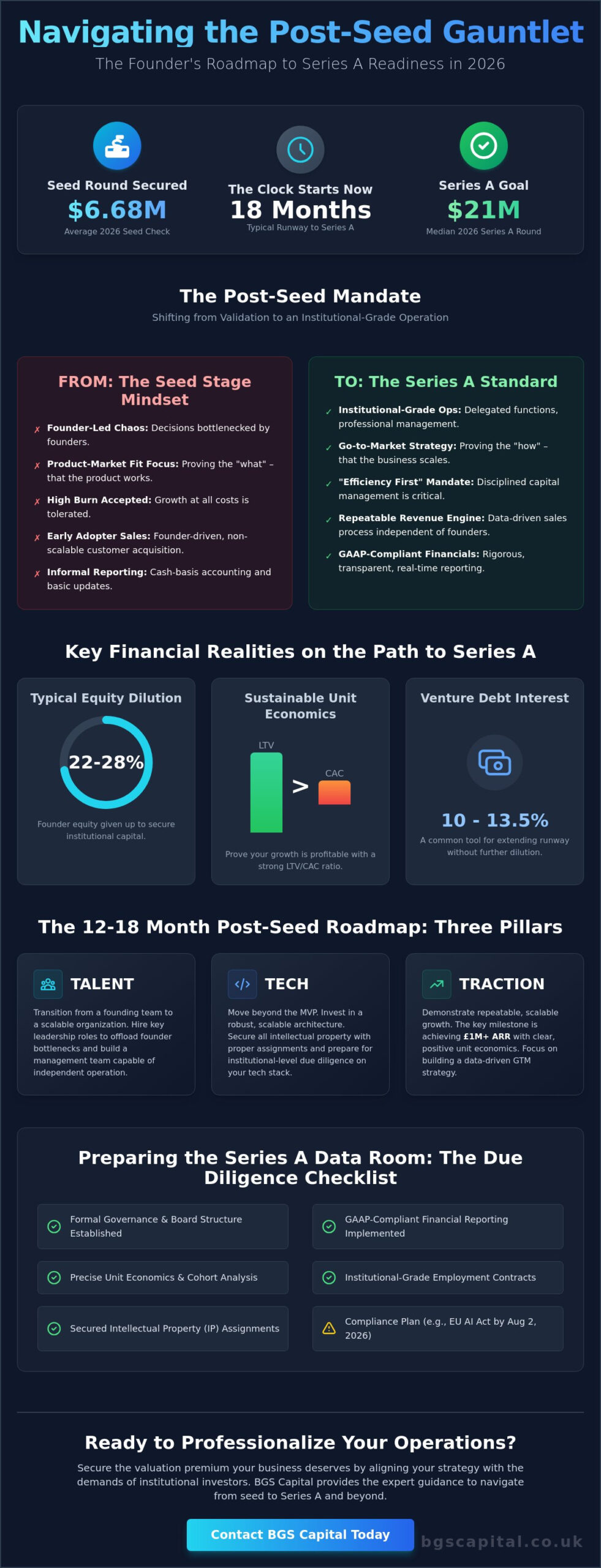
If you believe the hardest part of the startup journey ended when the $6.68 million average seed check cleared your bank account, you are likely unprepared for the institutional scrutiny of 2026. Securing capital is a milestone; however, understanding what happens after seed funding determines whether your venture reaches a $21 million median Series A or stalls in the valley of death. You’ve likely felt the pressure of balancing aggressive growth against the reality of 22% to 28% equity dilution and increasing regulatory overhead.
This strategic guide provides the professional roadmap required to bridge the gap between seed validation and institutional readiness. We will outline the specific capital allocation strategies, governance standards, and KPI benchmarks that accredited investment firms demand in the current market. You’ll gain clarity on managing 10% to 13.5% venture debt interest rates and preparing for the August 2, 2026 EU AI Act deadline. Our analysis ensures you’re equipped to professionalize your operations and secure the valuation premium your business deserves.
Key Takeaways
- Establish formal governance and board structures to transition from founder-led operations to an institutional-grade organization.
- Identify the precise unit economics and GAAP-compliant reporting frameworks required to meet the Series A expectations of accredited investment firms.
- Implement strategic capital allocation to maintain an 18-month runway while balancing R&D, sales, and operational efficiency.
- Navigate what happens after seed funding by securing intellectual property assignments and institutional-grade employment contracts for your data room.
- Align your scaling strategy with the pre-IPO ecosystem to attract sophisticated capital and high-net-worth investor networks.
The Post-Seed Mandate: Shifting from Validation to Professional Growth
Closing a seed round is a transition point, not a destination. In 2026, the median seed round of $6.68 million serves as a high-stakes timer. Founders have approximately 18 months to transform a validated concept into a scalable machine. Understanding what happens after seed funding requires a definitive move away from “founder-led” chaos toward institutional-grade operations. This period is a clock, not a cushion. Every dollar spent must advance the company toward specific value inflection points that trigger Series A interest.
The psychological shift is often the most difficult. Founders must transition from being the primary drivers of every tactical decision to building an organization-led structure. This involves delegating core functions to specialized talent and establishing governance protocols that meet the standards of accredited investment firms. Seed investors in 2026 act as essential conduits to future capital. They expect transparency and rigorous reporting. If the internal transition to professionalized management fails, the company will likely stall before reaching the $21 million median Series A benchmark.
Value inflection points in the 2026 landscape are strictly defined. Institutional investors look for repeatable unit economics, a clear path to profitability, and a robust data room. What happens after seed funding is a pivot from product validation to operational excellence. You’re no longer proving that the product works; you’re proving that the business scales. Failure to hit these milestones within the 18-month window often leads to the “valley of death,” where capital runs dry before the next round is viable.
From Product-Market Fit to Go-to-Market Strategy
The seed round was about the “what,” but Series A is about the “how.” Transitioning from early adopters to a scalable customer acquisition model is the primary objective. You must build a sales engine that functions independently of founder involvement. This foundation is critical for attracting venture capital at the next stage. In 2026, startups must analyze LTV/CAC ratios with surgical precision to prove that their growth is sustainable and not merely a result of high burn.
Setting the 12-18 Month Roadmap
The post-seed roadmap must prioritize three pillars: Talent, Tech, and Traction. Immediately after closing, align board expectations with operational reality. In the current venture capital funding landscape, institutional investors prioritize “Efficiency First” over growth at all costs. Use your capital to hire leadership roles that offload founder bottlenecks. Transparency with seed investors builds the bridge to Series A. Establish regular governance cycles now to prove the business is ready for professionalized oversight and sophisticated capital networks.
Operational Milestones: What Institutional Investors Demand in 2026
Institutional investors in 2026 have shifted their focus from raw user acquisition to sustainable unit economics. Understanding what happens after seed funding involves mastering the transition from a founder-led sales process to a repeatable revenue engine. To secure the $21 million median Series A funding, or the $75 million median for AI-native firms, companies must demonstrate a clear path to £1M+ ARR with disciplined capital management. Investors now prioritize the “Efficiency First” mandate, where high burn rates are viewed as operational failures rather than growth indicators.
Professionalized financial reporting is no longer optional. Accredited investment firms expect GAAP compliance and real-time data stacks. This level of visibility allows founders to calculate their marketing payback periods with surgical precision. If your financial models still rely on cash-basis accounting, you are likely to fail the due diligence requirements of sophisticated venture capital networks. Establishing these foundations early ensures that your business remains attractive to high-net-worth individuals and institutional partners who demand transparency and risk mitigation.
Scaling beyond the founding duo requires a deliberate approach to leadership. You must build a management team capable of operating without constant founder intervention. This transition is essential for companies looking to feature your business to a wider network of professional investors. Demonstrating that the organization can function as an independent entity is a primary requirement for any successful Series A raise in the current 2026 landscape.
The Unit Economics of Series A
Series A investors in 2026 prioritize the Magic Number and LTV/CAC ratios above all other metrics. A Magic Number above 0.75 indicates efficient sales growth, while anything below 0.5 suggests your customer acquisition model is not yet ready for institutional scaling. You must standardize your data stack to provide real-time performance insights. This technical infrastructure allows you to identify which segments yield the highest margins and prioritize capital allocation accordingly. Efficiency is the new benchmark for valuation premiums.
Talent Acquisition and Organisational Debt
Headcount often doubles in the 12 months following a seed round. Identifying “Stage 2” hires is critical. You need VPs who can build departments and establish scalable processes, not just managers who execute daily tasks. Managing the cultural shift during this expansion is vital to prevent organizational debt. You must also address technical and operational debt before Series A due diligence begins. Investors will scrutinize your code base and employment contracts for compliance with the latest 2026 regulations, including the EU AI Act and updated GDPR frameworks.
Managing the Runway: Strategic Capital Allocation vs. Rapid Burn
Capital efficiency is the primary metric for 2026. High burn rates are no longer celebrated as aggressive growth; they’re viewed as a lack of operational discipline. Founders who fail to grasp what happens after seed funding often find themselves in the “Series A Gap,” a period where capital needs exceed market appetite for high-risk, low-efficiency models. Strategic allocation requires a precise balance between R&D, Sales, and Operations. In the current landscape, 40% of capital typically flows to sales and marketing once unit economics are proven, while 30% maintains R&D momentum and the remaining 30% professionalizes operations and compliance.
Managing cash flow involves more than just monitoring a bank balance. It requires sophisticated startup funding strategies that align spend with specific growth milestones. You must identify exactly when to initiate your next raise, typically 6 to 9 months before your projected zero-cash date. This lead time is essential because institutional due diligence has become more rigorous in 2026. Founders must prove they can reach their next valuation inflection point without requiring emergency liquidity.
Calculating Your Default Alive vs. Default Dead Status
The “Default Alive” framework dictates your scaling plans. If your current trajectory leads to profitability before your cash runs out, you’re Default Alive. If you rely on a Series A round to survive, you’re Default Dead. In 2026, being Default Alive provides significant leverage during valuation negotiations. You must set “Triggers” for cost-cutting immediately. If growth milestones are missed for two consecutive quarters, reducing burn becomes a mandatory requirement to preserve the company’s future. High burn without corresponding traction will lead to a lower Series A valuation or a flat round.
The Role of Bridge Rounds and Venture Debt
A seed-extension or bridge round can be a strategic move to reach a specific milestone. However, if it’s used merely to cover a high burn rate, it’s a red flag for future investors. Venture debt has become a common non-dilutive tool to extend the runway. In early 2026, typical interest rates for venture debt are between 10% and 13.5%, reflecting a spread of 6% to 9% over the Secured Overnight Financing Rate (SOFR). When presenting these options to your angel investors, focus on how this capital accelerates your path to a $21 million median Series A rather than just delaying the inevitable.
Preparing the Series A Data Room: Governance, Compliance, and Tax
Institutional investors perform exhaustive due diligence. A significant part of what happens after seed funding is the transition from informal management to a rigid governance framework. You must establish a formal Board of Directors immediately. This group should hold regular governance cycles, typically monthly or quarterly, to oversee capital allocation and risk management. VCs will scrutinize your board minutes for evidence of professional oversight and compliance with 2026 regulatory standards. If your records are incomplete, you risk appearing operationally immature to sophisticated backers.
Intellectual Property (IP) assignments and employment contracts must be institutional-grade. In 2026, this includes specific clauses for AI governance to align with the August 2, 2026 EU AI Act deadline. Failure to secure clean IP assignments from every founder, employee, and contractor is a primary reason Series A deals fail. You must also audit your cap table for “dead equity,” which refers to shares held by former founders or advisors who no longer contribute value. Sophisticated investors expect a streamlined cap table that leaves sufficient room for future option pools and new institutional capital.
Maintaining EIS and SEIS compliance is vital for your existing investor base. If you’ve raised capital through these schemes, you must ensure your company’s activities don’t disqualify investors from their tax relief. This includes monitoring the “gross assets” and “number of employees” tests as you scale. If you are ready to reach a broader network of professional backers, you can feature your business on our platform to connect with accredited investment firms.
The UK Compliance Checklist for Scaling
Due diligence starts with your statutory books. You must ensure all SEIS/EIS certificates, specifically form EIS3, are correctly issued to investors within the required timeframes. Institutional firms will conduct rigorous “Know Your Customer” (KYC) checks on all major shareholders. Verify that all Companies House filings are up to date and consistent with your internal records. Missing filings or discrepancies in your share register are red flags that suggest a lack of internal control.
Building the ‘Permanent’ Data Room
The most efficient founders start their Series A data room the day their seed round closes. Organizing financial models, customer contracts, and HR records for instant access prevents the last-minute scramble that kills deal momentum. Use a tiered folder structure that reflects the standard VC due diligence checklist. A clean cap table is an absolute prerequisite for Series A success, as it demonstrates that the founders retain enough equity to drive the next stage of growth.
The Road to Pre-IPO: Positioning for Sophisticated Capital
Founders who successfully manage what happens after seed funding recognize that Series A is merely a stepping stone toward a liquidity event. In 2026, the IPO market has shown significant momentum. As of May 9, 2026, there have been 129 IPOs on the US stock market, representing a 9.32% increase compared to the same period in 2025. This robust activity in sectors like AI and infrastructure means that post-seed scaling must align with the expectations of the pre-IPO ecosystem. Positioning your company for sophisticated capital requires a shift in focus from local angel networks to global institutional standards.
Establishing institutional-grade governance early allows you to command better investor finance terms. Professional investors and wealth managers prioritize companies that demonstrate a clear path to profitability and regulatory transparency. BGS Capital operates as an introducer, connecting qualified companies with a network of accredited investment firms and high-net-worth individuals. By moving beyond the “friends and family” stage, you’re signaling to the market that your business is ready for the rigours of secondary placings and eventual public listing.
Attracting Sophisticated Investors
Sophisticated investor networks demand a higher level of reporting and risk mitigation than seed-stage backers. They look for companies that have already addressed “stacked liability” concerns, such as the integration of the EU AI Act with GDPR frameworks before the August 2, 2026 deadline. To gain exposure to these pre-IPO networks, you can feature your business on specialized platforms designed for professional discovery. Am I Eligible? This is the primary question founders must answer; using tools like the business survey from Bright Side Capital can help you determine if your financial models and compliance structures meet the stringent requirements of accredited firms.
Next Steps: From Seed to Scale
As you approach your Series A launch, you must review your capital gains tax exposure. With the federal corporate tax rate for C corporations holding at a flat 21% in 2026, founder equity management becomes a critical component of long-term wealth preservation. Your final six-month checklist should include a full audit of your data room, the finalization of all IP assignments, and the verification of your “Default Alive” status. If you’re ready to expand your reach to sophisticated capital, the next step is to FEATURE YOUR BUSINESS to our network of professional investors.
CAPITAL AT RISK. BGS Capital operates as an introducer and does not provide financial advice or facilitate raises directly. All investment opportunities carry risk, and past performance is not a guarantee of future results.
Securing Your Path to Series A and Beyond
The transition from seed validation to institutional scaling requires more than just capital. It demands a rigorous shift toward professionalized governance and disciplined runway management. Companies that successfully navigate what happens after seed funding are those that prioritize GAAP compliance, clean cap tables, and the “Efficiency First” mandate. By establishing these frameworks now, you ensure your business remains eligible for the $21 million median Series A funding expected in the 2026 market.
BGS Capital operates as a professional introducer. We connect qualified companies with an exclusive network of high-net-worth and sophisticated investors. Our model provides access to pre-IPO and IPO investment opportunities for businesses ready to scale. If you’re RAISING CAPITAL, FEATURE YOUR BUSINESS on our platform to gain exposure to sophisticated capital networks. Establishing institutional-grade operations today is the most effective way to secure your company’s future valuation. You’ve built the foundation; it’s time to professionalize the growth.
Frequently Asked Questions
How long should seed funding typically last?
Seed funding should provide between 12 and 18 months of operational runway. This timeframe allows founders to reach the value inflection points required for institutional interest. In the 2026 market, capital efficiency is paramount; therefore, maintaining a buffer for at least 6 months of fundraising is a standard requirement. Understanding what happens after seed funding involves mapping this runway against specific growth milestones to avoid the valley of death.
What is the average time between seed and Series A funding?
The average interval between seed and Series A rounds is approximately 18 months. While high-growth firms may accelerate this to 12 months, others extend to 24 months using non-dilutive venture debt. Institutional investors expect a company to have utilized at least 70% of its seed capital before initiating a Series A raise. This timeline ensures the business has sufficient data to prove repeatable unit economics and scalable growth.
What traction do I need for a Series A in 2026?
For SaaS models, a minimum of £1M in Annual Recurring Revenue (ARR) is the 2026 benchmark. Beyond revenue, investors demand a Magic Number above 0.75 and a LTV/CAC ratio exceeding 3:1. AI-native firms often require higher technical validation and a pre-money valuation reflecting their 42% premium over non-AI counterparts. Traction is now defined by sustainable, repeatable growth rather than experimental user acquisition or high-burn scaling strategies.
Can I raise Series A without reaching profitability?
Yes, raising Series A without current profitability is possible, provided there’s a clear path to being “Default Alive.” In 2026, accredited investment firms prioritize a disciplined burn rate over growth at any cost. You must demonstrate that your unit economics are profitable at the customer level. Investors will scrutinize your financial models to ensure that scaling won’t lead to an unsustainable cash drain during the next 18 months.
What happens if I run out of seed money before the next round?
Running out of capital before a Series A often leads to a bridge round or a “down round” with significant equity dilution. Founders may also utilize venture debt, which carries interest rates between 10% and 13.5% in early 2026. If milestones are missed, the risk of liquidation or a distressed sale increases significantly. Proactive runway management and early engagement with sophisticated investor networks are essential to avoid these outcomes.
Is it possible to skip Series A and go straight to Series B?
Skipping Series A is rare but occurs in approximately 5% of high-growth cases, particularly for AI-native companies with exceptional traction. These firms often raise larger initial rounds that bypass traditional Series A revenue benchmarks. However, the governance and compliance requirements for a Series B are significantly more demanding. Most companies benefit from the structural professionalization that a standard Series A provides before they pursue larger institutional rounds.
How much equity should I expect to give away in a Series A round?
Founders typically give away between 15% and 25% of their equity during a Series A round. This usually includes a 10% top-up for the employee option pool. Combined with seed-stage dilution, which averages 22% to 28%, founders may retain approximately 40% to 50% of the company post-Series A. Maintaining a clean cap table is vital to ensure that founders and key talent remain incentivized for future growth stages.
What is a ‘bridge round’ and when should I use one?
A bridge round is an interim financing event designed to extend a company’s runway until a larger Series A is secured. It’s best used when a specific, imminent milestone will significantly increase the company’s valuation. In 2026, these are often structured as convertible notes or SAFEs. Using a bridge round to cover operational inefficiencies is a red flag for sophisticated investor networks and can complicate future institutional due diligence.