
Global convertible bond issuance reached a record $167 billion across 264 deals in 2025, and Q1 2026 has already seen $31 billion in offerings. This isn’t just a market trend. It’s a fundamental shift in how high-growth companies bridge the gap to a public listing. Having a convertible loan note explained through a technical lens is essential because these instruments are strategic bridge tools, not just debt. CAPITAL AT RISK is a reality in these sophisticated placements, making an exact understanding of mechanics mandatory for any accredited investor or founder.
You’re likely aware that CLNs offer speed to market, yet you’re concerned about the complexity of conversion triggers and the risk of equity dilution. We’ll demystify these mechanics, from valuation caps to the 12 to 24-month maturity periods typical of 2026 issuances. You’ll learn to evaluate CLNs as a bridge to IPO while utilizing risk mitigation strategies. This guide analyzes current market data, including typical 4% to 8% interest rates and 15% to 25% discount rates, to ensure your next capital raise or investment is built on a transparent, professional foundation.
Key Takeaways
- Understand the technical transition of the hybrid finance model as it moves from a balance sheet liability to equity during future funding rounds.
- Gain a professional perspective on convertible loan note explained mechanics, including the strategic application of 10-30% discount rates and protective valuation caps.
- Analyze the strategic trade-off between speed of execution and the risk of a debt bomb if a company fails to raise a qualifying round before the longstop date.
- Identify how late-stage companies utilize convertible notes to fund the final push toward a public listing, specifically covering accounting and legal costs.
- Access specific checklists for founders and accredited investors to determine if a CLN structure is the optimal choice for your current capital requirements.
What is a Convertible Loan Note? The Hybrid Finance Model Explained
A Convertible Loan Note (CLN) is a short-term debt instrument that facilitates capital flow without requiring an immediate company valuation. It functions as a loan that converts into equity during a future, specified funding event. This is the core of having a convertible loan note explained; it is a strategic bridge. It allows founders to secure capital quickly while deferring the complex “priced round” negotiations. On the company’s balance sheet, the CLN initially sits as a liability. Upon a trigger event, such as a startup funding round or an IPO, this debt converts into shares. This transition from debt to equity is why professionals categorize it as a hybrid instrument.
This structure is a specialized variation of a Convertible bond, adapted for the private and pre-IPO markets. It serves as a vital tool for companies needing to fund the final push toward a public listing or to bridge the gap between Seed and Series A. However, investors must recognize that CAPITAL AT RISK is a fundamental condition of this asset class. If the company fails before a conversion event occurs, the note remains a debt obligation that the business may be unable to repay. Investors may not recover their principal investment.
Debt vs. Equity: Why the Distinction Matters
Unlike traditional bank loans, CLNs don’t require immediate cash repayment of the principal. They focus on conversion. This distinction is critical for maintaining cash flow during high-growth phases. By using a CLN, founders delay setting a fixed company valuation. This is often advantageous if they expect significant growth before the next round. For investors, CLN holders sit higher in the creditor hierarchy than equity holders. In the event of a Chapter 11 bankruptcy or liquidation, debt holders are prioritized. This provides a layer of downside protection that standard equity doesn’t offer.
The Role of the CLN in the Capital Stack
In the capital stack, CLNs are the primary vehicle for bridge financing. They allow a company to maintain momentum between larger raises without the administrative burden of a full equity round. This structure is particularly attractive to angel investors. They often seek early-entry discounts, which typically range from 15% to 25% in the 2026 market, as a reward for providing capital when risks are highest. Sophisticated investors use these notes as risk-mitigation tools. They secure a position early while ensuring their investment converts at a more favorable price than future Series A or IPO participants.
The Mechanics of Conversion: Discounts, Caps, and Triggers
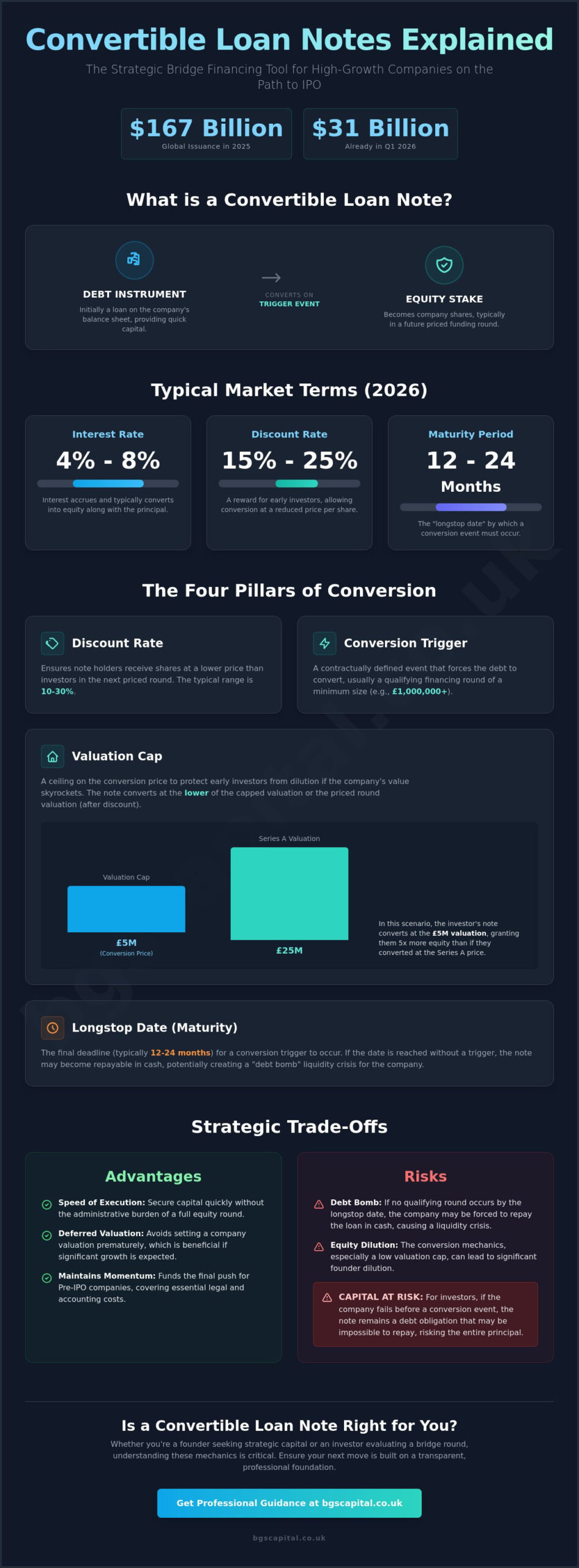
Understanding the technical execution of conversion is where the strategic value of having a convertible loan note explained truly resides. Conversion is not an automatic process; it’s a strictly governed contractual event triggered by specific milestones. The primary objective is to transition debt into equity at a price that rewards the investor for early-stage risk while providing the founder with necessary liquidity. These mechanics are defined by four pillars: the discount rate, the valuation cap, conversion triggers, and the longstop date.
The discount rate typically ranges from 10% to 30%. It ensures that the note holder receives shares at a lower price per share than investors in the subsequent priced round. This 20% average discount is a direct reward for the liquidity risk taken before a formal valuation is established. Conversion triggers define the specific events, usually a qualifying financing raise exceeding £1,000,000, that force the debt to convert. If no trigger occurs by the longstop date, which is generally 12 to 24 months from issuance, the note may become repayable in cash, potentially creating a liquidity crisis for the company.
Valuation Caps: Protecting the Investor’s Upside
A valuation cap is a ceiling on the conversion price regardless of the next round’s actual valuation. It serves as a vital safeguard for investors in high-growth scenarios where company value skyrockets between rounds. For example, if a cap is set at £5 million but the Series A valuation reaches £25 million, the note holder converts at the £5 million rate. This prevents excessive dilution of the early investor’s stake. This term often creates the most tension during negotiations. Founders prioritize higher caps to preserve equity, while investors demand lower caps to capture more of the growth they are funding. Relying on a professional Convertible Note Definition helps both parties align on these technical boundaries without the friction of subjective valuation models.
Interest Rates and Accrual
In the current UK market, interest rates for CLNs generally sit between 5% and 10% per annum. Most sophisticated structures utilize Payment-in-Kind (PIK) interest. Rather than draining company cash through monthly payments, the interest accrues and is added to the principal balance. Upon conversion, the total accrued interest converts into additional shares alongside the principal. This mechanism maximizes the investor’s equity position while allowing the company to deploy all available cash toward scaling operations. Before entering these complex negotiations, sophisticated parties often check their eligibility to participate in these exclusive private placements.
Strategic Advantages and Risks: Evaluating the CLN Structure
The decision to utilize a CLN involves a calculated trade-off between immediate liquidity and long-term equity structure. While the previous sections detailed the technical mechanics, the strategic value of having a convertible loan note explained lies in its efficiency during volatile market conditions. For founders, the primary benefit is speed. Bypassing the friction of valuation negotiations during a venture capital pitch allows for rapid capital injection. This speed ensures that operational momentum isn’t sacrificed to administrative delays. However, this convenience carries a significant risk; the “debt bomb” is a real threat. If a qualifying round isn’t secured by the longstop date, the company faces a mandatory repayment of principal plus interest, which often exceeds available cash reserves.
Investors view the CLN as a dual-purpose instrument. It provides downside protection through seniority in the creditor hierarchy, while also offering an upside “sweetener” via the conversion discount. Despite these perks, investors must acknowledge the lack of control. Until conversion occurs, note holders typically don’t possess voting rights or board seats. There’s also the risk of dilution if subsequent rounds involve heavy liquidation preferences or massive equity pools. CAPITAL AT RISK remains the defining characteristic of this asset class. There is no guarantee of conversion or capital return.
The Speed Advantage for High-Growth Firms
CLNs are significantly faster to document than a full Shareholders’ Agreement (SHA) revision. A standard equity round requires extensive due diligence and complex legal drafting, often taking 3 to 6 months to close. In contrast, a CLN can be finalized in weeks. This reduces legal costs and allows management to focus on scaling. In competitive fundraising environments, the ability to close a bridge round quickly can be the difference between reaching an IPO or stalling.
Tax Implications: EIS and SEIS Considerations
A critical conflict exists between CLNs and UK tax incentives. Standard convertible notes generally do not qualify for EIS or SEIS tax relief. HMRC views these instruments as “repayable debt” rather than “at-risk equity” at the time of investment. For a note to be eligible, it must be structured as an Advanced Subscription Agreement (ASA). ASAs do not accrue interest and cannot be repaid in cash; they must convert to shares. Investors seeking 30% to 50% tax relief should prioritize ASAs over traditional CLNs to avoid unexpected tax liabilities.
Convertible Notes in the Pre-IPO Landscape
Global convertible issuance reached $167 billion in 2025, marking the strongest year on record. This momentum continued into Q1 2026, with $31 billion across 38 offerings. While early-stage startups use these instruments for survival, late-stage companies utilize them as a tactical weapon. Having a convertible loan note explained within this pre-IPO context reveals how businesses fund the “final push” toward a public listing. These notes bridge the liquidity gap required to meet the stringent requirements of a stock exchange.
The costs associated with an IPO are substantial. Legal fees, accounting audits, and underwriting preparation often require significant upfront capital. A CLN provides this liquidity without the immediate dilution of a priced round. Investors benefit by securing a guaranteed entry price before public market hype drives valuations higher. These instruments usually include a specific “IPO Trigger.” This clause ensures the debt converts automatically into equity upon a successful listing, typically at a pre-determined discount to the offer price. CAPITAL AT RISK remains a factor, as a failed listing can leave the company with a significant debt obligation.
Bridging to the Public Markets
Managing cash flow during the 12 to 18 months prior to a listing is a high-stakes balancing act. Companies use CLNs to attract institutional “cornerstone” investors who provide validation to the broader market. These investors secure a senior position in the capital stack while awaiting the conversion event. From a tax perspective, the timing of the conversion is vital. It directly impacts the capital gains tax position of early investors upon exit. Holding the resulting shares for a specific duration post-conversion can influence the final tax liability when the shares are eventually sold on the open market.
Secondary Placings and Pre-IPO Opportunities
Pre-IPO convertible notes are typically exclusive to sophisticated, accredited investors and wealth managers. They offer a unique risk-return profile compared to seed-stage notes. While the potential growth multiple might be lower than a seed investment, the path to liquidity is significantly shorter and more defined. BGS Capital operates as an introducer in this specialized space. We connect high net worth individuals and accredited firms with companies utilizing these structures for secondary placings or pre-listing rounds. The current market is driven by a “maturity wall” in 2026 and 2027, with issuers seeking attractive ways to extend maturities. If you are looking for exclusive pre-IPO opportunities, find new IPO investments through our network today.
Strategic Implementation: Is a Convertible Loan Note Right for You?
The strategic implementation of a CLN requires a rigorous assessment of both current liquidity needs and future equity goals. Having a convertible loan note explained in the context of your specific portfolio is the final step before committing capital or equity. For founders, the CLN is a tool for momentum. For investors, it is a method of securing early-entry advantages in high-growth firms. However, neither party should proceed without a clear understanding of the technical trade-offs involved in the 2026 investment landscape.
Decision Matrix for Capital Raising
Founders must evaluate their current position against the following criteria to determine if a CLN is the superior choice over a priced equity round:
- Valuation Uncertainty: Is your current valuation difficult to pin down due to rapid scaling or market volatility?
- Execution Speed: Do you require capital injection within 14 to 21 days rather than the 3 to 6 months required for a full Series A?
- Debt Tolerance: Are you prepared for the instrument to remain a liability on your balance sheet, potentially accruing 5% to 10% interest per annum?
- Maturity Alignment: Can your company reach a qualifying trigger event within the standard 12 to 24-month maturity window?
Investors must perform their own due diligence, specifically focusing on the valuation cap and the longstop date. A well-structured note should provide a clear path to conversion while maintaining seniority in the creditor hierarchy. CAPITAL AT RISK remains the primary consideration; if the company’s path to a public listing or subsequent raise fails, the note holder’s position is only as strong as the company’s remaining assets.
Am I Eligible? The Gatekeeper for Sophisticated Investing
Access to pre-IPO convertible notes is restricted to a select group of participants. Under FCA regulations, these opportunities are generally reserved for individuals who meet the criteria for “Sophisticated” or “High Net Worth” investors. This gatekeeping function ensures that those entering the high-stakes pre-IPO landscape possess the financial resilience to manage the inherent risks. BGS Capital operates strictly within these boundaries, requiring all participants to complete an eligibility check before accessing specific deal flow.
We act as a specialist facilitator, connecting accredited investment firms and wealth managers with qualified companies. If you are a founder looking to feature your business to our network, or an investor seeking exclusive secondary placings, the first step is always qualification. Our role as an introducer is to maintain a serious, transparent gateway for high-level financial opportunities. Am I Eligible? This is the essential question for any individual looking to master the mechanics of the convertible loan note explained in this guide and apply them to their own strategic objectives.
Secure Your Position in the Pre-IPO Market
The global convertible bond market reached a record $167 billion in 2025, and Q1 2026 has already seen $31 billion in new offerings. This volume underscores the strategic importance of hybrid instruments for companies bridging the gap to a public listing. With the convertible loan note explained, you’ve gained the technical foundation to navigate 15% to 25% discount rates and protective valuation caps. These mechanics are the difference between a successful bridge to IPO and a failed capital raise.
BGS Capital serves as a specialist introducer, leveraging a network of accredited investment firms and wealth managers to facilitate access to exclusive pre-IPO opportunities. We prioritize legal transparency and strict adherence to FCA compliance. CAPITAL AT RISK remains a core reality, so we require all participants to verify their status before accessing deal flow. Am I Eligible? Check your status to access exclusive pre-IPO opportunities. We look forward to connecting you with the next generation of high-growth leaders.
Frequently Asked Questions
What is the difference between a convertible loan note and an Advanced Subscription Agreement (ASA)?
The primary difference is that a convertible loan note is a debt instrument, while an ASA is a pure equity agreement. CLNs carry an interest rate, usually 5% to 10% per annum, and have a mandatory maturity date for repayment. ASAs don’t accrue interest and cannot be repaid in cash; they must result in the issuance of shares to the investor.
This distinction is critical for UK tax purposes. Because a CLN is a repayable debt, it generally fails the “risk” requirements for EIS or SEIS relief. Investors seeking these 30% to 50% tax incentives must utilize the ASA structure instead of a standard note.
Do convertible loan notes pay interest?
Yes, most CLNs include an interest rate that typically ranges from 4% to 8% in the 2026 startup market. However, this interest is rarely paid out in cash during the term of the loan. It is structured as Payment-in-Kind (PIK) interest that accrues over time.
Upon a conversion trigger, such as an IPO or a qualifying funding round, the total accrued interest is added to the principal balance. This combined sum then converts into equity, increasing the investor’s total shareholding without requiring additional cash deployment from the company.
What happens if a company is sold before the loan note converts?
Most notes include a “Change of Control” clause to protect the investor during an acquisition. This clause typically allows the investor to choose between a cash repayment of the principal plus a premium, often 100% of the original investment, or converting the note into equity immediately before the sale completes.
Having a convertible loan note explained in this context shows the “downside protection” for the investor. If the acquisition price is high, the investor converts to shares to capture the upside. If the price is low, they can opt for the cash repayment as a senior creditor.
Are convertible loan notes eligible for EIS tax relief?
Standard convertible loan notes are not eligible for EIS tax relief. HMRC rules specify that for an investment to qualify, it must be “at risk” equity from the moment the capital is deployed. Since a CLN is a debt obligation that can be repaid in cash, it does not meet this criteria.
Investors who prioritize tax efficiency often pivot to Advanced Subscription Agreements. These documents are specifically drafted to meet HMRC’s stringent requirements by removing the interest and repayment features found in traditional notes.
What is a valuation cap in a convertible loan note?
A valuation cap is a contractual ceiling that determines the maximum company valuation at which the note will convert into shares. It is designed to reward early investors if the company’s valuation increases significantly before the next formal funding round occurs.
If a company raises a Series A at a £20 million valuation but the CLN has a £10 million cap, the note holder converts their debt at the lower £10 million price. This mechanism ensures the investor receives a larger percentage of equity than they would have based solely on the new round’s price.
What happens at the ‘Longstop Date’ if no conversion has occurred?
The Longstop Date is the final maturity deadline, usually set 12 to 24 months after the note is issued. If the company hasn’t reached a conversion trigger by this date, the note holder can demand full repayment of the principal and accrued interest in cash.
Alternatively, some agreements include an automatic conversion at a pre-set “floor” valuation if the deadline passes. This protects the company from a “debt bomb” where they are forced to pay out cash they don’t have, while ensuring the investor finally receives their equity stake.
Can individual retail investors buy convertible loan notes?
Direct access to these instruments is generally restricted to “Sophisticated” or “High Net Worth” individuals as defined by FCA regulation. Because these are private placements with high risk and no immediate liquidity, they aren’t suitable for the general public.
Firms like BGS Capital act as introducers, connecting accredited investment firms and qualified individuals with these opportunities. Every participant must pass an eligibility check to confirm they understand the CAPITAL AT RISK nature of pre-IPO and seed-stage debt instruments.
How is the conversion price actually calculated?
The conversion price is typically the lower of two specific figures. The first is the price per share in the new funding round multiplied by the discount rate, which is often 20%. The second is the price per share derived from the valuation cap.
This dual-calculation method is a core part of having a convertible loan note explained for sophisticated portfolios. It ensures the investor captures the benefit of the discount if growth is steady, or the benefit of the cap if growth is exponential.