The UK government effectively subsidises half of your early-stage risk through the Seed Enterprise Investment Scheme. For sophisticated investors facing 45% additional rate income tax, the opportunity to offset 50% of an investment against their tax bill remains the most aggressive incentive in the current tax code. Having this SEIS tax relief explained is essential for high net worth individuals who want to mitigate the inherent volatility of pre-seed ventures. CAPITAL AT RISK.
You likely agree that managing high income tax liabilities and capital gains from asset disposals requires more than traditional portfolio diversification. It’s often difficult to find pre-vetted opportunities that justify the risk. This guide shows you how the SEIS framework allows you to reduce your income tax bill by up to £125,000 per tax year while eliminating capital gains tax on all future startup profits. We’ll examine the specific mechanics of 50% upfront relief, the 100% CGT exemption, and the loss relief safety net that protects up to 86.5% of your total capital.
Key Takeaways
- Understand the 2026 HMRC landscape for seed-stage investing and how the Seed Enterprise Investment Scheme incentivises high-net-worth participation.
- Gain a comprehensive understanding of the five core pillars of the scheme with SEIS tax relief explained, covering everything from 50% upfront Income Tax relief to Loss Relief protections.
- Evaluate the strategic differences between SEIS and EIS to determine which tax-efficient vehicle best suits your risk appetite and capital allocation goals.
- Identify critical eligibility requirements for sophisticated investors to ensure full compliance and protect your relief from potential HMRC clawbacks.
- Learn how to access exclusive, pre-vetted SEIS and pre-IPO opportunities by connecting with BGS Capital’s network of accredited investment firms.
Understanding the Seed Enterprise Investment Scheme (SEIS) in 2026
The Seed Enterprise Investment Scheme (SEIS) remains a critical component of the UK venture capital ecosystem in 2026. It’s a government-backed initiative designed to stimulate economic growth by incentivising investment into high-risk, early-stage companies. For the sophisticated investor, having the SEIS tax relief explained within the current legislative framework is essential for effective capital allocation. This scheme isn’t merely a business investment; it’s a structured tax vehicle that allows individuals to support innovation while significantly reducing their net exposure.
In the 2026 investment landscape, the primary purpose of SEIS is to offset the extreme volatility associated with seed-stage ventures. These companies often lack a proven track record or significant assets. To compensate for this risk, HMRC provides aggressive tax breaks that are among the most generous in the developed world. It’s vital to distinguish between the underlying business performance and the tax benefits. While the goal is capital appreciation, the tax relief provides a substantial safety net that triggers regardless of the company’s eventual exit value. CAPITAL AT RISK.
The Strategic Role of SEIS for High-Net-Worth Investors
In 2026, sophisticated investors use SEIS to build diversified portfolios that are non-correlated with standard equity markets. The UK government continues to support this scheme because early-stage firms account for a significant portion of new intellectual property in the biotech and fintech sectors. We operate using an “introducer” model; we connect qualified individuals with pre-IPO opportunities that have already secured HMRC advance assurance. This model allows investors to find vetted, high-growth companies that qualify for relief before they reach secondary markets or larger funding rounds.
Key Limits and Thresholds for 2026
Compliance is mandatory to retain the benefits of the scheme. HMRC enforces strict thresholds that investors must monitor throughout the lifecycle of their holding. The following limits apply for the 2026/27 tax year:
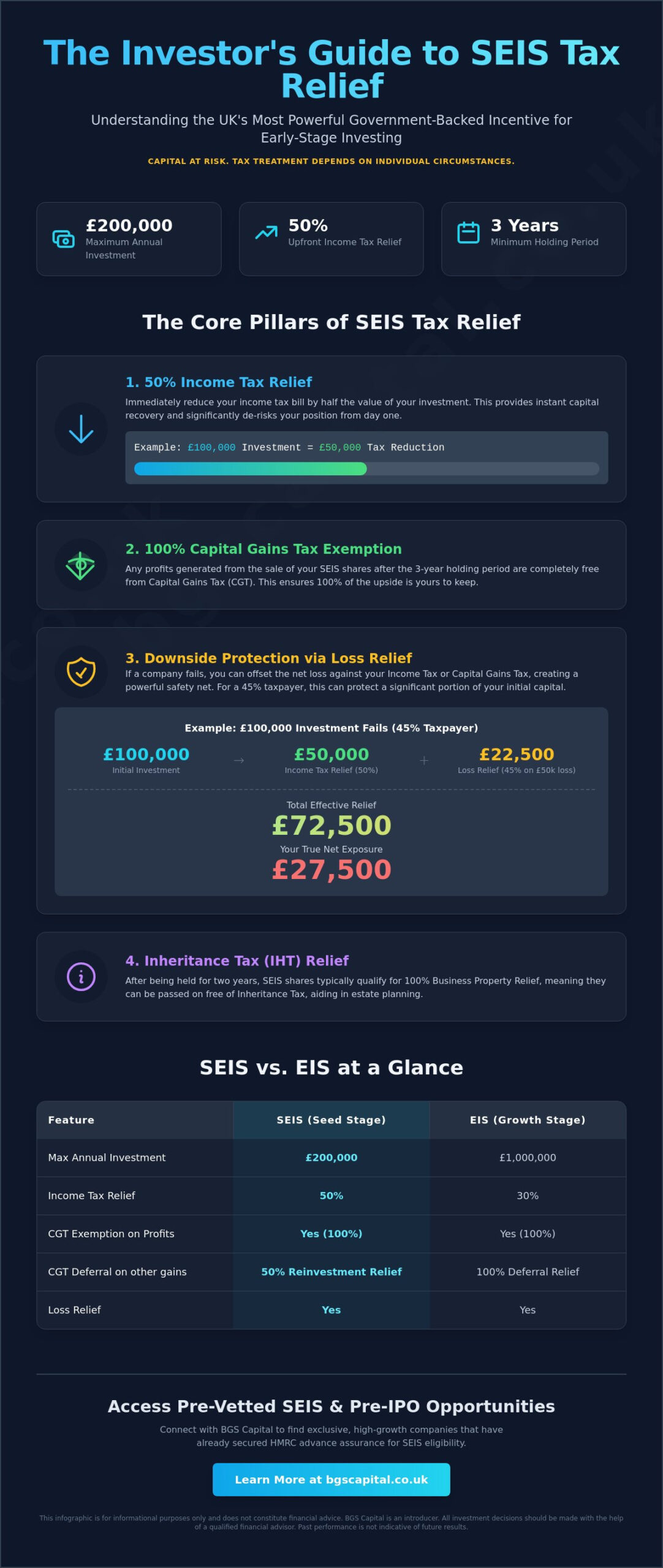
- Individual Investment Limit: Investors can deploy up to £200,000 per tax year into qualifying SEIS companies. This limit was increased from £100,000 in April 2023 to encourage larger capital injections into the startup economy.
- Maximum Equity Stake: To remain eligible for relief, a single investor cannot hold more than a 30% stake in the company. This ensures the investment is viewed as a passive equity stake rather than a means of corporate control.
- Three-Year Holding Period: You must hold the shares for a minimum of three years from the date of issue. If you dispose of the shares before this period ends, HMRC will reclaim any SEIS tax relief explained or claimed at the outset.
Sophisticated investors should treat these thresholds as hard boundaries. Any breach, even accidental, can result in the total loss of tax relief and potential penalties. We focus on ensuring that the companies we introduce maintain their qualifying status through rigorous ongoing monitoring.
The Five Pillars of SEIS Tax Relief: A Detailed Breakdown
The Seed Enterprise Investment Scheme (SEIS) provides a robust framework for mitigating investment risk through four primary tax reliefs: Income Tax, Capital Gains Tax (CGT), Inheritance Tax (IHT), and Loss Relief. To access these benefits, investors must receive an SEIS3 certificate from the investee company, which serves as the official confirmation of eligibility. Having SEIS tax relief explained through these distinct pillars is essential for any sophisticated investor looking to optimise their 2026 tax planning. The holding period for SEIS shares is exactly three years from the date of share issue.
A specific hierarchy exists when claiming these benefits. Income Tax relief is typically the first claim made because it acts as the foundation for subsequent reliefs. For instance, you cannot usually claim CGT disposal relief unless you’ve successfully claimed Income Tax relief on those same shares. As the British Business Bank explains SEIS, the scheme is structured to drive capital into the highest-risk sectors of the UK economy by significantly lowering the entry cost for private individuals.
50% Income Tax Relief: Immediate Capital Recovery
Investors can claim 50% of their investment back as a deduction against their income tax bill. If you make a £100,000 investment in an eligible startup, your tax liability for the year is reduced by £50,000. This relief is available regardless of whether you’re a basic, higher, or additional rate taxpayer, provided you have sufficient tax liability to cover the claim. Carry-back rules offer additional flexibility; you can apply investments made in 2026 to your 2025 tax bill to trigger a faster rebate.
Capital Gains Tax (CGT) Exemption and Reinvestment Relief
Disposal relief is a major draw for long-term investors. If you hold your SEIS shares for the full three-year period, any profit made upon selling them is 100% exempt from CGT. Furthermore, Reinvestment Relief allows you to offset 50% of a capital gain from a different asset sale, such as property or listed equities, if those proceeds are reinvested into SEIS-eligible shares. For a broader perspective on current regulations, consult our guide on Capital Gains Tax UK: A Guide for Investors & Founders. While the 50% break is a primary focus, the full scope of SEIS tax relief explained here demonstrates how it protects the entire investment lifecycle.
Inheritance Tax (IHT) and Loss Relief: The Safety Nets
SEIS shares generally qualify for Business Relief, making them 100% exempt from IHT after a two-year holding period. This makes the scheme an effective tool for estate planning. In the event a startup fails, Loss Relief provides a final layer of protection. You can offset the net loss against your marginal income tax rate. For an investor in the 45% tax bracket, the “worst-case scenario” is limited to a loss of approximately 27.5p per £1 invested. This is calculated by taking the initial 50% relief and adding the 45% tax relief applied to the remaining 50% of capital at risk.
Before committing capital to early-stage ventures, it’s vital to confirm your status. Am I Eligible?
SEIS vs. EIS: Which Scheme Fits Your Investment Strategy?
Sophisticated investors must distinguish between the Seed Enterprise Investment Scheme (SEIS) and the Enterprise Investment Scheme (EIS) to optimize tax efficiency. While both offer significant incentives, they target different stages of a company’s lifecycle. SEIS focuses on seed-stage ventures. EIS supports larger, growth-stage entities. Choosing between them depends on your appetite for risk and your total capital allocation for the tax year.
Having SEIS tax relief explained often begins with the headline rate. SEIS offers 50% income tax relief on investments up to £200,000 per tax year. EIS provides 30% relief on up to £1 million, or £2 million if investing in knowledge-intensive companies. The higher relief in SEIS compensates for the increased risk profile of very young companies. CAPITAL AT RISK is a fundamental reality here; the failure rate of seed-stage startups is statistically higher than their growth-stage counterparts.
Most startups follow a predictable trajectory. They raise an initial SEIS round to prove a concept or build a minimum viable product. Once they hit specific revenue or development milestones, they transition to EIS to scale operations. This progression is a standard pathway for companies moving from startup funding toward an eventual IPO. Investors often follow their money, participating in the SEIS round and maintaining their position through subsequent EIS raises.
When to Prioritize SEIS Over EIS
Prioritize SEIS when seeking to maximize immediate tax returns on smaller-ticket, high-risk allocations. It’s a tool for aggressive portfolio diversification. You can offset losses more effectively due to the 50% initial relief combined with loss relief. However, strict limits apply. You must ensure you haven’t exceeded the £200,000 SEIS annual cap before committing capital. For a deeper look at growth-stage options, consult The Enterprise Investment Scheme (EIS): A Complete Guide for UK Investors.
Structural Differences for the Investee Company
The eligibility criteria for the investee company are rigid and non-negotiable. A company must be under 3 years old to qualify for SEIS. For EIS, the limit is generally 7 years, though it extends to 10 years for knowledge-intensive firms. Other key structural differences include:
- Gross Assets: Must not exceed £350,000 for SEIS; the limit is £15 million for EIS.
- Employee Count: Companies must have fewer than 25 full-time employees for SEIS, compared to 250 for EIS.
- Total Raising Limit: A company can only raise £250,000 through SEIS over its lifetime.
BGS Capital monitors these structural shifts. We focus on identifying companies that successfully navigate the transition from early-stage incentives to the scale required for public markets. Understanding these boundaries ensures your portfolio remains compliant with HMRC regulations while maximizing the available SEIS tax relief explained in this guide.
Eligibility and Compliance: Navigating HMRC Requirements
Securing the benefits of SEIS requires more than just capital. Investors must meet specific statutory definitions to participate in these high-risk opportunities. Under FCA conduct of business rules (COBS 4.12), you must qualify as either a High Net Worth Investor or a Sophisticated Investor. A High Net Worth individual typically declares an annual income exceeding £170,000 or net assets of at least £250,000, excluding their primary residence and pension rights. This gatekeeping ensures that SEIS tax relief explained in this guide is applied only to those who can absorb the total loss of capital.
HMRC enforces a strict “no pre-existing interest” rule. You cannot be “connected” to the company at the time of investment. Connection is defined as owning more than 30% of the ordinary share capital or voting rights. Furthermore, the “risk to capital” condition, introduced in the Finance Act 2018, mandates that the company must have objectives to grow and develop in the long term. HMRC will deny relief if the investment structure appears to be a low-risk “capital preservation” scheme where the primary goal is tax mitigation rather than genuine commercial growth.
The Investor Certification Process
BGS Capital acts as a specialist introducer. We require all users to complete an eligibility statement before accessing specific pre-IPO or SEIS-qualified opportunities. This process mirrors the formal compliance chain required by HMRC. Once your investment is made, the company submits form SEIS1 to HMRC. After review, HMRC issues an SEIS2 authorization to the company. You will then receive an SEIS3 certificate. This document is the only way to claim your 50% income tax relief through your self-assessment tax return. Without a valid SEIS3, your claim cannot proceed.
Maintaining Relief: The Three-Year Rule
Relief is not permanent until a three-year “period of restriction” has passed. If you sell your shares or the company is liquidated before the third anniversary of the issue date, HMRC will claw back the tax relief. Angel investors must also be cautious about receiving “value” from the firm. This includes:
- Non-commercial loans or credit from the company
- Perks or benefits that aren’t available to the general public
- Dividends that exceed a normal commercial rate
Any value received during this window can reduce your tax relief pound-for-pound. Meticulous tracking of holding dates is essential for your annual tax planning.
Are you ready to view current SEIS-qualified opportunities? Am I Eligible?
Accessing SEIS Opportunities via BGS Capital
BGS Capital serves as a professional network and introducer. We don’t manage funds or provide financial advice. Instead, we offer a streamlined database of pre-IPO and SEIS-eligible opportunities for qualified individuals. Once you’ve had the SEIS tax relief explained, the challenge becomes sourcing companies that meet the strict 2026 HMRC requirements. Our platform solves this by providing direct access to firms that have already secured Advance Assurance. Access to our database is free for high-net-worth and sophisticated investors who meet the eligibility criteria.
We operate as a conduit between private equity opportunities and professional investors. Our role is to simplify the discovery phase. We provide the infrastructure for you to identify, evaluate, and connect with high-growth UK startups. This approach removes the barriers usually found in traditional private equity, allowing for a more direct and transparent investment process.
Our Selection Criteria for Featured Businesses
We focus on companies that demonstrate high IPO potential and clear scalability. Our team identifies businesses seeking venture capital that are already investment-ready. This involves a rigorous check of their SEIS status. To qualify for our featured list, a company must typically be within its first three years of active trading and have gross assets under £350,000. We prioritize sectors like fintech, healthtech, and green energy where 2026 market projections suggest significant growth. We ensure all featured businesses provide a comprehensive Information Memorandum (IM) before they’re listed on our platform.
Next Steps for Eligible Investors
The first step is to confirm your status. You must ask yourself: “Am I Eligible?” We only work with individuals who qualify as sophisticated or high-net-worth under FCA regulations. Once registered, you can browse specific SEIS investment memorandums at your own pace. The process is transactional and efficient. If a particular opportunity aligns with your portfolio goals, we facilitate a direct introduction to the company’s Investor Relations (IR) team. This allows you to perform your own due diligence and ask technical questions directly to the founders. We operate as the gateway, ensuring you have the data needed to make an informed decision. Having the SEIS tax relief explained is vital, but the quality of the underlying business remains the most important factor in your decision.
CAPITAL AT RISK: Early-stage investing involves significant risk. The 50% income tax relief and CGT exemptions associated with SEIS are designed to compensate for the high failure rate of startups. You may lose your entire investment. Tax treatments depend on individual circumstances and may be subject to change in the future. BGS Capital does not provide tax or investment advice. Always consult a qualified professional before committing capital.
Securing Your 2026 Venture Portfolio
Navigating the early-stage landscape requires a technical understanding of HMRC frameworks. As this SEIS tax relief explained guide demonstrates, the 50% income tax relief and capital gains exemptions remain vital tools for British investors. Successful participation in 2026 hinges on rigorous compliance with the £200,000 annual investment limit and the three-year holding period. Sophisticated investors must ensure their target companies maintain qualifying status to avoid relief clawbacks.
BGS Capital operates as a professional introducer, providing a curated network of pre-IPO and IPO opportunities. This is a free service for qualified High Net Worth and Sophisticated investors seeking institutional-grade deal flow with full regulatory transparency. We don’t provide financial advice; we facilitate connections to accredited investment firms. CAPITAL AT RISK: All investments carry significant risk and your capital may be lost.
Am I Eligible? Check your status to access exclusive SEIS opportunities.
Take the next step in diversifying your private equity holdings through a compliant, structured approach to seed-stage enterprise.
Frequently Asked Questions
Can I claim SEIS relief if I am not a UK resident?
You can claim SEIS relief as a non-UK resident provided you have a UK tax liability to offset. The relief applies specifically to your UK Income Tax bill for the year the shares are issued or the previous year via carry back. If you don’t pay UK tax, the 50% relief offers no financial benefit. Always confirm your status with a qualified tax professional before committing capital.
What happens to my SEIS tax relief if the company fails?
If an SEIS qualifying company fails, you can claim Loss Relief on the remaining capital at risk. This allows you to offset the net loss, which is the initial investment minus the 50% initial tax relief, against your marginal income tax rate. For a 45% additional rate taxpayer, this can limit total exposure to 27.5p for every £1 invested. CAPITAL AT RISK.
How do I actually claim the 50% income tax relief on my tax return?
You claim the 50% relief by completing the “Additional Information” section of your HMRC Self Assessment tax return. You must possess a formal SEIS3 certificate issued by the company before making the claim. This document confirms the company has met HMRC requirements for at least 120 days or spent 70% of the raised funds. This is a critical step in having the SEIS tax relief explained and applied correctly.
Is there a limit to how much I can invest in SEIS companies each year?
The maximum annual investment limit for SEIS is £200,000 per tax year for the 2025/26 cycle. This limit applies to the total amount invested across all qualifying companies, not per individual business. Investments exceeding this £200,000 threshold won’t receive tax relief on the surplus amount. Ensure you track your total allocations to remain within HMRC’s statutory boundaries.
Can I get SEIS relief for investing in my own company or a family member’s business?
You can’t claim relief if you’re “connected” to the company, which includes holding more than a 30% stake or being an employee. HMRC defines connection to include associates like spouses or lineal ancestors and descendants, but excludes siblings. If you’re a paid director, you’re generally disqualified from claiming SEIS relief on your own firm’s shares.
How long do I have to hold SEIS shares to avoid paying Capital Gains Tax?
You must hold SEIS shares for a minimum of three years from the date of issue to maintain your tax benefits. If you sell the shares before this three year anniversary, HMRC will claw back the initial 50% income tax relief and apply Capital Gains Tax to any profits. After this 36 month period, any gains realized on the disposal of the shares are 100% tax free.
What is the difference between SEIS and EIS tax relief?
SEIS targets early stage startups with a 50% income tax relief, while EIS focuses on larger companies with 30% relief. Under SEIS, companies can only raise up to £250,000 in total SEIS funding, whereas EIS allows for much higher limits. SEIS is restricted to companies with fewer than 25 employees and less than £350,000 in gross assets at the time of investment.
Can I carry back my SEIS tax relief to a previous tax year?
You can carry back all or part of your SEIS investment to the previous tax year, provided you hadn’t reached the £200,000 limit in that year. This is a common strategy for investors looking to optimize their tax position against prior earnings. It effectively treats the investment as if it happened in the preceding 12 month period. This flexibility is a key part of having the SEIS tax relief explained for sophisticated portfolio management.