
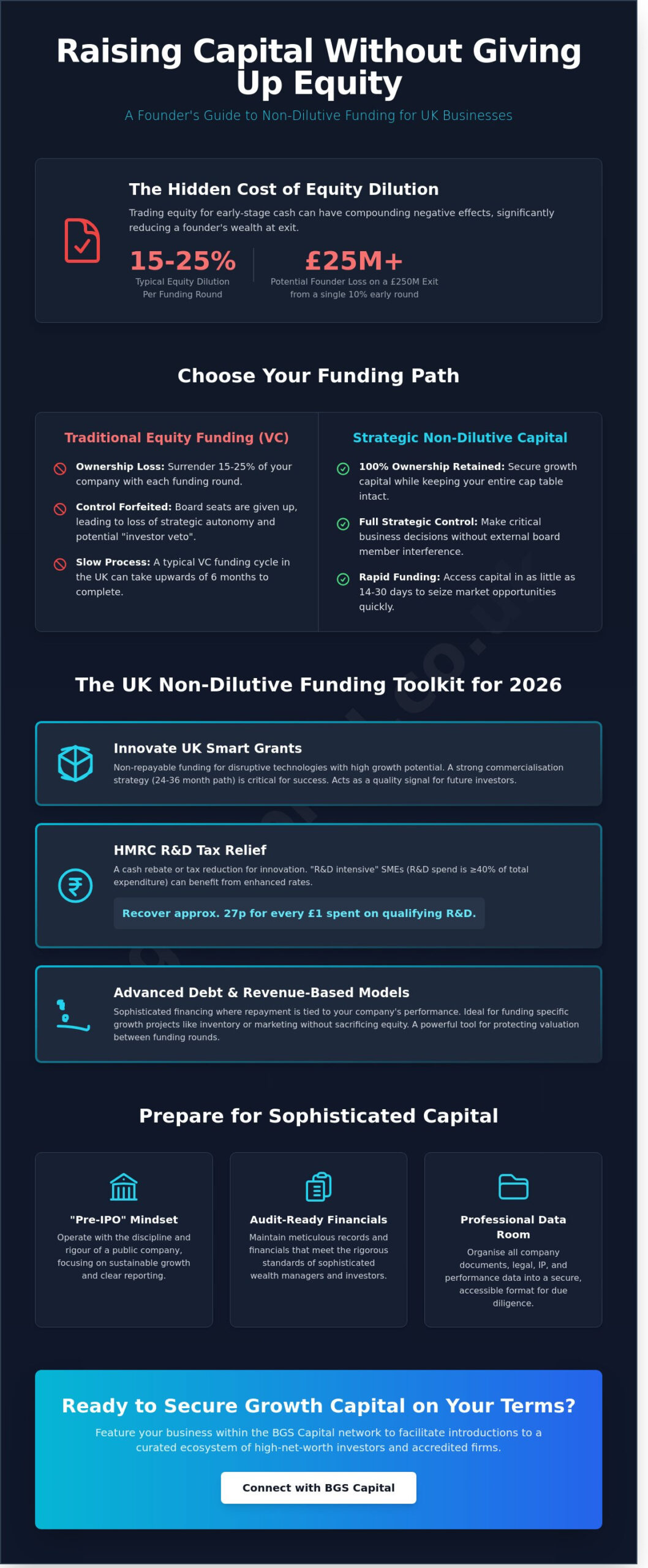
Surrendering a board seat and 20% of your company is no longer the mandatory price for scaling a UK business to a multi-million pound valuation. Many founders face persistent pressure from venture capitalists to prioritise a premature exit, often resulting in equity dilution of 15% to 25% per funding round according to industry benchmarks. This loss of strategic autonomy can compromise the long-term value of the enterprise. Understanding the process of raising capital without giving up equity allows you to bypass these constraints while securing the necessary liquidity for expansion.
This guide demonstrates how to access sophisticated, non-dilutive structures emerging for 2026. You’ll discover how to secure high-level growth capital while retaining 100% ownership of your company. We’ll examine the specific mechanisms, including private debt and advanced revenue-based models, that position your firm for a high-valuation exit on your own terms. Accessing these exclusive financial opportunities requires a clear understanding of eligibility and current market regulations within the United Kingdom. It’s time to stop trading your future for today’s liquidity.
Key Takeaways
- Understand the strategic advantage of non-dilutive capital and how to protect founder wealth by avoiding the compounding long-term costs of equity dilution.
- Navigate the 2026 UK landscape for Innovate UK smart grants and HMRC R&D tax credit schemes to establish a predictable, non-repayable cash flow engine.
- Evaluate sophisticated debt and revenue-based alternatives for raising capital without giving up equity, allowing for high-level growth without sacrificing board seats.
- Implement a “Pre-IPO” mindset by structuring audit-ready financials and data rooms to meet the rigorous standards of sophisticated wealth managers.
- Discover how to feature your business within the BGS Capital network to facilitate introductions to a curated ecosystem of high-net-worth investors and accredited firms.
The Strategic Case for Raising Capital Without Giving Up Equity
Non-dilutive capital refers to any funding arrangement that doesn’t require the issuance of new shares or the surrender of ownership. For high-growth UK companies, raising capital without giving up equity is becoming a priority to avoid the compounding costs of dilution. A founder who surrenders 10% of their company during an early Seed or Series A round might see that decision cost them £25 million or more during a £250 million exit. This isn’t just a matter of personal wealth; it’s about maintaining strategic autonomy and long-term decision-making power.
The compounding cost of dilution is often underestimated in the early stages of a business. When equity is traded for cash, the founder loses a portion of every future pound the company earns. By utilizing non-dilutive structures, businesses can fund specific projects, such as inventory expansion or marketing campaigns, using the performance of the business itself as the primary security. This approach ensures that the “upside” remains with the people driving the growth.
Equity vs. Non-Dilutive Funding: The Core Differences
Ownership retention allows founders to keep 100% of the upside as they approach a pre-IPO stage. Speed is another critical differentiator. While a standard Venture Capital (VC) cycle in London often lasts six months, alternative routes like Revenue-Based Financing can be secured in as little as 14 to 30 days. This agility prevents the “investor veto” where external board members might block essential pivots, acquisitions, or secondary placings that are in the founder’s best interest.
Why 2026 is the Year of Non-Dilutive Growth
The UK startup funding environment is shifting toward sustainable, revenue-first models. With current interest rates creating a higher floor for the cost of capital, founders are moving away from equity-heavy rounds that undervalue their hard-earned progress. Non-dilutive capital serves as a strategic tool for valuation protection. It allows companies to bridge the gap between major milestones without being forced into a “flat” or “down” round. In 2026, successful UK firms are using these tools to reach the £50 million revenue mark while keeping their cap tables clean and attractive for a future IPO.
Maximising Government Grants and R&D Tax Credits
Government-backed funding remains a primary mechanism for raising capital without giving up equity. These schemes allow UK businesses to retain full control while securing the liquidity needed for high-risk innovation. Unlike private equity, grant funding doesn’t require board seats or a percentage of future dividends. It’s a transactional process based on technical merit and economic impact rather than investor sentiment.
Innovate UK Smart Grants in 2026
The 2026 landscape for Innovate UK Smart Grants focuses on disruptive technologies with high growth potential. Eligibility requires a clear path to commercialisation within 24 to 36 months. Technical excellence is only half the battle; applications fail most often on their commercial strategy. You’ve got to demonstrate a clear market opportunity and show how the project delivers a return for the UK taxpayer. Securing these grants often acts as a quality signal, making it easier to attract angel investors for follow-on rounds when additional scale is required.
R&D Tax Relief: SME vs. RDEC Schemes
HMRC’s R&D tax relief has undergone significant reform. As of 2026, most companies operate under the merged scheme, though “R&D intensive” SMEs still benefit from enhanced rates. If your R&D spend accounts for at least 40% of your total expenditure, you can claim a higher credit rate. For every £1 spent on qualifying activities like staff costs, software, or consumables, intensive firms can recover approximately 27p. Founders often compare these grants to international debt instruments, such as SBA loan programs, which provide similar non-dilutive benefits in the US market. Using R&D advance funding can turn these future credits into immediate cash flow, accelerating project timelines by several months.
Managing the “Grant Gap” is essential for liquidity. There’s often a three-to-six-month delay between winning an award and receiving the first payment. Bridging this gap requires careful financial planning or specialised short-term debt. Compliance is equally critical. HMRC increased its enquiry rate into R&D claims by 22% in the 2023-24 tax year. Maintaining meticulous records of technical challenges and staff hours is the only way to ensure your claim survives scrutiny. Before committing to a funding route, check your eligibility to see which capital structures suit your current growth stage. This disciplined approach ensures you’re raising capital without giving up equity while maintaining a clean balance sheet for future opportunities.
Debt Financing and Revenue-Based Alternatives
Raising capital without giving up equity requires a shift from valuation-based thinking to cash-flow analysis. Debt financing serves as a strategic alternative for firms that have moved past the seed stage. Venture debt specifically provides large-scale capital without the requirement for board seats or significant interference in company operations. This allows founders to execute their growth plans while retaining 100% of their voting power. Most lenders in this space focus on companies that already have institutional backing or a proven revenue model.
Structured debt solutions from private equity groups provide the flexibility needed for complex expansions. Asset-based lending (ABL) is particularly effective for capital-intensive industries. By leveraging inventory, equipment, or even accounts receivable as collateral, businesses can access facilities ranging from £100,000 to over £10 million. Intellectual property (IP) is increasingly used as collateral in the UK, with specialist lenders valuing patent portfolios and trademarks to back term loans for tech-heavy firms.
Is Venture Debt Right for Your Scale-up?
The ideal profile for venture debt includes companies that have already raised institutional venture capital or have reached a revenue run rate exceeding £1 million. It’s a tool for scaling, not for survival. You must understand the role of warrants. These are “equity kickers” that give the lender the right to buy equity at a set price in the future, typically representing 1% to 2% of the total loan value. In the 2026 UK market, providers like HSBC Innovation Banking, Claret Capital, and Kreos Capital dominate the landscape. They offer sophisticated structures that combine term loans with revolving credit lines to support working capital during rapid expansion phases.
Revenue-Based Financing for SaaS and E-commerce
Revenue-based financing (RBF) is a modern solution for businesses with high gross margins and predictable income. Repayments fluctuate based on your monthly recurring revenue (MRR). If you earn more, you pay back faster; if sales slow down, the repayment burden lightens. It’s a scalable method for raising capital without giving up equity during periods of rapid growth. While RBF avoids personal guarantees and rigid fixed payments, the total cost of capital can be higher than a standard bank loan. These revenue-based models protect cash flow during seasonal dips by ensuring your debt service never exceeds a pre-set percentage of your actual income. UK providers like Outfund and Uncapped currently lead this sector, offering funding from £50,000 to £5 million based on real-time data integrations.
Preparing Your Business for Sophisticated Capital
Transparency serves as the primary currency when raising capital without giving up equity. Sophisticated lenders and high-net-worth individuals (HNWIs) expect audit-ready financials that withstand rigorous stress testing. According to 2023 industry benchmarks, UK SMEs with external audits access credit lines at rates 1.5% lower than those relying on unaudited management accounts. You must prove your cash flow can service debt without compromising operational stability.
Raising capital without giving up equity requires a level of preparation that mimics an IPO. You must adopt a “Pre-IPO” mindset by structuring your data room for high-level scrutiny. This includes securing your Intellectual Property (IP) through the UK Intellectual Property Office. Loans are frequently secured against these intangible assets; if your patents or trademarks aren’t legally protected, your borrowing capacity drops significantly. Compliance is equally vital. Most exclusive networks require businesses to pass a strict “Am I Eligible?” test to ensure they meet regulatory standards for non-dilutive funding.
The Role of Sophisticated Investors
HNWIs often favour structured debt or pre-IPO opportunities because they offer defined exit timelines and fixed returns. This differs from public crowdfunding, which lacks the exclusivity and direct communication these investors demand. By working with an introducer network, you bypass traditional brokers who often add layers of cost and slow the process. These direct introductions facilitate faster closing times, often within 30 to 60 days, as the relationship is built on institutional-grade trust rather than mass-market appeals.
Maximising Valuation for Future Rounds
Non-dilutive capital serves as a valuation bridge. It allows you to hit key performance indicators (KPIs) before your next major equity round, ensuring you don’t sell shares while the company is undervalued. A London-based software firm demonstrated this in 2022. They secured £2.5 million in debt to scale operations, eventually reaching an IPO while the founders retained 60% ownership. This would’ve been impossible if they’d taken venture capital at a seed stage.
Effective capital gains tax planning is essential during these raises. Since you aren’t selling shares, you defer tax liabilities that would otherwise trigger during an equity sale. This strategy preserves more wealth for the eventual exit and ensures your balance sheet remains attractive for future institutional investors. It’s about maintaining control while fueling growth through disciplined financial structures.
Feature Your Business: Connecting with the BGS Capital Network
BGS Capital operates as a specialist introducer within the UK financial landscape. We bridge the gap between qualified companies and a curated network of sophisticated investors. Our platform provides high-level exposure to high-net-worth individuals and wealth managers who actively seek pre-IPO and secondary placing opportunities. We don’t facilitate raises directly; instead, we function as a professional conduit for visibility. This model ensures that businesses gain the right eyes on their proposition without the complexities of traditional brokerage interference.
Gaining pre-IPO visibility is a strategic move for any firm. By featuring your business, you position your brand in front of capital providers who understand the nuances of the UK market. We focus on transparency and qualification. This ensures that every connection made through our network is grounded in professional standards. CAPITAL AT RISK. It’s vital to remember that all investment carries inherent risks, and our role is strictly to introduce, not to advise or manage the transaction.
The BGS Capital Introducer Model
Our platform maintains a free database for investors. This accessibility is a primary driver for attracting high-quality, ready-to-act capital. Because there are no barriers for accredited investors to browse opportunities, your business reaches a wider pool of liquidity. You connect directly with investor relations teams. This removes the middleman and allows for a more efficient communication flow between the company and the capital source.
We work to ensure your business is investor-ready before it’s presented to our network. This preparation is essential for raising capital without giving up equity, as alternative funding structures often require more rigorous financial disclosures than standard venture rounds. Our network values clarity and precision. We provide the infrastructure to showcase your metrics effectively to wealth managers who manage portfolios for sophisticated clients.
- Direct access to accredited investment firms.
- Streamlined communication with wealth managers.
- Enhanced brand authority within the pre-IPO sector.
- Zero-cost entry for qualified investors to increase reach.
Next Steps: Am I Eligible?
Eligibility is the first gate for any business looking to join our platform. We maintain strict criteria to ensure the quality of opportunities remains high for our accredited investment firms. We typically look for companies with a proven track record, clear revenue streams, or significant technological advantages. If your business meets these standards, you can submit your opportunity for a formal review by our team.
The submission process is direct. Once we receive your details, we evaluate the investment’s suitability for our specific audience of high-net-worth individuals. If approved, your business is featured, providing immediate exposure to a network that understands the UK’s regulatory environment. Take the first step toward high-level visibility and professional introductions today.
Secure Your Growth Strategy for 2026
Founders in 2026 face a more nuanced funding landscape. Success requires a strategic mix of non-dilutive instruments. Government support remains a pillar; HMRC reported £7.6 billion in R&D tax credit claims for the 2021-22 period, demonstrating the significant scale of available support for UK innovation. Alternative debt structures and revenue-based financing provide the liquidity needed to scale operations while you retain 100% ownership. Preparing for this level of sophisticated capital requires rigorous financial hygiene and a clear path to profitability.
By raising capital without giving up equity, you protect your long-term valuation and maintain complete control over your company’s direction. BGS Capital operates as a professional introducer service with a strict focus on compliance. We provide access to a network of sophisticated and high-net-worth investors, offering specific expertise in pre-IPO and IPO investment opportunities. This ensures your business is positioned correctly before a qualified, high-level audience. Take the next step in your funding journey by connecting with our established network.
RAISING CAPITAL? FEATURE YOUR BUSINESS
Your business deserves a capital structure that supports long-term ambition.
Frequently Asked Questions
Is it really possible to raise millions without giving up any equity?
Yes, companies frequently secure seven-figure sums through debt instruments or government grants. Innovate UK Smart Grants provide up to £2,000,000 for R&D projects. Large scale asset-backed lending or venture debt facilities often exceed £5,000,000 for established firms. Raising capital without giving up equity allows founders to maintain 100% control while scaling operations. This approach is essential for businesses that’ve already achieved product-market fit.
What is the most common form of non-dilutive funding in the UK?
R&D tax credits represent the most prevalent form of non-dilutive funding in the UK market. HMRC data shows that in the 2021-22 tax year, over 90,000 claims were made, providing £7.6 billion in tax relief. This is a primary method for raising capital without giving up equity in the UK tech sector. It remains a stable and predictable source of capital for qualified companies.
How much capital can I raise through R&D tax credits in 2026?
Your claim amount depends on your qualifying expenditure and current HMRC rates. Under the merged scheme effective from April 2024, the gross credit is 20%, resulting in a net benefit of approximately 15% to 16.2% after corporation tax. For 2026, loss-making R&D intensive SMEs may still access a higher 27% credit rate if their R&D spend exceeds 30% of total expenditure.
Does venture debt require a personal guarantee from the founders?
Venture debt providers typically don’t require personal guarantees from founders. Instead, they secure the loan against company assets and intellectual property. Lenders often include a warrant component; this grants them the right to purchase a small percentage of equity at a future date. This is a standard risk mitigation tool for high-growth, pre-profit businesses that’ve already secured institutional backing.
What is the difference between an introducer and a broker?
An introducer connects a company with potential investors or lenders without providing specific financial advice. Brokers take a more active role by negotiating terms and arranging the deal; they often require FCA authorisation for specific regulated activities. BGS Capital operates as an introducer, maintaining a network of accredited investment firms and wealth managers to facilitate connections for qualified companies.
Can I use EIS schemes alongside non-dilutive funding?
You can combine the Enterprise Investment Scheme (EIS) with non-dilutive options like grants or loans. This hybrid approach is common among sophisticated founders. While EIS involves issuing shares to investors, it offers significant tax incentives to those individuals. Using it alongside non-dilutive capital reduces the total amount of equity you need to sell to reach your specific funding target.
How does BGS Capital help companies raising capital?
BGS Capital functions as a specialist facilitator and introducer for companies seeking high-level investment. We connect qualified companies with a network of accredited investment firms and high net worth individuals. Our platform allows businesses to feature their opportunities to a sophisticated, professional audience. Interested parties should first check our site to see: Am I Eligible?
What happens if I cannot repay a revenue-based loan?
Revenue-based loans are designed to fluctuate with your sales performance. If your revenue drops to zero, your repayments typically pause until sales resume. Persistent failure to generate revenue may trigger a default under the loan agreement. CAPITAL AT RISK. Always review specific terms regarding minimum repayment clauses which might apply regardless of your monthly turnover or current cash flow position.