
Approximately 70% of business failures are linked to capital depletion, yet running out of money is often a symptom of underlying strategic misalignment rather than the root cause. If your current capital raise has stalled, you must understand exactly what happens if a funding round fails before your cash runway disappears. This situation is critical. It demands an immediate shift from aggressive growth to capital preservation and network diversification. You’re likely facing the dual pressure of diminishing liquidity and potential reputational damage within your professional network. We recognize the urgency of this position.
This guide provides a professional framework to manage these risks effectively. You’ll discover how to stabilize your operations, manage existing investor expectations, and evaluate the strategic implications of a failed raise. We’ll outline a clear recovery roadmap. This includes pivoting toward break-even or securing a more targeted bridge round to maintain viability. Use this information to qualify your next steps and protect your firm’s long-term interests.
Key Takeaways
- Distinguish between stalled and collapsed rounds to quantify immediate operational and reputational risks to the business.
- Evaluate internal bridge rounds and down rounds as primary mechanisms for extending cash runway and maintaining solvency.
- Understand what happens if a funding round fails to pivot the business model toward immediate capital efficiency and a “default alive” status.
- Identify and mitigate due diligence red flags and valuation misalignments to prepare for future market re-entry.
- Diversify your investor network by targeting high-net-worth individuals and family offices to reduce reliance on traditional venture capital.
Defining the Failed Funding Round: Immediate Consequences
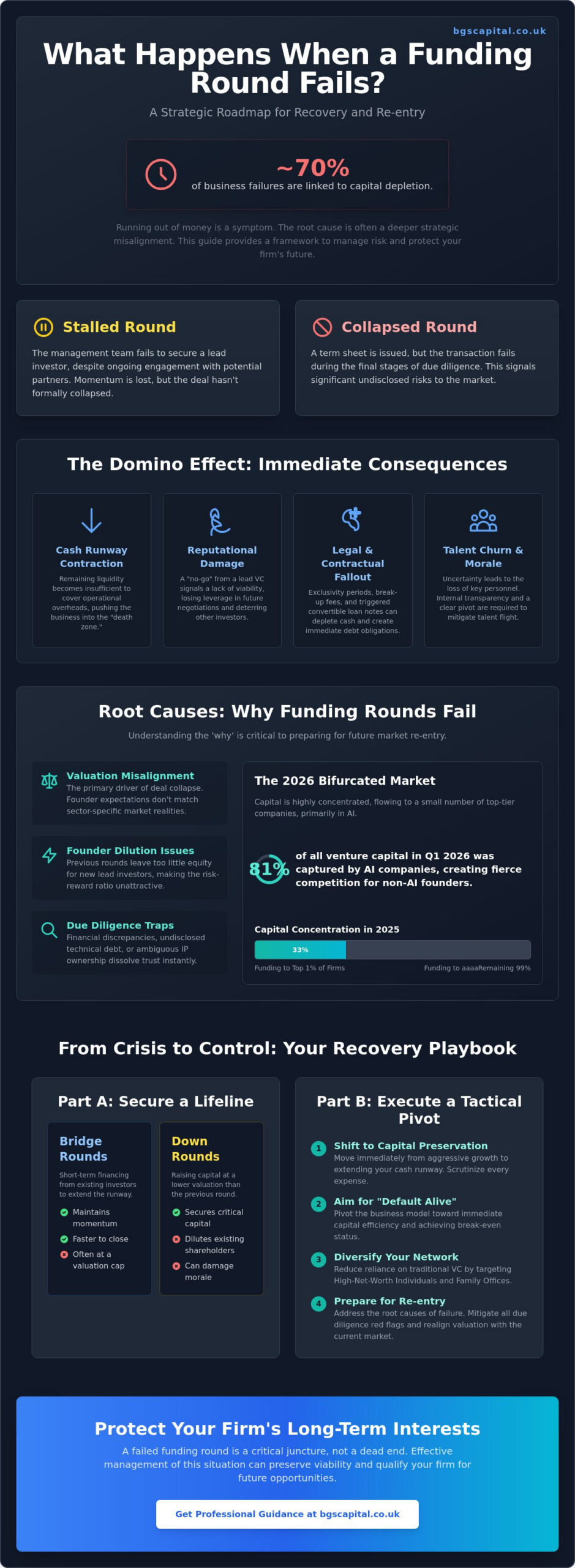
A failed funding round is defined as the inability of an entity to secure the minimum subscription of capital required by a specific contractual closing date. This outcome serves as a critical market signal. Understanding what happens if a funding round fails requires a precise distinction between two primary failure states. A “stalled” round occurs when the management team fails to secure a lead investor, despite ongoing engagement with potential partners. Conversely, a “collapsed” round occurs when a term sheet is issued but the transaction fails during the final stages of due diligence. Both scenarios result in an immediate contraction of the cash runway. Running out of capital is a factor in 70% of startup failures, according to industry research, often pushing the business into the “death zone.” This is a state where remaining liquidity is insufficient to cover operational overheads through a necessary strategic pivot.
Venture capital financing relies on momentum and perceived scarcity. When a lead VC issues a “no-go” decision, the broader market interprets this as a lack of fundamental viability or the discovery of significant undisclosed risks. This perception is difficult to reverse without a substantial change in the company’s valuation or operational structure. The immediate consequence is a loss of leverage in any subsequent negotiations.
The Legal and Contractual Fallout
Exclusivity periods in term sheets prevent founders from seeking alternative capital while a failed deal is in progress. If a round collapses, break-up fees may apply, depleting cash reserves at a critical juncture. Existing convertible loan notes (CLNs) frequently have maturity dates tied to the completion of a qualified financing round. When considering what happens if a funding round fails, the impact on existing debt is often the most immediate threat. Failure to close can trigger repayment obligations or forced conversion at unfavourable terms. Directors must also fulfill fiduciary duties by notifying shareholders of this material change. This transparency is a regulatory requirement that cannot be bypassed.
Reputational Management in the UK Ecosystem
The signalling risk in the UK venture ecosystem is significant. A failed round leads other angel syndicates to assume the presence of “deal-breaker” technical or financial issues. Founders must manage internal transparency to mitigate talent churn, as uncertainty leads to the loss of key personnel. Communicating a strategic pivot requires focusing on tangible revenue targets rather than speculative growth. This maintains credibility without projecting desperation to the existing investor network. It’s essential to manage this downturn with technical precision to qualify for future opportunities within sophisticated networks.
Root Causes: Why Funding Rounds Fail in 2026
Valuation misalignment remains the primary driver of deal collapse in the current market. While global venture funding reached a record $297 billion in April 2026, this capital is not distributed evenly across all sectors. AI companies captured 81% of all venture capital in the first quarter of the year. This creates a bifurcated market where non-AI founders often struggle to meet valuation benchmarks established during previous periods of high liquidity. If a founder’s expectations don’t align with these sector-specific realities, the round will likely stall. Understanding what happens if a funding round fails starts with recognizing that capital is now flowing into a small number of top-tier companies. In 2025, for example, 33% of all US VC funding went to just the top 1% of firms by valuation.
Macroeconomic conditions also dictate failure. Sustained high interest rates impact the ability of Limited Partners to fulfill capital calls, which forces venture funds to be increasingly selective. Founder dilution issues frequently terminate deals in the final stages. If earlier rounds have left too little equity for new lead investors, the risk-reward ratio becomes unattractive for sophisticated networks. When a lead investor cannot secure a significant enough stake to justify their involvement, they’ll often withdraw from the transaction entirely.
The Due Diligence Trap
Financial discrepancies often surface in the final hour of a transaction. Inconsistent revenue recognition or undisclosed technical debt can immediately dissolve trust between parties. Due diligence is the rigorous verification of all business claims before capital transfer. Intellectual Property (IP) ownership is another critical area where deals fail. Any ambiguity regarding the ownership of core technology or unresolved legal disputes will stop a transaction in its tracks. Sophisticated investors require a clean legal history before committing capital.
Market Sentiment and Investor Risk Aversion
The market has shifted decisively from “growth at all costs” to a “path to profitability.” Investors now prioritize unit economics and sustainable margins over raw user acquisition. Modern venture capital expectations also include stringent ESG (Environmental, Social, and Governance) compliance. Failure to meet these governance standards can disqualify an otherwise viable business from receiving capital. To mitigate these risks, founders should seek an investor introduction to partners whose mandates specifically align with their current stage and sector. This alignment is essential to avoid the terminal consequences of a failed raise in a tighter market.
Strategic Alternatives: Bridge Loans vs. Down Rounds
When a primary capital raise fails, the objective shifts from expansion to immediate survival. Understanding what happens if a funding round fails is vital for selecting the correct recovery instrument. Founders must choose between internal support and external restructuring. This decision determines the long-term equity structure and operational autonomy of the firm. Selecting the wrong vehicle can lead to terminal dilution or restrictive debt covenants that stifle future growth.
Internal Bridge Rounds involve leveraging current shareholders to extend the runway. These instruments are typically structured as convertible notes. As of May 2026, interest rates for bridge loans generally range between 9.5% and 12%. These loans frequently include fees in the form of “points,” with 1.5 to 2.5 points being the current market standard. This mechanism provides short-term liquidity without requiring an immediate valuation adjustment. It allows the management team to hit specific milestones before re-entering the market.
A Down Round involves accepting a lower valuation than the previous raise. While dilutive, it ensures business continuity when internal capital is exhausted. A Flat Round represents a middle ground. The valuation remains constant, but investors often demand aggressive liquidation preferences to offset risk. These may include 2x non-participating or 1x participating terms. Venture debt remains a non-dilutive option for companies with predictable cash flows. However, lenders in the 2026 environment typically require a clear path to break-even within 12 months to qualify for these instruments.
Calculating the Cost of Dilution
Accepting a down round significantly alters the startup funding trajectory for Series B and subsequent stages. Anti-dilution clauses protect early investors but often result in massive equity loss for the founding team. This creates a significant psychological burden. It often necessitates “re-upping” employee stock option pools to prevent the loss of key talent. Founders must model these scenarios carefully to understand the impact on their final exit proceeds.
The Role of Existing Investors
Your current angel investors are the first line of defence. Negotiating “pay-to-play” provisions can force participation in rescue rounds. This ensures that only committed backers remain on the cap table. In the UK, utilizing the EIS scheme provides significant tax incentives for follow-on investment. This makes bridge financing more attractive to existing private backers during periods of market uncertainty. It also signals to the wider market that those with the most intimate knowledge of the business still perceive long-term value.
Tactical Recovery: Operational Changes to Buy Time
Operational intervention must be immediate. If a primary capital raise fails, the management team must shift focus from aggressive expansion to capital preservation. Understanding what happens if a funding round fails allows for the implementation of a structured recovery plan. This starts with an aggressive burn rate reduction. Non-essential overheads must be eliminated to protect the remaining cash runway. Restructuring for efficiency often involves strategic hiring freezes. In some cases, it requires a reduction in force to align the payroll with current revenue rather than projected growth.
The “Default Alive” pivot is a fundamental change in strategy. It prioritizes immediate revenue over long-term research and development. Customer-led growth utilizes existing cash flow to fund operations. This approach forces the business to focus on products with the highest margins and shortest sales cycles. By doing so, the firm reduces its reliance on a volatile venture market. Key actions for immediate burn rate reduction include:
- Terminating non-core R&D initiatives that don’t contribute to short-term revenue.
- Renegotiating vendor contracts and service level agreements to lower fixed costs.
- Implementing a total hiring freeze for all non-revenue-generating roles.
- Consolidating operational software to reduce per-seat licensing costs.
Reaching Break-Even as a Defensive Strategy
Break-even is the point where revenue equals operating expenses, removing the immediate need for external capital. Achieving this status fundamentally changes the power dynamic in future negotiations. It signals to potential backers that the business is self-sustaining and no longer operating under duress. Management must identify “zombie projects.” These are initiatives that drain capital without contributing to Monthly Recurring Revenue (MRR). Terminating these projects preserves liquidity for core operations. This defensive posture is often the only way to retain control of the cap table during a market downturn.
Managing the Pipeline of Rejected Investors
A failed round doesn’t mean all previous leads are permanently lost. Founders should re-open conversations with secondary choices. These are the investors who were previously sidelined in favour of the failed lead. Positioning the event as a “strategic pause” rather than a collapse maintains professional credibility. The data room must be updated to address the specific technical or financial concerns that stalled the previous deal. This transparency demonstrates a proactive approach to risk management and operational discipline. To explore how to re-engage with high-level networks, consider an investor introduction to diversify your funding options.
Re-entering the Market: Connecting with Sophisticated Networks
Recalibrating your investor profile is the final stage of recovery. If a traditional venture capital round fails, the narrative must shift from mass-market appeal to targeted private placements. Understanding what happens if a funding round fails involves recognizing that the “signalling risk” is often specific to the institutional VC ecosystem. High-net-worth (HNW) individuals and family offices often operate with different mandates. They prioritize long-term fundamentals and sector-specific expertise over the aggressive growth-at-all-costs metrics that drive many venture funds. This pivot requires a clean cap table. You must ensure that any bridge financing or internal rounds haven’t created a “messy” equity structure that complicates future exits.
Professional introducers act as a vital gateway to these exclusive networks. They provide access to pre-vetted, sophisticated capital that’s often inaccessible through standard channels. BGS Capital facilitates introductions to qualified investors, specifically focusing on pre-IPO opportunities and established firms. This intermediary framing ensures your business is positioned as an exclusive opportunity rather than a distressed asset. It moves the conversation away from the failure of a previous round and toward the strategic value of the current offering. Accessing these networks requires a high level of professional qualification and transparency.
The Pre-IPO Pivot
You must stop employing “seed stage” logic once your business has matured beyond early experimentation. Preparing for a professional private placement involves demonstrating rigorous financial controls and a clear path to liquidity. Sophisticated investors provide “patient capital.” They’re often more resilient to market volatility if the underlying unit economics remain sound. It’s essential to find investors who understand your specific sector niche. This alignment ensures that your recovery strategy is viewed as a rational response to market conditions rather than a sign of operational weakness.
Final Steps: Feature Your Business for 2026
Prepare a high-impact teaser specifically for a network of accredited investment firms. This document should be clinical and data-driven. It must highlight the operational efficiencies and burn rate reductions achieved during the tactical recovery phase. Verify your eligibility to list on exclusive facilitator platforms to ensure you meet the professional standards required by high-level networks. This qualification process serves as an initial layer of due diligence, increasing your credibility with sophisticated backers. Feature your business with BGS Capital to connect with sophisticated investors.
Strategic Recovery and Market Re-entry
Transitioning from institutional dependence to network diversification is the final phase of corporate stabilization. Understanding exactly what happens if a funding round fails allows you to move from a position of vulnerability to one of strategic discipline. You’ve now identified the operational pivots and alternative financing structures required to maintain your firm’s viability. The focus must now shift toward connecting with backers whose mandates align with your “path to profitability” model. This involves moving beyond traditional venture capital toward high-net-worth individuals and family offices.
BGS Capital serves as an established conduit to these exclusive opportunities. We specialize in pre-IPO and IPO introductions, providing access to a curated database of HNW and sophisticated investors. Our platform offers a free service for qualified investors seeking to identify high-potential private placements. Secure your business’s future by accessing a network that values fundamental strength over market hype. Are you ready to qualify for exclusive introductions? Your next capital raise depends on reaching the right network.
FEATURE YOUR BUSINESS: Connect with our network of sophisticated investors today.
Frequently Asked Questions
Can a company survive a failed Series A funding round?
Survival is possible if the management team implements immediate capital preservation measures. Approximately 90% of startups ultimately fail, often because they lack the runway to pivot. To remain viable, you must reach a “default alive” state by focusing on immediate revenue over long-term growth. Securing internal bridge financing from existing shareholders can provide the necessary liquidity to maintain operations until market conditions improve.
What is the difference between a down round and a failed round?
A down round is a completed financing event at a lower valuation than the previous raise, whereas a failed round results in no capital transfer. A down round provides liquidity but triggers dilutive anti-dilution clauses. A failed round forces the business to rely entirely on existing cash reserves. Understanding what happens if a funding round fails is critical for distinguishing between these two high-stakes scenarios.
How do I tell my employees that our funding round failed?
Communicate the status with transparency and technical precision to prevent the loss of key talent. Avoid emotional language and focus entirely on the revised operational roadmap. Explain the shift from aggressive growth to capital efficiency. Providing clear data regarding the remaining runway and the “path to profitability” helps maintain professional credibility and reduces uncertainty within the internal team.
Should I take a bridge loan if my equity round stalls?
A bridge loan is appropriate if the business requires short-term liquidity to reach a specific valuation milestone. As of May 2026, interest rates for these loans typically range between 9.5% and 12%. You must ensure the cost of debt doesn’t create unmanageable financial pressure. This instrument functions as a temporary conduit to a more stable capital structure and should not be a permanent solution.
What are the main reasons VCs pull out of a deal during due diligence?
Deals often collapse due to the discovery of undisclosed technical debt, financial discrepancies, or IP ownership issues. In the 2026 market, valuation misalignment is a primary driver of deal failure. If a founder’s expectations don’t align with current sector benchmarks, sophisticated investors will likely withdraw. Rigorous verification of all business claims is mandatory before any capital transfer occurs.
How long should I wait before trying to raise capital again?
Re-entry timing depends on achieving the specific milestones missed during the previous attempt. Market sentiment generally suggests waiting at least six months to demonstrate operational discipline and improved unit economics. Use this interval to clean up the cap table and update the data room. This delay signals to the market that the business has successfully pivoted toward a self-sustaining model.
Does a failed funding round affect my Capital Gains Tax position?
A failed round does not directly trigger a capital gains event because no shares are disposed of. However, it may impact the future valuation used for tax purposes. Founders should check their specific eligibility and status with professional tax advisors regarding the valuation of existing holdings. Material changes in the company’s financial health can influence long-term tax planning strategies and liability calculations.
How can I find private investors if VCs have rejected my business?
Diversify your search by targeting high-net-worth individuals and family offices who prioritize sector-specific fundamentals over venture capital trends. Professional introducers can facilitate access to these sophisticated networks. This approach bypasses the signalling risk associated with institutional rejection. It allows you to present your business as an exclusive opportunity to qualified private backers who offer patient capital. Knowing what happens if a funding round fails allows you to pivot your search effectively.