
With the global pre-IPO private share trading market projected to reach $67 billion in 2026, the margin for error in late-stage entry has never been thinner. You likely recognize that private market pricing remains notoriously opaque. It’s a common concern that market hype often outpaces hard data in the lead-up to a public debut. This authoritative analysis demystifies current pre-ipo valuation methods by reconciling private-market venture math with the rigorous liquidity expectations of the public exchanges.
You’ll gain a clear framework for evaluating late-stage deal terms and identifying the specific risks inherent in private equity. We examine how the current 5.20% 20-year Treasury yield recalibrates risk-free rate assumptions in Discounted Cash Flow models. The text covers the critical shift from early-stage growth multiples to public-market parity. It also addresses recent regulatory shifts, such as the June 2026 FINRA Rule 4210 amendments regarding intraday margin standards. This guide serves as a technical resource for qualified investors seeking to understand the mechanics of institutional-grade pricing before a company hits the stock exchange.
Key Takeaways
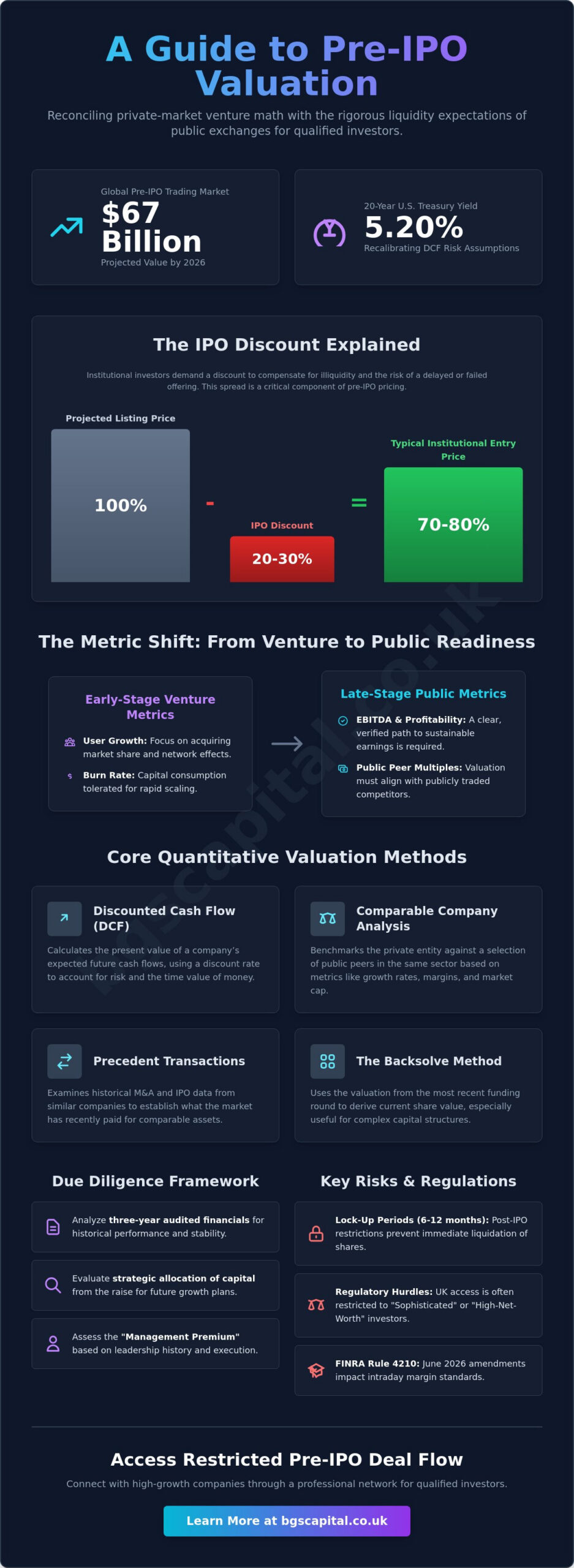
- Analyze the fundamental drivers behind the “IPO Discount” and why institutional entry points typically sit 20-30% below projected listing prices.
- Compare quantitative pre-ipo valuation methods, specifically how to reconcile Discounted Cash Flow (DCF) projections with public-market comparable benchmarks.
- Evaluate qualitative factors like the “Management Premium” to determine how leadership history and market moats impact private share premiums.
- Apply a standardized due diligence framework focused on three-year audited financials and the strategic allocation of capital from the raise.
- Discover how to access restricted deal flow through professional networks that facilitate direct introductions between qualified investors and high-growth companies.
The Mechanics of Pre-IPO Valuation: Why Private Pricing Differ
Pre-IPO valuation is the formal determination of a private entity’s fair market value in the period immediately preceding an initial public offering. Unlike public equities, where price discovery occurs in real-time on an exchange, private pricing relies on negotiated terms between the issuing company and institutional participants. This process is the final bridge between venture-style speculation and the rigorous reporting standards of public markets.
Institutional investors typically demand an “IPO Discount” of 20% to 30% below the projected listing price. This spread compensates for the inherent risks of a failed or delayed offering. It also accounts for the fundamental lack of liquidity. While public shares can be liquidated instantly, pre-IPO shares are restricted. This illiquidity is a central pillar in the technical Business Valuation Methods applied to late-stage companies. The lead investor in a pre-IPO round sets the benchmark for all subsequent participants. Their due diligence and negotiated share price serve as the primary anchor for the company’s final private valuation.
The Transition from Venture to Public Metrics
As a company nears its debut, the metrics used for pre-ipo valuation methods shift dramatically. Analysts move away from early-stage indicators like “burn rate” or “user growth” in favor of EBITDA and a verified path to profitability. The impending timeline forces a convergence with public peer multiples. If a company’s public competitors trade at 10x earnings, the private valuation must align with this reality or risk a “down-round” IPO. Additionally, lock-up periods usually prevent insiders and pre-IPO investors from selling shares for six to twelve months post-listing. This restriction reduces the immediate value of the shares, as holders cannot capitalize on initial trading volatility.
Regulatory Constraints for UK Investors
UK-based investors face a specific regulatory environment governed by the Financial Conduct Authority (FCA). Access to these opportunities is generally restricted to individuals classified as “Sophisticated Investors” or “High-Net-Worth Individuals” (HNWIs). Unlike the London Stock Exchange (LSE), where transparency is mandated by Listing Rules, private placements offer significantly less public data. Investors must rely heavily on the Information Memorandum (IM). This document is the primary source for assessing valuation claims and understanding the capital structure. Because the 20-year U.S. Treasury yield sits at 5.20% as of May 2026, the cost of capital has increased, making the precision of these private valuations even more critical for capital preservation.
Quantitative Valuation Methods: From DCF to Comparable Company Analysis
Quantitative pre-ipo valuation methods provide the mathematical foundation for price negotiation by stripping away market sentiment to focus on fiscal reality. These models allow sophisticated investors to determine if a private share price aligns with its eventual public market potential. While early-stage venture capital relies on broad growth projections, late-stage valuation requires a rigorous analysis of historical performance and projected cash flows. Understanding the correlation between Financial Performance and IPO Pricing is essential for calculating a defensible entry point.
Four primary quantitative frameworks dominate the pre-IPO landscape:
- Discounted Cash Flow (DCF): This method calculates the present value of a company’s expected future cash flows. It uses a discount rate to account for the time value of money and the specific risk profile of the business.
- Comparable Company Analysis (Comps): This benchmarks the private entity against a basket of public peers within the same sector. It relies on shared characteristics like growth rates, margins, and market capitalization.
- Precedent Transactions: Analysts examine historical data from similar companies that recently transitioned from private to public status. This provides a baseline for what the market has recently been willing to pay for similar assets.
- The Backsolve Method: This approach uses the valuation from the most recent funding round to derive current share value. It’s particularly useful when a company has a complex capital structure with multiple share classes.
If you are looking to review current opportunities that have undergone these rigorous assessments, you may view our network’s latest listings for qualified participants.
Applying Multiples in a Pre-IPO Context
The choice between Price-to-Earnings (P/E) and Enterprise Value-to-Revenue (EV/Rev) multiples depends on the company’s maturity. For profitable firms, P/E is the standard. For high-growth tech firms yet to reach net profitability, EV/Rev is more common. Investors must apply a “Private Company Discount,” typically ranging from 10% to 25%, to account for the lack of immediate liquidity. Sector-specific multiples are further adjusted by applying a growth premium to companies that consistently outperform their public peers’ CAGR.
The DCF Model: Factoring in 2026 Risk Premiums
In 2026, DCF models must be adjusted for higher capital costs. The 20-year U.S. Treasury yield, currently at 5.20%, serves as a high risk-free rate that compresses Terminal Value projections. Additionally, analysts must factor in “Execution Risk.” This is the specific probability that the IPO fails to launch due to market volatility or regulatory hurdles. Because of these variables, DCF is often used as a secondary check against Comps in late-stage tech valuations, where public market sentiment often dictates the final listing price more than long-term cash flow models.
Qualitative Drivers: Assessing Management, Moats, and Market Sentiment
Quantitative models establish the baseline. Qualitative drivers define the final premium. While the spreadsheets discussed in previous sections provide a mathematical floor, the final price in most pre-ipo valuation methods is dictated by intangible assets that data alone cannot capture. Sophisticated investors must look beyond EBITDA to the structural defensibility of the enterprise and the environment in which it operates.
The “Management Premium” is a primary driver of valuation uplift. A C-suite with a proven track record of navigating a public listing reduces execution risk. This expertise allows the company to command a higher multiple compared to first-time founders. Similarly, competitive moats in 2026 are defined by AI integration and proprietary data sets. A company that is a recognized “category leader” benefits from brand equity that translates directly into a valuation premium during the final private rounds. This intangible value is often what separates a successful exit from a stagnant private placement.
Institutional Backing as a Valuation Signal
Analyzing the quality of existing venture capital on the cap table is a critical due diligence step. Tier-1 private equity firms provide a “Halo Effect” that validates the company’s internal audits and growth projections. This institutional presence often acts as a price floor for the pre-IPO round. Conversely, any history of “Down Rounds” in the cap table signals that previous valuation claims were overextended. This history forces a more conservative approach in current pre-IPO pricing and may lead to more aggressive liquidation preferences for new participants.
Market Sentiment and Macroeconomic Headwinds
The 2026 economic environment is defined by a 5.20% 20-year Treasury yield. This high risk-free rate creates a selective “Risk-On” appetite. Investors now prioritize sector-specific trends such as Green Energy and FinTech, where regulatory tailwinds are strongest. Scarcity value also plays a significant role. As the pre-IPO private share trading market is projected to reach $67 billion in 2026, high demand for a limited supply of shares in top-tier companies maintains a seller’s market. This scarcity allows elite companies to maintain high valuations despite broader macroeconomic volatility, as institutional investors compete for a fixed pool of high-growth assets.
Due Diligence Framework: Evaluating Pre-IPO Opportunities in 2026
A rigorous due diligence framework is the only safeguard against the information asymmetry prevalent in private markets. While pre-ipo valuation methods provide a mathematical range, the quality of the underlying data dictates the validity of the output. Sophisticated investors must move beyond the executive summary to conduct a multi-stage audit of the target entity. This process requires a shift from passive observation to active verification of all fiscal and operational claims.
- Step 1: Financial Verification. Review audited financial statements for the previous three fiscal years. This provides a baseline of historical performance against which future projections can be measured. Pay close attention to revenue recognition policies and any one-time gains that might inflate the valuation.
- Step 2: Capital Allocation Analysis. Analyze the ‘Use of Proceeds’. Capital earmarked for market expansion or R&D is a growth signal. Conversely, funds used primarily for debt repayment or secondary liquidity for early founders may indicate a lack of internal reinvestment.
- Step 3: Exit Realism. Evaluate the proposed IPO timeline against current market conditions. In 2026, the SEC’s proposal to raise the “large accelerated filer” threshold from $700 million to $2 billion creates a new “on-ramp” for companies. This change allows firms to stay private longer while preparing for the reporting requirements of a public listing.
- Step 4: Structural Seniority. Assess the capital structure and liquidation preferences. You must determine if the pre-IPO shares carry participating or non-participating preferences. These structural details often dictate who gets paid first in a liquidity event. They can fundamentally alter the effective pre-ipo valuation methods used to calculate your potential ROI.
- Step 5: Contextual Knowledge. Verify your understanding of the broader startup funding landscape. Knowing where a company sits in its lifecycle helps calibrate risk expectations before capital is committed.
Before proceeding with a technical assessment, you should verify your eligibility to access exclusive listings through our professional network.
Red Flags in Pre-IPO Valuation
Excessive reliance on ‘Pro-Forma’ metrics is a primary warning sign. These non-GAAP figures often mask underlying operational inefficiencies or unsustainable burn rates. Unrealistic growth projections that deviate significantly from industry averages suggest a disconnect from market reality. Additionally, frequent changes in the CFO or lead auditor in the 24 months preceding an IPO often signal internal reporting instability or disagreements over accounting treatments. These personnel shifts are rarely coincidental.
The Role of Independent Third-Party Valuations
Independent 409A valuations provide a necessary price floor for tax compliance but rarely reflect the true market premium. There’s a distinct difference between internal fair value assessments and external appraisals conducted by independent firms. Internal teams often have a bias toward optimistic outcomes. Independent audits are non-negotiable for sophisticated investors because they provide the only objective verification of a company’s claimed fiscal health.
Accessing Exclusive Pre-IPO Opportunities via BGS Capital
The transition from understanding pre-ipo valuation methods to executing a transaction requires a secure and compliant gateway. BGS Capital operates as a specialized intermediary for high-net-worth individuals and sophisticated investors. We provide a professional conduit to late-stage private opportunities that are typically inaccessible through traditional retail channels. Our role is strictly that of a facilitator. We bridge the gap between private equity issuers and qualified capital providers without providing financial advice or direct brokerage services.
Accessing these opportunities begins with a rigorous status verification process. This ensures all participants meet the necessary regulatory thresholds for private market activity. Once verified, investors gain entry to a curated database. This resource spans the investment lifecycle, covering everything from early-stage angel investors rounds to mature companies nearing their public debut. Each listing provides the necessary documentation to allow investors to apply their own valuation frameworks and due diligence standards.
Professional Investor Introduction Service
BGS Capital facilitates direct connections to the investor relations teams of high-growth companies. We do not participate in the capital raise itself. Instead, we act as a network connector. This model allows qualified UK investors to browse a centralized database of opportunities for free. The primary benefit is direct access. By removing unnecessary layers, investors can engage directly with the issuing entity to review the Information Memorandum and verify the pre-ipo valuation methods used to price the round. Compliance is our priority. We maintain stringent status checks to ensure all introductions align with current FCA requirements for sophisticated and high-net-worth classifications.
Feature Your Business for Capital Raising
Companies seeking late-stage capital can utilize our platform for strategic exposure. Listing a pre-IPO opportunity on our network provides immediate visibility to a broad audience of accredited investment firms and wealth managers. The process is streamlined for efficiency. Issuers submit their opportunity for review, and once accepted, it is featured to our qualified network. This exposure is critical in a 2026 market where institutional “dry powder” has shifted toward more selective, late-stage placements. It allows companies to find the right partner for their final private round before the complexities of a public listing begin. If you are a qualified investor seeking to expand your portfolio, you must first verify your status to access pre-IPO opportunities and view our current database.
Capitalizing on Late-Stage Private Equity
The transition from private growth to public liquidity requires a technical mastery of pre-ipo valuation methods. You’ve analyzed how quantitative models like DCF must be balanced against qualitative drivers such as management track records and structural moats. Success in this sector depends on a standardized due diligence framework that verifies every fiscal claim before capital is committed. Navigating the higher cost of capital in 2026 demands precision and access to high-quality deal flow.
BGS Capital serves as a specialist facilitator for exclusive UK investment opportunities. We maintain a curated network of high-net-worth individuals and provide direct introductions to investor relations teams. Our platform removes the barriers to restricted opportunities while ensuring all participants meet rigorous status verification standards. This intermediary role allows you to evaluate potential entries directly from the source without unnecessary brokerage layers.
Are you a sophisticated investor? Access our pre-IPO database today.
Position your portfolio for the next generation of market leaders by engaging with opportunities that align with your strategic objectives. The window for late-stage entry remains selective, and the right network is your most valuable asset.
Frequently Asked Questions
What is the most common pre-IPO valuation method used by institutional investors?
Comparable Company Analysis (Comps) is the most prevalent framework. It benchmarks the private entity against a basket of public peers with similar growth profiles and margins. While other pre-ipo valuation methods like DCF provide internal checks, institutional participants prioritize Comps because they reflect the current “exit multiples” public markets are willing to pay at the time of listing.
How much of a discount should I expect when buying shares in a pre-IPO placement?
Investors typically target an “IPO Discount” of 20% to 30% below the projected listing price. This spread accounts for the lack of immediate liquidity and the execution risk of the offering itself. If the company fails to debut within the expected window, this discount serves as a necessary buffer against the prolonged holding period and potential market volatility.
Are pre-IPO valuations regulated by the Financial Conduct Authority (FCA)?
The FCA does not regulate the specific valuation or share price of a private company. However, the promotion and distribution of these opportunities are strictly governed. Companies must ensure that offerings are only marketed to individuals who meet the statutory definitions of “Sophisticated Investors” or “High-Net-Worth Individuals” to remain compliant with UK financial promotion rules.
What is the difference between a 409A valuation and a pre-IPO market price?
A 409A valuation is an internal appraisal used primarily for tax compliance and setting the strike price for employee stock options. It is intentionally conservative. In contrast, the pre-IPO market price is the result of negotiation between the company and external investors. This market price almost always carries a premium over the 409A value as it reflects current demand and growth expectations.
Can individual retail investors participate in pre-IPO placements in the UK?
Direct participation is generally restricted to qualified participants who meet high-net-worth or sophisticated status. Retail investors are typically excluded from these placements due to the high minimum entry requirements and the complexity of the risk profile. Verified status is a prerequisite for accessing the restricted information memorandums required to evaluate these private opportunities effectively.
How do high interest rates in 2026 affect private company valuations?
High interest rates compress private valuations by increasing the discount rate used in financial models. With the 20-year U.S. Treasury yield at 5.20% in May 2026, the risk-free rate is significantly higher than in previous cycles. This reduces the present value of future cash flows. It forces companies to demonstrate a clear path to profitability rather than relying solely on top-line growth metrics.
What happens to my pre-IPO share value if the company decides not to go public?
If an IPO is cancelled or delayed, your shares remain illiquid. You must wait for an alternative liquidity event, such as a trade sale (M&A) or a secondary market transaction. The share value may stagnate or decline without the “liquidity premium” associated with a public listing. Investors must analyze the company’s “use of proceeds” to ensure it has enough runway to survive without public capital.
What are liquidation preferences and how do they affect my investment value?
Liquidation preferences dictate the order of payout during a sale or liquidation event. They ensure that certain share classes, usually held by institutional investors, receive their initial investment back before common shareholders receive any proceeds. These preferences can significantly dilute your effective returns if the company exits at a valuation lower than the initial pre-ipo valuation methods suggested during the funding round.