
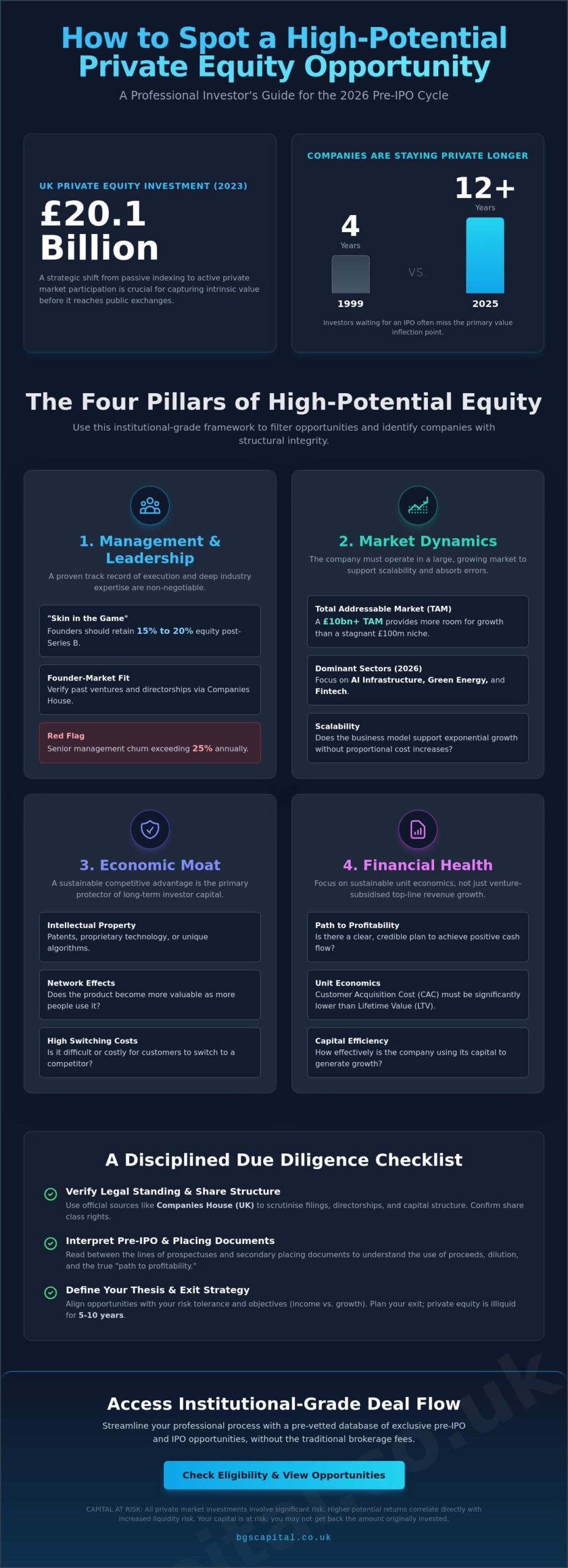
The most lucrative private equity deals are rarely found on public exchanges; they are secured through rigorous, institutional-grade filtering long before a prospectus is ever filed. In a market where private equity investment in the UK reached £20.1 billion in 2023, understanding how to spot a good investment opportunity in the 2026 pre-IPO cycle requires a disciplined, professional approach. You likely recognise that information asymmetry remains the primary barrier to entry. It’s difficult to separate genuine high-growth potential from overvalued hype without the resources of an institutional analysis team.
This article provides the framework you need to bridge that gap. You’ll master the same due diligence processes used by professional firms to identify and vet private equity opportunities before they reach the mainstream. We will examine how to evaluate a management team’s track record, assess financial scalability, and provide a repeatable checklist for your next capital allocation. CAPITAL AT RISK.
Key Takeaways
- Understand why the 2026 market landscape requires a strategic shift from passive indexing to active private market participation to capture intrinsic value.
- Discover how to spot a good investment opportunity by rigorously assessing the four pillars of equity, focusing on founder “skin in the game” and market dominance.
- Master the nuances of interpreting a “path to profitability” within pre-IPO prospectuses and secondary placing documents to identify institutional-grade assets.
- Execute a disciplined due diligence process using UK-specific protocols, including the verification of legal standing and share structures via Companies House.
- Streamline your professional deal flow by accessing a pre-vetted database of exclusive pre-IPO and IPO opportunities without incurring traditional brokerage fees.
The Fundamentals of Investment Selection in 2026
Understanding how to spot a good investment opportunity requires a departure from speculative guesswork. It’s the systematic identification of assets where the intrinsic value significantly exceeds the current entry price. This process relies on Fundamental Analysis Explained as a core methodology to evaluate a business’s health and future cash flows. In the 2026 market, the traditional reliance on passive indexing is proving insufficient for High Net Worth (HNW) individuals seeking alpha. The shift toward active private market participation is now a necessity for those aiming to outperform standard benchmarks.
Access to exclusive pre-IPO deal flow is the hallmark of the Sophisticated Investor. These individuals leverage professional networks to find equity before it reaches public exchanges. This level of access was previously reserved for institutional funds, but the “introducer” model has decentralised these opportunities. However, this pursuit demands a rigorous understanding of risk. CAPITAL AT RISK: All private market investments involve significant risk. Higher potential returns correlate directly with increased liquidity risk. Your capital is at risk; you may not get back the amount originally invested. Private equity is often illiquid for five to ten years, meaning your exit strategy must be as robust as your entry plan.
The Shift from Public to Private Markets
Data shows companies stay private for significantly longer durations. In 1999, the median age of a tech company at IPO was four years; by 2025, this figure exceeded 12 years. Investors who wait for the public listing often miss the primary value inflection point. Entering the startup funding cycle early allows for participation in the growth phase that previously occurred in public markets. The introducer model acts as a vital bridge, connecting eligible investors with these restricted opportunities.
Defining Your Investment Thesis
A clear thesis is mandatory. You must determine if your objective is immediate income generation or long-term capital growth. This choice dictates your approach to how to spot a good investment opportunity within specific sectors. In 2026, three sectors dominate the private equity landscape. AI infrastructure requires heavy capital expenditure but offers massive scale. Green energy projects provide stable, long-term yields. Fintech remains a high-growth area as traditional banking systems decentralise. Align these opportunities with your personal risk tolerance and existing sector expertise to ensure portfolio synergy.
The Four Pillars of High-Potential Equity Opportunities
Identifying how to spot a good investment opportunity requires a shift from speculative betting to rigorous, framework-based analysis. Sophisticated investors prioritise four specific pillars before committing capital. These pillars filter out companies that show superficial growth but lack the structural integrity to survive market volatility. CAPITAL AT RISK.
First, the management team must demonstrate a track record of execution. We look for “skin in the game,” typically defined as founders retaining at least 15% to 20% of equity post-Series B. Second, market dynamics must support scalability. A company operating in a £10bn Total Addressable Market (TAM) has more room for error than one in a stagnant £100m niche. Third, the economic moat provides the necessary barrier against competitors. Finally, financial health must be assessed through the lens of unit economics rather than just top-line revenue. Utilising fundamental analysis for stock selection helps investors distinguish between sustainable cash flow and temporary, venture-subsidised growth.
Evaluating the Leadership “Pedigree”
Assessing a team doesn’t require institutional terminals. Investors should scrutinise Companies House filings to track previous directorships and the outcomes of past ventures. Founder-market fit is vital; a leadership team with 10 years of experience in logistics is far more likely to solve supply chain inefficiencies than a generalist team. Red flags include a senior management churn rate exceeding 25% annually or lack of transparency regarding past failures. High-net-worth individuals often check their eligibility to access opportunities where this level of due diligence is pre-vetted.
Analysing the Competitive Moat
An Economic Moat is the primary protector of long-term investor capital. To determine how to spot a good investment opportunity, you must decide if the product is a “must-have” that solves a critical regulatory or operational pain point. In the current UK economic climate, “nice-to-have” consumer apps are vulnerable to reduced discretionary spending. A strong moat is often built on high switching costs. If a B2B software platform integrates deeply into a client’s workflow, the cost and time required to migrate data to a rival act as a natural barrier to entry. Proprietary technology is only a moat if it’s defensible through patents or significant lead-time advantages that competitors cannot easily replicate through capital alone.
- Unit Economics: Customer Acquisition Cost (CAC) should be recovered within 12 months.
- Burn Rate: A company should maintain at least 18 to 24 months of runway at current spending levels.
- Transparency: Management must provide clear, audited financial statements without obfuscating “adjusted” metrics.
Analysing Pre-IPO Opportunities: Reading Between the Lines
Pre-IPO investing represents a distinct shift from early-stage angel investors strategies. While angel rounds focus on proof of concept, pre-IPO opportunities prioritise scaling and institutional readiness. Sophisticated investors must evaluate the “Path to Profitability” within the prospectus or secondary placing document. This outlines how a company intends to reach break-even or sustain margins. You’re looking for unit economics that remain stable as volume increases. If marketing spend grows faster than revenue, the model is likely unsustainable. CAPITAL AT RISK.
The cap table provides essential context for any entry. Anchor investors, such as Tier 1 firms or sovereign wealth funds, signal institutional confidence. Their presence suggests the business has already cleared rigorous due diligence. Secondary placings, where existing shareholders sell their stakes before the official float, offer a strategic entry point for High Net Worth individuals. These often occur at a discount to the projected IPO price, providing an immediate margin of safety. Understanding how to spot a good investment opportunity in this space requires looking at who is selling and why. Founder exits are red flags; early employee liquidity is standard.
Deciphering the Prospectus
A prospectus is a legal requirement, yet it’s often used as a marketing tool. Focus on the “Use of Proceeds” section. If 65% of the capital raised is earmarked for debt repayment rather than R&D or market expansion, the upside is limited. Scrutinise the “Risk Factors” for specific regulatory threats. Window dressing in financial forecasts often appears as aggressive “Adjusted EBITDA” figures that strip out essential operational costs. Accredited investment firms vet these documents to ensure compliance with UK Financial Conduct Authority standards before they reach your desk.
Market Sentiment vs. Fundamental Value
The “FOMO” trap often drives valuations in high-profile tech IPOs. To determine how to spot a good investment opportunity, ignore the media hype and analyse previous venture capital rounds. If the Series D valuation was £400 million and the pre-IPO ask is £1.5 billion without a commensurate increase in revenue or market share, the valuation is likely inflated. A true margin of safety exists when the entry price is supported by tangible assets or predictable cash flows. In private equity, this means buying at a multiple that allows for market volatility without wiping out your principal.
A Professional Due Diligence Checklist for Individual Investors
Identifying value requires a systematic approach. To understand how to spot a good investment opportunity, you must move beyond the pitch deck and into technical verification. Professional due diligence is the only way to mitigate the inherent risks of private equity and pre-IPO placements.
- Step 1: Legal Verification. Access Companies House to verify the company’s legal standing. Review the Persons with Significant Control (PSC) register and the latest confirmation statements to ensure the share structure matches the pitch.
- Step 2: Financial Audit. Review the last three years of audited accounts. If the company is younger, demand management accounts. Look for consistency in revenue recognition and examine the burn rate relative to cash reserves.
- Step 3: Customer Discovery. Validate the product-market fit. A viable opportunity must solve a documented pain point. Speak to existing clients or review retention data to confirm the product isn’t easily replaceable.
- Step 4: Exit Strategy Analysis. Evaluate the most likely liquidity event. Whether it’s an IPO on the London Stock Exchange, a trade sale (M&A), or a secondary buyout, the path must be realistic based on current sector multiples.
- Step 5: Sector Benchmarking. Consult with an introducer or wealth manager. Comparing the deal against current sector benchmarks helps determine if the valuation is grounded in reality or inflated by sentiment.
Financial Ratios That Matter Most
Gross margins reveal the efficiency of the core product, but EBITDA margins tell the story of operational scalability. A high gross margin is irrelevant if administrative costs consume all profit. For growth-stage firms, the ratio of Customer Acquisition Cost (CAC) to Lifetime Value (LTV) is vital; a 1:3 ratio is generally considered the minimum for sustainable growth. In an environment where the Bank of England base rate has remained at 5.25% recently, assessing debt-to-equity is critical. High leverage is significantly more expensive than it was in 2021.
UK Regulatory Compliance & Eligibility
Access to high-level investment opportunities in the UK is restricted by the Financial Conduct Authority (FCA). Investors must typically qualify as either High Net Worth (HNW) or Sophisticated. HNW status requires an annual income of at least £250,000 or net assets of £250,000 or more, excluding a primary residence and pension. Sophisticated investors often have professional experience in private equity or have been members of a business angel network for at least six months.
The FCA oversees how opportunities, including the eis, are promoted to ensure they’re clear and fair. Self-certification is the essential gateway to exclusive databases. Without this qualification, you won’t see the most competitive deal flow. CAPITAL AT RISK.
Determine your status to access exclusive investment opportunities.
How BGS Capital Facilitates Professional Deal Flow
BGS Capital operates as a specialist introducer, functioning as a bridge between sophisticated investors and high-growth UK companies. The platform focuses on the “Introduction” phase of the investment cycle, removing the layers of intermediation that typically obscure value. By providing a free database of pre-IPO and IPO opportunities, the platform allows you to bypass traditional brokerage fees and commissions. Identifying how to spot a good investment opportunity requires a streamlined process where the noise of retail marketing is removed, allowing for direct analysis of company fundamentals.
The network prioritizes efficiency. It doesn’t facilitate the capital raise itself; instead, it connects you directly with investor relations (IR) teams. This direct line of communication is essential for those looking to build a diversified private equity portfolio with precision. You gain access to the same data used by institutional wealth managers, ensuring your decision-making process is based on primary source material rather than third-party summaries.
The Advantage of Direct Introductions
Direct access to company IR teams offers a level of transparency that retail brokers cannot match. Retail platforms often prioritize their own commission structures, which can lead to a conflict of interest. BGS Capital eliminates this by charging no facilitation fees to the investor. This model ensures that 100% of your allocated capital goes toward the investment itself rather than being eroded by administrative costs.
Using the BGS platform helps you compare multiple “secondary placings” and early-stage opportunities side-by-side. You can download comprehensive company profiles and information memorandums instantly. This high-velocity access to data is a critical component of how to spot a good investment opportunity in the fast-moving UK growth sector. It allows you to assess the scalability and exit strategies of various firms before committing any capital.
Getting Started: Am I Eligible?
Access to these exclusive opportunities is restricted to individuals who meet specific UK regulatory criteria. You must qualify as either a High Net Worth (HNW) or a Sophisticated Investor. Under current FCA guidelines, a High Net Worth individual is defined as someone with an annual income of at least £100,000 or net assets exceeding £250,000, excluding their primary residence and pension rights. Self-certified Sophisticated Investors include those who have been a member of a business angels network for at least six months or have worked in a professional capacity in the private equity sector.
The process to begin is straightforward. Once you confirm your status, you can access the 2026 investment portfolio and begin downloading detailed profiles. CAPITAL AT RISK: All investments of this nature carry significant risk, and you may lose some or all of your initial outlay. Secure your access to the next generation of UK growth companies by verifying your status today.
- Step 1: Complete the “Am I Eligible?” assessment.
- Step 2: Browse the database of pre-vetted IPO and pre-IPO firms.
- Step 3: Download the information memorandums.
- Step 4: Connect directly with the company’s IR team to conduct final due diligence.
Maximising Your Portfolio Potential in 2026
Identifying high-potential assets in the current UK market requires more than a cursory glance at financial statements. You’ve learned that how to spot a good investment opportunity in 2026 relies on the four pillars of equity analysis and a professional due diligence checklist. Sophisticated investors must look beyond retail-level data to find value in pre-IPO and secondary placings. BGS Capital acts as a specialist introducer, connecting high net worth individuals and wealth managers with pre-vetted opportunities. We provide direct introductions to company Investor Relations teams and facilitate access to exclusive deal flow. Qualified investors benefit from a zero-fee structure when using our platform. It’s about data-driven selection and institutional-grade access. CAPITAL AT RISK.
Accessing these private markets shouldn’t be a hurdle for the modern investor. Our framework ensures you’re equipped to evaluate pre-IPO prospects with the same rigour as institutional firms. Take the next step in your investment journey by verifying your status today.
Check your eligibility to access our exclusive pre-IPO database
We look forward to facilitating your next strategic connection.
Frequently Asked Questions
What is the difference between a sophisticated investor and a high-net-worth individual?
A high-net-worth individual is defined by the FCA as someone with an annual income of at least £100,000 or net assets exceeding £250,000, excluding their primary residence and pension. A sophisticated investor is qualified based on professional experience and market knowledge. This certification requires you to have been a director of a company with a £1 million turnover or to have worked in the private equity sector for two years. Both categories must self-certify to access restricted investment opportunities.
How much capital do I need to start investing in pre-IPO opportunities?
Minimum capital requirements for pre-IPO opportunities typically start at £10,000 when using pooled investment vehicles or secondary market platforms. Direct participation in late-stage funding rounds often requires larger commitments ranging from £50,000 to £100,000. These thresholds ensure that participants have sufficient liquidity to manage the long-term nature of private placements. CAPITAL AT RISK. You must check your eligibility before committing funds to these illiquid assets.
How do I verify the claims made in a company pitch deck?
Verification involves cross-referencing financial statements with official filings at Companies House and requesting audited accounts from the last three years. Investors use a structured due diligence framework to understand how to spot a good investment opportunity. This includes speaking with existing customers to verify recurring revenue and checking the cap table for previous institutional backing. Third-party market reports from firms like Gartner can validate claims about market share and growth potential.
What are the main risks associated with investing in private equity?
The primary risks include total loss of capital and extreme illiquidity. Unlike public markets, there’s no guaranteed exit route and you might be unable to sell your shares for several years. Dilution is another factor, as subsequent funding rounds can reduce your percentage of ownership. CAPITAL AT RISK. Most private equity investments aren’t covered by the Financial Services Compensation Scheme (FSCS), so you lack the protections found in retail banking.
Can I hold pre-IPO investments in a SIPP or ISA?
You can hold certain pre-IPO investments in a Self-Invested Personal Pension (SIPP) if the provider permits unlisted shares. Most standard ISAs don’t allow for the inclusion of private company shares because they aren’t traded on a recognised stock exchange. Once a company completes its IPO and lists on the London Stock Exchange or AIM, the shares may become ISA-eligible. You should consult with a tax specialist regarding specific HMRC rules for your portfolio.
How long is the typical holding period for a pre-IPO investment?
The typical holding period for a pre-IPO investment ranges from three to seven years. This timeline depends on the company’s growth trajectory and the prevailing market conditions for an exit. Some firms might choose a trade sale rather than a public listing, which can accelerate or delay your liquidity event. Investors must be prepared for their capital to be locked up for the duration of the company’s private growth phase.
What happens to my shares when a company finally goes through an IPO?
Your private shares are usually converted into public common stock at a predetermined ratio. There’s often a lock-up period of 180 days following the listing date where early investors can’t sell their shares. This prevents market saturation and price volatility immediately after the debut. Once this period expires, you can sell your holdings through a standard brokerage account or continue to hold them as public equity.
Is BGS Capital a regulated financial advisor?
BGS Capital isn’t a regulated financial advisor and doesn’t provide investment advice or facilitate raises directly. We operate as an introducer and a professional network. We connect sophisticated investors with accredited investment firms and wealth managers. Our role is to provide access to exclusive opportunities while ensuring all users undergo an eligibility check. CAPITAL AT RISK. All investment decisions are the sole responsibility of the investor.