
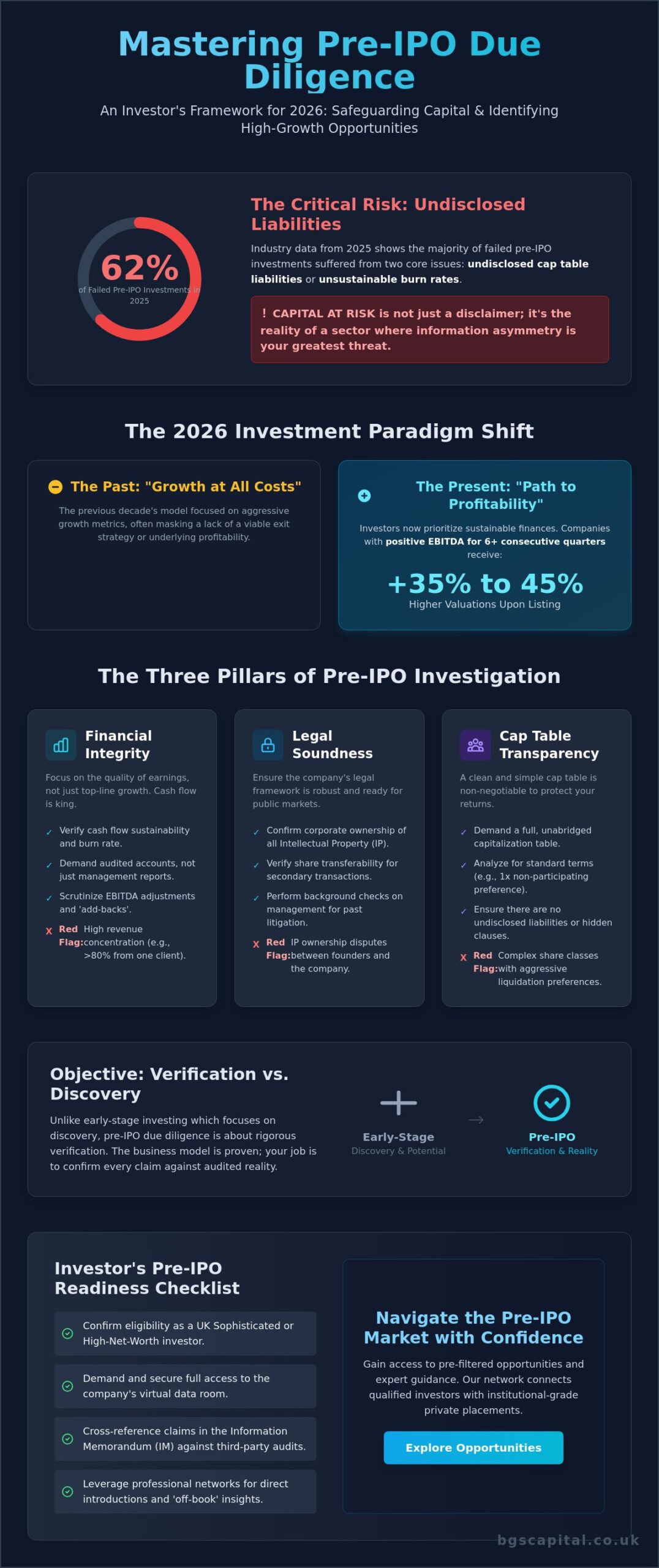
The difference between a high-growth exit and a total loss of capital usually comes down to the quality of your pre-investment audit. In 2025, industry data indicated that 62% of failed pre-IPO investments in the UK suffered from undisclosed cap table liabilities or unsustainable burn rates. You’re likely aware that information asymmetry remains your greatest risk when evaluating private firms that lack the transparency of public markets. CAPITAL AT RISK is not just a regulatory disclaimer; it’s the reality of the pre-IPO sector where “zombie” startups often mask their lack of a viable exit strategy behind aggressive growth metrics.
This guide allows you to master the rigorous process of due diligence for pre-ipo companies, providing a repeatable framework to safeguard your capital and identify genuine high-growth opportunities. You’ll gain the ability to spot critical red flags in financial disclosures and untangle complex cap table structures that threaten your eventual returns. We’ll examine the specific 2026 verification steps required to confirm a company’s path to liquidity, ensuring your portfolio is positioned for institutional-grade success. This analysis covers everything from forensic cash flow reviews to the legalities of secondary placings for sophisticated investors and high net worth individuals.
Key Takeaways
- Learn why rigorous due diligence for pre-ipo companies in 2026 must look beyond standard pitch decks to verify cash flow sustainability and burn rates.
- Identify critical “window dressing” red flags and temporary metric spikes designed to artificially inflate valuations prior to a liquidity event.
- Master the three pillars of investigation—financial integrity, legal soundness, and cap table transparency—to protect your capital from structural weaknesses.
- Follow a structured readiness checklist to confirm your eligibility as a UK Sophisticated or High-Net-Worth investor and secure full data room access.
- Discover how to leverage professional networks to gain direct introductions to exclusive pre-IPO placements and established investor relations teams.
The Fundamentals of Pre-IPO Due Diligence in 2026
Effective due diligence requires a systematic verification of a private company’s financial, legal, and operational status before a liquidity event. For sophisticated investors in 2026, this process isn’t about exploring possibilities; it’s about confirming reality. While seed-stage checks focus on product-market fit and founder vision, due diligence for pre-ipo companies prioritises regulatory compliance, scalable infrastructure, and audited financial performance. CAPITAL AT RISK.
The 2026 investment environment has undergone a fundamental shift. Investors now prioritise a clear ‘Path to Profitability’ over the ‘Growth at All Costs’ model that dominated previous decades. Data from 2025 indicates that companies showing positive EBITDA for at least six consecutive quarters receive 35% to 45% higher valuations upon listing compared to their loss-making counterparts. This makes the role of the specialist introducer vital. An introducer pre-filters opportunities, ensuring that only qualified companies with robust governance reach high net worth individuals and accredited investment firms.
The Objective: Verification vs. Discovery
Pre-IPO checks differ from early-stage discovery. By this stage, the business model is proven. The objective is to verify every claim made in the Information Memorandum (IM). This document serves as the foundation for all subsequent checks. Investors must cross-reference IM projections against historical bank statements and HMRC tax filings. In 2026, the ‘Path to Public’ is the definitive metric representing a company’s transition from venture-backed scaling to sustainable, public-market-ready governance.
Information Asymmetry and How to Close the Gap
Private companies naturally hold an information advantage over external investors. Closing this gap requires demanding full transparency and access to the virtual data room. Relying solely on internal reports is a high-risk strategy. Independent third-party audits from reputable firms are mandatory during due diligence for pre-ipo companies to validate asset valuations and intellectual property ownership.
Successful investors also leverage professional networks to perform background checks on management integrity. Finding ‘off-book’ information regarding past litigation or director conduct is essential to mitigate risk. Accessing these insights often requires a connection to an established investment network that understands the nuances of the UK private equity market.
The Three Pillars of Pre-IPO Investigation
Thorough due diligence for pre-ipo companies requires a multi-faceted approach that moves beyond basic profit and loss statements. Investors must scrutinise the underlying mechanics of the business to ensure long-term viability. Understanding the startup funding guide context is essential, as each preceding round influences the final pre-IPO structure. High-conviction investing in 2026 demands a rigorous assessment of financial, legal, and reputational integrity.
Financial Pillar: Quality of Earnings
Top-line growth often masks structural weaknesses. Analysts must identify revenue concentration risks. If 80% of a company’s income originates from a single client or contract, the valuation is fragile. Investors should verify EBITDA adjustments and ‘add-backs’ that may artificially inflate the company’s value. Management accounts are insufficient at this stage. Only audited accounts provide the necessary assurance for a London Stock Exchange listing. The importance of due diligence is evident when uncovering aggressive accounting practices that capitalise operational expenses to boost short-term margins. Cash flow sustainability and burn rate are the primary metrics for 2026 survival.
Legal Pillar: Cap Tables and Share Classes
A clean capital table is non-negotiable. Complex structures with multiple share classes can hide ‘Liquidation Preferences’ that disadvantage new investors. A 1x non-participating preference is standard, but more aggressive terms might leave common shareholders with zero returns during a liquidity event. Investors must also verify the transferability of shares in secondary market transactions. Ensure all intellectual property is legally owned by the corporate entity. Disputes over IP ownership between founders and the company are a common cause of IPO delays. Due diligence for pre-ipo companies must confirm that all employment contracts include robust IP assignment clauses.
Reputational Pillar: Board and Management Scrutiny
The human element determines institutional confidence. Background checks must identify ‘Bad Actor’ disqualifications or a history of failed ventures. The board needs to demonstrate readiness for the public scrutiny of the London market. By 2026, ESG scores significantly impact IPO valuations. Investors look for diverse boards and transparent governance frameworks. A management team with a 100% success rate in private markets might struggle with the continuous disclosure requirements of a public company. Professional investors should check their eligibility for exclusive placements before committing to these high-stakes opportunities. Compliance and transparency are the ultimate safeguards against capital loss.
Identifying Red Flags in Pre-IPO Placements
Investing in late-stage private firms requires a ruthless approach to risk. CAPITAL AT RISK is the fundamental reality of this asset class. Certain red flags shouldn’t just trigger caution; they should lead to an immediate exit from the deal. Effective due diligence for pre-ipo companies involves looking past the marketing deck to find the structural flaws that public markets will eventually punish.
One common trap is “window dressing.” This involves inflating metrics in the two to four quarters preceding a planned exit. You might see a 30% spike in user acquisition, but if you look closer, it’s often driven by unsustainable customer acquisition costs. The Importance Of Due Diligence is most evident when uncovering these temporary surges designed to boost valuation. A company must also prove it’s system-led rather than founder-led. If the original visionary is the only person holding the strategy together, the business is too fragile for the public eye. You can find more on identifying these risks in our venture capital guide for VC-backed firms.
The ‘Path to Public’ Obstacles
Unresolved litigation or pending investigations can stall an IPO for years. In 2024, several fintech firms saw their listings cancelled due to compliance failures or regulatory disputes. Investors must also scrutinise the “Use of Proceeds.” Capital should be earmarked for scaling operations or R&D. If the primary goal is to clear legacy debt or facilitate a massive secondary sale for early founders, growth isn’t the priority. A fragmented or “messy” capitalisation table remains the primary reason institutional listings fail in the final hour, as coordinating hundreds of disparate shareholders becomes an administrative and legal impossibility.
Operational Fragility
Aggressive growth often masks high churn rates. If a company acquires 10,000 users but loses 8,000 in the same period, the business model is a “leaky bucket.” This is a critical component of due diligence for pre-ipo companies. Investors must also evaluate platform reliance. If the core revenue stream depends entirely on a single third-party platform like Amazon or Google, the company lacks true independence. Finally, the absence of a qualified CFO with previous public market experience is a major warning. Without a leader who understands quarterly reporting and transparency requirements, the transition to a PLC is unlikely to succeed.
The Investor’s Pre-IPO Readiness Checklist
Effective due diligence for pre-ipo companies requires a systematic approach that moves beyond the initial excitement of a pitch deck. Investors must verify the technical and legal framework of a deal before committing capital to illiquid assets. Use this five-step checklist to ensure your investment strategy aligns with institutional standards for 2026.
- Step 1: Confirm Eligibility. You must qualify as a Sophisticated or High-Net-Worth investor under FCA regulations. Access to these private placements is restricted to individuals who meet specific income or asset thresholds.
- Step 4: Review the Data Room. Never rely solely on a pitch deck. Request the full disclosure pack, including audited accounts, the capitalization table, and existing debt obligations.
- Step 3: Verification of Secondary Sales. If you’re buying shares from an existing holder, check for ‘Right of First Refusal’ (ROFR) clauses. These allow the company or current shareholders to block your purchase by buying the shares themselves at the same price.
- Step 4: Tax Efficiency Check. Determine if the investment qualifies for the Enterprise Investment Scheme (EIS). This can provide up to 30% income tax relief and capital gains exemptions on the eventual exit.
- Step 5: Final Valuation Benchmarking. Compare the private share price to public peers. A pre-IPO entry should typically offer a 20% to 40% discount to its projected public market valuation to account for the liquidity risk.
Qualifying the Opportunity
A ‘Hot Lead’ is often just market noise; a ‘Qualified Opportunity’ is a deal that has undergone initial structural scrutiny. BGS Capital prioritises pre-vetted introductions for its network to ensure that high-level data is already available for review. Always verify the company’s registration details on Companies House. Check for active filings, director history, and any outstanding charges against the business assets. This basic step prevents engagement with entities that lack proper corporate standing or have undisclosed liabilities.
Benchmarking and Valuation
Using ‘Public Comps’ is the standard method to determine if the due diligence for pre-ipo companies justifies the entry price. If a public competitor trades at a 10x EBITDA multiple, paying 12x for a private firm is rarely logical. Analyse the most recent internal share price or 409A valuation equivalent to see how the price has evolved since the last funding round. You must also factor in the Capital Gains Tax implications of your eventual exit. UK tax rates on gains can significantly impact your net internal rate of return (IRR) if you don’t use tax-efficient wrappers.
Navigating the Pre-IPO Market with BGS Capital
BGS Capital operates as a specialist introducer to exclusive investment networks. We don’t facilitate raises ourselves; instead, we act as a conduit between sophisticated investors and established businesses preparing for a public listing. This model prioritizes direct access over the diluted structures found on open market crowdfunding sites. By using a curated database, we ensure that the opportunities presented are suited for those capable of handling the complexities of private equity. Our role is to provide the platform where these connections happen efficiently.
CAPITAL AT RISK: All pre-IPO investments carry a high degree of risk. The value of your investment can go down as well as up. You may lose all capital invested. It’s essential to seek independent financial advice from an FCA-regulated professional before committing any funds to these opportunities. BGS Capital does not provide investment advice or recommendations.
Am I Eligible for Pre-IPO Access?
Access to these exclusive opportunities is restricted to individuals who meet specific UK regulatory criteria. To qualify as a High-Net-Worth Individual, you must have an annual income of at least £100,000 or net assets exceeding £250,000, excluding your primary home and pension. Alternatively, you may qualify as a Sophisticated Investor if you have experience in private equity or have been a director of a company with a turnover of at least £1.6 million in the last 24 months. BGS Capital manages a rigorous gatekeeping process to ensure all members meet these compliance standards. The process is straightforward: complete the eligibility check, verify your status, and gain entry to the network to view featured businesses.
Connecting with Investor Relations
Direct communication with a company’s investor relations team is superior to third-party brokerage. It removes the filter often found in secondary markets, allowing you to ask critical questions directly to the source. This transparency is vital when conducting due diligence for pre-ipo companies. Our platform provides the infrastructure to download comprehensive information packs and compare multiple opportunities in a single interface. By engaging directly with the business, you can better assess management quality and financial projections before a potential 2026 listing. This direct link ensures you have the same data as institutional players, which is a core component of effective due diligence for pre-ipo companies.
Secure Your Position in the 2026 Pre-IPO Market
The 2026 private equity landscape offers significant potential for those who apply a rigorous framework. Effective due diligence for pre-ipo companies now requires a meticulous focus on the three pillars of investigation, specifically verifying financial integrity and governance structures before any capital is committed. Identifying red flags early prevents exposure to high-risk placements in the UK’s evolving regulatory environment. BGS Capital facilitates this process by acting as a professional conduit to a curated network of accredited investment firms. Qualified investors benefit from zero-cost access and direct communication with investor relations teams to streamline their decision-making.
It’s essential to remember that all capital is at risk, making thorough verification the most critical step in your investment journey. By utilizing a structured checklist and a vetted network, you can navigate these exclusive opportunities with the confidence required for high-level investing. BGS Capital remains committed to bridging the gap between sophisticated investors and high-growth firms. We look forward to connecting you with the UK’s most promising investment prospects.
Am I Eligible? Check your status and access exclusive pre-IPO opportunities.
Frequently Asked Questions
Is pre-IPO investing safe for individual investors?
Pre-IPO investing is high risk and isn’t considered safe for the average retail investor. CAPITAL AT RISK. These opportunities are typically restricted to High Net Worth Individuals or Self-Certified Sophisticated Investors under FCA COBS 4.12 regulations. Data from 2023 indicates that 10% of late-stage startups fail to reach an exit. You should only commit capital you’re prepared to lose entirely.
How long does the due diligence process typically take for a pre-IPO company?
A thorough due diligence for pre-IPO companies usually requires 30 to 90 days to complete. This timeframe allows for a deep dive into audited financial statements, legal contracts, and intellectual property audits. In 2024, the average private equity due diligence period in the UK was 45 days. Delays often occur if the company’s data room is disorganized or if complex cross-border tax issues arise.
What is the difference between pre-IPO and venture capital due diligence?
Pre-IPO due diligence focuses on public market readiness and regulatory compliance, whereas venture capital due diligence prioritizes growth metrics and product-market fit. By the pre-IPO stage, auditors examine if the firm can meet London Stock Exchange Listing Rules. VC rounds might accept 20% more risk in financial reporting than the stringent standards required for a 2026 listing.
Can I sell my pre-IPO shares before the company goes public?
You usually can’t sell pre-IPO shares easily due to strict lock-up agreements and limited secondary market liquidity. Most companies impose a 180-day lock-up period after the public debut. While secondary platforms like JP Morgan’s private market desk exist, transactions often require board approval. Only 5% of private shareholdings are traded on secondary markets before a formal exit event occurs.
How much capital do I need to participate in a pre-IPO investment?
Minimum investment thresholds vary, but many UK platforms require £10,000 to £50,000 to participate in pre-IPO rounds. Institutional-grade opportunities often demand £100,000 or more. These entry points reflect the exclusive nature of the asset class. Always check the specific requirements of the accredited investment firm before proceeding to ensure you meet the qualification criteria.
What happens to my investment if the IPO is delayed or cancelled?
If an IPO is cancelled, your capital remains illiquid and tied to the private company. The firm might pursue a trade sale or another private funding round instead. In 2023, 40% of planned UK IPOs were postponed due to market volatility. You won’t have a guaranteed exit route; the value of your shares could decrease significantly if the company fails to secure alternative funding.
Why is the cap table so important in pre-IPO due diligence?
The capitalisation table is vital because it details the ownership structure and potential for share dilution. During due diligence for pre-IPO companies, investors check for “liquidation preferences” that could see early investors paid before you. A crowded cap table with 50 or more individual angel investors can complicate future voting rights. Clear ownership data ensures you understand your exact percentage of the company.
Does BGS Capital provide financial advice on these investments?
BGS Capital doesn’t provide financial advice or investment recommendations. We operate strictly as an introducer and a network to connect you with accredited investment firms. You must conduct your own independent research or consult a regulated financial advisor before committing funds. CAPITAL AT RISK. Our role is to facilitate access; you must determine: Am I Eligible?