
Did you know that UK SaaS companies raised $5.72 billion in equity funding across just 110 rounds in the first four months of 2026? This 128% increase from the previous year confirms that capital is available, yet securing the right funding for saas startups uk remains a significant hurdle for many founders. You’re likely aware of the challenges regarding excessive early-stage equity dilution and the resource requirements of lengthy due diligence. These barriers often impact companies that are otherwise ready for sophisticated capital.
This guide provides a professional roadmap to the 2026 funding ecosystem. You’ll learn to identify your optimal funding stage and understand investor expectations in a market where the Bank of England base rate is 3.75%. We’ll preview the strategic shift toward curated private capital networks and explain the process for securing introductions to qualified, high-net-worth investors. Access to these exclusive opportunities depends on your ability to meet rigorous eligibility standards and demonstrate a clear path to profitability.
Key Takeaways
- Analyze the 2026 UK ecosystem to align your recurring revenue model with current capital availability.
- Identify the ARR and NRR benchmarks that sophisticated investors demand for Series A through pre-IPO rounds.
- Evaluate Venture Capital and Private Equity options to secure the right funding for saas startups uk.
- Develop a professional IR function and data room that meets the standards of high-level due diligence.
- Utilize business listings and qualified introductions to connect with private capital networks focused on pre-IPO value.
The UK SaaS Funding Landscape in 2026: Navigating the Ecosystem
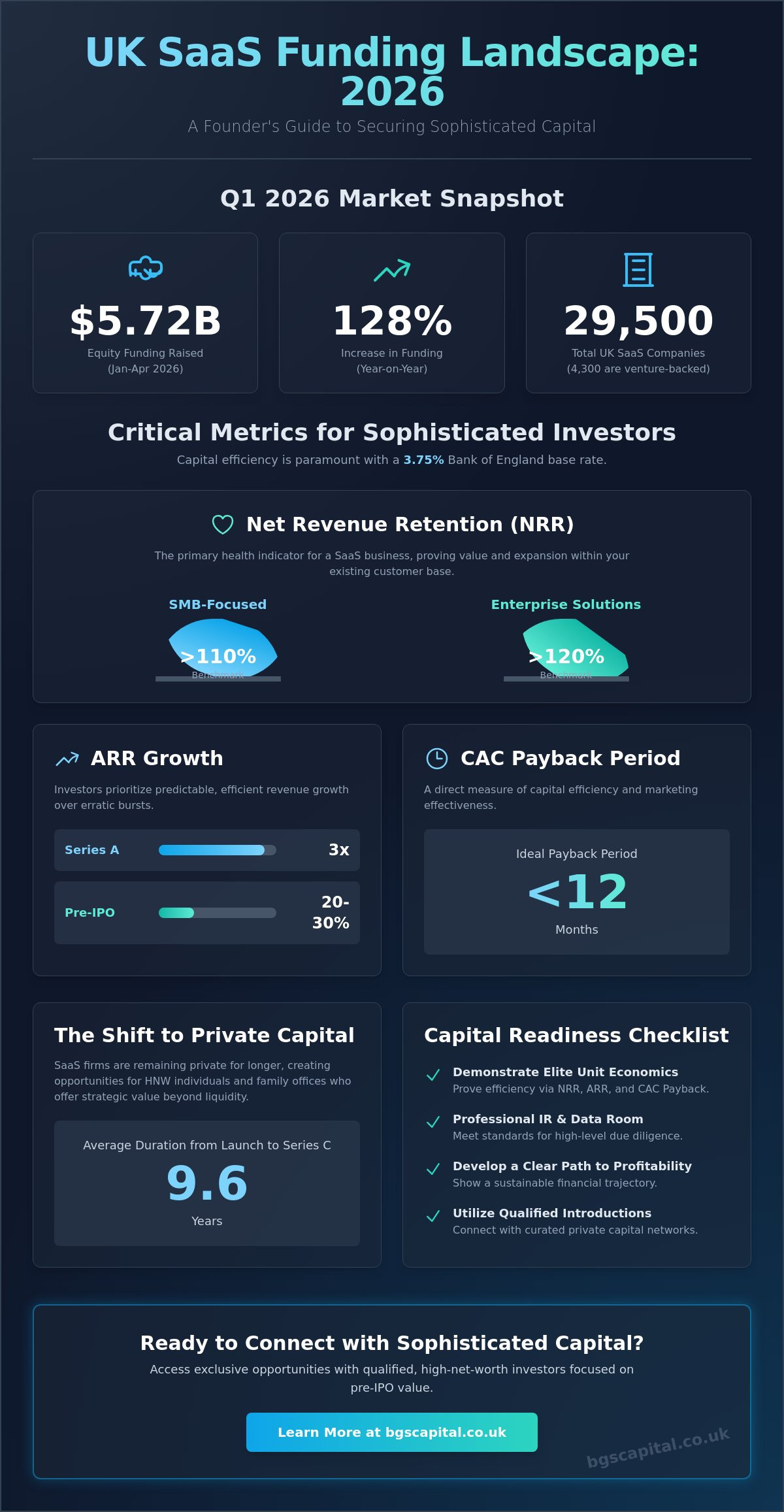
SaaS funding represents a specialized capital injection tailored to high-margin, recurring revenue models. In the UK, this sector has demonstrated significant resilience despite broader economic shifts. By April 2026, UK SaaS companies secured $5.72 billion in equity funding, marking a 128% increase over the same period in the previous year. This growth is supported by a robust ecosystem of 29,500 companies, of which over 4,300 are currently venture-backed. Identifying the right funding for saas startups uk requires an understanding of how institutional and private capital interact within this mature market.
The UK remains a global hub for software innovation due to targeted tax incentives and a high concentration of technical talent. London, Manchester, and Edinburgh currently account for 85% of all pre-seed activity. For founders, the choice between institutional venture capital and private sophisticated capital depends on growth stage and long-term exit goals. While institutional funds provide scale, private networks often offer more streamlined paths to capital for companies with verified unit economics and sustainable growth metrics.
The Shift Toward Private Placement
Many SaaS firms now choose to remain private for longer periods. The average duration from launch to Series C has expanded to 9.6 years. This shift has elevated the role of high-net-worth (HNW) individuals and private family offices in the tech ecosystem. These investors often provide strategic value that exceeds simple liquidity, offering industry-specific expertise and high-level networking opportunities. For a foundational understanding of these structures, Venture Capital Funding Explained provides context on traditional equity models versus modern private placements. Accessing these networks requires professional business listings and targeted introductions to ensure visibility among qualified capital providers who prioritize pre-IPO value.
Regulatory Context and Investor Protections
Transparency is a non-negotiable requirement in the 2026 market. The UK regulatory environment demands FCA-compliant communication for all investment promotions to ensure market integrity. Access to exclusive private deals is restricted to those who hold valid sophisticated investor or high-net-worth certificates. This gatekeeping ensures that capital flows from individuals who understand the inherent risks of the software sector. Founders must prioritize a clear risk-to-capital narrative, demonstrating that their business has genuine growth potential and a path to profitability. Maintaining a robust investor relations function is essential for surviving the rigorous due diligence processes that define modern funding for saas startups uk.
Critical Metrics Investors Demand: Beyond ARR and Churn
Securing funding for saas startups uk in 2026 requires more than a high growth rate. While the UK sector raised $5.72 billion in the first four months of the year, this capital is increasingly concentrated in companies that demonstrate elite unit economics. Investors now prioritize Annual Recurring Revenue (ARR) growth that’s predictable rather than erratic. For Series A rounds, the market still expects a 3x year-on-year growth trajectory. As companies approach pre-IPO stages, this expectation shifts toward a sustainable 20% to 30% growth rate supported by high-value enterprise contracts. You must demonstrate that your revenue isn’t just increasing, but doing so efficiently.
Net Revenue Retention (NRR) has become the primary health indicator for software businesses. Sophisticated investors look for NRR benchmarks exceeding 110% for SMB-focused models and 120% for enterprise solutions. This metric proves that your product provides enough value to expand within your existing customer base. In a high-interest environment where the Bank of England base rate sits at 3.75%, capital efficiency is paramount. Customer Acquisition Cost (CAC) payback periods should ideally remain under 12 months. Founders often utilize UK Government Grants for Startups to offset these initial acquisition costs and preserve equity for later stages.
The Quality of Revenue
Investors distinguish between “tourist” users and long-term enterprise commitments. Churn rates are scrutinized heavily because they directly dictate valuation multiples in the current UK market. A high churn rate suggests a lack of product-market fit or a weak competitive moat. You should focus on diversifying revenue streams within your product to avoid over-reliance on a single client or sector. Professional networks prioritize businesses that show a clear transition from experimental pilot programs to multi-year, legally binding service agreements.
Operational Efficiency and EBITDA
The 2026 investment trend has moved decisively away from “growth at all costs.” Sustainable scaling is the new mandate. Sophisticated capital providers look for margin expansion and a clear path to positive EBITDA. For AI-driven SaaS firms, the Rule of 40 dictates that the sum of the annual revenue growth rate and the EBITDA margin must equal or exceed 40% to demonstrate elite operational performance. Demonstrating this balance is essential before seeking investor introductions. Accessing high-level capital networks requires your financial data to reflect this shift toward operational maturity and fiscal discipline.
Strategic Funding Routes: From Seed Capital to Pre-IPO Placement
Venture capital remains the primary engine for high-growth software, yet the path to funding for saas startups uk often involves a transition to private equity as businesses mature. Early-stage validation typically relies on angel investors who provide the initial capital necessary to reach product-market fit. As a company scales, the complexity of startup funding increases, moving from venture-led Series A rounds to private equity placements that prioritize operational stability and cash flow. For founders developing deep tech or R&D-heavy software, Innovate UK provides critical non-dilutive support that bridges the gap between equity rounds.
The distinction between these routes is essential for long-term equity management. While venture capital firms often demand significant board control, private equity and sophisticated individual investors may offer more flexible terms for established firms. In the first four months of 2026, the UK saw 110 funding rounds, demonstrating that capital is available for those who select the route most aligned with their current metrics. Navigating this ecosystem requires a clear understanding of where your business sits on the growth curve and which investor profiles match your specific sector.
Tax-Efficient Schemes for UK Investors
The UK government incentivizes private capital through established tax-efficient structures. The Seed Enterprise Investment Scheme (SEIS) allows companies to raise up to a lifetime limit of £250,000, provided they have been trading for less than three years and have fewer than 25 full-time employees. For larger requirements, the EIS offers a significantly higher ceiling. From April 6, 2026, the annual fundraising limit for EIS increased to £10 million, with a lifetime limit of £24 million. Founders must ensure their business remains EIS-compatible by adhering to the risk-to-capital condition and maintaining gross assets under £30 million before investment. These schemes are vital because they mitigate investor risk and influence capital gains tax liabilities upon exit.
The Pre-IPO Opportunity
Pre-IPO funding represents the final private hurdle before a public listing. This stage is no longer reserved for institutional giants; sophisticated private investors increasingly seek entry points at this juncture to capture value before the liquidity event of an IPO. Mature SaaS companies must position themselves as IPO-ready by demonstrating rigorous governance and audited financials. Successfully securing funding for saas startups uk at this level requires visibility within professional introducer networks. These networks facilitate connections between high-growth firms and qualified individuals who understand the specific risk profile of pre-IPO software assets. Verification of professional status is a mandatory requirement for accessing these exclusive placement opportunities.
Preparing Your SaaS for Sophisticated Capital Introduction
Sophisticated investors in 2026 demand a level of operational transparency that exceeds standard venture capital requirements. Securing high-level funding for saas startups uk now hinges on the quality of your Investor Relations (IR) function. This function isn’t merely about sending occasional updates; it’s a systematic approach to managing expectations and reporting metrics with institutional precision. You must provide a data room that’s fully prepared for rigorous professional due diligence before any introductions occur. This includes verified contracts, clean cap tables, and a comprehensive “Path to Profitability” that aligns with the Rule of 40 metrics. In an environment where the Bank of England base rate is 3.75%, capital is deployed with significantly more caution than in previous cycles.
Your pitch deck must evolve to address the concerns of private capital networks. While growth remains a factor, the focus has shifted toward long-term sustainability and margin expansion. You’re no longer just selling a product; you’re selling a financial asset with predictable returns. Ensuring your business is ready to be featured to a curated network means having your financial and legal documentation verified and accessible. This preparation signals to the market that your SaaS is a professional operation ready for sophisticated placement.
Investor Readiness Checklist
- Audited Financials: Present at least two years of audited accounts to provide a baseline for your valuation.
- Cap Table Management: Ensure your cap table is uncluttered and accurately reflects all previous EIS or SEIS rounds.
- Intellectual Property: Provide clear evidence of IP ownership and recent software audits to verify code integrity and security.
- Founder Presence: The founder’s role in introductions is to project authority and a deep understanding of the sector’s regulatory landscape.
Navigating the Introduction Process
The 2026 UK market places high value on the “Sophisticated Investor” classification. Under current regulations, specific private placements are only accessible to individuals who meet verified financial or professional criteria. Professional introducers act as essential gatekeepers, ensuring your pitch reaches only those who are legally qualified to participate. This distinction is critical. A qualified introduction carries the weight of a pre-vetted opportunity, whereas a cold reach is often ignored by serious private capital networks. Maintaining momentum during a funding round requires you to be featured within a network that understands these regulatory nuances. This ensures your business isn’t just visible, but visible to the right class of capital. To increase your visibility among these qualified groups, consider a professional business listing to signal your readiness to the market. This positioning confirms that your business meets the rigorous standards required for exclusive private placement and funding for saas startups uk.
Scaling to Exit: Connecting with Professional Investor Networks
The transition from a growth-stage entity to a pre-IPO asset requires a fundamental shift in market engagement. While UK SaaS companies raised $5.72 billion in equity funding by April 2026, the final stages of a raise often hinge on access to non-institutional, sophisticated capital. BGS Capital operates as an established conduit to these exclusive opportunities. We facilitate introductions to a network of qualified individuals and private equity firms that understand the complexities of high-level software transactions. This approach ensures your search for funding for saas startups uk reaches a pre-vetted audience capable of supporting late-stage rounds and pre-IPO placements.
Accessing a database of high-net-worth individuals and wealth managers requires more than a standard pitch. It demands visibility on a platform that prioritizes professional status and regulatory compliance. By featuring your business on a dedicated pre-IPO platform, you move beyond the limitations of traditional venture rounds. This environment allows you to engage directly with investor relations teams who are actively seeking software-as-a-service innovation with proven unit economics. Moving from a featured listing to direct engagement is the final step in securing sophisticated capital.
Why Feature Your Business with BGS Capital?
Exclusivity is a core requirement for late-stage software firms. Featuring your business provides exposure to a curated network of accredited investment firms without compromising your brand reputation through broad, unvetted outreach. Direct introductions to professional investor relations teams streamline the engagement process. This efficiency is critical in a market where the average time from launch to Series C has expanded to 9.6 years. You maintain control over your narrative while gaining visibility among those who prioritize pre-IPO value and long-term exit potential.
Next Steps for High-Growth Founders
The first step is to verify your business eligibility for a featured listing. Professional networks require businesses to meet specific benchmarks before they are presented to our network of wealth managers and high-net-worth individuals. This gatekeeping function protects the integrity of the ecosystem and ensures that only high-growth, sophisticated opportunities are featured. Once verified, you can begin the process of direct investor engagement to secure the final stage of funding for saas startups uk. Are you ready to present your business to a qualified network? FEATURE YOUR BUSINESS today to start your introduction journey.
Strategic Deployment of Capital in 2026
The 2026 UK SaaS market rewards operational discipline and fiscal maturity. Success depends on aligning your recurring revenue model with the specific expectations of private capital networks. You must prioritize high-value enterprise contracts and maintain NRR benchmarks that exceed 120% to attract serious interest. Navigating the funding for saas startups uk ecosystem requires more than a strong product; it necessitates a professional IR function and a data room prepared for institutional-grade due diligence. Each metric must demonstrate a clear path to profitability to survive the scrutiny of sophisticated placement rounds.
Accessing exclusive opportunities involves moving beyond traditional venture capital toward curated private placements. BGS Capital acts as a specialist facilitator for pre-IPO and IPO opportunities. We provide direct introductions to professional investor relations teams and a curated network of HNW and sophisticated investors. This process ensures your business is positioned as a credible asset for those seeking high-growth software investments. Are you ready to verify your eligibility for a featured listing and connect with professional capital?
FEATURE YOUR BUSINESS: Connect with Sophisticated Investors
The opportunity for significant capital deployment remains robust for founders who adhere to these rigorous standards. Your path to a successful exit starts with the right introductions.
Frequently Asked Questions
What is the most common funding route for UK SaaS startups?
Angel investment and venture capital remain the primary pathways for early-stage software firms. Most founders utilize the Seed Enterprise Investment Scheme (SEIS) for the initial £250,000 before transitioning to institutional venture rounds. In the first four months of 2026, the UK completed 110 funding rounds, highlighting a competitive but active market for companies with proven recurring revenue models.
How much ARR do I need to attract venture capital in 2026?
Series A investors generally expect a minimum of £1 million in Annual Recurring Revenue (ARR) with a clear trajectory toward £3 million. Late-stage and pre-IPO rounds demand significantly higher revenue bases and superior unit economics. Investors prioritize the Rule of 40, where the combined growth rate and EBITDA margin must equal or exceed 40% to demonstrate elite operational performance.
What is a sophisticated investor in the UK?
A sophisticated investor is a regulatory classification for individuals who possess the knowledge and experience to evaluate high-stakes private placements. They must hold a valid certificate confirming their status under FCA-compliant standards. This classification is a mandatory requirement for accessing exclusive funding for saas startups uk opportunities that aren’t available to the retail public.
Can I use EIS or SEIS for my SaaS startup funding?
Most SaaS firms qualify for these schemes if they meet the risk-to-capital condition and specific asset limits. From April 6, 2026, the annual EIS fundraising limit is £10 million, provided your gross assets don’t exceed £30 million before the investment. These tax-efficient structures are vital for incentivizing private capital and mitigating risk for high-net-worth individuals entering the software sector.
How does pre-IPO funding differ from Series C?
Series C is typically the final major expansion round focused on scaling market share and entering new territories. Pre-IPO funding is a specialized bridge that prepares the cap table and governance structures for a public listing. It requires audited financials and rigorous internal controls that exceed standard venture capital requirements to ensure the business is ready for the public markets.
What are the main costs associated with raising capital in the UK?
Primary costs include legal due diligence, comprehensive financial audits, and fees for featuring your business on professional introduction platforms. Founders should also budget for intellectual property protection and software audits to verify code integrity. These expenses are necessary to ensure the business meets the standards required for professional investor engagement and sophisticated placement.
How do I prepare a SaaS business for a professional investor introduction?
You must establish a robust investor relations function and a complete data room before seeking an introduction. This includes two years of audited accounts, verified intellectual property ownership, and a clean cap table. High-level funding for saas startups uk depends on your ability to present a documented path to profitability that withstands rigorous professional scrutiny from private capital networks.
What role does BGS Capital play in the funding process?
BGS Capital operates as a specialist intermediary and network connector for high-growth firms. We provide a professional business listing service and facilitate direct introductions to sophisticated investors and wealth managers. We don’t manage investment funds or provide financial advice; our role is to bridge the gap between qualified businesses and exclusive private capital networks.