
Did you know that 96% of venture capital deals recorded in late 2024 utilized a 1x liquidation preference multiple? While this figure suggests a uniform market standard, the underlying mechanics of what is a liquidation preference serve as the economic “priority code” for your cap table. These clauses function as essential risk management tools that determine exactly which shareholders receive proceeds first when a company is sold or wound up.
It is common to feel overwhelmed by the technical complexity of term sheet clauses or the looming risk of equity dilution. You require absolute certainty regarding exit payouts rather than surprises during a high stakes corporate transaction. This guide provides the professional foundation required to master these mechanics and protect your financial interests. We will analyze the functional differences between non-participating and participating structures, explain how seniority “stacks” impact investor returns, and provide the data needed to negotiate fair terms in the current market. By the end of this analysis, you will possess the ability to identify aggressive investment terms that could jeopardize your long term equity value.
Key Takeaways
- Identify specific triggers for payout priority. Recognize that liquidation events extend to mergers, acquisitions, and asset sales rather than just insolvency.
- Master what is a liquidation preference to evaluate exit outcomes accurately. Differentiate between standard 1x multiples and aggressive structures while distinguishing between non-participating and participating rights.
- Analyze the “Priority Stack” to determine seniority in complex cap tables. Apply the Last-In, First-Out (LIFO) principle to predict the distribution of proceeds across multiple investment rounds.
- Evaluate the strategic impact of term sheet clauses on founder motivation. Understand how preference terms influence subsequent capital raises and the ability to attract growth capital.
- Secure access to exclusive UK investment opportunities. Leverage professional intermediary channels to identify vetted companies seeking growth capital through business listings and introductions.
Defining Liquidation Preference in Venture Capital
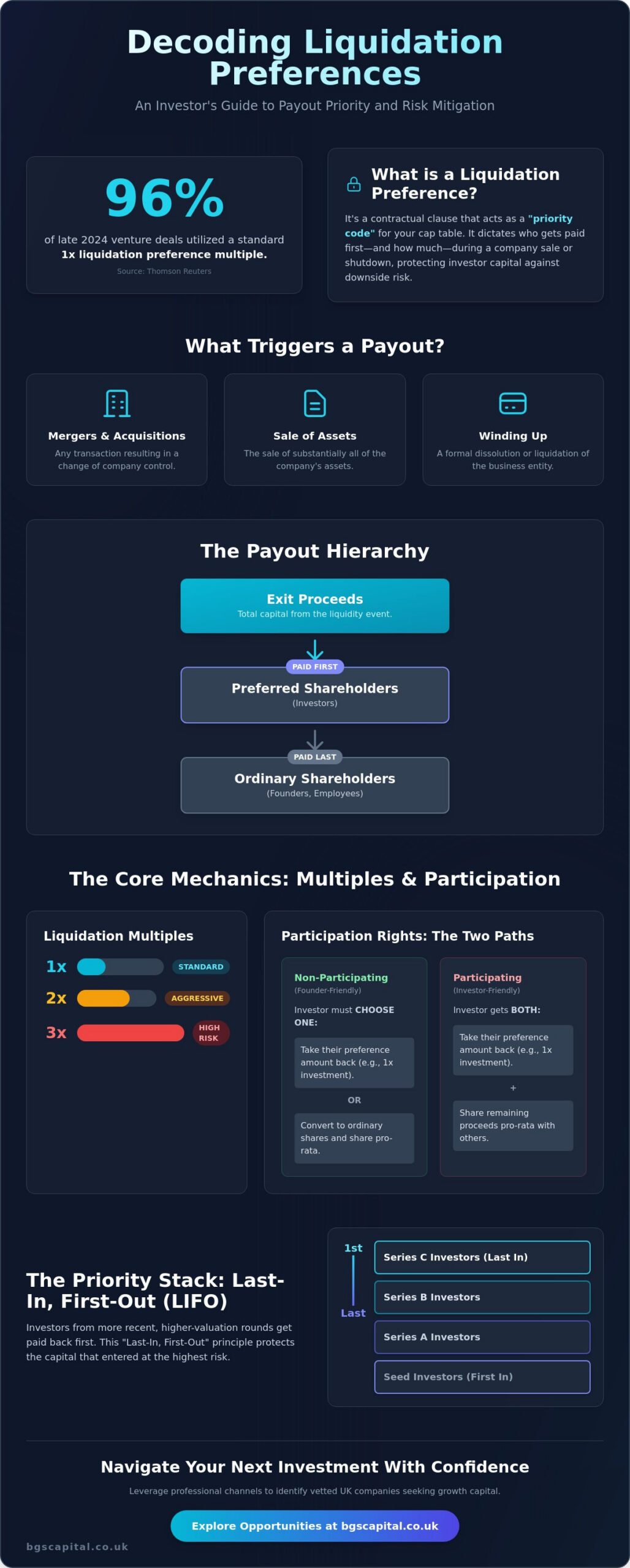
A liquidation preference is a critical contractual provision within a company’s articles of association or shareholders’ agreement. It dictates the specific order and amount of capital distributed to shareholders during a liquidity event. Understanding what is a liquidation preference requires looking beyond the narrow definition of insolvency or bankruptcy. In professional venture finance, a “liquidation event” encompasses any transaction that results in a change of control or a return of capital. This includes:
- Mergers and acquisitions where the company is the target.
- The sale of substantially all company assets.
- A formal winding up or dissolution of the entity.
- An Initial Public Offering (IPO), though preferences often convert to ordinary shares at this stage.
This clause serves as a standard requirement for private equity and venture capital firms. It establishes a clear economic hierarchy, ensuring that specific investors receive their capital back before other stakeholders. Without this protection, investors would share proceeds pro-rata with founders and employees regardless of the entry price or risk profile. For sophisticated investors, this isn’t merely a preference; it’s a fundamental mechanism for capital preservation in high-stakes environments.
The Core Purpose: Risk Mitigation
Risk mitigation remains the primary driver for these terms. Investors often provide capital at high valuations, placing them at significant risk if the company exits for less than its last private market valuation. The preference protects the “last money in” by guaranteeing a return of the initial investment before common shareholders receive any payout. This structure is particularly vital for high-net-worth individuals participating in pre-IPO rounds. It provides a necessary safety net against downside scenarios while allowing participation in the upside potential of a successful exit. If a company sells for a price lower than the total capital raised, the liquidation preference ensures the investors are made whole first.
Preferred vs Ordinary Shareholders
Share classes define the economic rights and priorities of the business. Investors typically receive preferred shares, which carry superior rights to dividends and capital distributions. In the UK, these rights are formally documented to ensure clarity during complex transactions. Founders and employees generally hold ordinary shares, which sit at the bottom of the payout stack. This means ordinary shareholders only receive proceeds after all preferred obligations are satisfied. While this creates a high bar for founder returns in a modest exit, it aligns interests toward achieving a high-value liquidity event that clears the preference stack and distributes remaining value across the entire cap table. Understanding what is a liquidation preference is therefore essential for any founder negotiating a term sheet, as it directly impacts their ultimate take-home pay.
The Mechanics: Multiples and Participation Rights
The economic impact of a term sheet depends largely on the designated multiple. In late 2024, approximately 96% of venture deals utilized a 1x multiple, which serves as the current market standard according to Thomson Reuters. A 1x multiple ensures the investor receives exactly their initial capital back before other distributions occur. When a term sheet specifies a 2x or 3x multiple, it’s considered aggressive. These higher multiples typically appear during down rounds or bridge financing where the risk profile is significantly elevated. For those evaluating what is a liquidation preference in a competitive round, the multiple is the first line of defense against capital loss.
Non-Participating Preferred: The Standard Choice
Non-participating preferred shares are widely regarded as the founder-friendly option in the UK. Under this structure, the investor must choose between two mutually exclusive outcomes at the time of exit. They can either exercise their preference to recoup their initial investment or convert their preferred shares into ordinary shares to participate pro-rata in the total proceeds. They cannot do both. The conversion point occurs when the pro-rata share of the total exit value exceeds the fixed preference amount. This mechanism prevents investors from over-recovering at the expense of founders in high-value exits. Investors seeking to understand What is a Liquidation Preference? often start here to grasp the basic trade-off between downside protection and upside participation.
Participating Preferred: The ‘Double Dip’
Participating preferred shares allow an investor to receive their preference amount and then share in the remaining proceeds on a pro-rata basis. This is frequently referred to as “double dipping” because the investor recovers their capital before sharing the remaining pool as if they were an ordinary shareholder. This structure significantly reduces the effective ownership of founders and employees during an exit. While less common in Series A rounds, sophisticated investors might insist on participation rights in distressed scenarios or high-risk sectors. To mitigate the dilution, founders often negotiate a “cap” on participation. A 3x cap, for example, stops the investor from participating further once their total return reaches three times their initial investment. Understanding these nuances is vital for anyone reviewing startup funding opportunities where term sheet structures vary by growth stage.
Participation rights effectively shift the economic reality of the cap table. In a participating scenario, a 20% equity stake doesn’t necessarily equate to 20% of the exit proceeds. The preference amount is subtracted first, and the 20% is calculated from the remaining balance. This distinction is why what is a liquidation preference remains a central point of negotiation in every funding round. Founders must model these scenarios carefully to understand their actual take-home value under different exit valuations.
The Priority Stack: Seniority and Payout Order
The “Priority Stack” describes the sequence in which different classes of preferred shares receive distributions during a liquidity event. While a single funding round is straightforward, multi-round financing creates a layered hierarchy that dictates the order of payout. Understanding what is a liquidation preference in this context requires analyzing how Series A, B, and C investors interact when proceeds are distributed. The arrangement of these layers determines who recovers their capital first and who might receive nothing if the exit value is insufficient to clear the entire stack.
Last-In, First-Out (LIFO) vs Pari Passu
Standard seniority in venture finance often follows the Last-In, First-Out (LIFO) principle. This means later-stage investors, such as those in a Series C round, sit at the top of the stack and receive their preference before Series B or Series A investors. This structure compensates later investors for entering at higher valuations with less room for error. Alternatively, some rounds are structured as Pari Passu. Pari Passu is a state where all preferred investors hold equal payout rank. In a Pari Passu arrangement, if exit proceeds cannot cover all preferences, the available funds are distributed pro-rata among all preferred shareholders. This Liquidation Preference Explained resource details how these rankings function across global markets. For early-stage angel investors, a LIFO stack is often disadvantageous, as their capital sits at the bottom of the preferred hierarchy.
Exit Scenario Analysis
The practical impact of the priority stack depends entirely on the company’s final valuation relative to the total capital raised.
- The Fire Sale: If a company exits below its total capital raised, the priority stack ensures that senior investors recoup as much as possible. Ordinary shareholders and junior preferred investors often receive zero proceeds in these scenarios.
- The Home Run: When the exit valuation is exceptionally high, every investor’s pro-rata share exceeds their preference amount. At this conversion point, the stack becomes irrelevant because everyone converts to ordinary shares to maximize their return.
- The Muddle Through: This is the most contentious scenario. The exit value is high enough to pay the senior preferences but leaves little for the junior stack or founders. In these cases, what is a liquidation preference becomes the primary driver of value allocation, often shifting significant wealth from the founding team to the most recent investors.
Founders must monitor the accumulation of these preferences across rounds. As the preference stack grows, the “effective” valuation required for founders to see a meaningful return increases. While 1x preferences were used in over 80% of Series A and B deals in 2024-2025, the seniority of later rounds can still squeeze early stakeholders during a modest exit.
Strategic Implications for Founders and Investors
Aggressive preference structures don’t just shift economics; they alter founder psychology. If the preference stack exceeds the likely exit value, the founding team effectively becomes employees of the investors. This misalignment can lead to “founder fatigue” and decreased operational performance. Negotiating what is a liquidation preference early on ensures that the team remains incentivized to drive the company toward a high-value exit. A well-structured term sheet balances investor protection with enough founder upside to maintain long term commitment.
Future startup funding rounds are heavily influenced by the terms of the previous round. New investors rarely accept terms less favorable than those held by existing shareholders. If a Series A investor holds a 2x participating preference, Series B investors will likely demand the same or better. This creates a compounding effect that can quickly erode the common equity pool. Capped participation serves as a professional middle ground. By limiting the “double dip” to a specific multiple, such as 3x, founders can protect their equity in “home run” scenarios while still providing investors with enhanced returns in mid-tier exits.
Common Pitfalls in Term Sheet Negotiation
One of the most dangerous pitfalls is accepting a “stacked” preference structure without modeling the outcomes. Founders often prioritize a higher headline valuation while conceding on liquidation multiples or participation rights. In reality, a lower valuation with “clean” 1x non-participating terms is often superior to a high valuation with aggressive preferences. The role of venture capital in setting these standards is significant. Market data from 2024-2025 shows that 80-85% of Series A and B deals utilized 1x non-participating terms. Deviating from this standard requires a strong justification, such as a distressed bridge round or a significant increase in the investment’s risk profile.
Downside Protection for Sophisticated Investors
Sophisticated investors use 1x non-participating preferences as a baseline for risk management. This structure ensures capital preservation without creating a toxic cap table that discourages future talent. These preferences also interact with capital gains tax considerations at the point of exit. In the UK, the structure of the payout can impact the eligibility for specific tax reliefs, especially if the company has utilized EIS or SEIS schemes. Investors evaluating pre-IPO opportunities must analyze the existing preference stack to determine their actual position in the payout hierarchy. Understanding what is a liquidation preference in the context of the total capital raised is the only way to accurately project net returns.
To identify high-growth UK businesses with professional capital structures, view our current business listings.
Connecting Sophisticated Investors with UK Opportunities
Mastering the technical nuances of what is a liquidation preference is a prerequisite for professional engagement in the private equity sector. This knowledge allows investors to evaluate the risk-reward profile of a cap table with precision. For founders, it is a critical component of how to find investors who provide not only capital but also a commitment to professional corporate governance. BGS Capital serves as a conduit within this ecosystem, connecting vetted UK companies with a network of qualified individuals and institutional entities. We focus on high-growth opportunities transitioning toward significant liquidity events, including pre-IPO and IPO stages.
The UK regulatory landscape is currently undergoing a shift toward more flexible, post-Brexit frameworks. With the full implementation of the Consumer Composite Investments (CCI) regime expected by June 2027 and new FCA rules on non-financial misconduct taking effect in September 2026, transparency is paramount. Our role as an intermediary ensures that both parties operate within a framework of professional disclosure. We provide the infrastructure for businesses to list their opportunities and for investors to identify firms that adhere to market-standard economic terms, such as the 1x non-participating preference found in over 96% of recent venture deals.
Accessing the BGS Capital Network
BGS Capital operates a curated database designed for efficiency and exclusivity. We facilitate direct introductions to the investor relations teams of high-growth UK firms. Our service model is built on specific functional benefits:
- Direct Introductions: We remove the barriers between sophisticated investors and corporate leadership.
- Vetted Listings: Our platform features businesses that have demonstrated a clear path toward scale and professionalized their capital structures.
- Intermediary Framing: We act as a connector and network facilitator. We do not provide financial advice, manage investment funds, or execute transactions.
Next Steps for Founders and Investors
Are you a certified sophisticated investor or a high-net-worth individual? Verification of your status is the mandatory first step to unlock access to our exclusive business listings. This qualification gate ensures that all participants possess the financial literacy required to navigate complex clauses like the liquidation preference stack. For founders, featuring your business on our platform provides immediate exposure to a network of accredited investment firms and private capital providers. Professional introductions are the lifeblood of the private equity ecosystem. By aligning with market standards and utilizing professional intermediary channels, you protect your long-term interests and position your entity for a successful exit. Are you ready to verify your eligibility?
Optimizing Your Position for Corporate Exit
Mastering the technicalities of payout priority and seniority stacks is a prerequisite for professional equity management. Identifying the nuances of what is a liquidation preference ensures that you can evaluate term sheets with the precision required to protect long term value. Whether you are navigating a 1x non-participating standard or a complex participating structure; the economic reality of your cap table depends on these specific contractual rights. You now possess the analytical framework to distinguish between founder friendly terms and aggressive investor protections that could impact your final proceeds.
BGS Capital serves as a specialist introducer for pre-IPO and IPO opportunities. We maintain a curated network of high-net-worth individuals and provide free access for qualified investors to our database of vetted businesses. If you are a founder seeking growth capital or an investor looking for high level financial activity, our platform facilitates the professional introductions necessary for success. Professional preparation is the key to securing favorable exit outcomes and maintaining equity integrity.
FEATURE YOUR BUSINESS and connect with sophisticated investors
Frequently Asked Questions
What is the difference between participating and non-participating liquidation preference?
A participating preference allows investors to receive their initial investment back and then share the remaining proceeds pro-rata with common shareholders. This is often called a “double dip.” Conversely, a non-participating preference requires the investor to choose between receiving their fixed preference amount or converting to ordinary shares to share in the total proceeds pro-rata. Non-participating terms are generally more founder-friendly.
Is a 1x liquidation preference standard in the UK?
Yes, the 1x non-participating preference is the current market standard for venture capital in the UK. Data from 2024 and 2025 indicates that between 80% and 85% of Series A and Series B rounds utilized this specific structure. It protects the investor’s downside without excessively diluting the founding team during a successful exit, making it a balanced baseline for professional negotiations.
Can a liquidation preference be triggered by a merger?
Yes, a merger is almost always defined as a “liquidation event” within a company’s articles of association. Contractual definitions of what is a liquidation preference extend beyond bankruptcy to include acquisitions, asset sales, and changes in control. Any transaction where shareholders receive cash or stock in exchange for their holdings will typically trigger the priority payout hierarchy established in the term sheet.
How does a liquidation preference affect common stockholders?
Common stockholders occupy the lowest tier of the capital structure and only receive proceeds after all preferred obligations are met. This creates a valuation hurdle that the company must exceed before founders and employees see any financial return. If the exit price is lower than the total preference stack, common stockholders may receive zero proceeds from the transaction despite holding significant equity percentages.
What happens to liquidation preferences if a company goes public (IPO)?
Liquidation preferences usually terminate upon an Initial Public Offering. Preferred shares typically convert into ordinary shares at a one-to-one ratio as part of the listing process. This conversion ensures that all shareholders hold the same class of stock and receive equal treatment in the public markets, effectively removing the priority payout status held during the private stages of the company’s growth.
What is a ‘stacked’ liquidation preference?
A stacked preference refers to a tiered seniority structure where different investment rounds have different payout priorities. Under the Last-In, First-Out (LIFO) principle, Series C investors are paid before Series B, who are paid before Series A. This creates a vertical hierarchy that can significantly reduce the proceeds available to earlier investors and founders in a modest exit scenario where capital is limited.
Why do investors ask for a 2x or 3x liquidation preference?
Investors demand higher multiples to compensate for significantly elevated risk levels. These aggressive terms are common in down rounds, where the company valuation has decreased, or in bridge financing for distressed firms. A 2x or 3x multiple ensures the investor receives a multiple of their capital before junior stakeholders participate, acting as a form of insurance against further valuation decline or capital loss.
Does a liquidation preference apply to debt holders?
No, liquidation preferences are exclusive to preferred equity shareholders. Debt holders, including banks and venture debt providers, sit above all equity holders in the capital structure. They must be repaid in full, including interest, before any distribution occurs to preferred or common shareholders. Understanding what is a liquidation preference is vital for equity holders to grasp their actual position relative to senior creditors and secured lenders.