
For a sophisticated founder, a vesting schedule isn’t a sign of distrust; it’s the primary mechanism for protecting your enterprise value from the volatility of human capital. What if your equity structure was the single greatest barrier to your next funding round? High-net-worth investors and institutional funds view unvested equity as a critical risk mitigation tool, not a penalty on your ownership. This founder vesting schedule explained guide addresses the strategic necessity of aligning co-founder commitments with long-term growth objectives.
You already recognize the tension between maintaining control and satisfying the rigorous demands of professional capital. Concerns regarding complex leaver provisions or misalignment within the leadership team are valid obstacles to institutional readiness. Mastering these mechanics is essential to secure the investor confidence required for pre-IPO scaling. We’ll show you how to build a term-sheet-ready structure that accounts for the April 2026 increase in Business Asset Disposal Relief rates to 18% and the expanded EIS gross asset thresholds. You’ll gain a clear framework for balancing UK legal compliance with strategic enterprise protection.
Key Takeaways
- Differentiate between standard and reverse vesting models to ensure compliance within the UK corporate framework.
- Review this founder vesting schedule explained guide to mitigate Key Person Risk and satisfy the requirements of sophisticated capital providers.
- Implement market-standard benchmarks, including the four-year duration and one-year cliff, to demonstrate enterprise maturity.
- Protect equity retention through defined leaver provisions and manage tax exposure with mandatory Section 431 elections.
- Standardise your vesting structure to accelerate due diligence and facilitate high-level investor introductions.
Understanding Founder Vesting: Mechanics of Equity Accrual
Vesting is a contractual process where a founder earns their right to full equity ownership over a predetermined period. It’s not an emotional hurdle. It’s a structural guarantee that ensures every participant remains incentivised to build enterprise value. Without a clear founder vesting schedule explained within your shareholders’ agreement, your cap table remains vulnerable to “dead equity” from early departures. This occurs when a founder leaves the business early but retains a significant portion of the company, diluting the remaining team and making the entity uninvestable.
Sophisticated investors view these schedules as mandatory. When seeking startup funding, you’ll find that institutional capital requires founders to “re-vest” their shares even if they’ve been working on the venture for years. This ensures that the team driving the pre-IPO growth is legally bound to the company’s future. It protects the collective effort. It ensures that if one person stops contributing, they don’t walk away with a windfall at the expense of those who stayed.
The Mechanism of Reverse Vesting
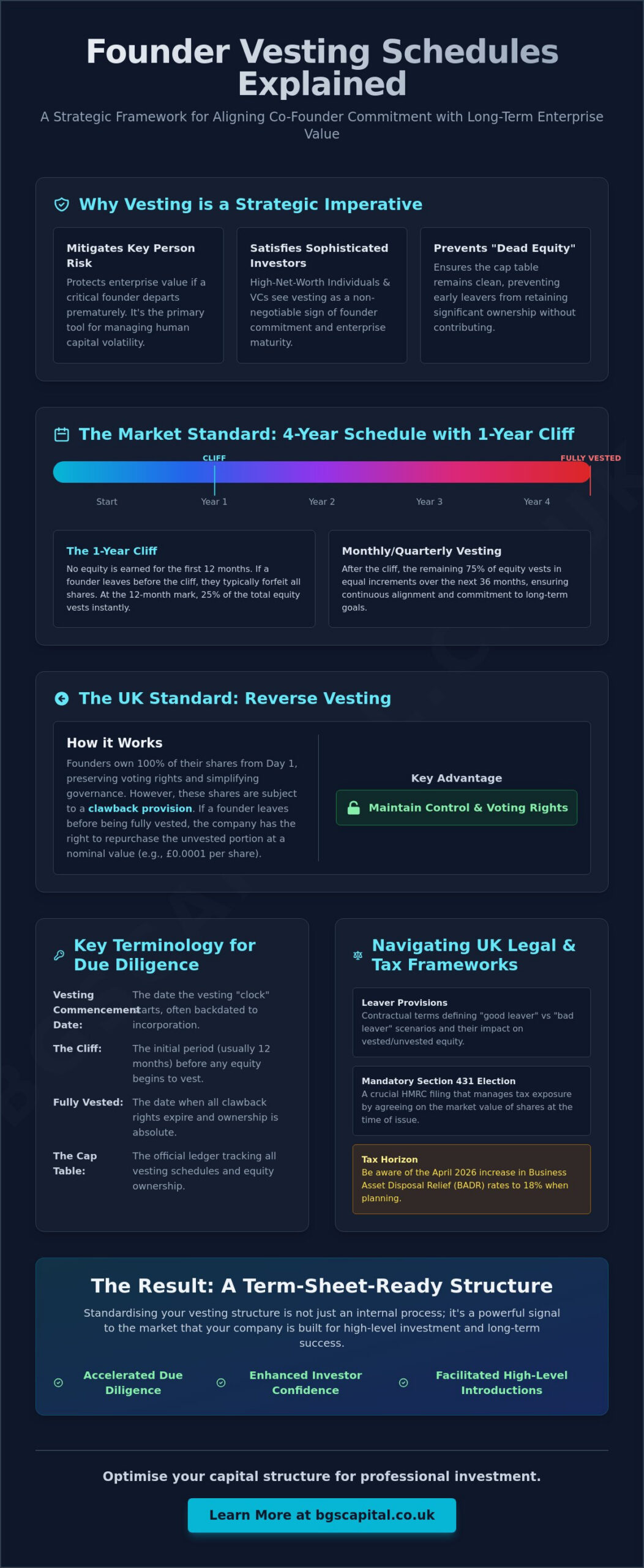
In the UK ecosystem, the reverse vesting model is the prevailing standard. Founders technically own 100% of their shares from day one, which preserves their voting rights and simplifies corporate governance. However, these shares are subject to clawback provisions. If a founder leaves before the schedule concludes, the company holds a legal right to repurchase unvested equity at nominal value. This is often as low as £0.0001 per share. This distinction is vital; you maintain the control required to run the business, but you earn the economic rights to the exit over time.
Key Technical Terminology
Precision in documentation is non-negotiable for due diligence. Investors expect to see a founder vesting schedule explained through these specific metrics:
- Vesting Commencement Date (VCD): The agreed-upon date when the clock starts. This is frequently backdated to the company’s incorporation or the date of a specific funding round.
- The Cliff: A milestone, typically 12 months, where no equity is earned. If you leave before this date, you walk away with nothing. This prevents short-term fragmentation of the cap table.
- Fully Vested: The terminal milestone where all clawback rights expire and your ownership of the equity block becomes absolute and unrestricted.
- The Cap Table: The central ledger where these schedules are tracked. Professional investors scrutinise this record to ensure the founding team remains sufficiently incentivised for the long-term scale-up journey.
Why Sophisticated Investors Mandate Vesting Schedules
Sophisticated investors prioritise stability over sentiment. For High-Net-Worth Individuals (HNWIs) and institutional funds, the primary risk is not market failure but the loss of human capital. This is known as Key Person Risk. If a critical founder departs shortly after a funding round, the remaining enterprise value collapses. A founder vesting schedule explained through the lens of risk mitigation shows that equity is the ultimate retention tool. It ensures the cap table remains clean and that every share is actively contributing to the mission.
Beyond individual risk, vesting creates structural alignment. It signals to capital providers that the founding team is committed to the multi-year journey required for a successful exit. When you standardise your equity accrual, you prepare the company for future venture capital or private equity interest. These entities expect professional-grade structures. They won’t tolerate “dead equity” where a former partner owns 20% of the business while doing zero work. Such imbalances make a company uninvestable during the due diligence phase.
The Investor Perspective on Founder Commitment
Institutional capital is a long-term bet. Investors provide liquidity and resources; in exchange, they require a time-based commitment from the leadership. Vesting acts as a proxy for management stability. While founders often argue they’ve already provided the initial value, investors focus on future performance. The value of your pre-incorporation sweat equity is acknowledged in your initial share price. Your vesting schedule, however, is a down payment on the future enterprise value you promise to create. It bridges the gap between current valuation and the eventual exit price.
Protecting Co-Founders and Equity Holders
Vesting is a mutual protection treaty. It protects you from your co-founders as much as it protects the investors. Imagine a scenario where a co-founder leaves after 14 months with a 30% stake. You and the remaining team are left to do 100% of the work for 70% of the rewards. This imbalance is a primary cause of startup failure. By implementing a standard schedule, you ensure a shared burden. If a partner leaves, their unvested shares are typically returned to the company or the option pool. This allows you to recycle that equity to hire a replacement executive without further diluting yourself. If you’re looking to secure professional backing, ensure your structure is ready for scrutiny. You can showcase your investment-ready business to our network of sophisticated investors.
Standard Vesting Benchmarks: Cliffs, Acceleration, and Durations
The four-year duration with a one-year cliff is the non-negotiable standard for UK tech and high-growth sectors. If a founder vesting schedule explained to a sophisticated investor deviates from this without significant justification, it raises immediate red flags regarding governance. This structure ensures that the core team is committed for a period long enough to achieve a meaningful valuation uplift or a liquidity event. While four years is the benchmark, some pre-IPO companies extending their runway might push schedules to five years for incoming executive talent.
Post-cliff, the remaining 75% of equity typically vests in equal instalments. Monthly vesting is the preferred market practice for its granularity. It provides a smoother accrual of value and simplifies the calculation of equity for any founder departing mid-year. Quarterly increments are less common in modern term sheets but still appear in legacy structures. For late-stage founders joining during a Series B or growth round, durations are often compressed to two or three years. This reflects their specific entry point and the company’s accelerated proximity to an exit.
The Anatomy of the 1-Year Cliff
The first 12 months serve as a probationary period for founder equity. If a founder leaves the business for any reason before the 12-month anniversary, they walk away with zero shares. This prevents the cap table from being cluttered by individuals who didn’t contribute to the first year of scale-up operations. On the 366th day, a “catch-up” vest occurs. The founder immediately secures 25% of their total equity allocation. From this point forward, the vesting transitions to the agreed monthly or quarterly schedule.
Single Trigger vs. Double Trigger Acceleration
Acceleration clauses protect founders during an acquisition or a successful IPO. A single-trigger clause allows for automatic, full vesting upon a change of control. Investors rarely accept this as it allows the founding team to exit immediately after a sale, leaving the buyer with a talent vacuum. The double-trigger mechanism is the market standard. It requires two events: a change of control AND the founder being terminated without cause within a specific window, usually 12 months. This ensures team continuity post-exit while protecting the founder’s economic interest if the new owners decide to restructure the leadership. Understanding these nuances is critical when presenting a founder vesting schedule explained to high-net-worth networks.
Navigating UK Legal Frameworks: Leaver Provisions and Tax
A robust equity structure requires more than a handshake. It must be codified within the company’s Articles of Association and Shareholders’ Agreement to be enforceable during a dispute or an exit. This founder vesting schedule explained through a legal lens focuses on the mechanics of departure and the mitigation of tax liabilities. In the UK ecosystem, these provisions determine how much equity you retain if you leave the business and, critically, how much of that value you keep after HMRC takes its share. Failure to align these documents with market standards can jeopardise your EIS eligibility, particularly following the April 2026 threshold increases to £30 million pre-money.
Good Leaver vs. Bad Leaver Definitions
Leaver provisions define the price at which the company can repurchase your shares. A “Bad Leaver” typically includes anyone terminated for fraud, gross misconduct, or voluntary resignation within a specific window. These individuals often forfeit all unvested shares and may be forced to sell vested shares at nominal value. Conversely, a “Good Leaver” status is granted in cases of death, permanent disability, or termination without cause. Good leavers generally retain their vested equity or sell it back at fair market value. Negotiating a “Middle Leaver” category is common in sophisticated growth rounds to account for nuanced departures that don’t fall into binary categories.
Tax Optimisation: The Section 431 Election
Tax compliance is a primary concern for founders during the vesting period. Without proactive planning, HMRC may view the “lifting” of restrictions as you vest as a taxable event for income tax purposes. This can lead to a significant cash-flow crisis if you’re taxed on a high paper valuation before an exit. A Section 431 election ensures that founders are taxed on the unrestricted market value of shares at the time of acquisition, rather than as employment income when they vest. You must sign this election within 92 days of the share issue. It effectively shifts the tax burden from high income tax rates to capital gains tax, which is more efficient even with the April 2026 BADR increase to 18%.
Vesting schedules must also respect the technical requirements of tax-advantaged schemes. While HMRC allows vesting on EIS shares, the specific rights attached to those shares cannot create a “second class” of equity that disqualifies the relief for your investors. Sophisticated capital providers will scrutinise your leaver provisions to ensure they don’t inadvertently trigger a clawback of their tax benefits. Ensuring your legal framework is ready for this level of inspection is a prerequisite for professional growth. If your structure is finalised, apply to feature your business for introduction to our network of qualified investors.
Optimising Your Capital Structure for Professional Investment
Operational excellence extends beyond your product. It resides in the architecture of your cap table. A clean, standardised equity structure is a prerequisite for any pre-IPO growth round. When you present a founder vesting schedule explained through market-standard benchmarks, you eliminate a primary friction point during due diligence. Sophisticated investors and High-Net-Worth Individuals (HNWIs) view structural anomalies as red flags. They suggest a lack of professional oversight or unresolved tension within the founding team. By adhering to the 4-year/1-year cliff model established earlier, you signal that your company is ready for institutional capital.
Maturity in governance often dictates the speed of a transaction. Investors want to see that you’ve accounted for Key Person Risk and leaver provisions before they deploy capital. This foresight demonstrates that the leadership team prioritises enterprise value over individual liquidity. It’s about being “deal-ready.” Once your legal and tax frameworks are secure, the focus shifts to execution. You must find investors who specifically target companies with high standards of corporate governance and clear paths to exit.
Standardisation as a Fundraising Strategy
Exotic vesting schedules or bespoke equity arrangements complicate the legal review process. They increase the cost of capital. Sophisticated networks, including the BGS Capital ecosystem, prioritise transparency. Aligning your schedule with market expectations reduces the time spent in the data room. It allows the conversation to remain focused on your growth metrics and market position rather than the mechanics of your share classes. A well-structured cap table serves as a silent endorsement of your management capability.
Next Steps: Feature Your Business
Structural preparation is the foundation. Active capital raising is the objective. BGS Capital acts as a conduit, connecting investment-ready businesses with a network of qualified, sophisticated investors. We facilitate the visibility required to secure high-level introductions. Sophisticated investors prioritise opportunities where the founding team’s incentives are structurally aligned with long-term capital appreciation. If your company meets these criteria and is prepared for professional scrutiny, you can apply to feature your business on our platform. This provides a direct path to the capital providers who value structured, pre-IPO growth.
Securing Institutional Readiness for Pre-IPO Growth
Standardising your equity structure is a transition from startup idealism to corporate maturity. This founder vesting schedule explained guide has detailed the mechanics of the four-year benchmark and the critical nature of Section 431 elections for UK tax compliance. You now possess the framework to prevent cap table fragmentation and satisfy the stringent risk-mitigation requirements of institutional capital. Professional governance is a prerequisite for scaling toward a successful exit.
Once your structure is market-ready, the objective is capital access. BGS Capital acts as a specialist conduit to an exclusive UK-based professional investor network. We provide compliant businesses with access to high-net-worth individuals and specialist pre-IPO and IPO introducers who value structured governance. This intermediary role ensures your proposition reaches the right audience without the friction of unrefined equity arrangements.
Feature your business to our network of sophisticated investors to begin the transition from structural preparation to active capital raising. Your commitment to rigorous organisational standards is the clearest indicator of long-term enterprise value.
Frequently Asked Questions
Is a founder vesting schedule legally required in the UK?
No statutory requirement exists under the Companies Act 2006 for equity to vest. However, it’s a commercial prerequisite for any professional investment. Sophisticated investors won’t deploy capital into a business where the cap table isn’t protected by these provisions. It’s a matter of institutional readiness rather than legal mandate.
What is a typical founder vesting period for a pre-IPO company?
The market benchmark for high-growth UK entities is a 48-month duration. This includes a 12-month cliff. Some pre-IPO companies extending their runway may implement 60-month schedules for late-stage executive hires. This ensures management remains aligned with the multi-year timelines required for a liquidity event or public listing.
What happens to unvested shares if a founder is fired without cause?
Termination without cause typically triggers Good Leaver status. The founder usually retains their vested shares. Depending on the specific Shareholders’ Agreement, unvested shares are often repurchased by the company at fair market value or nominal value. Some agreements include partial acceleration of unvested equity in no-fault dismissal scenarios.
Can a founder vesting schedule be changed after an investment round?
Changes are possible but require board and investor consent. Investors often mandate a re-vesting of founder shares during subsequent funding rounds to reset the commitment clock. This ensures the founder vesting schedule explained during initial due diligence remains relevant to the new capital providers entering the cap table.
Do I need a Section 431 election if my shares are subject to vesting?
A Section 431 election is essential for any founder receiving restricted shares in the UK. It prevents HMRC from taxing the uplift in share value as employment income at each vesting milestone. By electing to be taxed on the unrestricted market value at acquisition, you protect your future capital gains from higher income tax rates.
How does a vesting cliff differ from a vesting period?
A vesting cliff is a specific duration at the start of the schedule where no equity is earned. If you depart before this milestone, you walk away with zero shares. The vesting period refers to the total timeframe, usually four or five years, required to achieve 100% unrestricted ownership of the equity block.
Does vesting affect my voting rights as a founder?
Under a standard UK reverse vesting model, your voting rights aren’t affected. You technically own the shares from the date of issue. This allows you to exercise voting and dividend rights immediately. The vesting schedule only impacts the company’s contractual right to repurchase those shares if you depart the business prematurely.
What is the difference between a good leaver and a bad leaver in UK law?
A Bad Leaver is someone who resigns voluntarily or is dismissed for gross misconduct. A Good Leaver departs due to death, permanent ill health, or termination without cause. These definitions are central to any founder vesting schedule explained to High-Net-Worth Individuals as they dictate the repurchase price of the shares upon exit.