
Why is a £100,000 annual income the specific threshold that separates a retail investor from the world of exclusive private equity? Many sophisticated investors find themselves excluded from lucrative pre-IPO opportunities because they lack clarity on current regulatory definitions. Understanding how to qualify as a high net worth individual uk is no longer just about personal wealth; it’s about navigating a precise legal framework that governs access to high-stakes financial markets.
The UK investment landscape remains strictly bifurcated between protected retail products and high-growth, restricted opportunities. This guide provides the exact financial metrics and self-certification steps required to verify your status under 2026 standards. We clarify the distinction between FCA regulatory thresholds and HMRC tax classifications, ensuring your eligibility is documented correctly to avoid unnecessary exclusion from institutional-grade deals.
We will examine the £100,000 income and £250,000 net asset rules, explain the criteria for self-certified sophisticated investors, and outline the process for accessing BGS Capital’s database of pre-IPO opportunities, including current placements in the premium spirits and biotech sectors.
Key Takeaways
- Distinguish between HMRC tax definitions and FCA investment eligibility to align your financial profile with specific regulatory standards.
- Verify the precise financial metrics required for how to qualify as a high net worth individual uk, focusing on the £100,000 income and £250,000 asset thresholds.
- Explore the Sophisticated Investor classification as an alternative gateway for company directors and professional finance practitioners.
- Execute the self-certification process correctly to unlock access to institutional-grade pre-IPO opportunities and IPO listings.
- Gain entry to the BGS Capital database to identify and engage with high-growth ventures in the premium spirits and biotech industries.
Understanding HNWI Status: The Gateway to Exclusive UK Investments
The Financial Services and Markets Act 2000 (FSMA) establishes the legal framework for financial promotions in the United Kingdom. Within this structure, the Financial Conduct Authority (FCA) dictates who can receive information regarding high-risk, non-mainstream investments. A High-net-worth individual (HNWI) is a specific regulatory classification. It isn’t merely a description of wealth; it’s a legal gatekeeper. This status permits investors to access opportunities usually restricted from the general public, such as private equity, venture capital, and pre-IPO placements. Understanding how to qualify as a high net worth individual uk is the primary requirement for entering these exclusive markets.
The UK government restricts these investments because they are often illiquid. They carry a higher risk of total capital loss compared to standard retail products. Unlike ISA-eligible stocks or bonds, these assets don’t carry the same consumer protections. The FCA ensures that only those with the financial resilience to withstand significant losses can participate. Firms use these classifications to filter their audience, ensuring compliance with strict anti-fraud and investor protection laws. If you don’t meet these criteria, you’re legally barred from viewing certain investment memoranda.
The Purpose of Regulatory Classification
Classification serves as a necessary barrier. It protects retail investors from complex financial instruments that lack secondary markets. Specifically, the rules test for a “capacity for loss.” This ensures an investment failure won’t jeopardize an individual’s primary residence or retirement security. These regulations also provide a structured environment for UK startup funding. By defining a clear pool of qualified capital, the government facilitates the flow of funds into high-growth sectors while maintaining market integrity. It balances the need for entrepreneurial capital with the necessity of professional risk awareness.
Why 2026 is a Critical Year for Qualification
The regulatory environment is currently in a state of heightened oversight. Following the 2024 reversal of threshold increases, the FCA has intensified its focus on how firms verify investor status. As of May 2026, digital platforms offer more access to private markets than ever before. This digital shift has led to stricter verification mandates. You must now complete updated investor statements that explicitly acknowledge the risks of illiquidity. Legislative updates in 2026 emphasize that self-certification isn’t a one-time event. It requires annual renewal and verification of your current financial standing. Staying compliant ensures you don’t lose access to deal flow when market conditions shift.
The Two Primary UK Definitions: FCA vs. HMRC
The term “High Net Worth Individual” is used differently by the Financial Conduct Authority (FCA) and His Majesty’s Revenue and Customs (HMRC). Understanding how to qualify as a high net worth individual uk requires a clear distinction between these two authorities. The FCA determines who is eligible to receive specific financial promotions for high-risk investments. HMRC determines which individuals require specialized tax oversight due to the complexity of their financial affairs. Confusing these two definitions can lead to compliance errors or missed investment opportunities in the private sector.
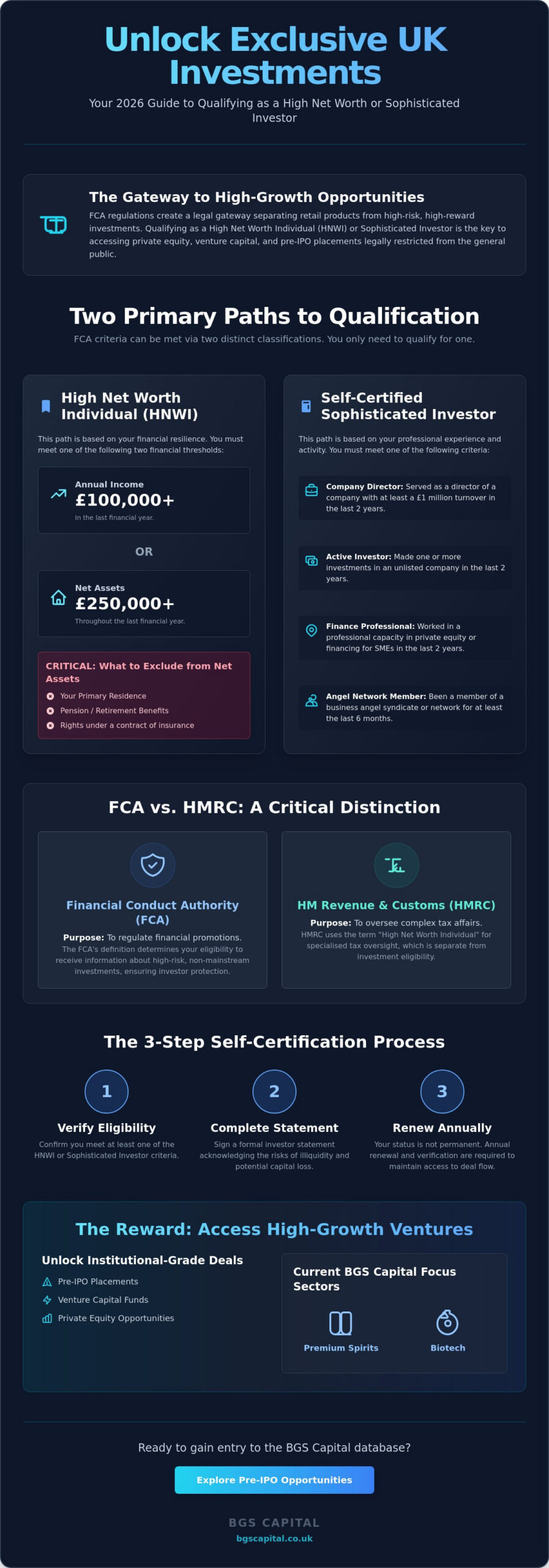
To understand how to qualify as a high net worth individual uk for investment purposes, you must look at the UK government’s official definition within the Financial Promotion Order. As of May 2026, the thresholds remain at an annual income of at least £100,000 or net assets of at least £250,000. These figures were reinstated on March 27, 2024, after a brief attempt to increase them. This move was designed to maintain the flow of capital into the UK startup ecosystem while ensuring investors have sufficient financial resilience.
The FCA Financial Promotion Order Criteria
The £100,000 annual income requirement applies to the individual’s income in the previous financial year. If you rely on the £250,000 net asset requirement, your calculation must be precise. You must exclude your primary residence, any rights under a qualifying contract of insurance, and any benefits payable on termination of service or retirement. This ensures the threshold represents investable wealth rather than essential living assets. Failing to exclude these items can lead to invalid self-certification, which creates legal risks for both the investor and the firm facilitating the introduction.
HMRC’s High Net Worth Unit (HNWU)
HMRC operates on a different scale entirely. They define “wealthy” individuals as those with an annual income of £200,000 or more, or assets exceeding £2 million in any of the last three years. If you meet these criteria, your tax affairs are managed by a dedicated “Wealthy Team.” This team monitors approximately 850,000 individuals who contribute roughly 25% of the UK’s total personal tax receipts. Their focus is on managing compliance and closing the tax gap, which was estimated at £1.9 billion for the 2022/23 tax year.
This HMRC classification is purely administrative and doesn’t grant you the right to view restricted investment offers. However, reaching this level of wealth often necessitates advanced capital gains tax planning to protect your portfolio’s growth. Understanding your status with both entities is vital for long-term wealth preservation. If you meet the FCA criteria, you’re positioned to explore our current business listings and connect with high-growth ventures that are otherwise closed to retail investors.
HNWI vs. Sophisticated Investor: Which Category Fits You?
While the previous section detailed how to qualify as a high net worth individual uk via specific wealth thresholds, many professionals gain access to exclusive markets through their experience. The “Self-Certified Sophisticated Investor” classification is a vital alternative for those who don’t necessarily meet high liquid wealth requirements but possess the expertise to evaluate complex risks. The FCA recognizes that financial literacy and professional background can serve as a proxy for financial resilience. This path allows individuals to bypass the standard income and asset tests by demonstrating a practical understanding of the private equity ecosystem.
To meet the FCA criteria for High Net Worth Investor status, you rely on capital. To qualify as a sophisticated investor, you must meet at least one of three qualitative criteria. First, you’ve been a member of a business angel syndicate for at least six months. Second, you’ve made two or more investments in unlisted companies within the previous two years. Third, you work, or have worked within the last two years, in a professional capacity in the private equity sector or in the provision of finance for small and medium enterprises. These criteria ensure that the individual understands the illiquidity and high-risk nature of early-stage ventures.
The ‘Director’ Qualification Route
The most common pathway for corporate leaders is the director qualification. You qualify if you’ve been a director of a company with an annual turnover of at least £1 million within the last 24 months. This rule acknowledges that managing a substantial enterprise provides the necessary commercial acumen to assess investment opportunities. It’s a primary route for founders transitioning into angel investors. By leveraging their operational experience, these individuals can legally access deal flow that would otherwise be restricted to institutional players.
Choosing the Right Classification for Your Profile
Determining how to qualify as a high net worth individual uk or a sophisticated investor is a strategic choice that impacts your long-term deal flow. HNWI status is usually the most efficient route for high earners in non-finance sectors, as it requires less documentation of professional history. However, Sophisticated Investor status often carries more weight in venture capital circles. It signals to founders and fund managers that you bring intellectual capital and a professional network to the table. You can be both, and dual-qualification provides the broadest possible access to UK investment promotions, covering every exemption under the Financial Promotion Order.
How to Self-Certify and Verify Your Status in 2026
The process for how to qualify as a high net worth individual uk has shifted significantly under the Financial Services and Markets Act 2000 (FSMA). Previously, third-party professional certification was the standard requirement. Today, the UK regulatory framework relies primarily on self-certification. This places the burden of accuracy directly on you. To access restricted investment promotions, you must follow a structured four-step verification process to ensure compliance with current FCA standards.
- Data Assessment: Audit your financial records against the current thresholds. Verify that your individual annual income exceeded £100,000 or your net assets surpassed £250,000 in the last financial year.
- Template Selection: Choose the specific statement template that matches your profile. HNWI statements focus on wealth, while Sophisticated Investor statements focus on professional experience.
- Legal Execution: Sign the mandatory declarations. These documents include specific risk warnings regarding the potential for total capital loss and the absence of retail-level protections.
- Annual Renewal: Maintain your status through consistent record-keeping. Self-certification statements are typically valid for 12 months. You must renew your certificate annually to retain access to deal flow.
The Legal Weight of the Self-Certification Statement
Signing a self-certification statement isn’t a mere administrative formality. It’s a legally binding declaration that you understand you’re waiving certain consumer protections. By certifying your status, you acknowledge that you have the financial capacity to lose your entire investment. Intermediaries like BGS Capital are legally mandated to hold this documentation before facilitating introductions. Providing false information on these statements can lead to the immediate voiding of investment agreements and potential legal repercussions for misrepresentation.
Verification Processes for Pre-IPO Platforms
Modern investment platforms use advanced digital KYC (Know Your Customer) protocols to verify your identity and status. If your income or assets fluctuate near the threshold, you must provide updated data to remain compliant. This rigorous verification ensures that only qualified capital enters the ecosystem. This process is equally important for founders who need to understand how to find investors who are legally permitted to view their offerings. Ensuring your status is current is the first step toward participation in restricted markets. Verify your investor status here to access our verified business listings.
Accessing Pre-IPO Opportunities via BGS Capital
Understanding how to qualify as a high net worth individual uk is the prerequisite for entering the BGS Capital network. Once your status is verified, you gain immediate access to a proprietary database of private equity and pre-IPO opportunities. We function as a strategic bridge, connecting sophisticated capital with high-growth UK businesses. Our model is ‘Free for Investors.’ We don’t charge subscription fees for access; instead, we prioritize the quality of our network and the integrity of our professional introductions. This ensures that only the most qualified capital is matched with institutional-grade ventures.
The 2026 deal flow is characterized by late-stage private companies preparing for public listing. Accessing these rounds requires more than just capital. It requires the regulatory standing to be included in limited-partner discussions. By documenting how to qualify as a high net worth individual uk within our system, you position yourself to receive introductions to companies that are otherwise invisible to the retail market. We focus on sectors with high barriers to entry, ensuring our members see opportunities that haven’t been diluted by mass-market exposure.
Direct Introductions to Investor Relations
Accessing our database is the initial step in the investment process. For qualified individuals, we facilitate direct introductions to the investor relations teams of featured companies. This direct conduit allows you to perform your own due diligence and negotiate terms without intermediary interference. Current opportunities in our database include a UK Premium Spirits Company and a Revolutionary Biotech Group. These placements allow HNWIs to utilize their status in eis opportunities, combining high-growth potential with the UK’s most robust tax-efficiency vehicles.
Risk Disclosure and Professional Conduct
REPEATED WARNING: ALL INVESTMENTS CARRY RISK. CAPITAL IS AT RISK. BGS Capital operates as a specialist facilitator and connector. We provide a business listing and feature service. We do not provide financial advice, manage investment funds, or execute transactions as a direct brokerage. Our role is to manage the network and facilitate introductions between qualified investors and high-growth businesses. We assume no liability for the performance of any company featured in our database. Final qualification and participation rest on your self-certification and the specific verification requirements of the issuing companies. You’re responsible for your own due diligence and professional conduct within the network.
Are you ready to access the 2026 deal flow? Verify your investor status and view current opportunities.
Strategic Access to Private Markets
Strategic success in the UK’s private equity sector depends on regulatory precision. We’ve defined the critical distinction between HMRC tax classifications and the FCA’s Financial Promotion Order. Whether you rely on the £100,000 income threshold or the £250,000 net asset rule, understanding how to qualify as a high net worth individual uk is your first step toward institutional-grade deal flow. Professional experience remains a powerful alternative through the Sophisticated Investor route, ensuring that expertise is valued alongside liquid capital.
BGS Capital facilitates this transition by providing a curated network of pre-IPO and IPO-ready opportunities. Our model is free for qualified investors and focuses on network quality. We provide direct access to Investor Relations teams, allowing you to conduct your own due diligence without intermediary fees. ALL INVESTMENTS CARRY RISK. CAPITAL IS AT RISK.
Verify your eligibility today to move beyond retail markets and identify high-growth ventures in the spirits and biotech sectors. Access is restricted to those who meet the necessary legal standards. ARE YOU A QUALIFIED INVESTOR? VIEW OUR PRE-IPO DATABASE. We look forward to facilitating your professional introductions.
Frequently Asked Questions
Does my primary residence count towards the £250,000 net asset threshold?
No, your primary residence is strictly excluded from the £250,000 net asset calculation. FCA rules ensure that the threshold represents liquid or investable wealth rather than your home or retirement security. You must also exclude pension rights and any benefits payable on termination of service. This ensures that an investment failure doesn’t jeopardize your essential living assets or long-term financial stability.
Can I qualify as an HNWI if my income is high but my assets are low?
Yes, you can qualify based solely on your earnings. If your individual annual income was £100,000 or more in the last financial year, you meet the criteria for how to qualify as a high net worth individual uk. You don’t need to meet the asset threshold if you meet the income requirement. This allows high-earning professionals with lower accumulated wealth to access private equity and pre-IPO opportunities.
How long does a self-certification statement remain valid in the UK?
A self-certification statement is valid for a period of 12 months from the date it is signed. Once this period expires, you must re-assess your financial data and sign a new declaration to maintain your status. This annual renewal is a regulatory requirement that ensures your classification remains accurate as your financial circumstances fluctuate. Intermediaries are required to verify that your certificate is current before presenting new offers.
What is the difference between a Certified and a Self-Certified Sophisticated Investor?
A certified sophisticated investor has a certificate signed by an FCA-authorized firm confirming they understand the risks. A self-certified sophisticated investor qualifies by meeting specific professional criteria, such as being a member of an angel syndicate or a director of a £1 million turnover company. Most individuals now use the self-certification route as it’s more efficient for accessing digital investment platforms and private equity databases.
Do I need a signed letter from my accountant to prove my HNWI status?
No, a signed letter from an accountant is not a legal requirement for self-certification under current UK law. You are responsible for accurately assessing your own income and assets against the thresholds. While an accountant can help you calculate these figures, the final declaration is a personal statement you sign yourself. Intermediaries must have a reasonable belief that you meet the criteria, but they don’t usually require third-party audits.
What happens if I invest in a pre-IPO deal but don’t actually qualify as an HNWI?
Investing without meeting the qualification criteria creates significant legal and financial risk. The firm facilitating the deal may be in breach of FCA financial promotion rules, which can lead to the investment being voided. You also lose the statutory protections afforded to retail investors. If the investment fails, you won’t have recourse to the Financial Ombudsman Service or the Financial Services Compensation Scheme for losses related to the investment’s risk.
Is there a specific threshold for Ultra High Net Worth Individuals (UHNWI) in the UK?
There is no single legal threshold for Ultra High Net Worth in UK financial promotion regulations. The term is generally used within the private banking sector to describe individuals with investable assets exceeding £20 million. For tax purposes, HMRC uses the Wealthy definition of £2 million in assets. Regulatory access to high-risk investments remains tied to the standard HNWI and Sophisticated Investor thresholds regardless of total wealth.
Can international investors qualify as HNWIs under UK law?
Yes, international investors can qualify as HNWIs if they are receiving financial promotions within the UK or investing in UK-regulated entities. They must meet the same financial thresholds of £100,000 income or £250,000 in net assets. Verification processes may require additional documentation to prove income or asset values held in foreign currencies. Understanding how to qualify as a high net worth individual uk is essential for any non-resident targeting the UK startup ecosystem.