
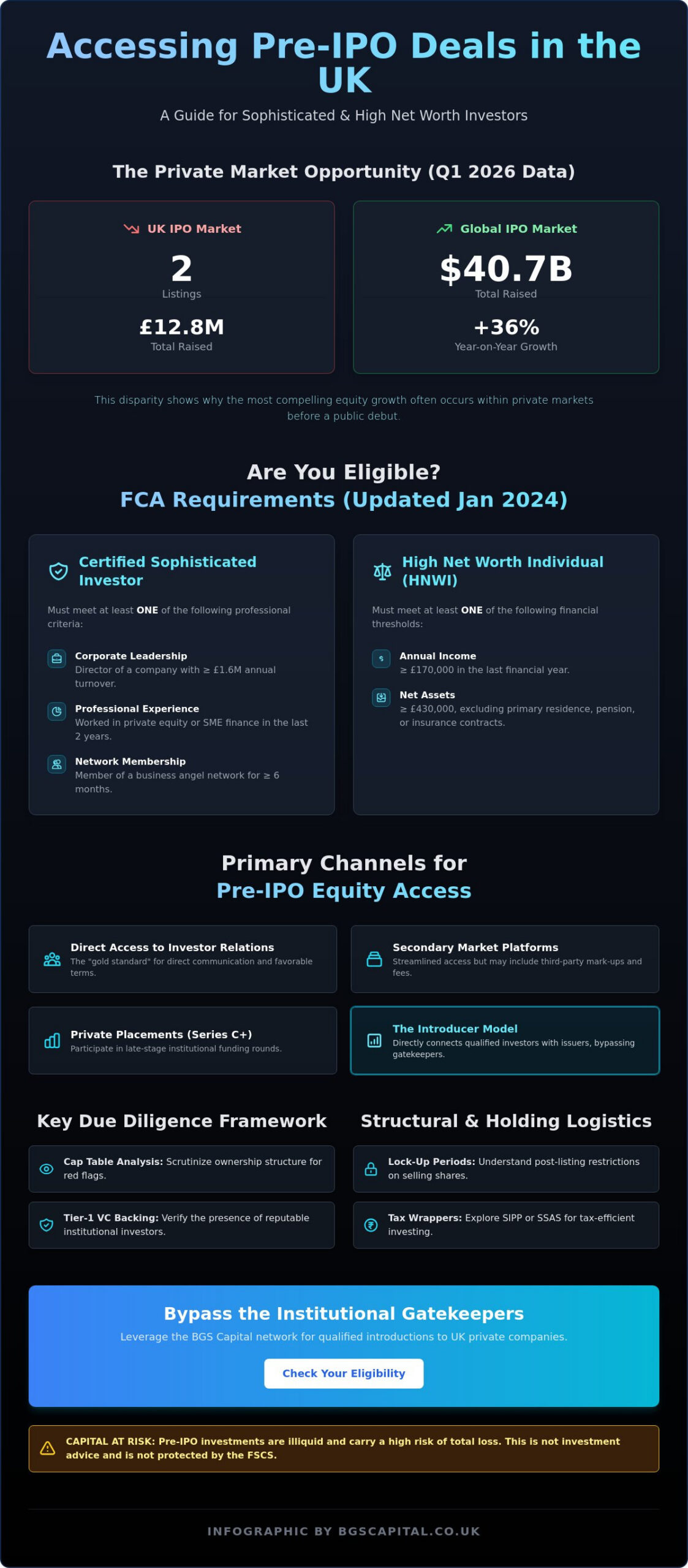
In Q1 2026, the UK IPO market recorded only two listings raising a total of £12.8 million; meanwhile, global IPO proceeds rose 36% year-on-year to $40.7 billion. This disparity underscores a significant shift where the most compelling equity growth often occurs within private markets before a public debut. For those wondering how to access pre-IPO deals as a sophisticated investor uk, the barrier isn’t just capital. It’s the ability to navigate complex FCA eligibility requirements and bypass institutional gatekeepers who traditionally control these allocations.
The lack of transparency in private markets makes it difficult to identify high-quality opportunities or conduct thorough due diligence. This guide provides a clear framework for securing pre-IPO equity by detailing the updated January 2024 FCA thresholds, including the £170,000 annual income requirement or the £430,000 net asset benchmark. You’ll gain a direct preview of the access channels and investor relations networks necessary to position yourself within the UK’s private securities market. CAPITAL AT RISK.
Key Takeaways
- Identify the specific FCA COBS 4.12 requirements and the 2024 certification thresholds for High Net Worth and Sophisticated individuals.
- Discover how to access pre-IPO deals as a sophisticated investor uk by positioning yourself within specialist introducer networks and secondary platforms.
- Implement a due diligence framework that prioritizes cap table analysis and the presence of Tier-1 venture capital backing.
- Manage liquidity expectations by understanding post-listing lock-up periods and exploring tax-efficient wrappers such as SIPP or SSAS.
- Access a database of qualified private companies through a professional introducer network to bypass traditional institutional gatekeepers.
Understanding the UK Regulatory Framework for Sophisticated Investors
Private market access is governed by the Financial Conduct Authority (FCA) under COBS 4.12 rules. These regulations ensure that only individuals with the requisite experience or financial cushion engage with illiquid assets. Understanding the UK Regulatory Framework for Sophisticated Investors is the first step for anyone learning how to access pre-IPO deals as a sophisticated investor uk. Access is restricted. It’s a binary qualification. CAPITAL AT RISK. Unlisted shares carry a high risk of total loss and lack the liquidity of the London Stock Exchange.
Self-certification acts as the primary gatekeeper for private equity access. You must verify your status before viewing specific deal flow or company data. This process isn’t a mere formality; it’s a legal requirement that protects both the investor and the network. The FCA updated these thresholds on 31 January 2024 to account for inflation and market shifts, effectively raising the bar for individual participation in private placements. BGS Capital operates as an introducer within this framework, ensuring all parties meet these stringent standards before any connection occurs.
Criteria for the ‘Certified Sophisticated Investor’ in 2026
To qualify as a self-certified sophisticated investor in May 2026, you must meet at least one of three specific criteria established by the FCA. The previous requirement regarding the number of investments made in unlisted companies was removed in early 2024. Current requirements include:
- Corporate Leadership: You’re a director of a company with an annual turnover of at least £1.6 million.
- Professional Experience: You’ve worked in the private equity sector or in the provision of finance for small and medium enterprises (SMEs) within the last two years.
- Network Membership: You’ve been a member of a network of business angels for at least six months.
You must hold a certificate signed by an authorised person within the last 36 months to maintain this status. This ensures your expertise remains current as market conditions evolve.
Criteria for ‘High Net Worth Individuals’ (HNWI)
The HNWI classification focuses on financial resilience rather than professional experience. Following the 31 January 2024 updates, the thresholds for this category are significantly higher than in previous years. You qualify if you meet either of the following:
- Annual Income: An individual income of at least £170,000 in the last financial year.
- Net Assets: Assets totaling at least £430,000, excluding your primary residence, insurance contracts, or pension savings.
These figures are verified through the “Am I Eligible?” check during the onboarding process. This step is mandatory. It confirms you possess the capital buffer necessary to withstand the inherent volatility of pre-IPO equity. BGS Capital provides the platform for these introductions, but the responsibility for maintaining valid certification rests with the investor.
Primary Channels for Accessing Pre-IPO Equity in the UK
Understanding how to access pre-IPO deals as a sophisticated investor uk requires a clear distinction between public market participation and private equity engagement. In the first quarter of 2026, the London Stock Exchange recorded only two listings, yet global IPO proceeds reached $40.7 billion. This gap suggests that the most significant valuation growth is currently captured within private channels. Accessing these opportunities is not a matter of retail brokerage but of network positioning and regulatory compliance. CAPITAL AT RISK.
Investors typically utilize four primary channels to secure pre-IPO equity: direct introductions, secondary market platforms, private placements (Series C and beyond), and the introducer model. While secondary platforms offer a streamlined interface, they often include third-party mark-ups. Conversely, the introducer model connects you directly with the issuer. This ensures that your engagement aligns with the UK Regulatory Framework for Sophisticated Investors, focusing on transparency and direct communication. To begin this process, you should first check your eligibility for these exclusive opportunities.
Direct Access to Investor Relations (IR)
Direct communication with a company’s internal IR team is the gold standard for private equity due diligence. It bypasses institutional gatekeepers who often prioritize their own fund allocations over individual sophisticated investors. By leveraging introduction services, you gain access to raw company data and intended listing timelines that aren’t available on secondary marketplaces. In the UK’s ‘Silicon Fen’ and London tech hubs, these direct connections are essential for identifying companies preparing for a 2026 or 2027 listing. This channel provides a level of transparency that third-party brokers cannot replicate, allowing for a clearer assessment of the company’s fiscal health.
Secondary Placements and Private Markets
The ‘Grey Market’ serves as a vital venue for trading shares in highly anticipated UK unicorns before they go public. These secondary placements involve buying shares from early-stage employees or venture capital funds looking for early liquidity. The mechanics are complex, often involving Right of First Refusal (ROFR) clauses that the company may exercise. While platforms like Forge or EquityZen provide a marketplace for these transfers, liquidity remains restricted. Sophisticated investors must compare these access points carefully. Secondary markets might offer immediate entry, but direct placements typically provide better structural positioning on the cap table. It’s vital to remember that unlisted shares are illiquid; you cannot sell them as easily as FTSE 100 stocks.
Evaluating Pre-IPO Opportunities: A Sophisticated Due Diligence Framework
Securing an entry point is only the initial phase. Learning how to access pre-IPO deals as a sophisticated investor uk must be followed by a clinical evaluation of the target’s fiscal and operational readiness. You’re looking for a clear ‘Path to IPO’. This involves reviewing draft prospectuses or UK-equivalent disclosure documents. Recent FCA’s IPO Process Reforms have altered how research is disseminated, making it essential to understand the revised deal timetables. CAPITAL AT RISK. High-growth companies often fail to transition from private scale to public scrutiny.
Analyze the cap table. The presence of Tier-1 venture capital firms suggests the business has already passed institutional-grade due diligence. Understanding these equity structures is a core component of how to access pre-IPO deals as a sophisticated investor uk effectively. You can review our guide to venture capital to better understand how these early-stage growth structures influence later-stage valuations. Management bench strength is equally critical. A team successful in private scaling may lack the experience required for the regulatory demands of the London Stock Exchange. Focus on revenue quality. Recurring revenue models are generally valued higher than transactional ones as the listing date approaches.
The Financial Health Checklist
Examine the burn rate. A company must have a cash runway extending at least 18 months to safely reach its intended IPO window. Unit economics reveal whether the business scales profitably or merely burns capital for aggressive growth. Compare current private valuations against public peers. If the private valuation exceeds the multiples of similar listed companies, the ‘IPO pop’ potential is likely non-existent. This data-driven approach separates sophisticated investors from speculators. Use our ‘Am I Eligible?’ gate to ensure you’re qualified to receive these detailed company briefings.
Governance and Regulatory Preparedness
Regulatory readiness is a binary state. The company is either ‘IPO ready’ or it isn’t. This includes having audited financials from a reputable firm and a board structure that meets UK Corporate Governance Code standards. The first transaction on the London Stock Exchange’s Private Securities Market (PSM) under the PISCES framework took place in Q1 2026, providing a new bridge for private trading. In 2026, ESG metrics are no longer optional. They directly influence the appetite of institutional funds that provide the post-IPO liquidity you need for an exit. BGS Capital operates as an introducer to companies that have already begun this rigorous preparation process.
Structural Logistics: Holding and Exiting Pre-IPO Investments
Securing an entry point is only the first stage of the investment lifecycle. Managing the holding period and planning for an eventual exit requires a deep understanding of the structural constraints unique to private equity. For those learning how to access pre-IPO deals as a sophisticated investor uk, the logistics of share ownership are just as critical as the initial due diligence. CAPITAL AT RISK. Private shares aren’t liquid assets. You can’t sell them with a click like a FTSE 100 stock. You’re committing to a multi-year horizon where your capital is tied to the company’s specific growth trajectory.
Dilution is a primary risk during the holding phase. If a company initiates subsequent funding rounds before the IPO, your share percentage will decrease unless you’ve secured pro-rata rights. For instance, a Series D raise could dilute early pre-IPO entrants by 15% to 25% depending on the valuation and the size of the round. Exit scenarios typically fall into two categories: a public listing on the London Stock Exchange or a trade sale through Mergers and Acquisitions (M&A). In the 2025 financial year, M&A activity remained a dominant exit route for UK tech firms, often providing a faster liquidity event than a delayed IPO.
Lock-up Agreements and Liquidity
Standard UK lock-up durations typically last 180 days following the IPO. During this period, you’re legally prohibited from selling your shares. This structure prevents market saturation and protects the stock price, but it exposes you to post-listing volatility. If the share price drops 30% during those first six months, you’re forced to hold through the decline. Managing this phase requires a strategic approach to capital gains. You should understand Capital Gains Tax implications for UK exits before the listing date occurs to ensure your net returns align with your expectations.
Tax-Efficient Investing in the UK
Sophisticated investors often overlook the benefits of holding private equity within tax-efficient wrappers. While many focus on direct ownership, using a Self-Invested Personal Pension (SIPP) or a Small Self-Administered Scheme (SSAS) for long-term pre-IPO holdings can provide significant advantages, provided the asset meets the provider’s compliance criteria. You should also consider the role of EIS and SEIS for early-stage opportunities, which offer substantial income tax relief and capital gains exemptions. Reporting unlisted assets in your annual self-assessment is mandatory. Accuracy is essential to avoid HMRC penalties. To ensure your portfolio meets these sophisticated structural requirements, you should check your eligibility for our network introductions.
Leveraging the BGS Capital Network for Pre-IPO Introductions
BGS Capital operates as a specialist introducer, bridging the gap between private companies and sophisticated individuals. If you’re researching how to access pre-IPO deals as a sophisticated investor uk, you must understand that our role is strictly to facilitate connections. We aren’t a direct brokerage. We don’t provide financial advice or manage investment funds. CAPITAL AT RISK. Our framework prioritises transparency and ensures that all participants meet the stringent FCA eligibility criteria updated on 31 January 2024. By using our network, you gain access to a transactional environment where efficiency and qualification are the primary drivers.
Our database features qualified companies seeking pre-IPO and IPO capital. These businesses range from UK tech unicorns to international firms preparing for a 2026 or 2027 listing. We provide the infrastructure for direct introductions to accredited investment firms, wealth managers, and company internal teams. This model removes the institutional gatekeepers that often obscure the most compelling private market opportunities. Accessing these deals requires more than just capital; it requires a verified position within a professional network.
The ‘Am I Eligible?’ Process
Access to our network is restricted. The “Am I Eligible?” process serves as our mandatory qualification gate. New investors must complete this check to verify their status as either a High Net Worth Individual or a Self-Certified Sophisticated Investor. This ensures that everyone within the network possesses the financial resilience or professional experience required for illiquid private equity. We prioritise direct connections over facilitating transactions ourselves to maintain a clear regulatory boundary. For business owners and founders currently raising capital, our platform offers a listing service to feature your business to our database of qualified participants.
Direct Connection with IR Teams
Bypassing the noise of third-party platforms is essential for thorough due diligence. Our network provides a direct line to company decision-makers and Investor Relations (IR) teams. This allows you to evaluate the ‘Path to IPO’ using raw company data rather than filtered marketing materials. In May 2026, the value of a curated database is clear. While the UK IPO market had a slow start with only £12.8 million raised in Q1, the global pipeline remains robust. Our network helps you find these international and domestic opportunities before they reach the public markets. Next steps for qualified investors involve completing the eligibility check and reviewing our current list of qualified companies. Focus on the data. Connect directly. Position your 2026 portfolio for the next generation of public companies.
Securing Your Position in the 2026 Private Market
The landscape for private equity has shifted. Success depends on navigating the 31 January 2024 FCA regulatory updates and establishing direct lines to company leadership. You now have a framework for the criteria for High Net Worth and Sophisticated status, along with the structural importance of lock-up periods and tax-efficient wrappers like SIPPs. Mastery of how to access pre-IPO deals as a sophisticated investor uk requires a shift from retail brokerage mindsets to a direct introducer model. CAPITAL AT RISK. High-growth equity remains illiquid and carries a high risk of total loss.
BGS Capital provides a gateway to this exclusive ecosystem. Our network offers direct introductions to IR teams and accredited investment firms without the layers of third-party brokerage. Access is free for qualified participants. By bypassing institutional gatekeepers, you can evaluate IPO-ready businesses based on raw data and management bench strength. Take the next step in your investment strategy by confirming your status. Am I Eligible? Check your status to access our pre-IPO database. We look forward to connecting you with the UK’s most anticipated private opportunities.
Frequently Asked Questions
What is the minimum investment for most UK pre-IPO deals?
Minimum investment levels vary based on the entry channel and the company’s funding stage. Secondary market platforms often set entry points between £10,000 and £25,000. For direct private placements or Series C rounds, minimums typically start at £50,000 and can exceed £100,000. These thresholds ensure that participants have the necessary capital resilience for illiquid assets.
Can I invest in pre-IPO companies through my SIPP?
You can hold pre-IPO shares within a Self-Invested Personal Pension (SIPP) provided your pension administrator accepts non-standard or unquoted assets. Many retail SIPP providers restrict holdings to listed securities; therefore, sophisticated investors often use specialist providers for private equity. This structure offers tax-efficient growth, though the underlying investment remains illiquid until a formal exit occurs.
How long is the typical lock-up period for a UK IPO?
The standard lock-up period for a UK listing is 180 days. During this timeframe, pre-IPO investors and company directors are legally barred from selling their equity. This prevents market saturation immediately after the IPO. You must factor this six-month window into your liquidity planning, as you cannot exit your position the moment the company debuts on the London Stock Exchange.
What is the difference between a sophisticated investor and a high-net-worth individual?
A high-net-worth individual is defined by financial capacity, requiring an annual income of £170,000 or net assets of £430,000 under the January 2024 FCA updates. A sophisticated investor is defined by professional expertise, such as being a director of a £1.6 million turnover company or a member of an angel network. Both classifications are essential for those learning how to access pre-IPO deals as a sophisticated investor uk.
How do I verify if a pre-IPO investment opportunity is legitimate?
Verify legitimacy by cross-referencing the firm on the FCA Financial Services Register and requesting audited financial statements from the company. Legitimate opportunities provide direct access to Investor Relations teams or accredited investment firms. Avoid any offer that lacks a formal “Am I Eligible?” qualification gate or uses high-pressure sales tactics to bypass standard due diligence procedures.
What happens to my pre-IPO shares if the company is acquired instead of going public?
If an acquisition occurs, your shares are usually converted into equity of the acquiring firm or settled in cash. This trade sale is a common exit route; in 2025, M&A activity remained a primary liquidity event for UK technology firms. The specific return depends on the acquisition price and your share class’s liquidation preferences on the company’s cap table.
Are pre-IPO investments eligible for EIS tax relief?
Pre-IPO deals qualify for Enterprise Investment Scheme (EIS) relief only if the company meets HMRC’s size and age requirements. The business must have fewer than 250 employees and gross assets under £15 million at the time of investment. Since many companies seeking pre-IPO capital have already exceeded these thresholds, you must confirm the company’s EIS status during your initial evaluation.
What are the main risks of investing in companies before they go public?
The primary risks are total loss of capital, extreme illiquidity, and dilution from future funding rounds. There’s no guarantee that a company will ever reach an IPO or acquisition. If the business fails, there’s no secondary market to sell your shares. CAPITAL AT RISK. You should only commit capital that you can afford to lose entirely over a multi-year horizon.