
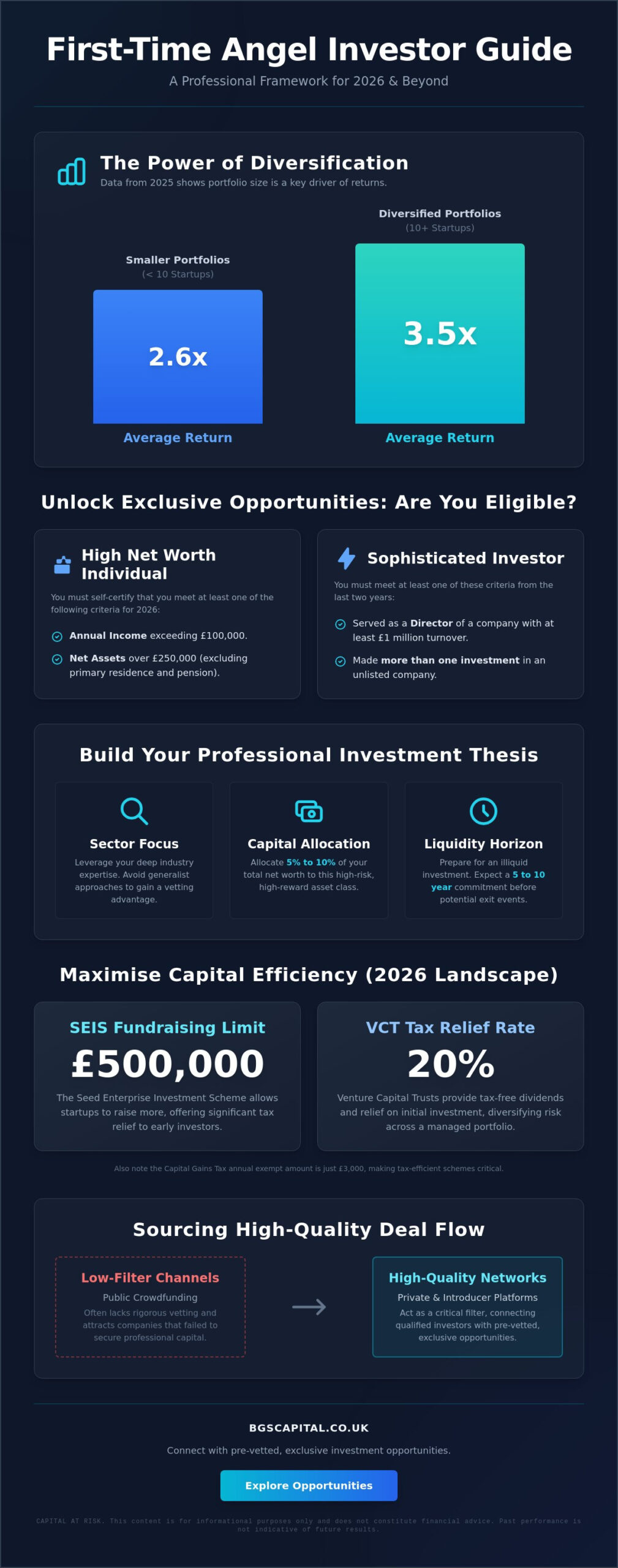
Portfolios of 10 or more startups delivered an average return of 3.5x in 2025, while smaller portfolios averaged 2.6x. This data confirms that successful early-stage investing requires a disciplined system rather than a reliance on luck or immediate social circles. You likely recognize that transitioning from a passive saver to a sophisticated participant involves more than just capital. It requires a repeatable process for evaluating founders and managing a harsher Capital Gains Tax regime where the annual exempt amount is just £3,000. This first time angel investor guide establishes a professional framework for sourcing, vetting, and managing early-stage deals with the same rigor used by institutional firms.
You’ll master the technical aspects of the 2026 investment landscape, including the updated SEIS fundraising limits of £500,000 and the 20% VCT tax relief rate. We examine how to identify high-quality deal flow beyond friends and family while maintaining strict compliance with self-certification requirements for high net worth and sophisticated investors. This roadmap covers everything from post-money SAFE structures to pre-IPO opportunities. CAPITAL AT RISK.
Key Takeaways
- Establish your legal eligibility as a High Net Worth or Sophisticated Investor to unlock access to exclusive, unlisted equity opportunities.
- Utilize this first time angel investor guide to transition from public crowdfunding to professional networks that filter for qualified companies.
- Execute rigorous commercial and founder-level due diligence to validate market advantages and a leadership team’s capacity for rapid scale.
- Maximize capital efficiency by applying 2026 SEIS and EIS tax relief frameworks to your early-stage investment strategy.
- Build a resilient portfolio based on the Power Law, ensuring you have a clear process for evaluating follow-on rounds and liquidity events.
Defining Your Angel Investment Thesis and Eligibility
Angel investing involves providing equity capital to high-growth startups in exchange for ownership stakes. Unlike retail market participation, this asset class requires a long-term commitment and a high tolerance for volatility. Understanding what is an angel investor is the first step in this professional roadmap. It’s a role defined by active participation in the private equity ecosystem, where your capital supports early-stage innovation. This first time angel investor guide prioritizes regulatory compliance and strategic alignment to ensure you enter the market with the necessary qualifications. CAPITAL AT RISK.
FCA Eligibility: Am I Eligible to Invest?
UK law mandates specific classifications for individuals accessing private deals. You must self-certify as either a High Net Worth Individual or a Sophisticated Investor before accessing high-level opportunities. For 2026, High Net Worth status requires an annual income exceeding £100,000 or net assets over £250,000, excluding your primary residence and pension. Sophisticated status is granted if you meet specific criteria, such as being a director of a company with at least £1 million turnover in the last two years or having made more than one investment in an unlisted company during that same period. Professional networks and introducer platforms use these gates to ensure compliance with FCA regulations. Exclusive deal flow is restricted to those who meet these criteria. Introducer platforms act as a filter, connecting qualified companies with individuals who have confirmed their eligibility. This process protects all parties by ensuring a baseline of financial sophistication. Am I Eligible?
Developing a Professional Investment Thesis
A professional thesis prevents emotional decision-making. Focus on sectors where you possess deep industry expertise. If you have spent 20 years in fintech, your ability to vet a founder’s technical roadmap is a distinct advantage. Generalist approaches often lead to poor deal selection. Most sophisticated investors allocate between 5% and 10% of their total net worth to this asset class. Prepare for a liquidity horizon of 5 to 10 years. Private equity is inherently illiquid; your capital is committed until an exit event such as an IPO or trade sale occurs. Setting clear parameters for your ticket size and sector focus allows you to scan deal flow efficiently. This first time angel investor guide emphasizes that discipline in the selection phase is the primary driver of long-term performance.
Diversification is the only protection against the high failure rates of early-stage ventures. Data from 2025 shows that portfolios with 10 or more startups achieve significantly higher average returns than smaller, concentrated holdings. In private equity, the majority of companies will fail. Your returns are typically driven by a single outlier that compensates for other losses. Spreading capital across multiple vetted opportunities is essential for risk management. CAPITAL AT RISK.
Sourcing High-Quality Deal Flow Through Networks
Public crowdfunding platforms often attract startups that failed to secure capital from professional networks. While these sites are accessible, they frequently lack the rigorous vetting required for high-level portfolios. In contrast, exclusive private networks and introducer platforms act as a critical filter. They prioritize qualified companies that have already demonstrated significant traction or are approaching a liquidity event. For those following a first time angel investor guide, the transition from public sites to private introducers is a hallmark of professional sophistication. CAPITAL AT RISK.
Introducer platforms operate by reducing search friction. They don’t provide financial advice or manage funds. Instead, they facilitate direct connections between sophisticated investors and company investor relations teams. This model ensures that you spend your time evaluating pre-vetted opportunities rather than sorting through hundreds of low-quality pitches. Building a network of wealth managers and accredited investment firms is equally vital. These entities often share deal flow that never reaches the open market, particularly in the pre-IPO sector.
Leveraging Introducer Services
BGS Capital functions as an established conduit to exclusive financial opportunities. We connect sophisticated investors with pre-IPO and IPO investments that are typically reserved for institutional players. By using an introducer model, you gain access to secondary placings and primary raises without the burden of solo-sourcing. This approach is particularly effective for those looking to find investors and peers who are already active in high-growth technology or AI sectors. You may check your eligibility to determine if you qualify for these exclusive introductions. Am I Eligible?
Evaluating the “Pre-IPO” Opportunity
A pre-IPO company differs from a standard seed startup in maturity and scale. These firms usually have a clear path to a public listing within 12 to 24 months. Investing at this stage often involves secondary placings, where you purchase shares from existing employees or early investors. This provides entry into established companies with proven revenue models. When evaluating these deals, investors often prioritize companies qualifying for SEIS and EIS Tax Relief to mitigate risk. The 2026 landscape shows that technology startups captured approximately 40% of all angel investments, making them a primary focus for pre-IPO sourcing.
A mature portfolio balances early-stage SEIS deals with later-stage pre-IPO opportunities. This strategy provides a mix of high-growth potential and shorter paths to liquidity. This first time angel investor guide suggests that sourcing through professional introducers is the most efficient way to achieve this balance while adhering to strict regulatory requirements. CAPITAL AT RISK.
Conducting Professional-Grade Due Diligence
Professional due diligence is the barrier between speculative gambling and institutional-grade investing. This first time angel investor guide prioritizes a four-pillar approach: commercial, founder, financial, and legal validation. You must move beyond the pitch deck to verify the “unfair advantage” that justifies the risk. In 2025, approximately 72% of angel investments went to startups with clear paths to scalability. Validating the Total Addressable Market (TAM) and the competitive moat is mandatory for any sophisticated portfolio.
Financial due diligence requires a forensic review of the cap table and burn rate. You need to ensure the company has a minimum runway of 12 to 18 months post-investment. Legal due diligence must confirm that all Intellectual Property (IP) is owned by the company rather than the founders. Clean corporate structures are a prerequisite for any follow-on institutional rounds. Failure to verify these details often leads to complications during Series A raises. CAPITAL AT RISK.
The Founder Vetting Framework
Approximately 85% of angel investors prioritize the competence of the team over the product itself. You must assess the leadership’s ability to execute and pivot under market pressure. Verify “skin in the game” by reviewing founder vesting schedules and personal capital contributions. A 2025 survey revealed that 89% of UK founders use their own savings to fund their business. Identify any red flags in the startup funding history, such as excessive dilution in early rounds or a lack of founder commitment. Ask direct questions about previous failures and the specific metrics used to track growth.
Understanding the Term Sheet
The term sheet dictates your economic rights and control. Post-money SAFEs dominated 90% of pre-seed rounds in 2025. You must distinguish between pre-money and post-money valuations to calculate your actual ownership percentage accurately. Liquidation preferences are critical; they determine the order of payout during an exit event. Ensure the presence of “Pre-emption rights.” These allow you to maintain your ownership percentage by participating in future funding rounds. Without these protections, your stake faces significant dilution as the company scales toward an IPO. CAPITAL AT RISK.
Optimising Returns with SEIS and EIS Tax Relief
Tax efficiency is a structural requirement for any professional portfolio in 2026. This first time angel investor guide emphasizes that the Seed Enterprise Investment Scheme (SEIS) and the Enterprise Investment Scheme (EIS) are not just incentives; they’re essential risk-mitigation tools. With the UK Capital Gains Tax (CGT) annual exempt amount reduced to just £3,000, these schemes provide a vital shield for your returns. CAPITAL AT RISK.
SEIS offers the maximum relief of 50% on investments up to £200,000 per tax year. It targets companies trading for less than three years with fewer than 25 employees. EIS provides 30% relief on investments up to £1 million, or £2 million if at least £1 million is allocated to knowledge-intensive firms. Both schemes require a minimum three-year holding period to retain these benefits. Failure to adhere to these timelines results in the clawback of claimed relief. Am I Eligible?
Comparing SEIS vs. EIS for First-Time Investors
| Feature | SEIS (Seed Stage) | EIS (Scaling Stage) |
|---|---|---|
| Income Tax Relief | 50% | 30% |
| Max Annual Investment | £200,000 | £1,000,000 (£2m for KI) |
| Holding Period | 3 Years | 3 Years |
| CGT on Gains | 100% Tax-Free | 100% Tax-Free |
EIS remains the gold standard for portfolio stability due to higher fundraising limits for companies, which now reach up to £10 million annually. When reviewing a pitch deck, always look for “Advance Assurance” from HMRC. This document confirms the company is pre-qualified for the scheme, reducing the administrative risk for the investor. You can view qualified investment opportunities that have already secured this assurance. CAPITAL AT RISK.
CGT Reinvestment Relief and Deferral
You can use angel investments to manage your broader capital gains tax liabilities. SEIS reinvestment relief allows for a 50% CGT exemption on gains reinvested into SEIS shares, capped at £100,000. EIS Deferral Relief is even more flexible; it lets you defer an existing CGT bill by reinvesting that gain into qualifying EIS shares. This effectively keeps your capital working within your portfolio rather than losing it to immediate taxation. Loss Relief allows an investor to offset up to 45% of a failed investment’s net cost against their taxable income, providing a significant safety net for unsuccessful ventures.
Portfolio Construction and the Path to Liquidity
The Power Law dictates that a minority of investments generate the majority of returns. In a professional portfolio, 1 in 10 deals must “return the fund” to compensate for the high failure rate of early-stage ventures. 2025 data confirms that portfolios of 10 or more startups delivered an average return of 3.5x. Smaller portfolios averaged only 2.6x. This first time angel investor guide treats diversification as a mathematical necessity rather than a suggestion. CAPITAL AT RISK.
Follow-on investing is the process of doubling down on your winners. As a company scales toward a Series A or B round, maintaining your pro-rata rights prevents dilution. Monitoring these assets requires a commitment to reviewing quarterly reports and ensuring SIPP integration for tax efficiency. Professional introducer networks facilitate access to these later-stage rounds, allowing you to support high-performing companies as they approach liquidity. Am I Eligible?
Building a Diversified 10-Deal Portfolio
Concentration risk is a primary threat to long-term performance. You shouldn’t allocate more than 10% of your total angel budget to a single deal. Staggering investments across different vintages helps combat economic cycles and market volatility. Many sophisticated angel investors operate within networks to share the due diligence workload and access a broader range of sectors. This collaborative approach ensures that your portfolio remains balanced across varying industries and stages of growth. Diversification is the only protection against the inherent risk of the private equity asset class.
Liquidity Events and IPOs
The path to liquidity has elongated, with the median time from pre-seed to Series A now exceeding 24 months. While an IPO is the ultimate objective, intermediate liquidity is increasingly found in secondary placings. These transactions allow you to sell a portion of your stake to accredited investment firms or wealth managers before a public listing. This provides a mechanism for capital recycling without waiting for a final trade sale or the ultimate IPO. It’s a critical strategy for managing cash flow within a mature portfolio.
When a company prepares for a public listing, the transition involves rigorous regulatory scrutiny. Professional introducers act as a conduit during this phase, connecting sophisticated investors with secondary placings and IPO opportunities. This first time angel investor guide concludes with a reminder that all private equity involves high stakes. CAPITAL AT RISK. Ensure you have professional advice before committing funds. We operate as an introducer and do not facilitate any raises ourselves.
Implementing Your Professional Investment Framework
Transitioning into the private equity asset class requires a shift from passive saving to active, disciplined vetting. This first time angel investor guide provides the necessary structure for navigating the 2026 landscape. Success depends on maintaining a diversified portfolio of at least 10 companies and maximizing the 50% tax relief offered through SEIS. You must verify founder competence and secure pre-emption rights to protect your ownership as firms scale toward liquidity. CAPITAL AT RISK.
BGS Capital operates as a specialized introducer, connecting qualified individuals with exclusive pre-IPO opportunities. We maintain a network of accredited investment firms and wealth managers to ensure high-quality deal flow for our members. There are zero fees for qualified investors to access our database of featured businesses. Our platform focuses on transactional efficiency and regulatory compliance for high net worth individuals. Am I Eligible? Check your status and access our pre-IPO database.
Start your journey toward becoming a sophisticated investor by securing access to vetted, high-growth opportunities today.
Frequently Asked Questions
What is the minimum amount needed to start angel investing in the UK?
The minimum investment varies by deal structure, though individual angel cheques averaged $22,000 in early 2026. Organized angel groups typically require higher entry points, with a median cheque size of $127,000. Some syndicates allow for smaller allocations, but professional portfolios usually require significant capital to achieve proper diversification across 10 or more holdings. CAPITAL AT RISK.
How do I certify as a sophisticated investor for FCA compliance?
Certification requires signing a formal self-declaration confirming you meet specific financial or professional criteria defined by the FCA. This first time angel investor guide highlights that you must either earn over £100,000 annually, hold £250,000 in net assets, or have relevant experience as a company director or active investor. Professional networks use these certificates to gate access to exclusive private placements. Am I Eligible?
What is the difference between an angel investor and a venture capitalist?
Angel investors provide their own personal equity capital, while Venture Capitalists (VCs) manage institutional funds on behalf of third-party limited partners. VCs typically operate within larger firms and enter at later stages, such as Series A or B, with significantly larger cheques. Angels focus on the pre-seed and seed stages where the risk and potential tax reliefs are highest.
Can I hold angel investments within a SIPP or ISA?
Unlisted angel investments are generally eligible for inclusion in a Self-Invested Personal Pension (SIPP) but cannot be held in a standard ISA. ISA eligibility is restricted to shares listed on recognized exchanges, such as the LSE or AIM. SIPP integration allows for tax-efficient growth, but the underlying assets remain illiquid and carry high risk. CAPITAL AT RISK.
What happens to my EIS tax relief if the company fails?
If an EIS-qualified company fails, you can claim Loss Relief to offset your net loss against your income tax bill for that year. This relief allows higher-rate taxpayers to recover up to 45% of the remaining loss after the initial 30% income tax relief is considered. This safety net is a critical component of risk management for sophisticated UK portfolios.
How long does it typically take to see a return on an angel investment?
Investors should prepare for a liquidity horizon of 5 to 10 years before seeing a return. Early-stage equity is illiquid, meaning your capital is committed until a specific exit event occurs, such as a trade sale or IPO. 2025 data shows the median time from pre-seed to Series A now exceeds 24 months, extending the overall path to liquidity.
Is angel investing taxable under Capital Gains Tax rules?
Angel investments qualifying for SEIS or EIS are 100% exempt from Capital Gains Tax if the shares are held for a minimum of three years. This exemption is particularly valuable in 2026 given the reduced CGT annual exempt amount of £3,000. Non-qualified investments are subject to standard CGT rates upon disposal or a liquidity event.
What is a “secondary placing” in the context of pre-IPO companies?
A secondary placing involves purchasing existing shares from current shareholders, such as founders or early employees, rather than the company issuing new equity. This is a common mechanism for entering established, high-growth companies that are approaching an IPO. It provides intermediate liquidity for early backers while allowing new sophisticated investors to secure a stake in a pre-vetted firm.