
In a year where total UK fintech investment reached $10.96 billion, the traditional venture capital model is no longer the primary gateway to London’s most lucrative deals. You’ve likely noticed that an oversaturated landscape makes it increasingly difficult to identify high-quality opportunities without significant delay. Traditional funds often suffer from slow response times, leaving sophisticated investors and high-growth firms searching for more efficient conduits to capital. Finding the right fintech investors london has active in 2026 requires moving beyond broad market lists and into specialized introducer networks.
We recognize the challenge of securing access to pre-vetted, high-quality pre-IPO opportunities. This guide provides a direct route to identifying active capital providers and explains how professional networks allow you to bypass traditional gatekeepers. You’ll gain a clear understanding of the current regulatory landscape, including the July 15, 2026, FCA regulation of Buy-Now, Pay-Later firms and the September 2026 cryptoasset regime. This overview ensures you can navigate the $21.44 billion UK market with the precision and compliance required for high-level financial decision-making.
Key Takeaways
- Identify how the 2026 FCA regulatory shifts, including new cryptoasset and BNPL frameworks, are reshaping the London fintech landscape for capital deployment.
- Analyze the specific investment theses of top-tier fintech investors london currently hosts, focusing on firms like Balderton Capital and Index Ventures.
- Understand the mechanics of secondary placings and pre-IPO opportunities to access high-growth assets before traditional public listings occur.
- Learn the essential steps for preparing a business for professional introductions and developing a robust Investor Relations strategy to attract sophisticated capital.
- Discover how to leverage specialized introducer networks to bypass traditional gatekeepers and gain exclusive access to vetted deal flow.
The Evolution of London Fintech Investment in 2026
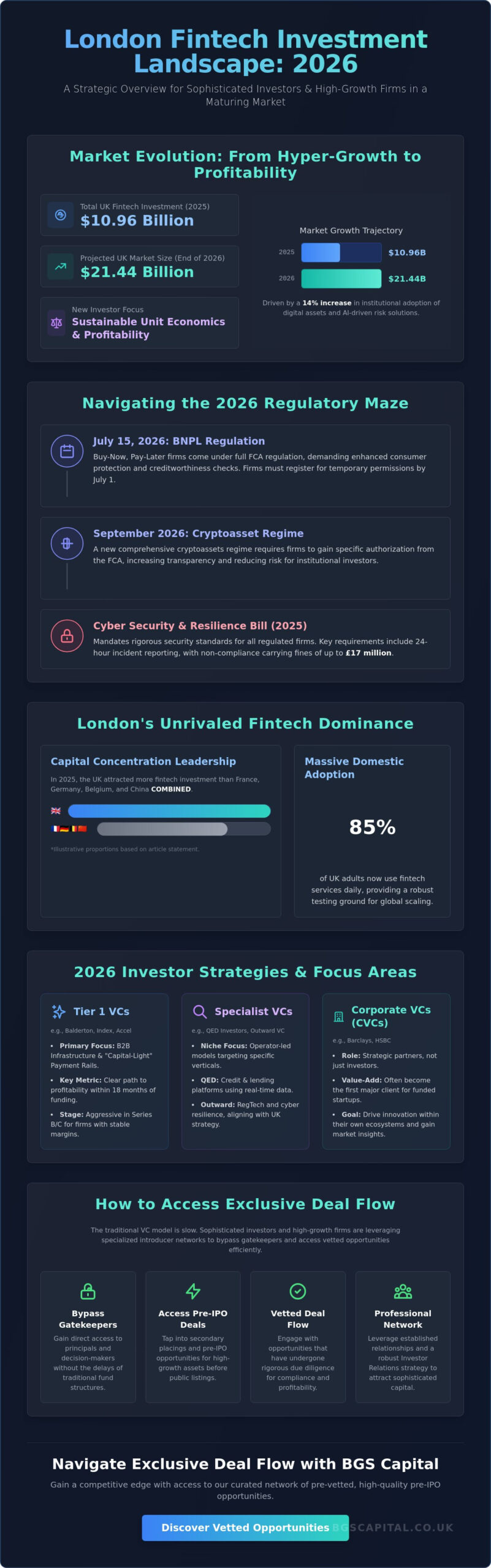
London maintains its position as the preeminent hub for the global fintech industry in 2026. While total investment in 2025 reached $10.96 billion, the market has matured significantly. The era of “growth at all costs” has ended. High inflation, recorded at 3.3% in March 2026, and a Bank of England base rate of 3.75% have forced a pivot. Investors now prioritize sustainable unit economics and clear paths to profitability. This shift hasn’t deterred activity; instead, it’s refined the quality of deal flow available to fintech investors london attracts. The market is projected to reach $21.44 billion by the end of this year, driven by a 14% increase in institutional adoption of digital assets and AI-driven risk management solutions.
Regulatory Trends Shaping Capital Raises
The Financial Conduct Authority (FCA) has introduced stringent updates that impact how private placements are conducted. Starting July 15, 2026, Buy-Now, Pay-Later (BNPL) firms will face full regulation, requiring firms to register for temporary permissions by July 1. Additionally, the new cryptoassets regime requires firm authorization from September 2026. These updates provide a clearer framework for sophisticated investors. Compliance isn’t optional. Companies seeking to feature their business must demonstrate adherence to the 2025 Cyber Security and Resilience Bill, which mandates 24-hour incident reporting and carries fines up to £17 million. This transparency reduces risk for accredited investment firms and wealth managers who demand rigorous due diligence before committing capital.
London vs. Global Fintech Hubs
London continues to outperform New York and Singapore in fintech capital concentration. The UK attracted more funding in 2025 than France, Germany, Belgium, and China combined. This dominance stems from a unique density of wealth managers and the agility of the London Stock Exchange (LSE) secondary markets. These markets provide essential liquidity for pre-IPO assets, which are key interests for fintech investors london has active today. The proximity of regulatory bodies like the FCA to the City’s financial core creates a feedback loop that fosters rapid innovation. It’s a bridge between European technical talent and global capital markets. With 85% of UK adults now using fintech daily, the domestic market provides a robust testing ground for infrastructure before global scaling.
Top London Fintech Venture Capital Firms and Their Theses
The landscape for fintech investors london hosts has narrowed to a group of disciplined, institutional players. Tier 1 firms like Balderton Capital, Index Ventures, and Accel Partners have shifted their 2026 strategies away from high-burn consumer applications. They now prioritize B2B infrastructure and “capital-light” payment rails. These firms are looking for companies that can demonstrate a clear path to profitability within 18 months of funding. Accel Partners, in particular, remains aggressive in Series B and C rounds for firms that have successfully navigated the UK’s 3.3% inflation environment with stable margins.
Specialist VCs provide a different value proposition. QED Investors continues to use its operator-led model to back credit and lending platforms that utilize real-time data. Outward VC has expanded its focus on RegTech and cyber resilience, aligning with the UK government’s fintech strategy to lead in financial safety and transparency. Corporate Venture Capital (CVC) also plays a critical role. Large institutions like Barclays and HSBC aren’t just investors; they act as strategic partners, often becoming the first major clients for the disruptors they fund.
Early-Stage vs. Growth-Stage Investors
Founders must distinguish between capital types to avoid wasted effort. Seed funding in 2026 requires a narrative built on technical defensibility. If you’re at this phase, consulting a startup funding guide will help you understand the transition from angel rounds to institutional backing. Growth-stage fintechs looking to scale internationally must prove they can handle varied regulatory environments. Many firms find that switching from venture capital to private equity is necessary when they reach a certain scale, as the focus moves from innovation to operational optimization. You can learn more about these shifts in our venture capital guide.
Sector-Specific Fintech Focus
Investment is no longer distributed evenly across the sector. AI-integrated fintech is dominating the 2026 deal flow, particularly in risk management and automated compliance. RegTech and InsurTech are also seeing high concentration. These sectors benefit from the UK’s new regulatory clarity, such as the upcoming September 2026 cryptoasset authorization requirements. ESG-focused funds are expanding as well, driven by institutional mandates that require 100% transparency in carbon footprint reporting for financial services. If your business fits these criteria, you might want to check your eligibility to feature your business on our introducer network.
Beyond Traditional VC: Pre-IPO and Private Placements
Traditional venture capital isn’t the only path for fintech investors london currently supports. By May 2026, the demand for pre-IPO opportunities has surged among high net worth individuals. These sophisticated investors seek assets that offer valuation arbitrage before a company reaches the public markets. Secondary placings have become a standard mechanism for providing liquidity to early employees and seed-stage investors. This allows new capital to enter at a lower cost basis than the projected public offering price. The UK’s fintech ecosystem remains a primary target for this capital because of its mature regulatory framework and high adoption rates.
Investors are moving away from broad-market strategies. They’re focusing on private placements that offer direct exposure to specific growth metrics. In a market where 85% of UK adults use fintech daily, the scale is already proven. The challenge lies in access. Exclusive deal flow isn’t found on public exchanges or through standard brokerage accounts. It requires a specialized network that understands the nuances of secondary markets and pre-IPO valuations. This is particularly relevant as the UK fintech market is projected to reach $21.44 billion by the end of this year.
The Role of the Introducer Network
BGS Capital operates as a professional introducer. We don’t facilitate raises ourselves; we connect qualified companies with a network of sophisticated investors and wealth managers. Many fintechs choose private placements over traditional venture capital to maintain tighter control over their cap table. They avoid the “growth at all costs” pressure often associated with Tier 1 VCs. For accredited investment firms, the primary benefit is the pre-vetted nature of the deal flow. Accessing these opportunities through a structured network ensures that the companies featured have already met specific institutional standards for governance and unit economics.
Sophisticated Investor Eligibility
Access to these exclusive databases is restricted to those who meet specific criteria. In 2026, a High Net Worth Individual or Sophisticated Investor is defined by income and asset thresholds set by the FCA. Our “Am I Eligible?” framework is the first step for any individual seeking to view current pre-IPO opportunities. It serves as a necessary gatekeeping function to ensure compliance with the Financial Services and Markets Act. You must understand the risks. CAPITAL AT RISK. Unlike public stocks, pre-IPO shares are illiquid. The potential for high returns is balanced by the possibility of total capital loss. We prioritize legal transparency and require all participants to acknowledge these risks before gaining access to our network.
How to Approach and Secure Fintech Investment in London
Securing capital from fintech investors london hosts requires a shift from speculative narratives to operational excellence. Step one involves preparing your business for a high-level introduction by auditing your financial data against 2026 benchmarks. You must demonstrate sustainable unit economics. Step two is developing a robust Investor Relations (IR) strategy that provides monthly transparency to potential backers. London based wealth managers and accredited investment firms prioritize incident reporting and regulatory compliance, especially following the 2025 Cyber Security and Resilience Bill. Proving technical defensibility is no longer optional.
Step three is the due diligence phase. Expect deep dives into your data centers and managed service providers. Step four involves leveraging introducer platforms to bypass traditional gatekeepers. These platforms connect you with pre-vetted investors who are specifically looking for fintech exposure. Finally, step five requires structuring the raise to maximize tax efficiency through SEIS, EIS, or VCT schemes. If your business meets the criteria for institutional backing, you can feature your business on our platform to access our specialized network.
Crafting the Fintech Pitch Deck
Investors in 2026 demand specific data points. Your deck must highlight your CAC/LTV ratio and burn multiples. A burn multiple above 2.0 is now considered high risk in a 3.75% interest rate environment. You must also prove you can scale while maintaining compliance with the FCA’s July 15, 2026, BNPL regulations. Demonstrating a 24-hour incident reporting protocol is essential for any firm handling sensitive financial data. If you are unsure where to start, you can learn how to find investors using our strategic guide for UK businesses.
Tax Efficiency for Investors
Tax-efficient structures are the primary selling point for private raises in the UK. Utilizing the Enterprise Investment Scheme (EIS) can significantly reduce the risk profile for a high net worth individual. With the Capital Gains Tax (CGT) rate for higher taxpayers sitting at 24% for the 2026/27 tax year, the relief offered by these schemes is vital. Founders must understand the Capital Gains Tax implications for their eventual exit to properly frame the opportunity for long-term backers. Offering a clear tax-advantaged route makes your business more attractive to the sophisticated fintech investors london attracts.
Navigating Exclusive Deal Flow with BGS Capital
BGS Capital functions as a specialized conduit within the network of fintech investors london facilitates. In a market projected to reach $21.44 billion by the end of 2026, the volume of deal flow is substantial, but the quality of access is often restricted by traditional gatekeepers. We act as a premier introducer for pre-IPO and IPO opportunities. We don’t facilitate any raises ourselves. Instead, we provide a structured environment where qualified companies and sophisticated investors connect directly. This model removes the friction of traditional brokerage fees. It focuses entirely on transparent, transactional data and direct access to investor relations teams.
The 2026 landscape requires a higher level of scrutiny for both parties. With 85% of UK adults using at least one fintech service daily, the potential for scale is evident, yet the regulatory environment is stricter. Our platform filters for firms that have already prepared for the July 15, 2026, FCA regulation of Buy-Now, Pay-Later services and the September 2026 cryptoasset regime. This ensures the deal flow remains high-quality and relevant for accredited investment firms. We operate as an introducer and a network, not as a broker or advisor. This clarity of role is essential for maintaining legal transparency in high-stakes investing.
For Companies: Raising Capital via BGS
Qualified firms seeking to feature their business on our platform must demonstrate technical defensibility and regulatory adherence. The process is streamlined for efficiency. Listing your fintech opportunity grants immediate exposure to a network of wealth managers and accredited firms. BGS Capital is a low-cost, expert-led alternative to traditional investment banks. We provide the infrastructure for visibility without the overhead of a direct advisor. Companies benefit from reaching a targeted audience of high net worth individuals who understand the 2026/27 tax year landscape, including the 24% Capital Gains Tax rate for higher taxpayers. This allows for a more focused IR strategy and faster deal cycles.
For Investors: Finding Your Next IPO Investment
The investor experience centers on efficiency and compliance. Registering as an eligible investor allows you to access a curated database of qualified fintechs. You can download comprehensive company profiles and compare opportunities across sectors like RegTech and AI-driven infrastructure. The “Am I Eligible?” gateway is the mandatory first step. This framework ensures that only high net worth individuals and sophisticated investors gain access to exclusive pre-IPO deal flow. It frames the offering as a restricted opportunity for those who meet the FCA’s specific 2026 criteria.
CAPITAL AT RISK. All investments featured through our network involve significant risk. Pre-IPO assets are illiquid and carry the potential for total capital loss. We don’t provide financial advice or facilitate transactions ourselves. We prioritize legal transparency and require all participants to acknowledge these risks. Start your qualification process today by asking yourself: Am I Eligible? This is the only way to gain access to our specialized network and find your next investment opportunity.
Securing Your Position in the 2026 Fintech Market
London remains the primary destination for financial technology innovation. The transition toward sustainable unit economics and the expansion of secondary markets have created a more disciplined environment for fintech investors london has active today. Success in this landscape requires more than just a technical solution; it demands a rigorous approach to regulatory compliance and a strategic connection to the right capital providers. You must navigate the July 15, 2026, FCA deadlines and the September 2026 cryptoasset regime with precision.
By utilizing professional networks, companies can bypass traditional gatekeepers and gain direct exposure to wealth managers and accredited investment firms. It’s critical for those seeking pre-IPO and secondary placing opportunities before a public listing occurs. We operate as a professional introducer, offering exclusive access to a curated database of sophisticated investors without the friction of traditional brokerage fees. We don’t facilitate raises ourselves; we provide the conduit for high-level introductions.
CAPITAL AT RISK. All investments involve significant risk and the potential for total loss.
RAISING CAPITAL? FEATURE YOUR BUSINESS
The opportunity for growth in the $21.44 billion UK market is significant for those who meet the institutional eligibility criteria. We look forward to facilitating your next professional connection.
Frequently Asked Questions
Who are the top fintech investors in London for 2026?
The top fintech investors london currently hosts include Tier 1 venture capital firms such as Balderton Capital, Index Ventures, and Accel Partners. These institutions have shifted their 2026 theses toward B2B infrastructure and firms demonstrating sustainable unit economics. Specialist funds like QED Investors and Outward VC also remain highly active, particularly in sectors adapting to the July 15, 2026, BNPL regulatory updates.
How do I find pre-IPO investment opportunities in the UK?
You find pre-IPO opportunities by accessing specialized introducer networks that focus on secondary placings and private rounds. These platforms provide visibility into high-growth firms before they list on public exchanges. In a market where the UK fintech sector is projected to reach $21.44 billion by December 2026, these networks are the primary conduit for sophisticated investors seeking valuation arbitrage.
What is the difference between an introducer and a broker?
An introducer acts as a bridge to connect qualified companies with potential investors without facilitating the transaction or providing financial advice. A broker typically manages the trade and acts as an intermediary throughout the deal process. BGS Capital operates strictly as an introducer and a network; we do not facilitate any raises ourselves, which allows us to provide a low-cost, transparent alternative to traditional brokerage models.
Am I eligible to invest in private fintech placements?
Eligibility is restricted to individuals who qualify as High Net Worth Individuals or Sophisticated Investors under FCA regulations. You must meet specific income thresholds or asset requirements to gain access to these exclusive opportunities. To determine your status, you should complete the “Am I Eligible?” qualification process, which serves as a mandatory gateway to our curated database of fintech deal flow.
How can I feature my fintech business to London investors?
You can feature your business by listing your opportunity on a professional introducer platform that connects firms with wealth managers and accredited investment firms. To qualify in 2026, your business must demonstrate technical defensibility and compliance with the 2025 Cyber Security and Resilience Bill. This process provides maximum exposure to a network of sophisticated backers without the friction of traditional investment banking.
What are the risks of investing in pre-IPO fintech companies?
CAPITAL AT RISK. Pre-IPO investments are inherently illiquid and carry a significant risk of total capital loss, as there is no guaranteed public market for the shares. Investors must also navigate a complex tax environment, including the 24% Capital Gains Tax rate for higher taxpayers in the 2026/27 tax year. These assets are not suitable for those who require immediate access to their capital.
Do I need a wealth manager to access London fintech deals?
You don’t need a wealth manager to access these deals, as professional introducer networks allow for direct connections to investor relations teams. While many individuals use wealth managers to handle their SIPP or portfolio allocations, our platform is designed to let sophisticated investors find and compare opportunities independently. This model removes traditional gatekeepers and prioritizes direct transactional access.
What is a sophisticated investor under UK law?
A sophisticated investor is an individual who has formally certified that they possess the knowledge to understand the risks of private placements. This certification is a legal requirement in 2026 for accessing non-mainstream pooled investments. By signing this declaration, you acknowledge that you are aware your capital is at risk and that you have the financial capacity to absorb potential losses from illiquid assets.