
How many investment vehicles allow you to claim back 30% of your initial outlay directly from your income tax bill while maintaining exposure to the UK’s fastest growing sectors? Understanding what is a venture capital trust (VCT) is now essential for sophisticated investors looking to mitigate the impact of the 45% additional rate tax bracket. According to HMRC data, VCTs raised £882 million during the 2023/24 tax year, reflecting a sustained appetite for tax efficient growth capital despite wider market volatility. CAPITAL AT RISK.
High net worth individuals often face a heavy income tax burden and limited access to genuine early stage growth. You understand that public markets don’t always offer the diversification needed for a robust portfolio. This guide details how Venture Capital Trusts function, the significant tax incentives available, and how they fit into a sophisticated investment strategy in 2026. We provide a technical overview of 30% upfront income tax relief, tax free dividends, and the process for identifying pre-IPO opportunities in the UK tech and life sciences sectors.
Key Takeaways
- Understand what is a venture capital trust (VCT) and how these London Stock Exchange-listed vehicles provide essential scale-up capital for high-growth UK enterprises.
- Evaluate the substantial tax incentives available to sophisticated investors, including 30% upfront income tax relief on annual investments up to £200,000.
- Analyze the specific liquidity and portfolio risks inherent in early-stage investing to determine if VCTs meet your requirements for capital preservation and risk management.
- Discover how to strategically position VCTs within a broader portfolio to complement startup funding and serve as a feeder for later-stage angel investment opportunities.
- Navigate the operational mechanics of VCTs, including the fundraising cycle and the 80% investment rule, to optimize the timing of your capital deployments.
What is a Venture Capital Trust (VCT)?
A Venture Capital Trust (VCT) is a company listed on the London Stock Exchange (LSE) that invests in small, unquoted UK businesses. The UK government established the scheme in 1995 to address the “funding gap” for entrepreneurial firms. These companies often require capital to scale but lack the profile for traditional bank lending or large-scale private equity. Understanding what is a venture capital trust (VCT) requires recognizing its role as a regulated vehicle for private capital to enter higher-risk, high-growth sectors.
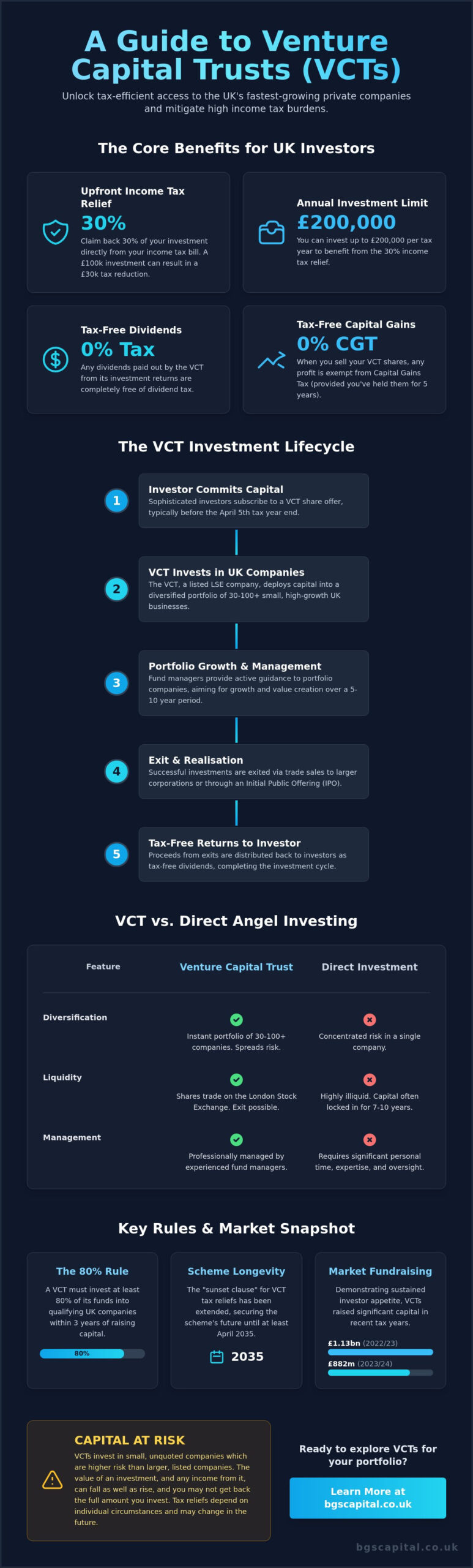
The primary purpose is to stimulate the UK economy by supporting businesses that create jobs and drive innovation. In the 2022/23 tax year, VCTs raised £1.13 billion, demonstrating sustained demand for these vehicles. The landscape for 2026 and beyond focuses heavily on Knowledge Intensive (KI) companies. These firms dedicate a significant portion of their operating costs to research and development. Recent legislative updates extended the “sunset clause” for VCT tax reliefs to April 2035, ensuring the scheme remains a pillar of UK venture funding for the next decade. CAPITAL AT RISK.
The Legal Structure of a VCT
VCTs operate as “closed-ended” investment companies. Unlike open-ended funds, they issue a fixed number of shares during an offer period; managers don’t have to sell underlying assets when investors want to exit. A VCT must maintain a listing on a UK-recognised stock exchange to retain its tax-privileged status. HMRC mandates that 80% of the VCT’s investments must be in “qualifying holdings” within three years of raising capital. The fund manager identifies these opportunities, conducts due diligence, and monitors the portfolio to ensure compliance and growth.
VCT vs Direct Venture Capital
Investing through a VCT offers distinct operational differences compared to holding direct equity in a private company. It’s a more structured approach to clarify what is a venture capital trust (VCT) for those evaluating high-growth UK opportunities.
- Liquidity: VCT shares trade on the London Stock Exchange. Investors can sell shares back to the market or the trust itself via buybacks, whereas direct private equity is often illiquid for 7 to 10 years.
- Diversification: A single VCT typically holds a portfolio of 30 to 100+ companies. This spreads risk across various sectors and stages of growth, from early-stage startups to established scale-ups.
- Professional Management: Fund managers provide active board-level guidance. Individual “angel” investors often lack the resources or expertise to provide this level of constant oversight.
The VCT structure provides a conduit to exclusive deals that are usually restricted to institutional investors. It’s designed for sophisticated investors who understand the risks of small-cap investing. CAPITAL AT RISK.
The Mechanics: How a Venture Capital Trust Operates
Understanding what is a venture capital trust (VCT) requires a look at its strict operational framework. These entities function as closed-ended investment companies listed on the London Stock Exchange. They raise capital through “offers for subscription,” which usually peak before the April 5th tax year deadline. Managers might also utilize “top-up rounds” to increase capital by up to 10% of their share capital annually without issuing a full prospectus. This allows for efficient capital deployment when specific opportunities arise.
HMRC enforces the “80% rule” to ensure capital reaches the intended small businesses. A VCT must invest at least 80% of its funds in qualifying holdings within three years of raising capital. These investments must be in “qualifying trades.” Excluded sectors include property development, financial services, and coal production. This ensures the tax relief incentivizes genuine innovation and growth in underserved sectors. If a VCT fails to meet these ratios, it risks losing its approved status, which triggers the clawback of investor tax reliefs.
The lifecycle of these investments focuses on a clear exit strategy. Managers typically target a five to ten-year window to realize value. Success is achieved through trade sales to private equity firms or larger corporations. Alternatively, a company may list via an IPO. Investors should check their eligibility for such high-growth opportunities before committing capital. CAPITAL AT RISK.
Investment Criteria for VCT-Backed Companies
Strict limits apply to the businesses receiving VCT funds. Companies must generally be within 7 years of their first commercial sale. This extends to 10 years for “Knowledge Intensive” (KI) firms. Employee counts are capped at 250 full-time staff, or 500 for KI companies. Additionally, the business’s gross assets cannot exceed £15 million immediately before the VCT investment is made. These rules ensure the capital supports early-stage growth rather than established enterprises.
Types of Venture Capital Trusts
- Generalist VCTs: These maintain a diversified portfolio across tech, healthcare, and professional services. They offer broad exposure to the UK’s early-stage ecosystem.
- AIM VCTs: These invest in companies already quoted on the Alternative Investment Market. They often provide higher liquidity than private equity holdings but remain subject to market volatility.
- Specialist VCTs: These focus on specific niches like life sciences or renewable energy. These require deep sector expertise from the fund manager to mitigate the specific risks of the industry.
VCT Tax Relief: Incentives for UK Investors
The UK government provides generous tax incentives to encourage investment into small, higher-risk companies. When asking what is a venture capital trust (VCT), most investors focus on the 30% upfront income tax relief. You can claim this relief on investments up to £200,000 per tax year. For an investor at the maximum limit, this results in a £60,000 reduction in their annual income tax bill. To benefit, you must have paid enough tax to cover the amount you’re claiming.
VCTs are a preferred vehicle for supplemental retirement income because of their tax-free dividends. Unlike standard equity dividends, which are subject to tax rates of up to 39.35% for additional rate taxpayers, VCT distributions are entirely exempt from income tax. There’s no requirement to report these dividends on your Self Assessment tax return. This makes them a strategic tool for high net worth individuals who’ve reached their pension lifetime or annual allowance limits.
Capital Gains Tax (CGT) exemption provides an additional layer of efficiency. When you sell your VCT shares, any profit you make is exempt from CGT. This is a significant advantage compared to traditional investment funds where gains above the annual allowance are taxed. Understanding the nuances of venture capital structures is vital for managing a tax-efficient portfolio.
The 5-Year Holding Rule
To retain your 30% upfront income tax relief, you must hold your VCT shares for at least five years. If you sell before this period ends, HMRC will trigger a clawback mechanism. You’ll be required to repay the full amount of the initial tax relief received. This rule ensures that capital remains committed to the UK’s growth economy for a meaningful duration. It forces a long-term capital allocation strategy, which is necessary given the illiquid nature of the underlying assets.
Comparing VCT and EIS Tax Benefits
While both schemes offer 30% income tax relief, they serve different strategic purposes. EIS allows for CGT deferral, meaning you can reinvest gains from other assets into EIS shares to delay a tax bill. VCTs don’t offer this feature. However, VCTs provide tax-free dividends, whereas EIS dividends are taxable. EIS also provides loss relief, allowing you to offset the net loss of a failed company against your income tax. This makes EIS more suitable for direct, high-conviction plays. You can read our complete guide to EIS to understand which scheme fits your risk profile. Understanding what is a venture capital trust (VCT) versus an EIS is essential for any sophisticated investor’s tax planning.
Understanding the Risks and Eligibility Requirements
CAPITAL AT RISK. Investing in a Venture Capital Trust involves significant financial exposure. While the tax incentives are substantial, they reflect the inherent dangers of backing early-stage enterprises. Before committing capital, you must understand what is a venture capital trust (VCT) regarding its specific risk profile and regulatory constraints.
Liquidity risk remains a primary concern for participants. VCT shares are listed on the London Stock Exchange, but the secondary market is notoriously thin. Finding a buyer can be difficult. Investors frequently have to sell at a 10% to 20% discount to the Net Asset Value (NAV) to exit a position. If you sell before the five-year anniversary, HMRC requires a full clawback of your initial 30% income tax relief.
Portfolio risk is equally high. VCTs invest in unquoted or AIM-listed companies. Data from the ScaleUp Institute suggests that a significant portion of early-stage businesses fail to reach their five-year milestone. If the underlying companies in the trust fail, your capital is lost. Regulatory risk is also a factor. Should the VCT breach HMRC’s strict rules, such as failing to maintain 80% of its funds in qualifying holdings, it may lose its approved status. This results in the loss of all future tax benefits and potential retrospective tax charges.
Who Should Invest in a VCT?
VCTs are intended for sophisticated investors and high-net-worth individuals. They’re typically used by high earners who’ve already reached their £60,000 annual pension contribution limit or fully utilized their £20,000 ISA allowance. They aren’t suitable for retail investors or anyone requiring short-term access to capital. You should only consider what is a venture capital trust (VCT) as a component of a diversified portfolio after securing your primary retirement and savings vehicles.
Risk Mitigation Strategies
Sophisticated investors often use a “VCT ladder” strategy. This involves investing a set amount annually over five years. By year six, the first year’s investment can potentially be sold and reinvested to claim new tax relief, creating a self-sustaining cycle of tax-free dividends. To address liquidity issues, many fund managers operate share buy-back policies. These are discretionary and not guaranteed, but they typically occur at a 5% to 10% discount to the current NAV.
BGS Capital operates as an introducer to accredited investment firms. We don’t provide financial advice or facilitate raises directly. Access to these schemes is strictly restricted to those who meet specific qualification criteria.
Integrating VCTs into a Broader Investment Strategy
Understanding what is a venture capital trust (VCT) requires viewing it as more than a tax-efficient vehicle. For sophisticated investors, these trusts serve as a strategic bridge between early-stage startup funding and the liquidity of public markets. VCTs raised £882 million in the 2023/24 tax year, highlighting their continued relevance in the UK’s high-growth ecosystem. They offer a diversified entry point into a portfolio of 30 to 70 companies, mitigating the concentrated risk associated with individual stakes.
Strategic investors often use VCTs as a feeder for later-stage angel investment opportunities. By monitoring the performance of companies within a VCT, you can identify “winners” that may require direct secondary placings or follow-on funding. This approach allows you to gain familiarity with a business’s management and growth trajectory before committing larger amounts of capital to a direct holding. BGS Capital operates as an introducer in this space, connecting qualified individuals with these high-growth businesses through a pre-vetted network.
VCTs as a Gateway to Pre-IPO Exposure
Companies backed by VCTs are typically at a stage where they are scaling operations toward a liquidity event. Many of these businesses progress toward full IPO listings on the London Stock Exchange or AIM. Identifying high-performers within a VCT portfolio provides a distinct advantage when these companies seek pre-IPO capital to finalize their balance sheets before going public. The synergy between VCTs and IPO pipelines in 2026 will be defined by the accelerated migration of tech-enabled scale-ups from private venture portfolios to public equity markets.
Successful companies in these portfolios often offer secondary placings to existing or connected investors. These opportunities allow you to increase your exposure to a proven entity without the blind-pool risk of the initial VCT investment. Accessing these placements requires a connection to the right network of wealth managers and corporate finance specialists.
Getting Started with BGS Capital
For founders seeking VCT-style capital, featuring your business through our network provides visibility to accredited investment firms and high net worth individuals. We streamline the connection process, ensuring your proposition reaches the right audience. We don’t facilitate raises directly; we act as the conduit for professional interaction.
Investors can access our network to view pre-vetted opportunities that align with their risk appetite and portfolio goals. Our platform focuses on clarity and efficiency, removing the friction often found in private equity markets. All investments carry risk, and capital is at risk. Check your status to determine if you are eligible for these exclusive opportunities.
Optimising Your Portfolio with VCT Opportunities
Understanding what is a venture capital trust (VCT) is the first step toward accessing significant tax efficiencies within the UK market. These vehicles offer 30% upfront income tax relief on investments up to £200,000 per tax year, provided shares are held for at least five years. They serve as a critical bridge for funding small companies with fewer than 250 employees and gross assets not exceeding £15 million. While the tax-free dividends are attractive, remember that these are long-term commitments involving illiquid assets.
BGS Capital operates as a specialist introducer, maintaining an exclusive network of accredited investment firms for sophisticated investors. We facilitate direct introductions to investor relations teams, bridging the gap between high net worth individuals and high-growth pre-IPO opportunities. We don’t offer financial advice; we provide the conduit to institutional-grade deal flow. CAPITAL AT RISK. Professional Introducer Status. Your investment’s value can fluctuate, and you may get back less than you originally invested.
Am I Eligible? Check your status to access pre-IPO opportunities
Take the next step in diversifying your strategy by qualifying for exclusive access today.
Frequently Asked Questions
Is a Venture Capital Trust the same as a Venture Capital fund?
No, a VCT is not the same as a traditional Venture Capital fund. A VCT is a tax-efficient company listed on the London Stock Exchange that allows individual retail investors to access small, high-growth businesses. While both provide capital to startups, understanding what is a venture capital trust (VCT) involves recognizing its status as a publicly traded security with specific HMRC tax benefits. Private VC funds are typically structured as limited partnerships for institutional investors.
Can I lose all my money in a VCT?
Yes, you can lose your entire investment. VCTs invest in early-stage companies that face high operational risks and a greater likelihood of failure. CAPITAL AT RISK. If the companies within the portfolio don’t succeed, the value of your shares can drop to zero. These are high-risk, long-term assets. You should only invest capital that you’re prepared to lose in full, as liquidity is often limited in this sector.
How much income tax relief can I get with a VCT in 2026?
You can claim 30% upfront income tax relief on investments up to £200,000 for the 2025/26 tax year. This relief is applied against your total UK income tax liability for the year you make the investment. You’ve to hold the shares for a minimum of five years to retain this benefit. If you sell your shares before this five-year period ends, HMRC will reclaim the tax relief you originally received.
What is the minimum investment for a VCT?
Most VCT managers set a minimum investment threshold between £3,000 and £5,000 per offer. Some specialized or exclusive offers might require a higher entry point of £10,000 or more. These limits vary significantly between different providers and specific share classes. You’ll find the exact requirements listed in the specific VCT’s prospectus. Access to these opportunities is restricted to investors who meet these specific financial qualifications and eligibility criteria.
Do I pay Capital Gains Tax on VCT dividends?
No, you don’t pay any Capital Gains Tax or Income Tax on dividends received from a VCT. This remains one of the most significant benefits for UK taxpayers seeking regular income. There’s no limit on the amount of tax-free dividends you can receive from your VCT holdings. Additionally, you won’t pay Capital Gains Tax when you sell your shares at a profit, provided the trust maintains its qualifying status with HMRC.
What happens to my VCT if the company goes public (IPO)?
When a portfolio company undergoes an IPO, the VCT manager typically retains the shares as they transition from private to public. The investment moves from an unquoted holding to a quoted one, usually on the AIM market. The manager then decides the optimal time to exit the position to maximize returns. These successful exits often generate the capital gains that VCTs distribute to their shareholders as tax-free dividends.
Can I hold VCT shares in an ISA or SIPP?
No, you can’t hold VCT shares inside an ISA or a SIPP. VCTs are standalone investments that provide their own unique set of tax incentives directly to the individual. Holding them within another tax-advantaged wrapper like a SIPP is not permitted under current HMRC regulations. To claim the 30% income tax relief and the tax-free dividends, the shares must be held in your own name rather than through a secondary vehicle.
What is the “Sunset Clause” and how does it affect VCTs in 2026?
The Sunset Clause was a statutory deadline originally set to end VCT tax reliefs on 6 April 2025. The UK government officially extended this deadline to 6 April 2035 in the 2023 Autumn Statement. This extension ensures that what is a venture capital trust (VCT) remains a stable and viable investment vehicle through 2026 and for the next decade. It provides long-term certainty for investors and the small businesses that rely on this specific pool of capital.