
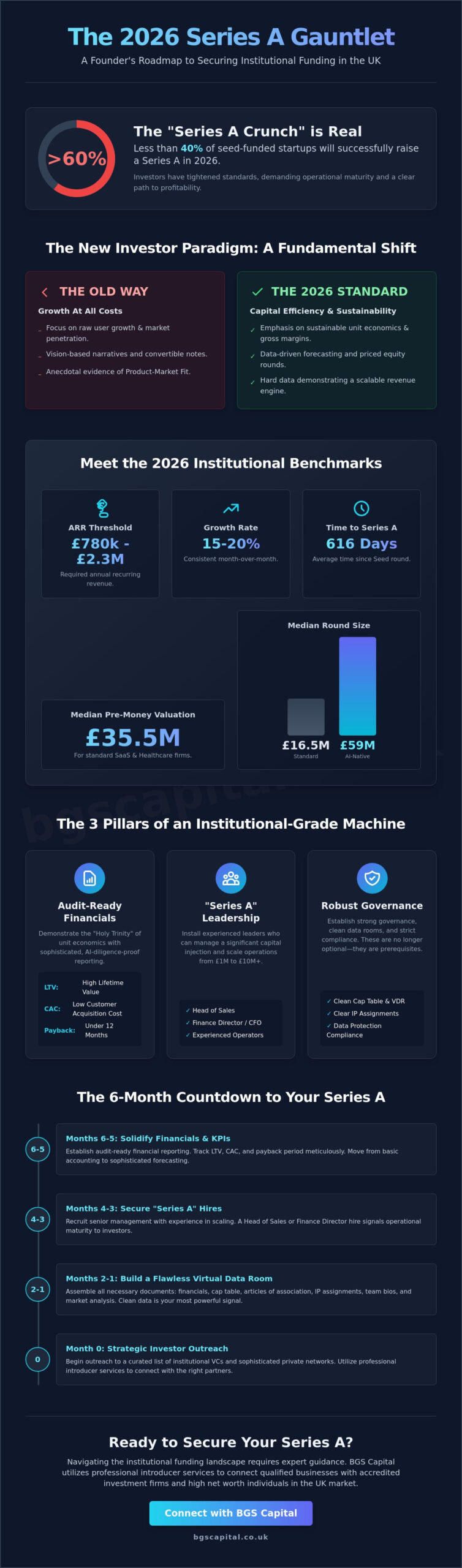
Less than 40% of seed-funded startups successfully raise a Series A in 2026. This statistic reflects a significant tightening of institutional standards where the median round size has climbed to £16.5 million, driven largely by AI-native companies securing £59 million medians. If you’re currently preparing for a series a funding round, you’ve likely realized that the era of growth at all costs has ended. Investors now prioritize capital efficiency and sustainable unit economics over raw expansion. High rejection rates are common for those who fail to adapt to these rigorous valuation benchmarks.
Securing institutional backing requires an institutional-grade data room and a clear path to at least £2.3 million in annual recurring revenue. We recognize the difficulty of meeting these 2026 benchmarks while facing overwhelming due diligence requirements. This guide provides a definitive roadmap for your next six months of preparation. You’ll learn the specific metrics required for a £35.5 million pre-money valuation and how to align your operations with the expectations of the sophisticated investors active in the UK market.
Key Takeaways
- Shift your operational focus from product-market fit to a scalable revenue engine to meet 2026 institutional benchmarks.
- Establish audit-ready financial reporting and secure the senior management hires required for Series A operational maturity.
- Execute a strategic six-month roadmap for preparing for a series a funding round to ensure your virtual data room is fully prepared.
- Understand the distinct requirements of institutional venture capital versus the sophisticated private networks active in the UK market.
- Utilize professional introducer services to connect your qualified business with accredited investment firms and high net worth individuals.
What is Series A Funding in 2026? Defining the Threshold
In the 2026 investment landscape, a Series A round is no longer a reward for early traction. It’s a certification of operational maturity. While seed rounds focus on the potential of a product, a What is a Series A round? functions as the first institutional priced round. At this stage, sophisticated investors move beyond convertible notes to purchase equity at a fixed valuation. This shift requires founders to transition from a “vision-based” narrative to a “scalable revenue engine” model. By May 2026, the market has shifted entirely; unit economics and gross margins now outweigh raw user growth in every major sector.
Preparing for a series a funding round in 2026 requires meeting rigorous benchmarks that have climbed significantly since 2024. Investors expect to see a repeatable sales process and a clear path to profitability. The “growth at all costs” mentality has been replaced by a focus on capital efficiency. Accredited investment firms now scrutinize customer acquisition costs (CAC) and lifetime value (LTV) with unprecedented depth. If your metrics don’t show a clear, sustainable trajectory, institutional capital will remain out of reach.
Series A vs. Seed Funding: The Maturity Gap
The transition from seed to Series A is often called the “Valley of Death” because the requirements change so fundamentally. Seed funding usually comes from angel investors or micro-VCs who bet on the founder’s vision. Conversely, Series A is dominated by institutional venture capital firms that demand data-driven forecasting. You must move from anecdotal evidence of product-market fit to hard data demonstrating a scalable business. You can learn more about these transitions in our guide to Startup Funding: A Founder’s Guide. Founders must also account for the rise of “Seed Extensions” which have blurred the lines, often requiring Series A-level metrics for what used to be a bridge round.
Typical Series A Funding Amounts and Valuations
Current 2026 benchmarks for UK-based companies show a median Series A round size of £16.5 million. However, sector-specific variations are stark. AI-native companies are currently dominating the market, raising medians of £59 million at valuations that far exceed the general market average. For standard SaaS or healthcare firms, the median pre-money valuation sits at approximately £35.5 million.
- ARR Threshold: Investors typically require £780,000 to £2.3 million in annual recurring revenue.
- Growth Rate: Consistent month-over-month growth of 15% to 20% is expected.
- Timeframe: The average time between a Seed round and a successful Series A is now 616 days.
The “Series A crunch” remains a reality for mid-stage startups. Less than 40% of seed-funded companies successfully bridge this gap. Success depends on presenting audit-ready financials and a management team capable of scaling toward an eventual exit or IPO.
The Pillars of Preparation: Building the Institutional-Grade Machine
Preparing for a series a funding round in 2026 demands more than a compelling vision. It requires an institutional-grade infrastructure capable of withstanding rigorous scrutiny. Investors now utilize AI-driven due diligence tools to scan for operational inefficiencies and financial discrepancies. This means your reporting must move beyond basic accounting. You need sophisticated, audit-ready financials that demonstrate the “Holy Trinity” of unit economics: Customer Acquisition Cost (CAC), Lifetime Value (LTV), and a Payback Period that ideally sits under 12 months. In the current market, capital efficiency is the primary signal of a qualified company.
Your management team must also evolve. Series A investors look for “Series A hires” who have experience scaling businesses from £1 million to £10 million in revenue. This often involves recruiting a dedicated Head of Sales or a Finance Director before you even begin the raise. For B2B firms in technical fields, establishing credibility through strategic media relations is equally vital; firms like BCM Public Relations can help bridge the gap between technical expertise and market visibility. Demonstrating that you have the right leadership to manage a £16.5 million capital injection is essential. Additionally, you must address the 2026 regulatory environment. Strong governance, clear IP assignments, and strict data protection compliance are no longer optional. They are prerequisites for any sophisticated investment firm.
The Virtual Data Room (VDR) Checklist
Clean data is the most powerful signal you can send to a venture capital firm. If your cap table is messy or your Articles of Association are outdated, sophisticated investors will likely disengage. Your VDR should include 3-5 year financial projections backed by sensitivity analysis. This shows how your business handles market volatility. Proper documentation distinguishes Series A vs. later funding rounds where the focus shifts from proving the model to aggressive market capture. Ensure all IP assignments are signed and stored centrally to avoid delays during the final stages of due diligence.
Refining the Series A Pitch Deck
Your pitch deck must transition from “The Problem” to “The Scalability” in exactly 12 slides. In 2026, you must provide clear evidence of your “Moat.” Explain how you defend your market position against AI-driven competitors and why your business model is sustainable. Investors prioritize companies that show a repeatable sales process rather than one-off wins. If you need a deeper understanding of what institutional VCs expect, consult our Venture Capital: A Founder’s Guide. Companies that maintain this level of preparation are significantly more likely to feature their business successfully to high net worth individuals and accredited firms.
Investor Landscape: Institutional VCs vs. Sophisticated Private Networks
Institutional venture capital firms remain the primary lead investors for Series A rounds in the UK. However, the 2026 landscape has seen a 25% increase in the participation of sophisticated private networks. These networks, comprised of high net worth individuals and family offices, often fill the capital gaps left by increasingly selective VCs. Preparing for a series a funding round now requires a dual-track approach. You must target both the institutional “lead” and the private “follow” capital. This diversification reduces the risk of a round failing if a single VC pulls out during due diligence.
This is where the introducer model becomes critical. Platforms like BGS Capital operate as a conduit, connecting qualified companies with accredited investment firms. Unlike traditional brokers, an introducer focuses on visibility and access to exclusive financial opportunities. This model allows founders to feature their business to a curated audience of wealth managers and sophisticated investors who are actively looking for pre-IPO and secondary placings. Secondary placings have also gained prominence in 2026. They allow early employees or seed investors to achieve partial liquidity during the Series A transition. This reduces the pressure on the cap table and ensures all stakeholders are aligned for the next growth phase.
The Rise of Private Placement in 2026
Many founders now prefer a syndicate of sophisticated investors over a single institutional VC. This preference stems from the flexibility and sector-specific expertise that private capital provides. A syndicate can often move faster than a large fund, which is essential when the average time between seed and Series A has stretched to 616 days. If you are exploring this route, understanding the mindset of your backers is vital. See our Angel Investors: The Ultimate Guide for detailed insights into managing these relationships. Private capital often comes with fewer restrictive covenants than institutional VCs, allowing for greater operational agility.
Navigating UK Tax Incentives: EIS and Beyond
For UK-based startups, the Enterprise Investment Scheme (EIS) is a powerful tool for attracting sophisticated private capital. As you transition from SEIS to EIS eligibility during your Series A, the tax relief offered to investors becomes a major selling point. EIS-qualified companies are significantly more attractive to high net worth individuals looking to mitigate risk while accessing high-growth opportunities. Consult The Enterprise Investment Scheme (EIS) Guide to ensure your company meets the stringent requirements for this status. Preparing for a series a funding round requires strict adherence to HMRC guidelines to maintain these tax advantages and ensure the round remains attractive to domestic capital.
The 6-Month Countdown: A Strategic Timeline for Success
Preparing for a series a funding round is a 180-day commitment that requires structured execution. Attempting to compress this timeline often leads to unfavorable terms or total round failure. Statistics from May 2026 indicate that the average time between seed and Series A has reached 616 days. This necessitates a disciplined approach to internal preparation before engaging with external capital. Founders who rush the process often face a 60% failure rate during the due diligence phase. Success depends on hitting specific milestones at each stage of the countdown.
Months 6-5 focus on internal audits and metric hardening. You must verify that your annual recurring revenue (ARR) is trending toward the £2.3 million threshold. Construct your virtual data room (VDR) during this period. This ensures that all legal documents, IP assignments, and cap tables are central and audit-ready. Months 4-3 involve curating your target investor list and “soft-circling” existing backers. Institutional VCs look for a minimum 10% to 15% follow-on participation from your seed investors as a signal of internal confidence. Without this signal, attracting new institutional capital becomes significantly more difficult.
Months 2-1 are dedicated to active pitching and term sheet negotiations. This is the most intensive phase for the management team. Once a term sheet is signed, the final month is spent in deep-dive due diligence and legal finalization. Month 0 marks the closing of the round and the immediate execution of your post-funding hiring plan. You must secure the “Series A hires” identified in your earlier preparation to maintain the 20% month-over-month growth that sophisticated investors expect. Remember that CAPITAL AT RISK is a fundamental reality of this high-stakes environment.
Building the Target Investor List
Identify partners, not just firms. In 2026, the specific partner’s track record in your sector is more important than the firm’s brand name. Warm introductions remain the gold standard, but the rise of AI-driven filtering has made the “Introducer” model more efficient. Use an introducer to filter for accredited investment firms and high net worth individuals who align with your specific growth stage. To increase your visibility within these exclusive networks, you should feature your business on a dedicated investor platform. This establishes your company as a qualified opportunity before the first pitch meeting occurs.
Negotiating the Term Sheet
Understand that the highest valuation isn’t always the best deal for the founder. You must scrutinize liquidation preferences, anti-dilution clauses, and board seat requirements. A £40 million valuation with a 2x liquidation preference is often less favorable than a £30 million valuation with a 1x preference. Sophisticated investors will also require a deep-dive due diligence process after the term sheet is signed. This process will verify every claim made in your pitch deck. Any discrepancy found during this stage can result in a “down-round” or the withdrawal of the offer entirely. Legal transparency and data integrity are your primary defenses.
Securing Your Series A: How BGS Capital Facilitates the Connection
BGS Capital operates as a specialist facilitator within the UK investment ecosystem. We don’t provide financial advice or facilitate raises directly. Instead, we function as a professional introducer. We connect qualified companies with a network of sophisticated investors and accredited investment firms. As established in the previous sections, preparing for a series a funding round in 2026 requires meeting a £16.5 million median round benchmark. Achieving this level of capital injection necessitates visibility among high net worth individuals and wealth managers who understand the complexities of secondary placings and pre-IPO opportunities.
The transition from a seed-stage startup to an institutional-grade machine is often hindered by a lack of access to the right networks. Our platform bridges this gap by offering a dedicated “Featured Business” service. This service provides qualified companies with the exposure needed to cut through the noise of traditional venture capital outreach. By positioning your opportunity within a curated environment, you ensure that your data room and pitch deck are seen by investors who are specifically looking for high-growth, mid-stage opportunities. This is a critical component for those preparing for a series a funding round who want to diversify their capital sources beyond a single lead VC.
Featuring Your Business for Capital Raising
Professional presentation is the primary requirement for success within an introducer network. Sophisticated investors prioritize clarity and efficiency when reviewing new opportunities. When you feature your business, you’re not just listing a company; you’re presenting a vetted, scalable revenue engine to high net worth individuals. This approach reduces the administrative burden of cold outreach. It allows you to focus on the 6-month strategic timeline required to harden your metrics and finalize your management team. A featured listing serves as a signal of readiness to the broader market.
Next Steps: Qualification and Outreach
Access to our network is restricted to ensure quality for both founders and investors. The signature question we ask every potential partner is: “Am I Eligible?” This gatekeeping function is vital. It ensures that only qualified companies with the necessary operational maturity are introduced to our accredited investment firms. If your business meets the 2026 benchmarks for ARR and unit economics, the next step is to undergo our qualification process. This process verifies your readiness for an institutional-grade raise and prepares you for the rigorous due diligence that follows a term sheet offer.
CAPITAL AT RISK. Investments in early-stage companies carry significant risk. You may lose all of your invested capital. BGS Capital operates as an introducer and does not provide investment recommendations or financial advice.
Executing Your 2026 Funding Strategy
Success in the 2026 venture market depends on your ability to transition from a seed-stage vision to an institutional-grade machine. You’ve seen that the median round size has reached £16.5 million, requiring audit-ready financials and a disciplined 6-month strategic countdown. The complexity of preparing for a series a funding round in 2026 requires more than just a strong pitch. It demands operational maturity and a data-driven Virtual Data Room that can withstand AI-powered due diligence.
BGS Capital acts as a specialist facilitator for qualified companies ready to engage with sophisticated investors. We provide a direct conduit to exclusive pre-IPO and IPO networks, ensuring your opportunity reaches the right accredited investment firms and high net worth individuals. If your metrics meet the current market benchmarks, it’s time to optimize your visibility within our private placement network. Accessing these exclusive financial opportunities starts with a single qualification step. CAPITAL AT RISK.
RAISING CAPITAL? FEATURE YOUR BUSINESS. We look forward to facilitating your connection to our sophisticated investor network.
Frequently Asked Questions
How much revenue is required for a Series A funding round in 2026?
In 2026, UK investors typically require between £780,000 and £2.3 million in annual recurring revenue (ARR). While some AI-native firms raise with less, the general market expects a proven, repeatable sales engine. You must also demonstrate 15% to 20% month-over-month growth to qualify for institutional capital.
What is the typical equity dilution in a Series A round?
Typical equity dilution for a Series A round ranges from 15% to 25%. This varies based on the valuation, which currently averages £35.5 million for UK startups as of May 2026. Founders should prioritize clean cap tables to ensure the round remains attractive to follow-on investors in later stages.
How long does the Series A due diligence process actually take?
The Series A due diligence process usually takes between 90 and 180 days. This timeline has lengthened in 2026 as investors utilize more rigorous AI-driven auditing tools. Preparing for a series a funding round requires having a fully populated virtual data room ready before the first term sheet is signed to avoid delays.
Can I raise a Series A from private investors instead of a VC firm?
You can raise a Series A from a syndicate of sophisticated private investors. In 2026, private capital participation has increased by 25% to fill gaps left by institutional VCs. These high net worth individuals often provide more flexibility and sector expertise than traditional funds.
What is the difference between a priced round and a convertible note?
A priced round involves selling equity at a specific, negotiated valuation per share. Convertible notes are debt instruments that convert into equity during a future financing event. Series A is considered the first major priced round, establishing a formal valuation for the company.
What happens if we fail to raise our Series A before our cash runway ends?
Failing to secure capital before your runway ends typically leads to a “down round” or insolvency. You might seek bridge financing or a seed extension, though these often come with high dilution. Companies preparing for a series a funding round must maintain at least six months of cash runway when they begin pitching.
How do introducers like BGS Capital differ from traditional brokers?
Introducers like BGS Capital provide visibility and access to exclusive networks of sophisticated investors. We don’t facilitate the raise, provide financial advice, or act as brokers. Our role is to connect qualified companies with accredited investment firms that match their growth stage.
What are the key legal documents needed for a UK Series A round?
Key documents for a UK-based round include the Articles of Association, Shareholders’ Agreement, and IP Assignment Agreements. You also need a Disclosure Letter and a clear Cap Table. Ensuring these documents are audit-ready is a primary signal of operational maturity for sophisticated investors.