
According to 2024 industry data, over 50% of UK seed deals experience delays of at least 30 days due to documentation errors. You understand that professional investors look past the pitch deck to evaluate the structural integrity of your firm. The complexity of SEIS/EIS compliance and the prospect of high legal fees often make the documentation process feel like a barrier to growth. Mastering the legal documents for seed funding isn’t just a formality. It’s a prerequisite for closing your round with sophisticated partners and high net worth individuals.
This guide provides a definitive roadmap to ensure your business is investment-ready for 2026. You’ll learn how to secure SEIS/EIS Advance Assurance and build a documentation suite that commands trust from accredited investment firms. This article delivers a comprehensive checklist of required documents, from Term Sheets to Shareholders’ Agreements, and explains how to maintain compliance throughout the entire fundraising cycle.
Key Takeaways
- Understand why professional legal readiness is a prerequisite for attracting sophisticated investors and how clean documentation facilitates faster connections within the UK ecosystem.
- Master the essential legal documents for seed funding, including the Term Sheet and Shareholders’ Agreement, to establish clear commercial parameters and governance rules.
- Evaluate the strategic advantages of agile funding instruments like Advance Subscription Agreements (ASAs) over traditional convertible notes for rapid 2026 capital rounds.
- Ensure your venture is investment-ready by securing SEIS/EIS Advance Assurance, a non-negotiable requirement for the majority of UK seed-stage investors.
- Implement a high-standard “self-due diligence” audit and structure your data room to meet the rigorous compliance expectations of accredited investment firms.
The Strategic Importance of Legal Documentation in Seed Rounds
Sophisticated investors do not back ideas alone. They back structured, compliant entities. Securing high-calibre investment requires more than a compelling pitch deck; it demands a robust suite of legal documents for seed funding that withstands rigorous due diligence. Legal readiness is a non-negotiable prerequisite for attracting high net worth individuals (HNWIs) and institutional seed funds. Without it, your venture is a liability, not an opportunity.
From an introducer’s perspective, clean legals are the catalyst for efficient capital matching. When a company’s documentation is orderly, connections to accredited investment firms happen faster. Disorganised records create friction. They signal a lack of management discipline, often causing sophisticated parties to terminate discussions immediately. Founders must prioritise risk mitigation by protecting equity and company intellectual property (IP) from day one. Failing to secure IP assignments or vesting schedules can lead to catastrophic disputes as the company scales.
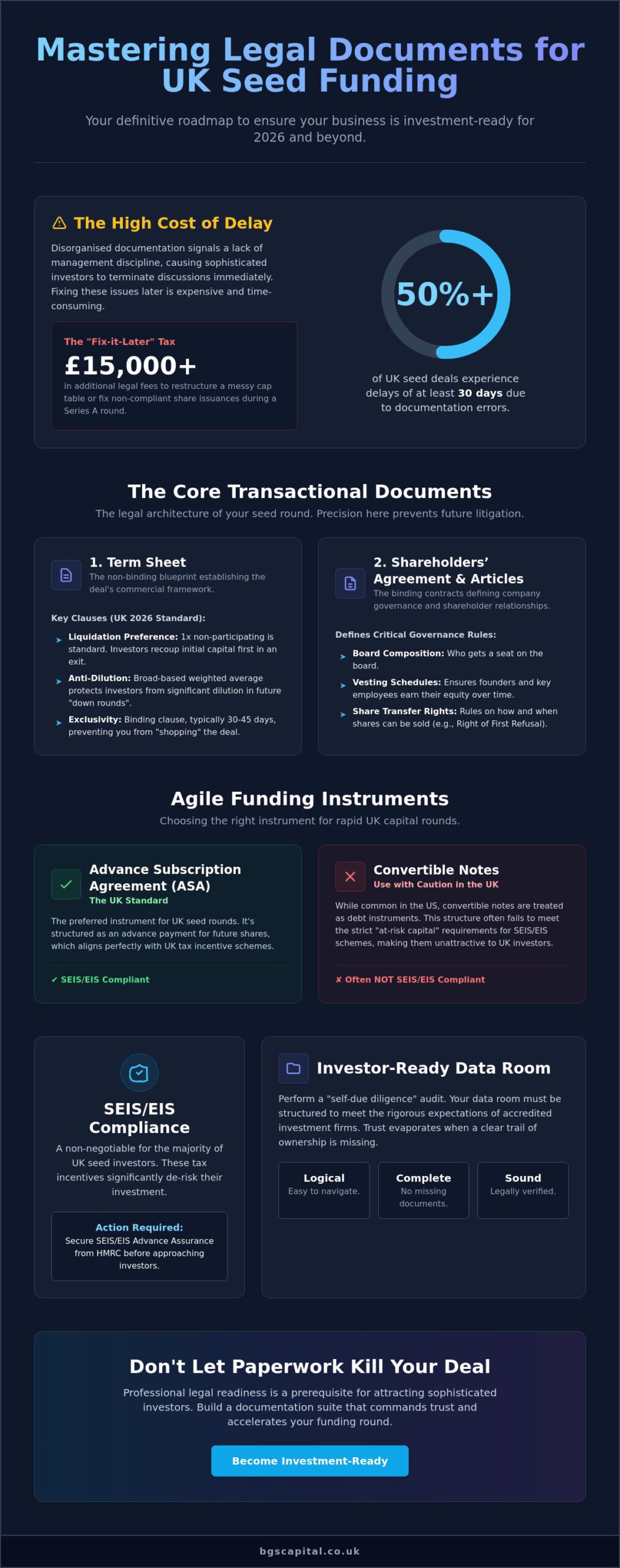
The financial implications of “fixing it later” are severe. Attempting to restructure a messy cap table or rectify non-compliant share issuances during a Series A raise can cost upwards of £15,000 in additional legal fees. Using standardised, UK-specific documentation from the outset ensures the company remains “investor ready” and saves thousands in future transaction costs.
Trust as a Currency in Private Capital
Professional documentation signals sophisticated management to HNWIs. It demonstrates that the founders respect the capital they’re seeking. Common legal red flags, such as missing board minutes or unverified shareholder rights, cause investors to withdraw from a seed round. Transparency is the foundation of the how to find investors journey. If a founder cannot provide a clear trail of ownership, trust evaporates. Investors expect a data room that is logical, complete, and legally sound.
Capital at Risk: The Regulatory Backdrop in 2026
The UK regulatory environment in 2026 demands stringent compliance for private raises. CAPITAL AT RISK is not just a disclaimer; it’s a regulatory reality. Founders must navigate the Financial Services and Markets Act 2000 and the updated Financial Promotion Order with precision. Generic templates often fail UK-specific regulatory scrutiny, particularly regarding SEIS/EIS eligibility and investor self-certification. Founder liability is a genuine concern. Professional indemnity and adherence to statutory requirements are essential to protect the personal assets of the leadership team. Every part of your legal documents for seed funding must align with current FCA standards to ensure the raise is lawful and enforceable.
Primary Transactional Documents: The Core of Your Funding Round
The legal architecture of a seed round rests on four primary documents. These instruments define the financial stakes, control mechanisms, and risk allocations between founders and investors. Precision in these legal documents for seed funding prevents future litigation and ensures the company remains attractive for subsequent Series A rounds. Mistakes during this stage often lead to “cap table rot,” where unfavorable terms from early investors block future institutional capital.
The Term Sheet: More Than Just a Price Tag
The Term Sheet acts as the blueprint for the Shareholders’ Agreement by establishing the commercial framework before formal drafting begins. While largely non-binding, it sets the precedent for the entire deal. Founders must distinguish between the commercial terms, which are “subject to contract,” and the binding clauses such as exclusivity and confidentiality. Exclusivity periods in the UK market typically last 30 to 45 days, preventing founders from “shopping” the deal to other investors once a lead is secured.
- Valuation: This is the pre-money valuation that determines the price per share.
- Liquidation Preference: In 2026, a 1x non-participating preference remains the standard for UK seed rounds, ensuring investors recoup their initial capital before common shareholders in a downside exit.
- Anti-dilution: Most seed investors require “broad-based weighted average” protection to mitigate the impact of future “down rounds.”
The Shareholders’ Agreement (SHA) and Articles
The SHA is a private contract that dictates the ongoing relationship between the company’s owners. It works in tandem with the Articles of Association, which is a public document filed at Companies House. These documents are essential for managing the startup funding lifecycle, specifically regarding governance and exit strategies. Founders should pay close attention to board composition. It’s common for a lead investor to demand a board seat or observer rights if they hold more than 10% of the equity.
Control is further managed through drag-along and tag-along rights. Drag-along clauses typically allow a 75% majority of shareholders to force a sale of the company, preventing minority holders from blocking an acquisition. Conversely, tag-along rights protect minority investors by ensuring they can join a sale on the same terms as the majority. If you’re unsure if your current structure meets institutional standards, you should check your eligibility for professional investment support.
Disclosure Letter: The Founder’s Shield
The Disclosure Letter is the primary tool for protecting founders against breach of warranty claims. While the Investment Agreement contains broad warranties about the company’s health, the Disclosure Letter allows founders to list specific exceptions. If a founder identifies a potential tax liability or an ongoing intellectual property dispute in this letter, the investor cannot later sue for a breach related to those specific facts. It’s a critical risk-management exercise that requires absolute transparency to be effective under UK law.
Agile Funding Instruments: ASAs vs. Convertible Notes
Speed defines the 2026 UK venture market. Founders increasingly bypass traditional priced rounds for agile instruments to secure capital without immediate valuation negotiations. These legal documents for seed funding allow companies to maintain momentum while deferring the technicalities of equity issuance until a later Series A or qualifying round. This flexibility is essential for early-stage startups requiring immediate liquidity to scale operations.
Capital at risk. Investors and founders must distinguish between Advance Subscription Agreements (ASAs) and Convertible Loan Notes (CLNs). While both delay valuation, their tax implications and legal structures differ significantly under current UK regulations.
ASAs and the SEIS/EIS Advantage
The ASA is the primary instrument for UK seed raises. It functions as an advance payment for future shares. Unlike the US-style SAFE, the ASA is specifically structured to comply with HMRC requirements for SEIS and EIS tax relief. This makes it the preferred choice for UK-based High Net Worth Individuals and seed funds.
HMRC maintains strict criteria for an ASA to remain equity-like. To ensure investors qualify for tax relief, the agreement must adhere to these standards:
- The 6-Month Rule: The agreement must mandate that shares are issued within six months of the cash investment. HMRC typically views any period longer than 180 days as a loan rather than an equity subscription.
- No Interest: ASAs cannot accrue interest. Any provision for interest payments will disqualify the instrument from SEIS/EIS eligibility.
- No Repayment: The investment cannot be repayable to the investor. It must convert into shares under almost all circumstances, including the long-stop date.
Convertible Notes: Strategic Use Cases
Convertible Loan Notes (CLNs) represent a debt obligation that converts into equity at a future date. These are rarely used for initial seed rounds involving UK retail investors due to the loss of SEIS/EIS benefits. Instead, CLNs are deployed during bridge rounds or by institutional investors who are ineligible for tax relief schemes.
Strategic considerations for CLNs include:
- Interest Rates: In 2026, interest rates for CLNs typically range from 8% to 12% per annum. This interest usually rolls up and converts into additional shares at the next round.
- Valuation Caps and Discounts: To reward early risk, investors receive a discount on the future share price, usually between 10% and 25%. A valuation cap sets a maximum price at which the debt converts, protecting investors from excessive dilution.
- The Long-Stop Date: This is a hard deadline, often 12 to 24 months from the date of the agreement. If a qualifying funding round has not occurred by this date, the note either becomes repayable or converts at a pre-determined floor price.
Founders should select their legal documents for seed funding based on their investor profile. If the target audience consists of UK-based angel investors, the ASA is the standard. If the round involves international debt-focused funds or bridge financing, the CLN provides the necessary debt-to-equity framework.
Regulatory Compliance and Tax Incentives (SEIS/EIS)
Tax incentives drive the UK seed ecosystem. The Seed Enterprise Investment Scheme (SEIS) and the Enterprise Investment Scheme (EIS) are non-negotiable requirements for most domestic investors. Without these, your legal documents for seed funding lack the necessary components to attract high net worth individuals. Investors prioritize capital preservation; these schemes offer up to 50% income tax relief and capital gains exemptions, which significantly de-risks the entry point for early-stage capital.
Securing SEIS/EIS Advance Assurance
In 2026, HMRC’s “Risk to Capital” test remains the primary hurdle for founders. You must prove the company has long-term objectives to grow and that the investment is not a low-risk tax shelter. Advance Assurance is a marketing tool for founders that signals to potential backers that their tax relief is pre-validated by HMRC. You shouldn’t start a formal pitch without this document in your data room. HMRC data from 2025 indicated that applications lacking detailed commercial forecasts faced a 40% higher rejection rate.
The application requires a specific set of documentation:
- A detailed pitch deck outlining the commercial opportunity.
- Current cap table and a 3-year financial forecast.
- A clear explanation of how the funds will be used for “growth and development.”
- The company’s Articles of Association and any existing shareholder agreements.
Post-Investment Compliance
Securing the cash is only the first step. You must submit a Compliance Statement, specifically Form SEIS1 or EIS1, once you’ve traded for four months or spent 70% of the investment. HMRC then issues form EIS3, which allows investors to claim their tax certificates. This administrative burden falls entirely on the company. Failure to maintain “Qualifying Company” status for the full 3-year holding period results in the clawback of tax relief; this scenario creates significant legal and reputational liability for the board.
These incentives heavily dictate the behavior of angel investors. They often refuse to sign a subscription agreement until Advance Assurance is confirmed in writing. Understanding the eis scheme’s intricacies prevents common pitfalls, such as issuing shares before receiving funds or failing the “gross assets” test. Currently, SEIS eligibility is limited to companies with less than £350,000 in gross assets before the share issue.
Your legal documents for seed funding must align with these regulatory frameworks to ensure long-term viability and investor confidence.
Preparing for Investor Introduction: The Final Legal Audit
Before you approach high net worth individuals or venture capital firms, perform a rigorous self-due diligence audit. This process identifies gaps in your legal documents for seed funding before an investor’s legal team finds them. Statistics from UK early-stage investment reports suggest that 25% of seed rounds face significant delays due to administrative errors in corporate filings or missing signatures. You must ensure every board minute, share certificate, and Companies House filing is accurate and accessible.
Clean up your cap table. Remove inactive advisors or consolidate small holdings to ensure your equity structure is transparent. A “messy” cap table with dozens of small, direct shareholders often requires a nominee structure to remain attractive to institutional investors. Professionalism at this stage signals that the business is ready for the scrutiny of a formal raise. CAPITAL AT RISK.
The Investor Data Room Checklist
Organize your virtual data room (VDR) into four primary folders: Corporate, Financial, Intellectual Property (IP), and Employment. Every employee and contractor must have a signed IP assignment agreement on file. Missing IP transfers can devalue a technology company by over 40% during a funding round. Use tiered access levels to protect sensitive data. Implement strict NDA protocols before granting full access to your financial forecasts or trade secrets. Ensure all legal documents for seed funding are stored in PDF format with clear, logical naming conventions.
Am I Eligible? Transitioning to the Raise
BGS Capital operates as an introducer. We connect qualified, investment-ready companies with a network of accredited investment firms, wealth managers, and sophisticated investors. Once your legal audit is complete and your documentation is standardized, the focus shifts to outreach. Being featured to a network of professional investors requires a high level of compliance and preparation. BGS Capital facilitates these connections for companies that meet specific eligibility criteria. We do not facilitate raises directly; we provide the conduit to exclusive financial opportunities.
Review your legals. Ensure your data room is secure. When you are ready to connect with accredited investment firms, the next step is to verify your status. Access to our network is restricted to qualified companies that demonstrate professional readiness.
Am I Eligible? Check your status to begin the introduction process.
Execute Your 2026 Funding Strategy with Precision
Navigating the UK venture landscape requires more than just a pitch deck; it demands a robust legal framework. Establishing the correct legal documents for seed funding ensures your cap table remains clean and your intellectual property stays protected. By prioritizing the Shareholders’ Agreement and aligning with SEIS/EIS requirements, you provide the structural certainty that sophisticated investors expect. HMRC data indicates that over £2.5 billion was raised via these tax-efficient schemes in recent cycles, proving their central role in UK startup growth. A rigorous pre-investment audit isn’t just a formality; it’s a vital step to verify compliance with current FCA standards and avoid costly delays during due diligence.
Once your documentation is airtight, the focus shifts to sourcing the right capital partners. Accessing a curated network of HNWIs and securing direct introductions to investor relations teams can significantly shorten your fundraising timeline. If you’re targeting high-growth trajectories, including pre-IPO and IPO opportunities, you need a platform that connects qualified companies with serious wealth managers and accredited firms.
RAISING CAPITAL? FEATURE YOUR BUSINESS
Your vision deserves a foundation that supports long-term scale. Start building it today.
Frequently Asked Questions
What are the most important legal documents for seed funding in the UK?
The core legal documents for seed funding in the UK include the Articles of Association, Shareholders’ Agreement, and Subscription Agreement. You also require a Disclosure Letter and IP Assignment Agreements to protect company assets. These documents define the relationship between founders and investors. Ensuring these are executed correctly is vital to maintaining investor confidence. CAPITAL AT RISK.
Can I use a US-style SAFE for a UK seed round?
You shouldn’t use a standard US-style SAFE because it often fails to qualify for SEIS or EIS tax reliefs. UK founders typically use an Advance Subscription Agreement (ASA) instead. ASAs are designed to meet HMRC requirements for equity conversion within 6 months to 36 months. Using a US document risks losing tax incentives for your UK investors.
How long does it take to get SEIS/EIS Advance Assurance in 2026?
In 2026, HMRC typically processes SEIS and EIS Advance Assurance applications within 15 to 45 working days. While 80 percent of applications are handled in this window; complex structures can take longer. You should apply at least 8 weeks before your planned round closure. This ensures you have the necessary confirmation to secure accredited investment. CAPITAL AT RISK.
Do I need a lawyer for a seed funding round if I use standardised documents?
You still need a lawyer even when using standardised documents like those from the BVCA. Standard templates require customisation to fit your specific cap table and governance needs. Legal counsel ensures your legal documents for seed funding don’t contain conflicting clauses. One mistake in your Articles of Association can lead to expensive disputes during a Series A round.
What happens if my legal documents are not compliant with HMRC rules?
If your documents are non-compliant, HMRC will reject SEIS or EIS claims. This results in investors losing their 30 percent or 50 percent income tax relief. It often triggers a breach of warranty in your investment agreement. Investors may then have the right to withdraw their capital or sue for damages. Compliance is a non-negotiable requirement for UK seed rounds.
Is a Term Sheet legally binding in the UK?
A Term Sheet is generally not legally binding in the UK, except for specific clauses regarding exclusivity and confidentiality. It acts as a framework for the final transaction documents. However, if you break the exclusivity period, which usually lasts 30 to 60 days, you may be liable for the investor’s legal costs. It’s a serious statement of intent.
What is a Cap Table and why do investors need to see it?
A Cap Table is a ledger that tracks the equity ownership of your company, including founders, employees, and investors. Investors review it to calculate their percentage stake and understand the dilution impact of the round. It must account for all ordinary shares, preference shares, and option pools. Accurate cap table management is essential for financial transparency and future fundraising.
How much does legal documentation typically cost for a seed round?
Legal documentation costs for a UK seed round typically range from £3,000 to £10,000 depending on complexity. Using automated platforms can reduce this to approximately £2,500; while bespoke firm advice often starts at £7,500. These figures exclude VAT and filing fees. Founders should budget for these costs early to avoid cash flow issues during the raise. CAPITAL AT RISK.