
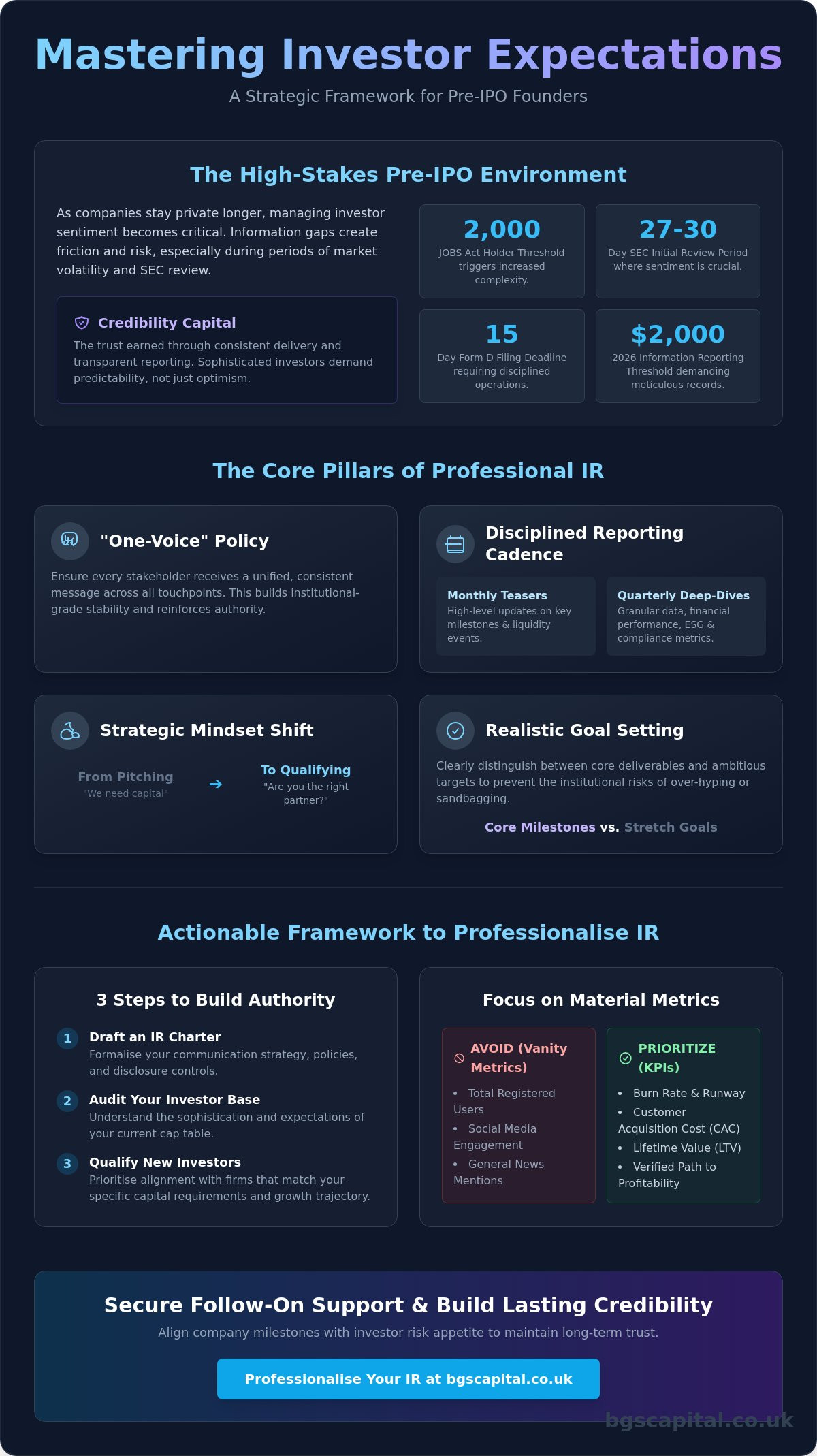
Credibility with accredited investment firms is a functional requirement for capital formation, not a secondary concern. In the current pre-IPO landscape, where qualified companies stay private longer due to the JOBS Act’s 2,000-holder threshold, founders often experience friction regarding how to manage investor expectations during periods of market volatility. You recognize that information asymmetry between your management and the secondary market leads to high-pressure demands. This tension often intensifies as you approach the SEC’s 27 to 30-day initial registration statement review period.
This guide outlines a professional framework for maintaining trust with sophisticated investors through strategic communication and a disciplined investor relations function. It details the specific cadences required to satisfy institutional requirements and secure follow-on support. Use this guide to professionalize IR operations by mastering regulatory safe harbors, managing the 15-day Form D filing deadline, and navigating the 2026 information reporting threshold of $2,000 to maintain a compliant, authoritative presence.
Key Takeaways
- Align company milestones with investor risk appetite to maintain long-term credibility and trust with accredited investment firms.
- Master how to manage investor expectations by implementing a “One-Voice” policy and a disciplined reporting cadence of monthly teasers and quarterly deep-dives.
- Establish clear distinctions between core milestones and stretch goals to prevent the institutional risks associated with over-hyping or strategic sandbagging.
- Professionalise the IR function by drafting an Investor Relations Charter and auditing the sophistication of your current investor base.
- Prioritise initial alignment by qualifying high net worth individuals and accredited firms that match your specific capital requirements and growth trajectory.
What Does it Mean to Manage Investor Expectations in 2026?
Investor expectation management is the strategic alignment of company milestones with specific investor risk appetites. It isn’t about general optimism. It’s a technical process of synchronizing your internal roadmap with the external requirements of accredited investment firms. In 2026, market volatility has made the cost of information gaps higher than ever. To succeed, founders must move beyond the “pitch” and adopt a rigorous framework for how to manage investor expectations through data-driven touchpoints.
A core component of this strategy is the preservation of Credibility Capital. This is the trust earned through consistent delivery and transparent reporting. Sophisticated investors don’t demand perfection; they demand predictability. While retail sentiment is often driven by news cycles and speculation, sophisticated investor requirements focus on financial materiality and regulatory compliance. Effective Investor Relations (IR) ensures that your most critical stakeholders remain aligned even when timelines shift.
The High Stakes of Pre-IPO Sentiment
Pre-IPO investors operate with a higher sensitivity to transparency than early-stage seed angels. As a company approaches the 2,000-holder threshold established by the JOBS Act, the complexity of the cap table increases. Secondary placings further complicate this dynamic. These transactions can create a disconnect between original investors and new entrants regarding exit timelines and valuation. To mitigate this, founders must proactively find investors who align with a specific long-term exit strategy. Failure to do so leads to fragmented sentiment that can jeopardize an IPO filing during the SEC’s 27 to 30-day initial review period.
The “Am I Eligible?” Mindset for Founders
Professionalising your IR function starts with shifting from a pitching mindset to a qualification mindset. You aren’t just seeking capital; you’re qualifying partners. Adopting the “Am I Eligible?” mindset allows founders to set firm boundaries early. This prevents investor creep, where stakeholders attempt to influence operational decisions outside their mandate. By establishing yourself as the authoritative source of truth for company data, you maintain control over the narrative. This is particularly vital in 2026, as the information reporting threshold for payments has increased to $2,000, requiring more meticulous record-keeping and disclosure discipline.
The Core Pillars of Professional Investor Relations
Professional investor relations (IR) is built on the principle of consistency. A “One-Voice” policy ensures that every stakeholder, from wealth managers to institutional partners, receives a unified message across all touchpoints. This discipline is a functional requirement for how to manage investor expectations among High Net Worth (HNW) individuals who demand institutional-grade stability. Using industry-standard terminology such as SIPP eligibility, secondary placings, and Pre-IPO valuation models reinforces your authority and signals that the company is ready for the public markets.
A modular reporting cadence is the most effective way to maintain this authority. Founders should implement monthly teasers that provide high-level updates on key milestones and liquidity events. These should be supplemented by quarterly deep-dives that offer granular data on financial performance, including ESG and compliance metrics. This structured flow of information prepares the organization for the rigorous disclosure requirements of a successful IPO. It also minimizes the friction caused by information asymmetry during periods of market volatility.
Setting Realistic Metrics and KPIs
Founders must move beyond vanity metrics like total registered users or social media engagement. Sophisticated investors focus on burn rate, Customer Acquisition Cost (CAC), Lifetime Value (LTV), and a verified path to profitability. Use venture capital benchmarks to contextualise your performance against sector peers and historical data. Realistic forecasting defines future performance as a probabilistic range rather than a single, fixed point. This approach manages risk by acknowledging uncertainty while demonstrating a clear grasp of operational levers. If you want to refine your investor targeting, you can check your eligibility to join our network of qualified companies.
Transparency and Risk Disclosure
Every communication must clearly state that capital is at risk. This foregrounding of risk isn’t just a legal requirement under UK financial promotion standards; it’s a tool for building long-term credibility. When a significant milestone is missed, founders should apply the 24-hour rule. Inform your lead investors within one business day, providing a concise explanation and a specific mitigation plan. Handling “bad news” with this level of professional immediacy prevents the erosion of trust. It ensures that investors remain supportive when milestones shift due to external factors. All communications must remain compliant with the latest SEC EDGAR Next platform requirements to ensure seamless transition to public reporting status.
Underpromising and Overdelivering: A Strategic Framework
The strategy of underpromising is frequently misunderstood as “sandbagging.” Setting excessively low targets is as damaging to credibility as over-hyping future performance. Institutional investors and wealth managers view artificially low bars as a lack of ambition or a signal of operational weakness. Professional founders must learn how to manage investor expectations by presenting a dual-track roadmap that clearly separates core milestones from stretch goals. Core milestones are the non-negotiable targets required to maintain your current valuation and secure your next funding round. Stretch goals represent the upside potential that drives follow-on support and premium valuations.
Managing the narrative arc between funding rounds requires a consistent, data-led flow. Perception studies are an essential tool for this process. These studies involve structured feedback loops with your cap table to identify what investors actually expect versus what they claim in formal meetings. By identifying these gaps early, you can adjust your communication strategy before sentiment shifts into friction. This proactive alignment is a functional requirement for maintaining your position as an established conduit to financial opportunities.
The Psychology of Investor Reactions
High Net Worth Individuals (HNWIs) are particularly susceptible to loss aversion. The psychological impact of a missed revenue target is significantly greater than the satisfaction of a beat. Founders must neutralize emotional reactions using historical data and peer comparisons. Expertise within your IR function is necessary to bridge the gap between technical progress and financial impact. This ensures that technical delays are framed as risk-mitigation efforts rather than management failures. This professional detachment is vital for maintaining trust during periods of market volatility.
Managing Expectations During M&A or IPO Prep
The transition toward a liquidity event shifts the focus from growth metrics to governance. Investors prioritize compliance, board composition, and financial materiality. Handling market reactions to board turnover requires immediate, transparent disclosure. During the 27 to 30-day SEC registration statement review period, silence is often mandated by regulatory “gun-jumping” rules. Founders must manage this period of limited communication by having established a robust “Credibility Capital” reserve beforehand. Following the IPO, shares are typically subject to a 90 to 180-day lockup period. Maintaining a steady course during this window is vital for long-term investor retention. Use the EDGAR Next platform to ensure all filings meet the March 2025 authentication standards. CAPITAL AT RISK.
Actionable Steps to Professionalise Your Investor Communications
Professionalising investor communications requires a shift from reactive updates to a structured IR function. Begin by auditing your current cap table. Pre-IPO founders must determine if their existing investors possess the sophistication required for the next growth phase. If your list includes individuals unfamiliar with secondary placings or the 2,000-holder registration threshold, friction is inevitable. Draft an Investor Relations Charter. This document should explicitly state communication frequency, data access levels, and the protocols for handling material non-public information. This is a foundational step in how to manage investor expectations effectively.
A standardised, “due diligence ready” data room is a functional requirement. Continuous maintenance ensures the company is prepared for the SEC’s 27 to 30-day initial registration statement review at any time. Leveraging third-party introducers can facilitate this alignment. As an introducer, we focus on the initial qualification of accredited investment firms. This ensures the founder-investor match is based on shared risk appetites and professional standards. All systems should be updated to the March 24, 2025, EDGAR Next authentication platform to ensure compliance during the transition to public reporting.
The Quarterly Update Template
Every update must include a CEO Summary, granular Financials, Milestone tracking, and a clear “Ask”. These updates must be tailored to the specific startup funding stage you’re navigating. In 2026, virtual briefings are the primary tool for efficiency. In-person sessions are reserved for final-stage qualification or high-stakes board turnover discussions. Providing a clear roadmap for the use of quarterly estimated tax payments for C-Corps reinforces your management’s financial discipline and operational transparency.
Leveraging Professional Networks
Wealth managers and accredited investment firms provide a necessary buffer between founders and HNWIs. They translate complex operational data into the financial outcomes that sophisticated investors prioritise. A curated network reduces the friction of expectation management by ensuring all parties adhere to the same professional rules. This structure is particularly vital when managing Regulation D, Rule 506(c) offerings where general solicitation is permitted. If you are preparing for a raise, feature your business on our platform to connect with qualified firms. CAPITAL AT RISK.
Alignment Starts with the Right Introduction
Misaligned expectations often originate at the point of entry. If a founder accepts capital from an unvetted source, the administrative burden of investor education frequently outweighs the capital value. Understanding how to manage investor expectations begins with the rigorous qualification of every participant on the cap table. Sophisticated and High Net Worth status are not just regulatory labels; they are indicators of a specific risk appetite and a familiarity with the pre-IPO lifecycle. BGS Capital operates as a specialist facilitator to ensure this alignment is established on Day 1. By filtering opportunities through a lens of professional compatibility, we ensure that the initial introduction is based on shared financial objectives rather than short-term speculation.
Closing the loop between a featured business and a long-term partnership requires a commitment to transparency. When the initial match is technically sound, the subsequent investor relations functions become a process of reporting rather than defending. This professional alignment reduces the friction caused by market volatility and ensures that sophisticated investors remain committed through the 90 to 180-day lockup periods following a successful listing. Establishing this foundation early prevents the “investor creep” that often destabilises companies during the high-pressure run-up to an IPO.
Qualifying Your Investor Base
A smaller pool of qualified investors is functionally superior to a large pool of unvetted holders. Large, fragmented cap tables increase the risk of triggering the SEC registration threshold of 2,000 holders prematurely. This triggers public reporting requirements before the company is operationally ready. The “Am I Eligible?” check serves as a critical gatekeeping function for both the investor and the business. It forces a verification of professional standing before any material non-public information is exchanged. This transition from capital raising to long-term investor relations is only sustainable when the investor base understands the specific risks associated with secondary placings and pre-IPO valuations. CAPITAL AT RISK.
Feature Your Business for the Right Audience
Exposure to the BGS Capital network streamlines the expectation-setting process by removing the need for foundational education on pre-IPO structures. Direct introductions to investor relations teams allow founders to bypass the noise of retail sentiment. This curated approach ensures that your business is presented to accredited investment firms that possess the expertise to evaluate complex milestones. By the time a business is featured, the groundwork for a professional partnership is already laid, allowing management to focus on core operational growth. Feature your business with BGS Capital to connect with sophisticated investors.
Professionalising Your Investor Relations Strategy
Securing a successful IPO in 2026 requires more than operational growth; it demands a professionalised investor relations function. Founders who master how to manage investor expectations do so by aligning their milestones with the risk appetites of sophisticated investors from day one. By maintaining a disciplined reporting cadence and adhering to the 27 to 30-day SEC registration review standards, you build the Credibility Capital necessary for long-term support. Transitioning from a private entity to a public one is a technical process where transparency is your most valuable asset.
Qualification is the primary gatekeeper of this process. Ensuring your cap table consists of HNWIs and accredited investment firms reduces friction during the 90 to 180-day lockup periods following a listing. Our network provides direct introductions to IR teams and a focused environment for pre-IPO and IPO opportunities. This structure ensures that your messaging reaches an audience that understands the specific regulatory requirements of the current financial landscape. CAPITAL AT RISK.
RAISING CAPITAL? FEATURE YOUR BUSINESS and connect with our exclusive network of sophisticated investors to begin your professional alignment.
Frequently Asked Questions
How often should I update my investors in 2026?
Maintain a cadence of monthly performance teasers and comprehensive quarterly reports. This structure ensures alignment with the 2026 quarterly estimated tax payment deadlines of April 15, June 15, September 15, and December 15. Regular touchpoints reduce information asymmetry. They also prevent the friction that occurs when stakeholders only receive data during periods of market volatility or emergency capital calls.
What is the best way to deliver bad news to HNWIs?
Deliver significant milestone misses within 24 hours using a data-led, objective format. Provide a specific mitigation plan and a revised timeline immediately. Sophisticated investors prioritise transparency over perfection. This approach preserves your Credibility Capital and prevents emotional reactions that stem from loss aversion. Focus entirely on the operational levers being adjusted to rectify the issue rather than using emotional language.
How do I handle an investor who wants more control than agreed?
Enforce the boundaries established in your Investor Relations Charter and legal shareholder agreements. If an investor seeks operational influence beyond their mandate, refer directly to the agreed-upon governance structure. This prevents investor creep into day-to-day management. Maintaining a professional distance is a key part of how to manage investor expectations regarding the division between capital provision and operational execution.
Can managing expectations improve my company valuation?
Effective expectation management improves company valuation by reducing the risk premium applied by sophisticated investors. Predictability is a functional requirement for institutional-grade pricing. When milestones are consistently met or managed transparently, the secondary market applies a higher multiple to your growth metrics. This disciplined approach leads to higher investor retention and more robust follow-on support during the pre-IPO phase.
What metrics do sophisticated investors care about most in a pre-IPO stage?
Sophisticated investors prioritise burn rate, CAC/LTV ratios, and a verified path to profitability over vanity metrics. In the pre-IPO stage, focus shifts toward financial materiality and compliance metrics. In 2026, disclosures regarding the $184,500 Social Security wage base limit and the $2,000 information reporting threshold are essential for demonstrating operational maturity. These technical data points signal that the company is ready for public market scrutiny.
Is it better to underpromise or be aggressively ambitious?
Adopt a dual-track roadmap that separates core milestones from stretch goals instead of choosing one extreme. Aggressive ambition without data leads to a loss of credibility; sandbagging suggests a lack of competitiveness. By defining core milestones as non-negotiable targets, you establish a reliable baseline. Stretch goals allow for upside potential without creating a breach of trust if they aren’t fully realised.
How do I manage expectations during a secondary placing?
Align all parties on the long-term exit timeline and the 2,000-holder registration threshold before the transaction occurs. Secondary placings can create friction if new entrants have different liquidity expectations than original investors. Use structured disclosure to explain how the placing impacts the cap table and the eventual IPO timeline. This ensures that the introduction of new capital doesn’t destabilise the existing investor relations function.
What role does an introducer play in managing expectations?
An introducer functions as a gatekeeper to ensure professional alignment between founders and accredited investment firms from the outset. We facilitate the initial qualification process to verify that both parties share a common understanding of how to manage investor expectations. This reduces the administrative burden on the founder by filtering for HNWIs who already possess the expertise to evaluate pre-IPO opportunities and secondary market risks.