
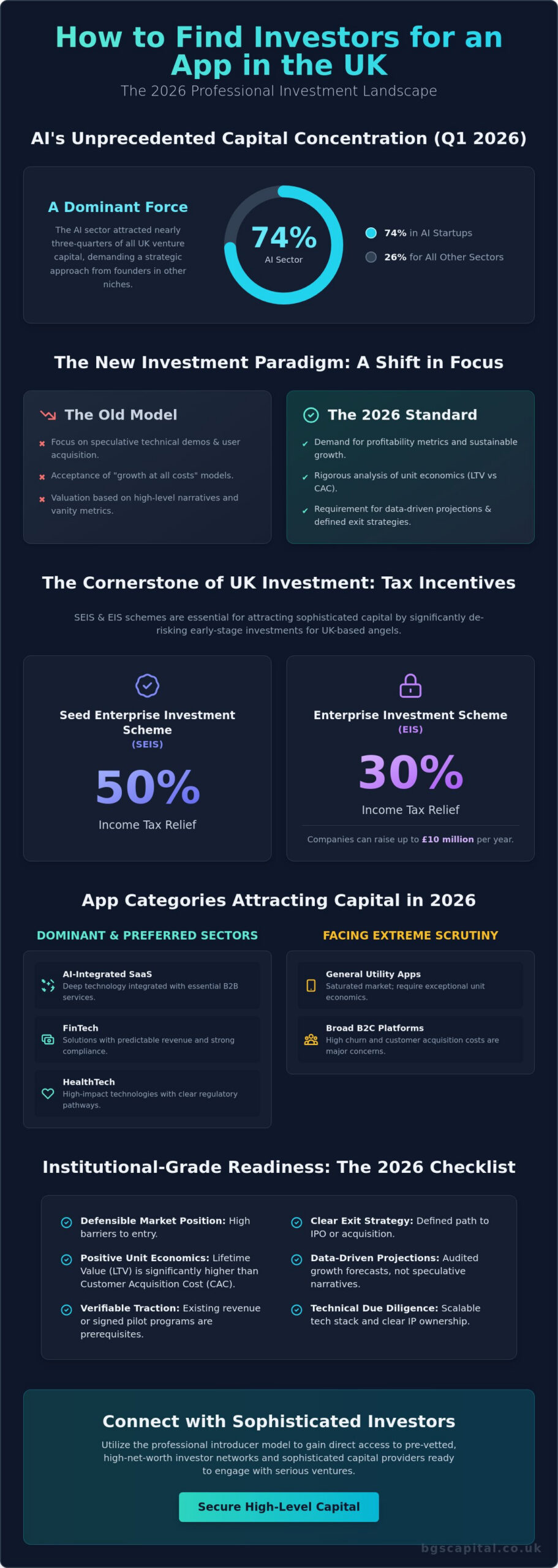
74% of all UK venture capital raised in Q1 2026 was concentrated in the AI sector, leaving founders in other niches to compete for a more discerning pool of sophisticated capital. If you are researching how to find investors for an app uk, you likely realize that technical merit alone is no longer sufficient to secure serious interest. Many founders stall their progress by engaging with unqualified leads or failing to address the rigorous SEIS and EIS requirements that professional investors expect as standard.
The 2026 investment climate demands a strategic alignment with regulatory frameworks and narrative scalability. This guide provides a professional framework for connecting with sophisticated investors and securing high-level capital. You will gain a clear roadmap to funding that covers the current regulatory landscape, including the Public Offer Platform (POP) regime, and learn how to position your venture for introductions to pre-vetted, high-net-worth networks. Success in this environment requires moving beyond the pitch deck to demonstrate a defensible, sustainable business model.
Key Takeaways
- Understand the 2026 shift toward institutional-grade requirements, where profitability metrics and sustainable growth outweigh speculative technical demos.
- Identify the most efficient frameworks for how to find investors for an app uk by targeting sophisticated angel networks and professional venture funds.
- Adopt the modern pitch deck standard, replacing high-level narratives with data-driven projections and clearly defined exit strategies.
- Utilize the professional introducer model to facilitate direct engagement with high-net-worth investor relations teams.
- Learn how curated business listings and feature services provide a high-visibility gateway to qualified, sophisticated capital providers.
Navigating the UK App Investment Landscape in 2026
The UK app funding environment has matured into a landscape defined by fiscal discipline and high-growth metrics. Investors have moved away from subsidising user acquisition for its own sake. In 2026, the focus has shifted toward profitability, unit economics, and long-term scalability. Understanding how to find investors for an app uk now requires a transition from technical development to rigorous financial modelling. Sophisticated investors prioritize ventures that demonstrate a clear path to positive EBIDTA and a defensible market position.
The United Kingdom remains a premier global hub for technology investment. This status is maintained through a robust ecosystem of Venture capital (VC) firms and private equity networks. While retail crowdfunding remains an option for some, it faces increased regulatory friction under the 2026 Public Offer Platform (POP) regime. Serious founders typically target “Sophisticated Investors” and “High-Net-Worth Individuals” (HNWIs). These classifications represent capital providers who possess the financial literacy and risk tolerance to support high-growth technology ventures through professional introduction channels.
The Role of SEIS and EIS in App Funding
Tax incentives are the cornerstone of the UK investment market. The Seed Enterprise Investment Scheme (SEIS) and the Enterprise Investment Scheme (EIS) significantly de-risk early-stage allocations for UK-based angels. For the 2026/27 tax year, EIS provides 30% income tax relief, while SEIS offers 50%. These schemes are essential for attracting sophisticated capital. Founders must ensure precise compliance documentation, as 2026 thresholds allow companies to raise up to £10 million per year under EIS. Detailed requirements are available in The Enterprise Investment Scheme (EIS): A Complete Guide.
App Categories Attracting Capital in 2026
Capital concentration is currently highest in sectors that integrate deep technology with essential services. AI-integrated SaaS, FinTech, and HealthTech dominate the 2026 funding rounds. AI startups alone accounted for 74% of all UK venture capital raised in the first quarter of 2026. General utility apps face extreme scrutiny. Investors now demand evidence of strong unit economics, such as a high Lifetime Value (LTV) to Customer Acquisition Cost (CAC) ratio. Niche B2B solutions are preferred over broad B2C platforms due to their predictable revenue streams and lower churn rates. Evidence of traction, such as revenue or signed pilot programs, is a prerequisite for engagement.
Investor Readiness: Beyond the Minimum Viable Product
An MVP is a starting point, not a destination for capital. In the 2026 investment climate, mastering how to find investors for an app uk requires a transition from technical proof-of-concept to institutional-grade readiness. Sophisticated investors no longer fund speculative “growth at all costs” models. They demand ventures that demonstrate operational maturity from the outset. This means presenting pre-vetted financial data, audited growth forecasts, and a clear understanding of your unit economics.
The primary objection in a saturated market is viability. Investors will ask why they should fund another app when thousands fail annually. Your response must be rooted in data. You must demonstrate a defensible niche, high barriers to entry, and a clear exit strategy. Whether through an IPO or a strategic acquisition, professional capital providers need to see how they will realize their return. Without a defined path to a liquidity event, your venture remains a lifestyle business rather than an investable asset. Founders who feature their business on professional networks often find it easier to bridge this credibility gap with high-net-worth individuals.
Technical and Commercial Due Diligence
Sophisticated capital requires rigorous scrutiny of your underlying infrastructure. Investors prioritize IP ownership, tech stack scalability, and churn rates over vanity metrics like total downloads. In 2026, the focus has shifted toward “Sustainable Growth.” This involves proving that your customer acquisition cost (CAC) is significantly lower than the lifetime value (LTV) of a user. Institutional Readiness is the exact alignment of technical scalability with audited financial viability. Ensure your data rooms are populated with clean, verifiable metrics before initiating contact.
Structuring Your Funding Round
The structure of your round dictates the type of investor you attract. While equity-based rounds remain the standard for long-term alignment, some founders utilize convertible notes for speed. You must align your structure with tax-efficient vehicles. For instance, the Seed Enterprise Investment Scheme (SEIS) is a critical component for early-stage UK apps, offering substantial de-risking for individual investors. Professional valuation methods are non-negotiable. Avoid arbitrary “founder valuations” and use industry-standard multiples. For a detailed breakdown of capital requirements at different growth phases, refer to Startup Funding: A Founder’s Guide to Every Stage.
Primary Sources of Capital: Angel Networks vs. Venture Funds
Identifying the right capital partner is a critical strategic decision. In the UK, the hierarchy of funding is tiered based on maturity and risk profile. Founders often struggle with how to find investors for an app uk because they fail to distinguish between broad-market awards and targeted introductions. While venture capital awards provide public validation, direct introductions to investor relations teams offer a more discreet and efficient path to high-level capital.
The “Introducer” model functions as a gateway to exclusive opportunities. Unlike traditional brokerage services, this model focuses on connecting qualified founders with sophisticated networks. This exclusivity is essential for apps with established revenue looking for high-net-worth participation. It bypasses the noise of retail-focused platforms and places your venture in front of decision-makers who understand technical scalability. For a founder, the most direct answer to how to find investors for an app uk is often through these curated, professional channels.
Venture Capital vs. Private Equity for Apps
The choice between Venture Capital (VC) and Private Equity (PE) depends on your app’s growth stage and risk profile. BGS Capital operates at the upper end of this hierarchy, facilitating professional introductions for companies approaching advanced growth stages. For a comprehensive overview of the VC sector, consult Venture Capital: A Founder’s Complete Guide.
- Venture Capital (VC): High risk and high growth focus. Typically targets Seed to Series B stages with a primary goal of rapid market capture and user acquisition.
- Private Equity (PE): Lower risk with a focus on stability and operational efficiency. Targets established revenue stages, often leading toward a Pre-IPO event or strategic exit.
Venture capital awards offer visibility but often require significant time commitments for pitching “theatre.” In contrast, direct introductions prioritize the data room and financial forecasts. For a founder, the trade-off is between public recognition and capital efficiency. Sophisticated networks value the latter. They seek ventures that are already “Institutional Grade” and ready for immediate deployment of capital.
The Rise of Sophisticated Angel Syndicates
Individual angels are increasingly pooling resources into syndicates to compete with institutional funds. Finding a “Lead Investor” with sector-specific expertise is the most effective way to secure these rounds. These individuals conduct the deep-tech due diligence that other syndicate members rely on. Accessing these groups is rarely achieved through cold outreach. Professional introduction platforms and curated business listings are the standard conduits for reaching these sophisticated syndicates in 2026.
Sophisticated investor networks are closed ecosystems. They prioritize privacy and pre-vetted opportunities. High-net-worth individuals (HNWIs) in the UK often prefer these curated channels over public crowdfunding platforms. This preference allows them to avoid the regulatory complexity of the 2026 POP regime while gaining access to high-growth tech ventures with proven unit economics.
The Fundraising Process: From Pitch Deck to Due Diligence
Professional fundraising is a systematic progression from initial identification to comprehensive due diligence. It is not a series of casual meetings but a rigorous transactional journey. Understanding how to find investors for an app uk requires mastering the transition from a compelling narrative to an audited data room. The 2026 environment dictates that every claim within a pitch deck must be backed by verifiable data points. Investors prioritize founders who demonstrate “Founder-Market Fit,” which is the specific domain expertise required to navigate the complexities of the app sector.
Preparation is the primary differentiator between successful rounds and failed attempts. You must have your data room populated before the first engagement. Essential documentation includes your cap table, intellectual property (IP) assignments, employment contracts, and three year financial projections. If these documents are not ready, the process will stall at the first hurdle. Sophisticated capital providers view administrative readiness as a proxy for operational competence. To streamline this phase, you can access professional investor introduction services to ensure your venture is positioned correctly for high-net-worth scrutiny.
Crafting a Narrative for Sophisticated Investors
The 2026 pitch deck standard has eliminated speculative fluff. Your narrative must follow a strict problem-solution-scale loop. Sophisticated investors focus heavily on the “Unit Economics” slide. This requires a granular breakdown of Lifetime Value (LTV), Customer Acquisition Cost (CAC), and payback periods. Treat your pitch as a professional business case rather than a creative presentation. Every slide should answer a specific financial or operational question, proving that the venture is an investable asset with a clear path to liquidity.
Managing Investor Introductions
Initial engagement typically begins with an “Investor Relations” call. This is a qualification gate, not a deep dive. Your objective is to secure a follow-up by demonstrating technical and commercial maturity. Handling follow-ups with precision is essential; provide requested data within 24 to 48 hours to maintain momentum. Professional etiquette suggests a direct, transparent approach to all inquiries. For a detailed breakdown of outreach tactics and engagement strategies, refer to How to Find Investors: A Strategic Guide. Maintaining a disciplined communication rhythm ensures that the due diligence process remains efficient and focused on the transaction.
Connecting with Sophisticated Investors via BGS Capital
Most founders exhaust their immediate networks and “friends and family” options early. These sources rarely provide the capital depth required for national or international expansion. BGS Capital provides a professional gateway to exclusive opportunities. It acts as a specialized conduit for companies seeking high-level capital. By utilizing a business listing and feature service, founders can bypass the noise of retail-focused platforms. This model prioritizes direct introductions to investor relations teams rather than broad, unvetted outreach.
Positioning your app within a database of pre-IPO and IPO-ready companies creates immediate credibility. It signals to the market that your venture has achieved a baseline of institutional readiness. Sophisticated capital providers look for these markers. They seek ventures that have moved beyond speculative growth into established revenue models. If you’re determining how to find investors for an app uk, professional curation is the most effective way to reach high-net-worth individuals (HNWIs) who avoid public-facing investment forums.
Why Sophisticated Investors Use Introducers
Sophisticated investors value efficiency above all else. They require pre-qualified opportunities that match specific sector and growth criteria. Professional networks offer exclusivity; these deals aren’t available on public crowdfunding sites or broad-market platforms. This restriction protects the privacy of both the founder and the investor. Transparency is another critical factor. Direct introductions allow for immediate access to company leadership and detailed financial data. This facilitates a faster due diligence process compared to traditional, fragmented outreach methods.
How to Feature Your App Opportunity
The process of listing your business for capital raising involves a structured presentation of your commercial merits. Your opportunity must be formatted to appeal to qualified investors who understand technical scalability and unit economics. This isn’t a marketing exercise. It’s a transactional proposal. BGS Capital ensures your venture is presented to the correct class of investor, preventing time-wasting interactions with unqualified leads. Once listed, your business becomes visible to a network of HNWIs and sophisticated syndicates specifically looking for how to find investors for an app uk with high-growth potential.
To begin the process of professional positioning and connect with our network, you can FEATURE YOUR BUSINESS on our curated platform. This step transitions your fundraising from a broad search to a targeted engagement with qualified capital providers.
Strategic Capital Acquisition in 2026
The current investment landscape rewards founders who prioritize fiscal discipline over speculative growth. Achieving institutional readiness is the prerequisite for engaging with sophisticated capital. You must ensure your venture is structured to leverage tax-efficient vehicles like SEIS and EIS while maintaining a data-driven narrative that addresses long-term scalability and exit viability. Success depends on your ability to bypass retail-focused noise and position your venture as a credible, investable asset.
Mastering how to find investors for an app uk requires a shift from broad market outreach to targeted, professional introductions. High-net-worth individuals and sophisticated syndicates operate within closed ecosystems that value privacy and pre-vetted data. BGS Capital facilitates this transition by providing direct introductions to investor relations teams and access to a curated network of high-net-worth individuals. We specialize in pre-IPO and IPO opportunities for companies ready for high-level capital deployment.
Feature Your Business and Connect With Sophisticated Investors to begin your capital raising journey. Secure the professional backing your venture requires to achieve market dominance.
Frequently Asked Questions
How do I find investors for an app in the UK in 2026?
Secure capital by focusing on institutional-grade readiness and professional introduction networks. Founders should utilize curated business listings to target sophisticated investors rather than relying on public crowdfunding. In 2026, the most efficient method for how to find investors for an app uk involves presenting a data-driven business case to high-net-worth individuals through established intermediaries. This approach prioritizes privacy and professional qualification over broad market outreach.
What is the difference between an angel investor and a sophisticated investor?
An angel investor is a high-net-worth individual who provides capital for startups. A “sophisticated investor” is a specific regulatory classification in the UK for individuals with the financial knowledge to evaluate high-risk, unregulated investments. Access to exclusive, pre-IPO opportunities is often restricted to those who meet these sophisticated or high-net-worth criteria. This ensures that the capital providers involved possess the necessary risk tolerance for technology ventures.
How much equity should I give away for my app’s seed round?
Seed rounds typically involve a dilution of 10% to 25% of company equity. The exact figure depends on your valuation and the total capital required to reach the next milestone. Founders must avoid excessive early-stage dilution to ensure the cap table remains attractive for future institutional rounds. Professional valuation methods should be used to justify these figures during investor introductions and due diligence.
Do I need a working app to find investors in the UK?
A working product with verifiable traction is generally a prerequisite for serious investment in 2026. Speculative funding for “idea-stage” apps has decreased significantly in favor of ventures with proven unit economics. Investors now demand evidence of user engagement, revenue, or signed pilot programs. Demonstrating a functional tech stack and clear market demand is essential for securing introductions to sophisticated capital networks.
How does SEIS/EIS help in finding investors for an app?
The Seed Enterprise Investment Scheme (SEIS) and Enterprise Investment Scheme (EIS) offer substantial tax relief to UK investors. SEIS provides 50% income tax relief on investments up to £200,000, while EIS offers 30%. These government initiatives are critical for de-risking early-stage technology ventures. Most sophisticated investors in the UK prioritize SEIS or EIS eligible companies when considering new additions to their portfolios.
Is BGS Capital a direct investment firm?
BGS Capital is a specialist facilitator and connector, not a direct investment fund or brokerage. The firm provides business listing and feature services that connect companies with a curated network of sophisticated investors. Its role is to act as an intermediary, facilitating professional introductions to investor relations teams. It does not provide financial advice or execute transactions directly on behalf of users.
What are the most attractive app sectors for UK investors right now?
AI-integrated SaaS, FinTech, and HealthTech remain the dominant sectors for UK capital allocation. AI startups accounted for 74% of all venture capital raised in the UK during Q1 2026. Investors prioritize niche B2B solutions over general consumer apps due to their predictable revenue and higher barriers to entry. Success in these sectors requires a defensible intellectual property strategy and a clear path to scalability.
How long does the app fundraising process typically take?
The fundraising cycle for a UK app typically spans three to nine months from initial preparation to closing. This timeline includes the development of a data-driven pitch deck, the introduction phase, and several weeks of rigorous due diligence. Administrative readiness, such as having a clean data room and audited financials, can significantly accelerate this process. Founders should maintain a disciplined communication rhythm to ensure momentum is preserved throughout the transaction.