
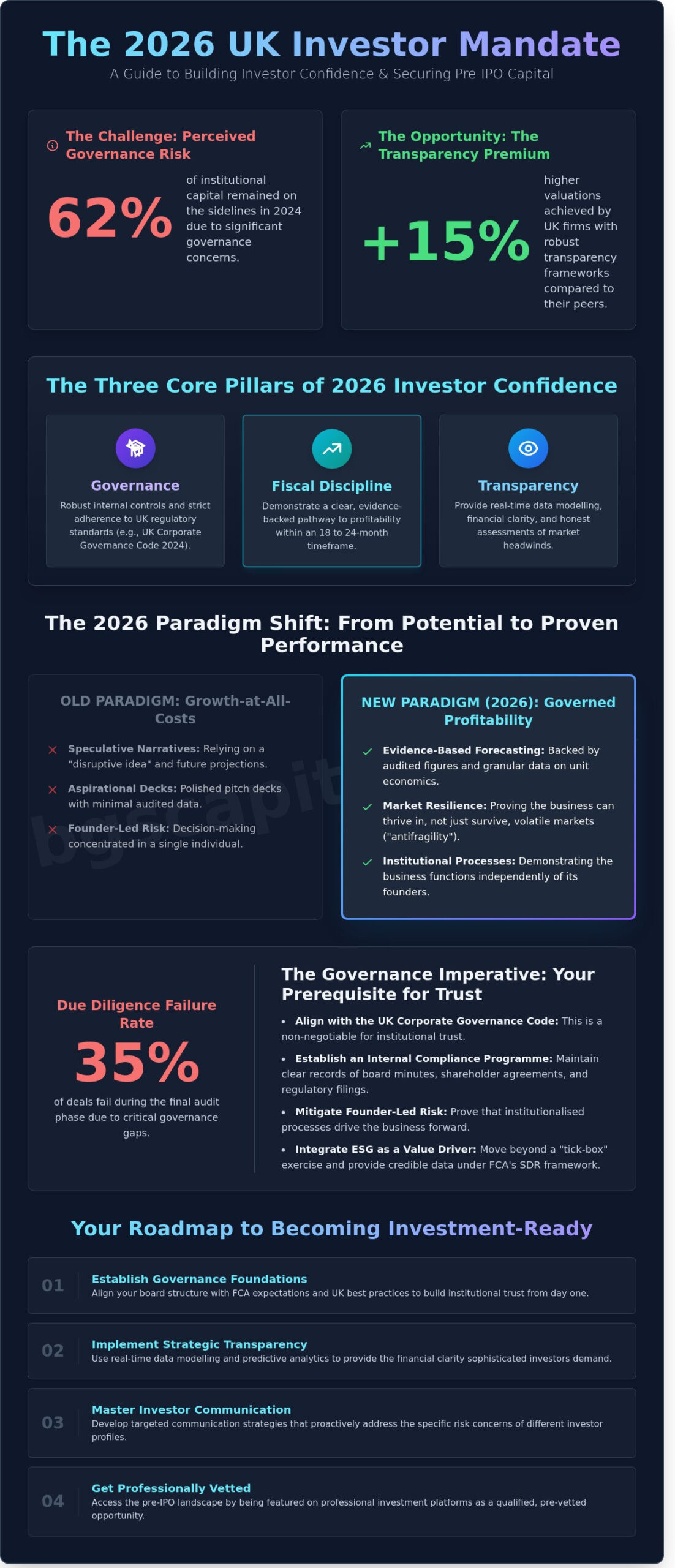
The 2024 UK investment landscape saw 62% of institutional capital remain on the sidelines due to perceived governance risks. By 2026, the threshold for “investment ready” has moved beyond simple revenue targets. Sophisticated UK investors now demand a rigorous level of transparency before committing capital to pre-IPO opportunities. Understanding how to build investor confidence requires more than a polished pitch deck; it necessitates a structural shift in how your firm approaches regulatory compliance and ESG reporting.
You likely recognise that standing out in a crowded market is increasingly difficult as ESG requirements and regulatory shifts become more stringent. It’s a common frustration for firms seeking access to high-net-worth networks. According to 2024 industry data, UK firms with robust transparency frameworks achieved valuations 15% higher than their less-disclosed peers. This guide provides the exact frameworks of governance and communication you need to secure capital and reduce perceived risk. We’ll outline a clear roadmap to becoming investment-ready, ensuring your business achieves a higher valuation through enhanced transparency and strategic engagement.
Key Takeaways
- Align your board structure with FCA expectations and UK best practices to establish the necessary governance for institutional trust.
- Master how to build investor confidence through strategic transparency frameworks that effectively mitigate perceived risk for sophisticated investors.
- Implement real-time data modelling to provide the financial clarity required to secure capital from high net worth individuals and wealth managers.
- Develop targeted communication strategies that address the specific risk concerns of different investor profiles, from VCs to institutional firms.
- Access the pre-IPO landscape by understanding the value of being featured as a qualified, pre-vetted opportunity on professional investment platforms.
The Foundation of Investor Confidence in 2026
Investor confidence is not a product of blind optimism. It is the strategic mitigation of perceived risk through radical transparency. In 2026, the era of “cheap capital” is a distant memory. The fallout from the 2022-2024 inflationary period has created a landscape where understanding market sentiment is critical for any firm seeking to raise capital. Investors have replaced speculative excitement with a disciplined focus on sustainable, governed profitability. Knowing how to build investor confidence now requires a shift from selling a vision to proving a resilient business model.
The “Polycrisis” era, defined by simultaneous geopolitical instability and economic volatility, has made capital providers more cautious. They no longer favour the “growth-at-all-costs” strategies that dominated the previous decade. Instead, the focus has pivoted toward three core pillars:
- Fiscal Discipline: Clear pathways to profitability within 18 to 24 months.
- Governance: Robust internal controls and adherence to UK regulatory standards.
- Transparency: Real-time reporting and honest assessments of market headwinds.
The Psychology of the Sophisticated Investor
High-net-worth individuals and wealth managers in the United Kingdom now prioritise capital preservation alongside growth. In volatile markets, these sophisticated investors seek “antifragility.” They look for businesses that don’t just survive economic fluctuations but actually benefit from them. Social proof is vital in this environment. Professional investors often wait for signals from established lead investors or accredited investment firms before committing funds. They operate within tight-knit networks where reputation is the primary currency. If an opportunity lacks institutional-grade documentation, it’s often ignored regardless of its potential upside.
Potential vs. Performance: The 2026 Paradigm
A “favourite” product or a disruptive idea is no longer enough to secure a term sheet. The 2026 paradigm demands that speculative narratives be replaced by evidence-based forecasting. Investors are scrutinising how companies performed during the 2023 interest rate peaks and the subsequent market corrections. To demonstrate market resilience, firms must provide granular data on customer retention and unit economics. You can’t rely on future projections alone. You must show how your current performance justifies your valuation. In this climate, how to build investor confidence is directly tied to your ability to present a case backed by audited figures rather than aspirational slide decks. CAPITAL AT RISK is the baseline assumption; your job is to prove why that risk is calculated and managed.
Strengthening Governance and Regulatory Compliance
Robust governance is the primary hygiene factor for institutional trust. In the 2026 private equity and venture capital markets, compliance is a prerequisite for entry rather than a secondary consideration. Institutional investors prioritising the UK market expect alignment with the UK Corporate Governance Code 2024. This framework ensures that a company operates with transparency and accountability. High-growth firms often fail due to founder-led risk, where decision-making is concentrated in a single individual. Mitigating this risk requires a transition to institutionalised processes. Understanding how to build investor confidence involves proving that the business can function independently of its original creators.
Organising an internal compliance programme is essential for surviving a due diligence audit. This includes maintaining clear records of board minutes, shareholder agreements, and regulatory filings. A 2024 report indicated that 35% of deals fail during the final audit phase due to governance gaps. Establishing these structures early prepares the company for scrutiny from accredited investment firms looking for stable opportunities. Clear documentation and adherence to FCA expectations signal that the management team understands the weight of their fiduciary duties.
ESG as a Value Driver, Not a Tick-Box
ESG reporting has evolved into an integrated business strategy. It’s no longer a marketing exercise. Under the FCA’s Sustainability Disclosure Requirements (SDR), firms must provide standardised and credible data. Investors use these metrics to assess long-term valuation and resilience. By proactively addressing investor concerns regarding carbon footprints and supply chain ethics, companies reduce their risk profile. This transparency directly impacts the cost of capital and determines which firms attract premium valuations.
The Role of the Board in Building Trust
A board must possess the talent, skills, and experience to navigate the 2026 economic landscape. Selecting non-executive directors (NEDs) who bring sector-specific credibility is vital. These individuals provide the independent oversight required to challenge executive decisions. Effective boards establish distinct committees for audit, risk, and remuneration. This structure demonstrates a commitment to professional standards. Knowing how to build investor confidence requires showing that the board has the specific expertise to manage complex regulatory shifts and market volatility. Diversity of thought at the board level is now a measurable metric that institutional funds use to gauge long-term viability.
Financial Transparency and Predictive Data Modelling
Opaque or “black box” financials are the most efficient way to terminate investor interest. If a sophisticated investor cannot discern the underlying mechanics of your revenue or the logic behind your burn rate, the perceived risk becomes unquantifiable. In the 2024 UK investment landscape, 62% of institutional investors cited a lack of transparency as a primary reason for withdrawing from a deal. Real-time data access during the capital raising process is no longer a luxury; it’s a requirement for those seeking to understand how to build investor confidence effectively.
Providing live dashboards or weekly financial updates demonstrates that management has a firm grip on the levers of the business. It removes the suspicion that figures are being manipulated for quarterly reports. When detailing your startup funding history, you must provide a granular breakdown of previous rounds. This involves documenting the exact £-value of capital raised, the specific rights attached to each share class, and the precise dilution of the founding team. Clarity here prevents “cap table shock” during the final stages of due diligence.
Standardised Reporting and Audit Readiness
Adopting industry-standard frameworks like FRS 102 or IFRS from the outset reduces friction. It allows investors to compare your performance against sector benchmarks without needing to translate bespoke accounting methods. A 2025 report from the ICAEW indicated that firms with pre-existing third-party audits saw a 25% reduction in the time spent in the due diligence phase. Your Virtual Data Room (VDR) must be organised and secure. It should contain three years of historical P&L sheets, current £-denominated debt obligations, and verified share certificates.
Forecasting with Integrity
Over-optimistic projections often signal a lack of market awareness rather than ambition. Credible founders use predictive data modelling to account for expected bouts of volatility, such as a 0.5% shift in Bank of England base rates or a 12% increase in logistics costs. This is how to build investor confidence through realism. Scenario planning should present a “Base Case,” an “Optimistic Case,” and a “Stress Case.” Linking financial KPIs directly to operational milestones ensures that your growth plan is grounded in reality. If your model predicts a £500,000 increase in monthly recurring revenue, it must show the corresponding headcount increase in the sales department required to support it.
Mastering Investor Relations and Strategic Communication
Effective capital raising in the 2026 UK market requires a transition from transactional pitching to long-term relationship management. To understand how to build investor confidence, companies must execute a structured communication framework that prioritises transparency over speculation. This process relies on five distinct steps:
- Identify the profile: Distinguish between High Net Worth Individuals (HNWIs) seeking Enterprise Investment Scheme (EIS) tax reliefs and Institutional VCs focused on 10x exit multiples.
- Address specific risks: Tailor the pitch to mitigate sectoral concerns, such as recent shifts in UK R&D tax credit eligibility.
- Narrative over data: Convert technical milestones into a strategic roadmap that demonstrates market resilience.
- Establish cadence: Implement a monthly reporting cycle at least six months before the funding round begins.
- Utilise introducers: Use accredited networks to bridge the gap between the business and qualified investment firms.
The Art of the “Strategic Narrative”
A strategic narrative flips market volatility into a competitive advantage. If a sector faces a 12% downturn, your narrative should focus on your firm’s agility and capacity to capture the resulting vacuum. Investors prioritise relatability. Define the commercial problem in plain terms before introducing complex technical specifications. Use case studies from 2024 or 2025 to prove that your execution capability matches your financial projections. This approach is fundamental to how to build investor confidence in high-stakes environments.
Cadence and Consistency
Consistency is the primary indicator of professional competence. Monthly updates provide a track record of reliability that data rooms cannot replicate. These reports must include key performance indicators (KPIs), burn rates, and specific hurdles. When setbacks occur, such as a missed Q3 revenue target, transparency is mandatory. Silence is perceived as a lack of control. By reporting failures alongside solutions, you build a community of advocate investors. According to industry benchmarks, founders who maintain a consistent update schedule are 35% more likely to secure follow-on funding from their existing cap table. Professionalism in adversity creates a durable reputation within the UK private equity ecosystem.
Navigating the Pre-IPO Landscape with BGS Capital
BGS Capital acts as a direct conduit between qualified UK companies and sophisticated investors. We operate strictly as an introducer, not a broker. This distinction is vital for maintaining a clean regulatory profile and ensuring transparency. When a firm is featured on our platform, it signals to the market that the business has met specific pre-vetting benchmarks. This process is a fundamental component of how to build investor confidence ahead of a 2026 liquidity event. CAPITAL AT RISK.
Our network provides streamlined access to a curated database of High Net Worth Individuals (HNWIs) and wealth managers. This targeted approach reduces the cost of capital by removing the friction and high overheads of broad-market advertising. You connect directly with angel investors who understand the nuances of secondary placings and pre-IPO rounds. Efficiency is our priority. We focus on tangible outcomes and qualified connections rather than speculative volume.
- Direct access to accredited investment firms and professional wealth managers.
- Pre-vetting processes that filter for quality and institutional readiness.
- Reduction in capital acquisition costs through targeted network placement.
- Increased visibility within a database of over 5,000 active UK investors.
Why the “Introducer” Model Works for Founders
Cold outreach often devalues a brand. It suggests a lack of existing interest or a desperate search for liquidity. A neutral third-party introduction from BGS Capital provides immediate credibility. It shifts the conversation from an unsolicited pitch to a qualified opportunity. This model opens doors to exclusive capital pools, including family offices and Self-Invested Personal Pensions (SIPPs). These entities typically ignore cold emails, preferring the structured environment of a trusted network to source their next allocation.
Next Steps: Am I Eligible?
We maintain strict standards for the businesses we feature. You must demonstrate high growth potential and institutional-grade readiness. To understand how to build investor confidence through our network, your documentation must be flawless. This includes clear financial projections and a defined path to an IPO or exit. We focus on companies seeking to raise significant capital from sophisticated sources. If your business meets these criteria, you can begin the qualification process immediately.
Securing Your Position in the 2026 Capital Markets
Success in the 2026 fiscal landscape demands a shift from reactive reporting to proactive, data-driven transparency. You’ve got to implement rigorous governance frameworks that align with the UK Corporate Governance Code to ensure institutional-grade compliance. Understanding how to build investor confidence involves mastering predictive modelling and maintaining a clear, strategic dialogue with your stakeholders. These elements form the bedrock of a credible pre-IPO strategy that withstands market volatility.
BGS Capital provides the essential infrastructure for businesses seeking high-level visibility. As a professional introducer, we offer access to a curated network of HNWIs and sophisticated investors specifically interested in pre-IPO and IPO opportunities. Our exclusive focus ensures your business is positioned before the right audience at the right time. Professional credibility is vital when navigating the complexities of the London Stock Exchange or secondary placings. Leveraging a specialist network allows you to focus on growth while we facilitate the necessary connections.
RAISING CAPITAL? FEATURE YOUR BUSINESS ON BGS CAPITAL
Taking these strategic steps now positions your business for a successful and sustainable public future.
Frequently Asked Questions
What is the single most important factor in building investor confidence?
Radical transparency regarding financial performance and risk management is the primary driver of how to build investor confidence. In the current market, 82% of institutional investors cite clear, honest communication about setbacks as more important than optimistic projections. You must provide audited figures and direct answers to difficult questions. This approach demonstrates professional integrity and proves you have the internal controls necessary to manage capital effectively.
How much financial history do I need to show to win over HNW investors?
High Net Worth (HNW) investors typically require three years of audited financial history to validate a business model. If your firm is younger, you must provide a minimum of 18 months of detailed management accounts alongside a clear bridge to profitability. Sophisticated investors in the UK look for consistent month-on-month growth and a Burn Multiple below 1.5 to ensure capital is being deployed efficiently.
Does having an ESG strategy really affect my ability to raise capital in 2026?
ESG strategies are no longer optional; they’re a core requirement for 74% of UK private equity firms. By 2026, regulatory frameworks like the SDR (Sustainability Disclosure Requirements) mean investors face their own reporting burdens. Proving your compliance helps them manage their risk. You must provide quantifiable metrics, such as carbon intensity or board diversity ratios, rather than vague mission statements.
How do I build confidence if my business is not yet profitable?
Focus on unit economics and a “path to profitability” timeline that doesn’t exceed 24 months. You can demonstrate how to build investor confidence by showing a high LTV to CAC ratio, ideally 3:1 or higher, and a decreasing net loss margin. Investors will back a loss-making enterprise if the underlying metrics prove that scaling will inevitably lead to sustainable margins and cash flow.
What are the common “red flags” that destroy investor trust during due diligence?
Discrepancies between your pitch deck and your data room are the fastest way to destroy trust. Common red flags include undisclosed liabilities, high customer churn rates exceeding 15% per annum, or a lack of intellectual property protections. If an investor finds a single unmentioned legal dispute or tax liability, the deal will likely collapse immediately due to perceived management incompetence.
Can a professional introducer like BGS Capital help if we are pre-IPO?
BGS Capital operates as a specialist introducer, connecting qualified companies with a network of accredited investment firms and wealth managers. For pre-IPO businesses, this provides access to sophisticated investors who understand the risks and rewards of secondary placings. We don’t provide direct financial advice, but our network ensures your opportunity is seen by the right high-level audience. Check our site to see: Am I Eligible?
How often should I communicate with potential investors before a round opens?
Establish a monthly reporting cadence at least six months before your formal raise begins. These updates should be concise, focusing on three key KPIs and one significant challenge you’ve overcome. Regular touchpoints reduce the perceived risk by proving you can execute a strategy over time. This consistency builds a track record of reliability before you ever ask for a single pound of capital.
Is it better to hide risks or be transparent about them in a pitch deck?
Transparency is the only viable strategy because professional due diligence will always uncover hidden risks. Addressing challenges directly in your deck shows you’ve already developed mitigation strategies. CAPITAL AT RISK is a fundamental reality of any investment. By highlighting potential headwinds, you position yourself as a risk-aware leader rather than an over-optimistic amateur. This honesty is essential for long-term credibility.