
In the current venture climate, SEIS eligibility is no longer a peripheral benefit; it is the fundamental architecture of a successful seed round. Many founders struggle with slow-moving rounds where investors express interest but fail to write the cheque. This delay often stems from a failure to address the investor’s primary concern: risk. Mastering how to attract SEIS investors for your startup UK requires shifting your focus from product-market fit to structural risk mitigation. You likely recognize that tax efficiency is the most powerful tool in your arsenal to bridge the gap between interest and investment.
This guide provides a strategic framework to position your startup for SEIS-eligible capital. You’ll learn how to leverage Advance Assurance as a closing tool and how to articulate the 50% income tax relief to mitigate downside risk for High Net Worth Individuals. We’ll explore the technicalities of maintaining compliance and the role of professional business listings in reaching qualified investors. This strategic approach aims to move your fundraise toward an oversubscribed status and significantly reduce closing times. Accessing a broader pool of sophisticated capital requires a precise, compliant, and professional presentation of your investment opportunity.
Key Takeaways
- Secure Advance Assurance early to signal technical eligibility and accelerate investor decision-making.
- Master how to attract SEIS investors for your startup UK by framing tax-efficiency as a structural hedge against capital risk.
- Deploy a dedicated “SEIS Slide” in your pitch deck to demonstrate the net investment cost and immediate income tax relief for HNWIs.
- Leverage professional business listings and introducer networks to access sophisticated capital and bypass inefficient cold outreach.
- Maintain strict post-investment compliance to protect investor tax relief and ensure long-term eligibility for future funding rounds.
The Strategic Value of SEIS in the 2026 UK Startup Ecosystem
The Seed Enterprise Investment Scheme (SEIS) functions as a high-impact tax incentive, specifically engineered to funnel capital into UK early-stage companies. In the 2026 venture market, the investor mindset has shifted toward extreme risk-awareness. HNWIs no longer chase speculative growth in isolation. They demand tax-efficient vehicles that provide immediate, tangible offsets against their tax liabilities. If you’re evaluating how to attract SEIS investors for your startup UK, you must treat the scheme as a primary risk-mitigation framework rather than a secondary perk.
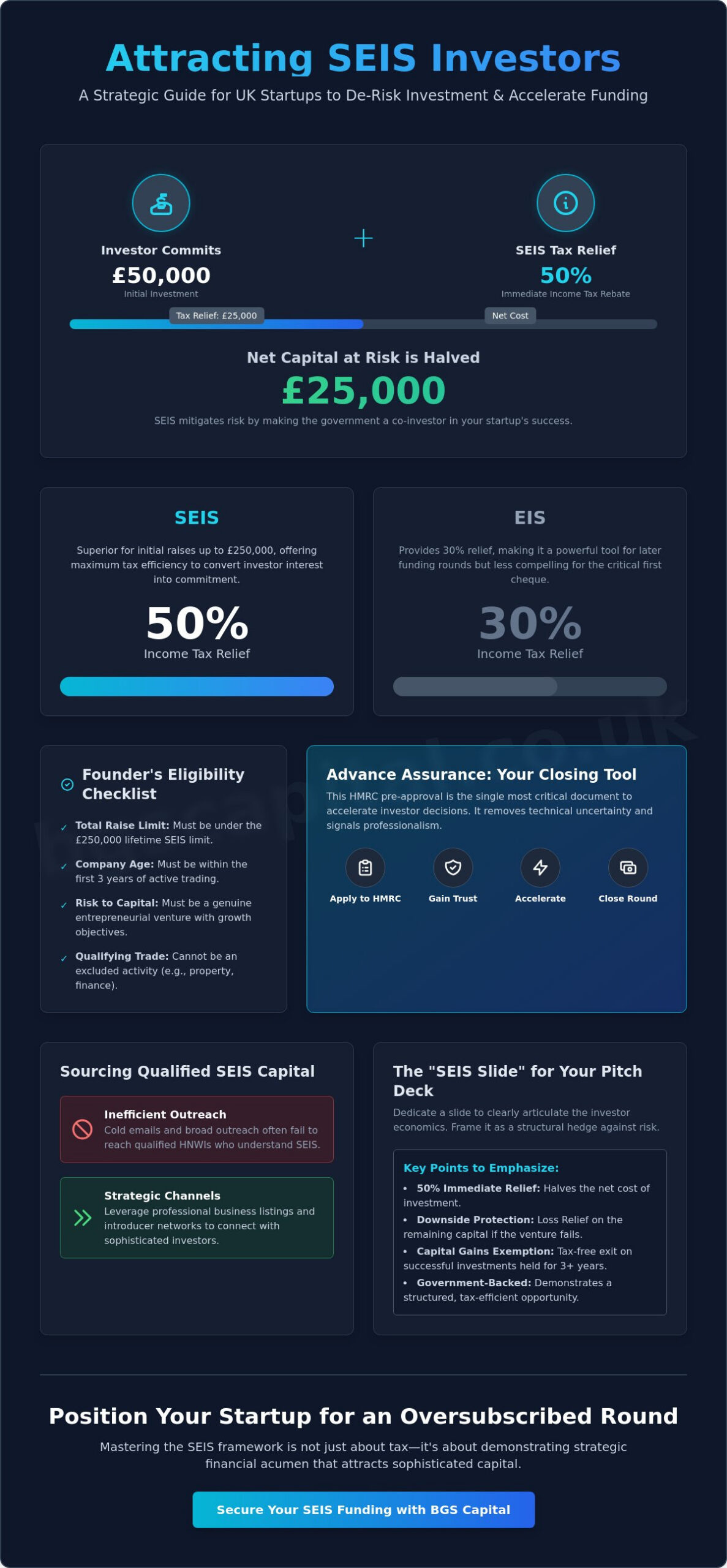
The “50% Rule” fundamentally alters the downside risk calculation. By offering 50% income tax relief on investments up to £200,000 per tax year, SEIS provides a buffer that traditional equity cannot match. For the initial £250,000 raise, SEIS is superior to the Enterprise Investment Scheme (EIS), which offers a lower 30% relief rate. This delta in tax efficiency is often the deciding factor that converts a passive observer into an active shareholder. It’s about presenting a structured opportunity where the government effectively subsidizes half of the investor’s entry cost.
De-Risking the Investment Proposition
The core of the SEIS proposition is the “Net Cost of Investment.” When an investor commits £50,000, their actual capital at risk is £25,000 after claiming relief. HMRC’s “Risk to Capital” condition ensures that the company is a genuine entrepreneurial venture with long-term growth objectives. SEIS mitigates this inherent risk. If the venture fails, loss relief can be applied against the remaining capital. This reduces the total exposure to a fraction of the original sum. This psychological safety net is vital for securing commitments in volatile markets where capital preservation is paramount.
2026 SEIS Limits and Thresholds
Adhering to strict thresholds is mandatory for maintaining eligibility. Startups are limited to a total lifetime SEIS raise of £250,000. Your company must be within its first three years of active trading to qualify for this specific status. For investors, the maximum annual investment eligible for relief is £200,000. These figures are absolute. Any breach of these limits or the three-year trading rule will invalidate the tax benefits for all participants. Utilizing professional business listings and feature services is an effective way to broadcast your status to qualified individuals who already understand these technical parameters.
Securing Advance Assurance: The Essential Signal for Investor Trust
Advance Assurance (AA) is the most critical document in your investor data room. It functions as a formal confirmation from HMRC that your company and the proposed share issue meet the technical requirements of the scheme. Sophisticated HNWIs often refuse to engage in substantive discussions without this document. It is the primary catalyst for accelerating investor decision-making. There is a direct, observable correlation between the possession of AA and the speed at which investors move from initial interest to signing a cheque. By removing the technical uncertainty of tax relief, you allow the investor to focus exclusively on your commercial potential.
The 2026 regulatory environment has placed greater emphasis on the “qualifying trade” condition. HMRC requires clear evidence that the business is a genuine entrepreneurial venture with long-term growth objectives. Certain activities, such as property development, legal services, or financial activities, remain excluded. A common pitfall that leads to immediate rejection is the failure to demonstrate how the investment will be used for the growth and development of the company. You must consult the official SEIS guidance to ensure your business model doesn’t inadvertently fall into a restricted category. Understanding these nuances is a prerequisite for anyone learning how to attract SEIS investors for your startup UK.
The Advance Assurance Application Process
The application requires a cohesive package consisting of a detailed business plan, three-year financial forecasts, and a precise cover letter. You must explicitly state how the “Risk to Capital” condition is met. A mandatory requirement in the current year is naming at least one potential investor. HMRC will not provide assurance for speculative raises; they require proof of intent from a third party. Response times typically range between four to eight weeks. If you want to improve your visibility during this period, securing a professional business listing can help bridge the gap between technical preparation and active outreach.
Communicating Assurance to Potential Backers
Once secured, your AA status should be prominent in all communications. Place an “Advance Assurance” badge on your pitch deck cover and your “Investment” slide. This signals that you have completed the necessary due diligence and are ready to transact. When investors query the Risk to Capital condition, explain that your business model prioritizes long-term asset growth over short-term capital preservation. This conversation is a vital part of the broader startup funding journey. Mastering this communication ensures you don’t just attract interest, but also secure the capital required for your initial £250,000 raise.
Structuring the Pitch: Communicating Investor Economics
Every seed-stage pitch deck requires a dedicated “SEIS Slide” to bridge the gap between interest and commitment. Investors evaluating early-stage opportunities prioritize capital preservation as much as growth potential. To master how to attract SEIS investors for your startup UK, you must present the investment not as a gross cost, but as a net outlay. Visualizing this delta is essential. For instance, a £20,000 investment carries a net cost of only £10,000 after the 50% income tax relief is applied. This immediate tax credit effectively subsidizes the entry price, making the equity significantly more attractive than non-eligible alternatives.
Beyond the initial relief, your pitch must address the long-term fiscal benefits. Shares held for at least three years are entirely exempt from Capital Gains Tax (CGT) upon disposal. In a successful exit scenario, this exemption dramatically increases the net internal rate of return (IRR) compared to standard equity. When presenting to potential backers, distinguish your approach based on their classification. High-Net-Worth Individuals (HNWIs) often focus on the immediate income tax offset, while Sophisticated Investors may place higher value on the CGT-free upside and the ability to carry back relief to the previous tax year.
The ‘Upside/Downside’ Framework
Your communication should focus on the combined protection of 50% upfront relief and subsequent loss relief. If a company fails, the investor can claim loss relief on the remaining net capital at risk, potentially reducing the total loss to just 22.5% for an additional higher-rate taxpayer. This creates a success-biased framework where the government shares the downside risk. For ventures qualifying as a Knowledge Intensive Company (KIC), these benefits remain a core component of the pitch, even if the scale of the raise differs. Compare your SEIS-backed returns against standard equity to demonstrate the superior risk-adjusted profile of your offering.
Handling Investor Objections on SEIS Compliance
Address the three-year holding period directly as a commitment to long-term value creation rather than a liquidity constraint. Investors may also raise concerns regarding “Replacement Capital” rules, which prevent the use of SEIS funds to purchase existing shares or pay off debt. Confirm that 100% of the capital will be used for qualifying “growth and development” activities. Providing this level of technical clarity is vital when engaging with Angel investors who have specific SEIS requirements. Clear documentation on these points prevents compliance-related delays during the closing process.
Sourcing SEIS Capital: Where to Locate Qualified Angel Networks
Securing capital requires more than a compelling deck; it demands a precise outreach architecture. Generic directories often result in low-conversion cold outreach. To master how to attract SEIS investors for your startup UK, you must navigate professional ecosystems where HNWIs are already conditioned to tax-efficient deal flow. Identifying these specific pools of capital is the difference between a stalled round and an oversubscribed one. Focus your efforts on verified networks that prioritize SEIS-eligible ventures rather than casting a wide, inefficient net across retail platforms.
Professional introducer platforms serve as the most efficient conduit to sophisticated capital. These networks bypass the friction of unverified leads. High-Net-Worth Individuals often rely on these intermediaries to filter opportunities based on technical eligibility and commercial viability. Leveraging LinkedIn also provides a tactical advantage. Search for individuals with a history of SEIS-related activity or those who explicitly identify as angel investors within the UK tech sector. Physical hubs, such as London-based incubators and accelerators, remain vital for community-led introductions. These environments allow for high-frequency networking with mentors and alumni who often act as the first cheque in a seed round.
Leveraging Professional Introducer Networks
Platforms like BGS Capital facilitate direct introductions to sophisticated investors who are actively seeking SEIS allocations. Being “Pre-Vetted” is a critical status. It signals to the network that your Advance Assurance and financial modeling have reached a professional standard. Relying on a single source of leads is a common failure point. Successful founders understand that finding investors requires a multi-channel approach that combines digital listings with direct introductions. Access our exclusive network to list your business for investor review.
Targeting SEIS-Specific Funds
SEIS-specific funds offer a different dynamic than individual angels. These entities often operate “Sidecar” funds that invest alongside lead angels, providing a significant boost to your total raise. Research a fund’s deployment history before engagement. Analyze their average cheque size and their typical timeline from first meeting to drawdown. Professional funds execute deeper due diligence than solo angels. They’ll scrutinize your cap table, your intellectual property ownership, and your long-term EIS transition plan. Aligning with these institutional-grade players provides a strong signal of quality to the broader market. It also simplifies the administrative burden, as funds typically use standardized subscription agreements.
Ensuring Compliance and Managing Post-Investment Obligations
Securing capital is only the first phase of the regulatory lifecycle. Maintaining compliance is as critical as the initial raise. Understanding how to attract SEIS investors for your startup UK involves a commitment to regulatory adherence long after the funds have cleared your account. Failure to manage post-investment obligations can lead to the retrospective withdrawal of tax relief, causing irreparable damage to investor relations and your company’s reputation. You must transition from a fundraising mindset to a strict administrative framework to protect your backers’ interests.
The primary administrative milestone is the Compliance Statement (SEIS1 form). You cannot issue the certificates required for investors to claim their relief until this form is processed by HMRC. This filing confirms that the company has met all qualifying conditions during the initial period of investment. Once the SEIS1 is approved, you will receive the authority to issue SEIS3 certificates. These documents are the final requirement for your investors’ tax claims. Accurate share certificates are non-negotiable; HMRC will reject applications based on clerical errors or discrepancies in share classes. Precision is mandatory.
Post-Investment Administration
Timing is a critical factor in the compliance process. You can only file the SEIS1 statement after the company has traded for at least four months or has spent at least 70% of the total investment amount. Any deviation from the original business plan submitted during the Advance Assurance stage must be documented. Maintaining your status for the full three-year “period of restriction” is essential. Certain actions, such as changing the nature of your trade to an excluded activity or a change in control, will disqualify your SEIS status. This would trigger a clawback of the 50% income tax relief from your investors.
Scaling to the Next Round
A compliant SEIS round provides powerful social proof for future institutional investors. It demonstrates that your startup has successfully navigated HMRC’s rigorous “Risk to Capital” scrutiny. As your capital requirements grow, you will naturally transition from SEIS to EIS for follow-on rounds. Once the £250,000 SEIS limit is reached, the “EIS Top-up” allows you to raise significant additional capital while still offering 30% tax relief to HNWIs. Keeping your current backers informed through regular reporting is the best way to secure their support for these subsequent rounds. Ready to present your SEIS opportunity? Feature your business with BGS Capital to access our network of sophisticated investors.
Accelerating Your Capital Raise Through Strategic Compliance
Success in the 2026 seed market depends on your ability to transform technical tax incentives into a primary risk-mitigation tool. You’ve seen that securing Advance Assurance is the first mandatory step to establish institutional-grade credibility. By effectively communicating the net cost of investment and maintaining rigorous post-investment compliance, you position your venture as a sophisticated opportunity for HNWIs. Mastering how to attract SEIS investors for your startup UK requires this shift from a product-centric pitch to an economics-centric proposition.
Accessing the right capital requires a direct conduit to qualified individuals. BGS Capital provides a compliance-focused platform for pre-IPO opportunities, offering you direct introductions to sophisticated investors who prioritize tax-efficient deal flow. You’ll gain visibility within a curated network of HNWIs who are actively seeking SEIS-eligible ventures. Taking these strategic steps ensures your fundraise is built on a foundation of transparency and structural safety. Are you ready to qualify for our exclusive network? FEATURE YOUR BUSINESS TO OUR INVESTOR NETWORK today and begin your journey toward an oversubscribed seed round.
Frequently Asked Questions
What is the maximum amount a startup can raise under SEIS in 2026?
A startup can raise a maximum of £250,000 in total lifetime SEIS funding as of 2026. This limit applies to all relevant investments received by the company and any of its subsidiaries. It’s essential to track this threshold accurately because exceeding it will disqualify the entire share issue from tax relief. This cap is a fundamental constraint when planning how to attract SEIS investors for your startup UK for the first time.
Can a founder also be an SEIS investor in their own company?
Founders typically cannot qualify for SEIS tax relief if they hold more than 30% of the company’s shares or voting power. This “substantial interest” rule applies to the individual and their associates, such as business partners or close family members. While some directors can qualify as “business angels” under specific conditions, most founding members with significant equity stakes are excluded from claiming the 50% income tax relief on their own capital.
How long does it take to get SEIS Advance Assurance from HMRC?
HMRC currently processes Advance Assurance applications within four to eight weeks. This timeline varies based on the complexity of your business model and the volume of applications being reviewed. You should submit your application well before your target closing date. Having this assurance in place is a mandatory requirement for most sophisticated investors. It signals that you’ve completed the necessary technical due diligence to protect their capital.
What happens to the SEIS tax relief if the startup fails?
If a startup fails, investors can claim loss relief on the remaining capital at risk. This relief is applied at the investor’s highest rate of income tax. When combined with the initial 50% relief, this significantly reduces the total financial loss. This structural protection is a key component of how to attract SEIS investors for your startup UK. It effectively hedges the downside risk of early-stage venture capital participation.
Do I need a signed investment agreement before applying for SEIS Advance Assurance?
You don’t need a signed agreement, but you must provide the names and addresses of potential investors. HMRC won’t process speculative applications or “dry” requests for assurance. You must demonstrate that you’re in active discussions with at least one individual or network. Providing a draft term sheet or a letter of intent can strengthen your application. This ensures HMRC resources are focused on genuine investment opportunities rather than hypothetical scenarios.
Can I raise SEIS and EIS funding in the same investment round?
You can raise SEIS and EIS capital in the same round, provided the SEIS shares are issued first. HMRC requires a clear sequence to ensure the £250,000 SEIS limit is utilized before EIS relief is applied. Issuing shares on different days is the standard method to maintain compliance. This allows you to accommodate larger cheques from investors who’ve already exhausted their annual SEIS allowance but wish to contribute via EIS.
Are there specific trades that are excluded from the SEIS scheme?
Several “excluded activities” are ineligible for the scheme. These include property development, financial services, legal services, and certain types of energy generation. HMRC requires the company to be a “qualifying trade” with a view to making a profit. If your business model involves leasing assets or receiving royalties, you must carefully review the technical definitions. Engaging in excluded activities will lead to the immediate withdrawal of all investor tax benefits.
How do investors actually claim their 50% income tax relief?
Investors claim their relief through their annual self-assessment tax return. They must possess a valid SEIS3 certificate issued by the company after the SEIS1 compliance statement has been approved by HMRC. The certificate contains a unique claim reference number. Investors can claim relief for the tax year the shares were issued or carry it back to the previous tax year. This flexibility is a primary driver for high-level financial activity among HNWIs.