
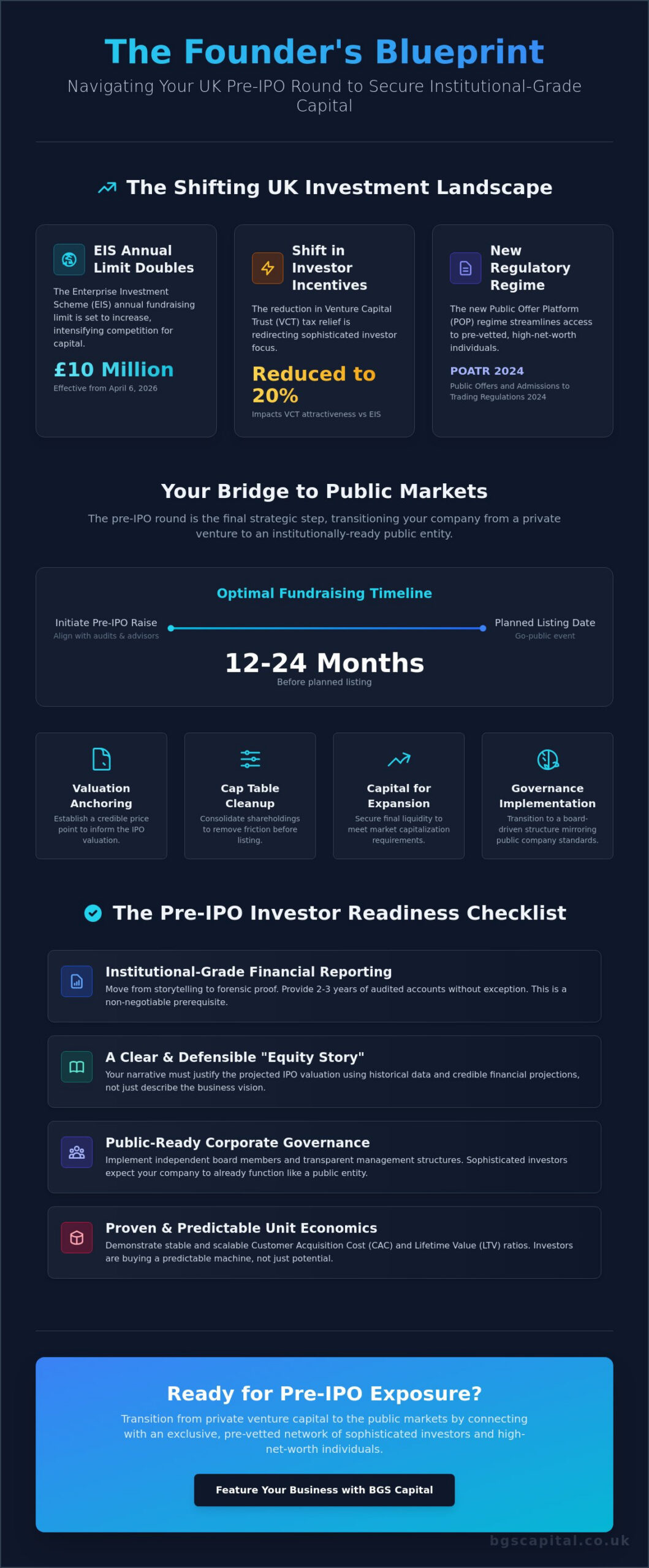
With the Enterprise Investment Scheme (EIS) annual fundraising limit doubling to £10 million as of April 6, 2026, the competition for sophisticated capital has reached a new level of intensity. You likely understand that securing a bridge to your initial public offering requires more than just a compelling pitch; it demands a rigorous approach to compliance and network access. Many founders waste months engaging retail investors who lack the capital for institutional-grade ticket sizes. Learning how to attract investors for a pre-IPO round UK effectively means moving beyond generic outreach and focusing on pre-vetted, high-net-worth individuals who understand the current regulatory landscape.
This guide provides the strategic framework needed to master the new Public Offer Platform (POP) regime and the Public Offers and Admissions to Trading Regulations 2024. You’ll gain a streamlined process for navigating Section 21 financial promotion rules while positioning your company for a successful capital raise. We’ll examine the shift in investor incentives following the reduction of VCT tax relief to 20%, the increased EIS gross asset thresholds, and the precise steps to gain exposure to an exclusive network of sophisticated investors.
Key Takeaways
- Position your company for a final private round by anchoring valuation and optimizing the cap table ahead of a public listing.
- Implement professional-grade financial reporting, including multi-year audited accounts, to satisfy the due diligence requirements of institutional-grade investors.
- Navigate the legal complexities of Section 21 and the Financial Promotion Order to learn how to attract investors for a pre-IPO round UK without regulatory breach.
- Transition to a streamlined, platform-based introduction model to access pre-vetted networks of certified sophisticated and high-net-worth individuals.
- Utilize specialist facilitators to bridge the gap between private venture capital and public markets through targeted business features and professional exposure.
The Pre-IPO Landscape: Positioning Your Company for the Final Private Round
The pre-IPO round serves as the final strategic bridge between private venture capital and the public markets. It marks the transition from private ownership to the rigorous transparency required for a listing. Unlike earlier startup funding stages, where capital is often deployed for rapid experimentation, Pre-IPO funding focuses on institutional readiness and scale. It’s the point where a company proves its operational maturity.
Primary objectives for this round include:
- Valuation Anchoring: Establishing a credible price point that informs the eventual IPO valuation.
- Cap Table Cleanup: Consolidating shareholdings to remove administrative friction before listing.
- Capital for Expansion: Securing the final injection of liquidity needed to meet market capitalization requirements.
- Governance Implementation: Transitioning from founder-led decision-making to a board-driven structure.
The investment thesis shifts significantly at this stage. Investors move away from “growth at all costs” metrics. They prioritize a clear path to profitability and robust internal controls. If you’re evaluating how to attract investors for a pre-IPO round UK, you must present a business that already functions like a public entity. Professionalism isn’t optional; it’s a prerequisite for access.
Why the Pre-IPO Round is Critical for UK Firms
Establishing an institutional-grade valuation before a listing provides a safety net against market volatility. This round is specifically designed to attract cornerstone investors. These sophisticated individuals or entities provide the market with a signal of quality. Their participation often dictates the success of the subsequent public offering. Additionally, these rounds can provide structured liquidity. This allows founders and early-stage employees to realize some value without waiting for the first day of trading on the London Stock Exchange.
The Timeline: When to Initiate Your Pre-IPO Raise
Timing remains a high-stakes variable. Most successful raises begin 12 to 24 months before the planned listing date. This duration provides enough time to align the raise with statutory financial audits and the appointment of formal IPO advisors. UK firms must remain sensitive to market sentiment. Windows of opportunity in the London financial sector can open and close rapidly based on macroeconomic data. Initiating the process early ensures you aren’t forced to raise capital during a period of low liquidity or high geopolitical uncertainty.
What Sophisticated UK Investors Demand in a Pre-IPO Opportunity
Sophisticated UK investors operate with a different set of heuristics compared to early-stage venture capitalists. While seed or Series A rounds focus on vision, a pre-IPO round requires forensic proof of operational stability. If you are refining your strategy for how to attract investors for a pre-IPO round UK, you must pivot from storytelling to institutional-grade reporting. This means providing two to three years of audited accounts without exception. Investors at this stage demand a clear “Equity Story” that doesn’t just describe the business but justifies the projected IPO valuation through historical data and defensible projections.
Corporate governance serves as a critical filter for high-net-worth individuals and family offices. They expect independent board members and transparent management structures that mirror public company standards long before the ticker is live. They look for proven unit economics and scalability metrics that indicate market dominance is a matter of capital deployment rather than product-market fit discovery. If the cost of customer acquisition (CAC) and lifetime value (LTV) ratios aren’t stable, the round will likely fail. Investors aren’t looking for potential; they’re looking for a predictable machine.
The Institutional-Grade Data Room
A chaotic data room is a signal of internal unreadiness. Your infrastructure must include comprehensive financial models, legal disclosures, and verified IP documentation. A dedicated Investor Relations (IR) team should manage the information flow to ensure consistency across all touchpoints. Every document must reinforce the narrative that the firm is IPO-ready. For those seeking professional exposure to high-net-worth networks, using a specialist business listing service can help bridge the gap between internal preparation and external visibility.
The Management Team: Beyond the Founders
Founders often lack the specific experience required to manage the transition to public markets. Sophisticated investors prioritize teams that include a CFO with public market or significant exit experience. You must demonstrate a deep bench of talent across operations, compliance, and technology. The board must be composed of individuals capable of withstanding the scrutiny of public market analysts. This shift from founder-led agility to institutional management is essential when considering how to attract investors for a pre-IPO round UK, as it provides the “cornerstone” confidence required for a successful listing.
Navigating UK Regulatory Compliance for Private Capital Raising
Compliance isn’t a peripheral concern. It’s the framework that dictates how you communicate with potential backers. Under Section 21 of the Financial Services and Markets Act 2000 (FSMA), any invitation or inducement to engage in investment activity is restricted. Unless your content is approved by an FCA-authorised firm or falls under a specific exemption, you risk criminal liability. This regulatory barrier is why determining how to attract investors for a pre-IPO round UK requires a sophisticated approach to distribution rather than broad marketing.
The Financial Promotion Order provides the exemptions necessary for private placements. You must ensure all promotional materials are directed exclusively at “Certified Sophisticated” or “High-Net-Worth” individuals. Standard marketing tactics used for retail audiences are strictly prohibited. Every document, from the teaser to the full information memorandum, must carry mandatory risk disclosures. A “Capital at Risk” warning isn’t just a footer. It must be prominent, clear, and legible to meet the FCA’s requirements for fair, clear, and not misleading communication.
Classifying Your Investors: HNW vs. Sophisticated
UK law demands precise classification. High-Net-Worth Individuals (HNWI) must meet specific income or net asset thresholds to qualify for exemptions. Certified Sophisticated Investors require a certificate from an authorised firm, whereas Self-Certified Sophisticated Investors must meet criteria regarding their investment history or professional experience. You’ve a legal obligation to verify this status before disclosing sensitive financial data. Failure to perform this gatekeeping function invalidates your exemption and exposes the firm to regulatory intervention. This is a critical step in understanding how to attract investors for a pre-IPO round UK while maintaining legal integrity.
The Impact of the Secondary Market
Pre-IPO rounds often trigger secondary market activity. Early angel investors may seek liquidity before the formal listing. Managing these transfers requires careful oversight to avoid being classified as a public offer of securities. Secondary transactions influence price discovery and set the tone for the IPO valuation. You must ensure that any share transfers between private parties remain compliant with the same Section 21 restrictions that govern the primary raise. This ensures the cap table remains clean and the transition to the London Stock Exchange isn’t hampered by historical compliance failures.
Building the Infrastructure for Investor Outreach
By the time a company reaches the pre-IPO stage, existing founder networks are typically exhausted. Scaling your outreach requires a transition from manual, organic networking to professional investor introduction platforms. Relying on personal connections is insufficient for the capital requirements of a final private round. You must leverage established conduits that provide access to family offices and wealth managers; these entities manage the significant liquidity necessary for institutional-grade ticket sizes. Reaching this tier of capital requires a structured, repeatable process rather than ad-hoc pitching.
Success at this level depends on “warm introductions” within the UK private equity ecosystem. Cold outreach to high-net-worth individuals is rarely successful and often viewed as a signal of internal unreadiness. Sophisticated investors prefer to discover opportunities through trusted intermediaries who have already verified the eligibility of the participants. Determining how to attract investors for a pre-IPO round UK involves moving your business into the view of pre-vetted, qualified audiences who are actively seeking late-stage private opportunities. This shift ensures you don’t waste time on retail investors who lack the capital for pre-IPO minimums.
The Role of Investor Introduction Services
Professional introduction services serve as a critical gatekeeper. They bypass the “cold call” hurdle by presenting your business to a centralised database of qualified capital. This provides an immediate layer of credibility. Using a facilitator allows the management team to maintain a professional distance, which is often preferred by institutional-grade backers. It signals that the company is using professional tools to manage its capital raise. For companies seeking this level of exposure, you can feature your business through our specialist facilitator network to reach pre-qualified, high-net-worth investors.
Crafting the Pre-IPO Pitch Deck
Your presentation materials must undergo a formal evolution. A pre-IPO pitch deck functions as a “prospectus-lite.” It moves away from the speculative narratives of seed rounds toward a data-heavy, transactional document. The “Use of Proceeds” section must be the primary focus. It should detail exactly how the capital will be deployed to meet listing requirements. You must also include clear visualisations of the transition from private to public status. Addressing the specific risks associated with the IPO timeline and market volatility is mandatory. This transparency is essential for anyone learning how to attract investors for a pre-IPO round UK, as it proves the management team understands the scrutiny of the public markets.
Feature Your Business with BGS Capital for Pre-IPO Exposure
BGS Capital operates as an established conduit to exclusive pre-IPO opportunities. We provide a professional business listing service designed to bridge the gap between institutional-grade companies and qualified capital. Our network is restricted to pre-vetted, high-net-worth individuals and sophisticated investors. This ensures your opportunity is viewed only by those with the financial capacity for pre-IPO ticket sizes. If you are solving the challenge of how to attract investors for a pre-IPO round UK, our platform provides the necessary infrastructure for professional exposure. We don’t act as brokers or financial advisors. We function as a specialist facilitator, managing the introduction process within a strict regulatory framework.
Compliance remains our primary focus. We ensure that every interaction follows the requirements of Section 21 of the Financial Services and Markets Act 2000. By featuring your business on our platform, you gain access to an environment where investor eligibility is verified before any sensitive data is disclosed. This protects your firm from the risks of non-compliant financial promotions while positioning your brand in front of serious, late-stage backers. It’s a transactional and efficient process built for firms that are ready for the scrutiny of the public markets.
Why BGS Capital is the Preferred Choice for UK Firms
- Exclusivity. We operate a rigorous gatekeeping function. This protects both the company and the investor by ensuring that only qualified participants can access the listing details.
- Efficiency. We facilitate direct introductions to relevant wealth managers and family offices. This bypasses the friction of manual outreach and cold calling.
- Alignment. We understand the specific nuances of the how to find investors journey in 2026. This includes navigating the recent reduction in VCT tax relief to 20% and the increased thresholds for EIS eligibility.
Next Steps: Securing Your Pre-IPO Capital
The path to a successful London Stock Exchange listing requires a clean cap table and a verified investor base. Before you can feature your business, you must verify your company’s eligibility for our platform. We look for firms that have already implemented robust corporate governance and professional financial reporting. Once qualified, you should prepare a high-level executive summary that clearly defines your “Use of Proceeds” and your timeline to IPO. This document will serve as the primary touchpoint for our network of sophisticated backers. Are you ready to move beyond retail outreach and engage with institutional-grade capital? Action: Feature your business on BGS Capital today.
INVESTMENT IN PRE-IPO SECURITIES INVOLVES A HIGH DEGREE OF RISK. ALL CAPITAL IS AT RISK. PAST PERFORMANCE IS NOT AN INDICATOR OF FUTURE RESULTS. ACCESS TO LISTINGS IS RESTRICTED TO CERTIFIED SOPHISTICATED AND HIGH-NET-WORTH INVESTORS ONLY.
Executing Your Final Private Capital Raise
Securing the bridge to a public listing requires a transition from founder-led growth to institutional-grade operations. Success depends on your ability to present audited accounts and robust governance while strictly adhering to Section 21 of the Financial Services and Markets Act. Understanding how to attract investors for a pre-IPO round UK is no longer about broad visibility; it’s about targeted exposure to qualified capital through professional channels. You must move away from manual outreach and leverage established networks that verify investor eligibility before any disclosure occurs.
BGS Capital provides the infrastructure needed to reach this exclusive tier of backers. Our specialist focus on the UK pre-IPO landscape ensures your firm is positioned correctly for the final stretch to the London Stock Exchange. By utilising a compliant investor introduction framework, you can access an exclusive network of pre-vetted high-net-worth individuals and family offices. This structured approach reduces the time spent on unqualified leads and focuses your efforts on sophisticated capital sources. Your company’s path to the public markets is defined by the quality of your final private partners. Take the strategic step to feature your business to our network of sophisticated investors and secure the capital required for your upcoming IPO.
Frequently Asked Questions
What is a pre-IPO round and how does it differ from Series C?
A pre-IPO round is the final private capital raise conducted specifically to bridge the gap to an initial public offering. While Series C rounds focus on scaling operations and market expansion, the pre-IPO stage prioritises institutional readiness and valuation anchoring. It’s a transactional phase where the company implements public-market governance standards. This round often includes cornerstone investors who provide a critical price signal for the upcoming listing on the London Stock Exchange.
Who is classified as a sophisticated investor in the UK?
A sophisticated investor is an individual who meets specific regulatory criteria under the Financial Promotion Order. This includes Certified Sophisticated Investors who hold a certificate from an FCA-authorised firm and Self-Certified Sophisticated Investors who qualify through professional experience. Eligibility usually requires membership in a business angel network for at least six months or having worked in a professional capacity in the private equity sector within the last two years.
Is a pre-IPO round legally required before going public on the LSE?
No statutory requirement exists for a company to conduct a pre-IPO round before listing on the London Stock Exchange. However, it is a strategic standard for most firms to ensure sufficient liquidity and valuation support. This round allows the company to meet minimum market capitalisation requirements and demonstrate institutional backing to public market analysts. Skipping this phase increases the risk of a failed IPO if market sentiment or liquidity is insufficient on the day of trading.
How much capital can a company typically raise in a pre-IPO round?
Capital amounts in a pre-IPO round vary based on the company’s valuation and the specific requirements of the listing. As of April 6, 2026, companies can raise up to £10 million annually under the Enterprise Investment Scheme (EIS), with a lifetime limit of £24 million. For knowledge-intensive firms, these limits increase to £20 million annually and £40 million over the company’s lifetime. These thresholds often dictate the size of the final private raise for UK businesses.
What are the main risks for investors in a pre-IPO investment?
Illiquidity remains the most significant risk, as capital is typically locked in until the public listing occurs. There is no guarantee that the IPO will proceed on the planned timeline or that the market price will meet the pre-IPO valuation. Geopolitical uncertainty and macroeconomic shifts can close listing windows unexpectedly. Investors must also consider the risk of dilution and the potential for a down-round if the public market appetite is lower than anticipated.
How do I ensure my pre-IPO raise is compliant with FCA regulations?
Compliance requires strict adherence to Section 21 of the Financial Services and Markets Act 2000. You must ensure all communications are approved by an FCA-authorised firm or fall under a specific exemption, such as those for high-net-worth or sophisticated individuals. Learning how to attract investors for a pre-IPO round UK safely involves using pre-vetted networks and including mandatory Capital at Risk disclosures on all promotional materials. Broad marketing to retail audiences is strictly prohibited.
Do I need a financial advisor to attract investors for a pre-IPO round?
No statutory requirement exists for a financial advisor to attract capital, but using professional facilitators is the industry standard for institutional-grade raises. Management teams often lack the time and network access to identify pre-qualified, high-net-worth backers. Professional conduits provide the necessary infrastructure for investor outreach while maintaining the distance required for a credible raise. This allows founders to focus on operational readiness while the facilitator manages the introduction process to sophisticated networks.
How does BGS Capital facilitate introductions for companies seeking capital?
BGS Capital facilitates introductions by providing a professional business listing service for companies seeking pre-IPO exposure. We feature your opportunity to a pre-vetted network of high-net-worth and sophisticated investors who are actively seeking late-stage private equity. Our platform serves as a compliant gateway, ensuring that your company details are only visible to eligible individuals. This streamlined process focuses on connecting management teams with investor relations professionals to bridge the gap to a successful IPO.