
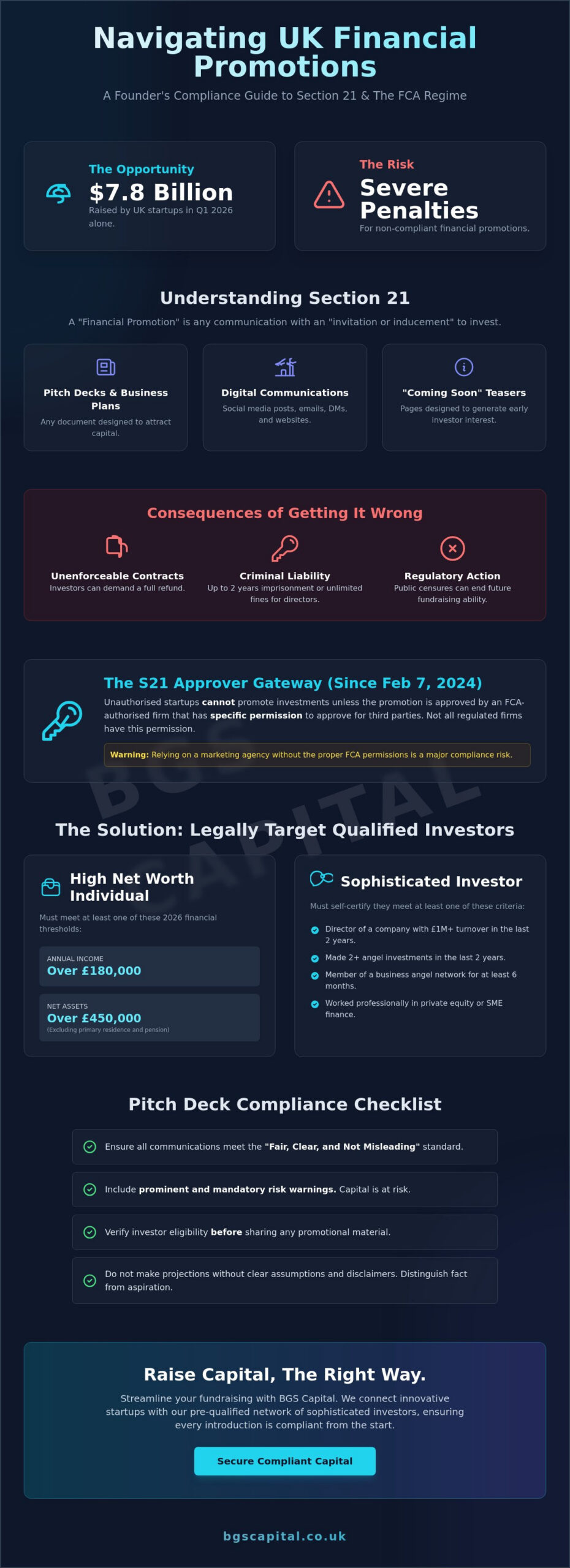
Regulatory compliance is not a barrier to fundraising; it’s the essential prerequisite for accessing the highest tier of sophisticated UK capital. While UK startups raised $7.8 billion in venture capital in the first quarter of 2026, many founders remain paralyzed by the risk of FCA fines or criminal liability. You cannot legally post your investment opportunity on social media or email it to unverified contacts without strictly adhering to the financial promotions rules for startups uk. The Section 21 restriction is absolute, and the consequences of non-compliance are severe.
We understand the frustration of interpreting complex investor classifications and the s21 approver gateway. This guide provides the technical clarity required to master the current FCA regime, allowing you to raise capital legally while mitigating regulatory risk. You’ll gain a precise understanding of the 2026 HNWI thresholds, the criteria for self-certified sophisticated investors, and the exact requirements for a compliant pitch deck that secures introductions to qualified capital.
Key Takeaways
- Define what constitutes an “invitation or inducement” under Section 21 to ensure every pitch deck and digital post remains compliant.
- Navigate the financial promotions rules for startups uk by identifying the specific permissions required under the 2024 FCA Approver Gateway.
- Apply the current 2026 thresholds for High Net Worth and Sophisticated Investor exemptions to target only qualified capital.
- Execute a comprehensive compliance checklist to meet the “Fair, Clear, and Not Misleading” standard and include mandatory risk warnings.
- Streamline the fundraising process through professional introduction networks that verify investor eligibility before any promotion occurs.
What Counts as a Financial Promotion for UK Startups?
The regulatory perimeter is wider than most founders realize. Under the Financial Services and Markets Act 2000, specifically Section 21, a financial promotion is defined as any communication that contains an “invitation or inducement” to engage in investment activity. If your startup is part of the ecosystem that raised $7.8 billion in venture capital in the first quarter of 2026, every document you shared likely fell under this definition. The “in the course of business” test is applied with extreme breadth. If you’re seeking capital to scale your operations, your communications are considered professional rather than personal.
Non-compliance carries severe penalties. Promoting an investment opportunity without proper authorization or an applicable exemption can lead to:
- Unenforceable Contracts: Investors may have the right to cancel their agreements and demand their money back.
- Criminal Liability: Directors can face up to two years’ imprisonment or unlimited fines.
- Regulatory Action: The FCA can issue public censures that effectively end your ability to raise future rounds.
Ignoring the financial promotions rules for startups uk is a risk that sophisticated founders cannot afford. It’s not just about the final pitch deck; it’s about every touchpoint in the investor journey.
The “Invitation or Inducement” Test
The FCA interprets “inducement” as any content that “persuades or encourages” a person to invest. Purely factual information, such as a statutory filing, generally falls outside this scope. However, the moment you add a “Call to Action” or highlight projected growth, you’ve crossed the line. Even a “Coming Soon” teaser page for an upcoming funding round triggers the regime because it’s designed to generate interest in an investment opportunity. You must distinguish between identifying your brand and soliciting capital.
Mediums of Communication in 2026
The FCA monitors every digital channel. In 2026, the rise of “finfluencer” style posting on LinkedIn and X has led to increased scrutiny of startup founders. Private channels offer no protection; the rules apply equally to direct emails, WhatsApp groups, and private messages. If the intent is to induce investment, the medium is irrelevant. The regulator’s focus is on whether the promotion reached an individual without a valid exemption. Publicly accessible websites are particularly high-risk, as they are viewed as promotions directed at the general public, including restricted retail investors.
The Section 21 Restriction and the FCA Approver Gateway
The general prohibition established by Section 21 of the Financial Services and Markets Act 2000 dictates that a person must not, in the course of business, communicate an invitation or inducement to engage in investment activity. For the majority of UK startups, which are not authorized by the Financial Conduct Authority (FCA), this means you cannot legally distribute a pitch deck or post investment opportunities unless the content is approved by an authorized person. This restriction is the cornerstone of UK financial regulation, designed to protect investors from unregulated and potentially misleading solicitations.
A critical shift occurred on February 7, 2024. The FCA introduced the “approver gateway.” This regulation mandates that authorized firms must now have specific permission from the FCA to approve financial promotions for unauthorized third parties. You can no longer assume any regulated firm can sign off on your materials. The gateway was designed to increase the quality of promotions and ensure that approvers have the necessary expertise to assess high-risk investments. If an unauthorized firm approves your content without this specific permission, the promotion is invalid, and you remain in breach of the financial promotions rules for startups uk.
Relying on an unauthorized marketing agency to manage your fundraising communications is a significant compliance risk. These agencies often lack the legal standing to approve promotions, leaving you vulnerable to the criminal sanctions mentioned previously. The Section 21 approver acts as a regulatory gatekeeper. They ensure your messaging aligns with the strict standards required for sophisticated capital raising. If you are seeking to bypass these complexities by engaging with a pre-qualified network, you might consider how professional investor introductions can streamline your path to capital while maintaining strict adherence to the law.
Finding an Authorised Approver
Startups must conduct thorough due diligence when selecting an approver. You should verify the firm’s status on the FCA Register to ensure they have the specific “approver” permission. An authorized firm will not simply skim your business plan. They will perform a deep-dive assessment of your commercial viability, your team’s credentials, and the accuracy of your financial models. Their responsibility is ongoing. If your business circumstances change, the promotion may need to be withdrawn or amended to remain compliant.
The Approval Process Step-by-Step
The approval process is rigorous and evidence-based. Every factual claim in your pitch deck must be substantiated with verifiable data. The “fair, clear, and not misleading” standard is the benchmark for every sentence. In 2026, the FCA requires specific formatting for risk warnings, including prominent placement and standardized wording that cannot be obscured by design elements. Both the startup and the authorized firm must maintain detailed records of the approval process, including the evidence used to back up claims and the date of approval.
Key Exemptions: High Net Worth and Sophisticated Investors
The Financial Promotion Order (FPO) provides the legal framework for communicating investment opportunities without direct FCA approval. For founders, these exemptions are the primary mechanism for capital raising. By restricting your audience to specific classifications, you operate within the safe harbor of the law. Adhering to the financial promotions rules for startups uk requires a strict verification process for every potential investor. You must ensure that your promotion is only directed at individuals who meet the criteria defined in Articles 48 or 50 of the FPO. Failure to do so renders the promotion illegal and the resulting investment contracts potentially void.
Using these exemptions correctly removes the requirement for an authorized firm to approve every communication. However, the burden of proof rests entirely on the startup. You must maintain a register of all certified individuals and the specific exemptions they meet. If you cannot prove that an investor was qualified at the time of the promotion, you are in breach of Section 21. This is why many firms choose to work with intermediaries who specialize in pre-vetted networks. These networks ensure that all participants have already undergone the necessary status verification.
Certified High Net Worth Individuals
To qualify under Article 48, an individual must meet the current 2026 thresholds. These require an annual income of at least £100,000 or net assets of at least £250,000, excluding the primary residence and pension rights. These figures were confirmed in March 2024 after the government reversed a short-lived increase. You must obtain a signed statement in the exact format prescribed by the FCA. These certificates are typically valid for 12 months. You must verify the date of the statement before sharing any promotional material. Transitional provisions for older statements expired on January 30, 2025. Any investor relying on outdated documentation must provide a new, compliant certificate to meet current standards.
Sophisticated Investor Classifications
Article 50 covers both certified and self-certified sophisticated investors. A self-certified sophisticated investor must meet specific criteria. For example, they may be a director of a company with an annual turnover of at least £1 million. Another pathway involves having made at least two investments in an unlisted company in the previous two years. This classification is vital when presenting your opportunity to angel investors who possess the requisite market experience. You are responsible for ensuring the investor has signed the relevant self-certification statement within the last year. This process protects your startup from the high standards of the Consumer Duty, which primarily applies to retail investor protections.
Compliance Checklist for Startup Pitch Decks
A pitch deck is more than a marketing asset; it’s a regulated financial promotion. The primary benchmark for any investor presentation is the “fair, clear, and not misleading” standard. Adhering to the financial promotions rules for startups uk requires a balanced presentation of risk and reward. If your deck highlights a potential 10x return, it must equally emphasize the risk of total capital loss. This balance is not a suggestion. It’s a regulatory requirement under the Consumer Duty that came into force in July 2023 and remains a core focus in 2026.
Mandatory risk warnings must be prominent. You can’t hide them in the final slide or use a font size that is significantly smaller than the main body text. The FCA expects these warnings to be “above the fold” in digital presentations or clearly visible at the start of any physical document. Forward-looking statements and financial projections require a reasonable, substantiated basis. You must be able to provide the underlying data for every growth claim. Past performance, while useful, cannot be the primary focus or a guarantee of future results.
Visual and Structural Requirements
Prominence is determined by the “overall impression” of the communication. Risk warnings must have equal or greater prominence than the “upside” claims. Avoid cherry-picking data; presenting only your best-performing month while ignoring a downward trend is considered misleading. Information must be tailored to the target investor class. While a deck for sophisticated investors can include technical data, it must remain understandable. Ensure that all charts use consistent scales and don’t omit the Y-axis to exaggerate growth trends.
Common Pitfalls in Startup Decks
Exaggerated market size calculations are a frequent target of regulatory scrutiny. You must cite reputable sources for your TAM, SAM, and SOM figures. Unrealistic exit multiples based on megaround outliers rather than sector averages will fail the “fair and clear” test. Hidden fees or complex equity structures that aren’t disclosed upfront can lead to claims of misrepresentation. This is particularly critical for AI startups, which raised a record $5.8 billion in Q1 2026 and currently face the highest levels of technical due diligence. To ensure your deck reaches the right audience without these risks, you may apply for a professional investor introduction.
Navigating Capital Raising with BGS Capital
BGS Capital operates as a specialized facilitator within the UK investment ecosystem. We provide a professional conduit that connects high-growth companies with a network of pre-vetted, qualified investors. By utilizing our business listing service, you ensure your investment opportunity is presented exclusively to individuals who’ve verified their status as high-net-worth or sophisticated investors. This methodology is essential for maintaining compliance with the financial promotions rules for startups uk. We don’t act as a broker or provide financial advice; our role is to manage the gateway through which introductory activity occurs.
Transitioning from early private rounds to pre-IPO visibility demands a sophisticated approach to communication. In the first quarter of 2026, the UK startup ecosystem saw venture capital reach $7.8 billion, yet a significant portion of this capital remains restricted to institutional-grade opportunities. Featuring your business on a professional platform allows you to bridge the gap between private seed capital and the public markets. Our network consists of individuals who understand the complexities of private equity and are prepared for the high-level due diligence required in late-stage megarounds.
Connecting with the Right Tier of Capital
Professional investors prioritize compliance-first startups because it reduces their own regulatory and reputational risk. A founder who strictly adheres to the FCA financial promotion regime demonstrates the necessary discipline to manage significant external capital. Through our platform, you gain access to a global network of capital providers who are specifically looking for qualified opportunities. When you’re preparing your materials, the inclusion of your EIS and SEIS status is a vital differentiator. These tax-efficient vehicles are highly sought after by high-net-worth individuals, but they must be presented within a compliant framework that highlights risks alongside the potential for tax relief.
Next Steps for Founders
The process for featuring your business begins with a rigorous internal review. We evaluate your company’s sector, current traction, and funding objectives to determine if it aligns with our network’s criteria. This gatekeeping function is what maintains the exclusivity of the BGS Capital network. Once your business passes our initial qualification stage, it is positioned before an audience of sophisticated investors who are already verified under the FPO exemptions. This streamlines your fundraising efforts and ensures that every introduction is legally sound. You are invited to feature your business with BGS Capital to begin this process and secure the visibility your company requires.
Securing Your Startup’s Capital Future
Adhering to the financial promotions rules for startups uk is a strategic necessity for any founder targeting high-level capital. You’ve identified the critical boundaries of Section 21 and the specific requirements for Article 48 and 50 exemptions. Compliance is not merely a legal obligation. It’s a signal of institutional readiness that professional investors demand. By ensuring your pitch deck meets the 2026 standards for risk disclosure and factual substantiation, you protect your company from the severe penalties of the FCA regime.
BGS Capital provides the infrastructure to bridge the gap between your opportunity and a verified network of capital providers. We offer access to a curated database of HNW and sophisticated investors. Our expertise in pre-IPO and IPO investor introductions ensures your business receives the visibility it needs within a secure, professional environment. We maintain strict adherence to UK compliance standards to protect the integrity of our network and the interests of our participants.
Connect with qualified HNW investors by featuring your business today.
Your path to successful capital raising starts with a commitment to regulatory excellence and professional transparency.
Frequently Asked Questions
Do the UK financial promotion rules apply if I am raising from foreign investors?
Yes, the rules apply if the communication is made from the UK or is “capable of having an effect in the UK.” Even if you target international capital, as a UK based entity, your promotional activity falls under the financial promotions rules for startups uk. You must ensure that every communication is either approved by an authorized person or strictly limited to individuals meeting specific exemptions in their local jurisdiction and the UK.
Can I promote my startup on social media if I include a risk warning?
A risk warning alone is insufficient for a public social media post. Public promotions are generally restricted because you cannot verify the recipient’s status as a high net worth or sophisticated investor. Unless the post is approved by an authorized person under the Section 21 gateway, it remains a breach of the general prohibition. You must use gated environments where investor status is verified before the promotion is visible.
What is the “Fair, Clear, and Not Misleading” rule for startups?
This standard requires all promotional materials to present a balanced view of the investment. You must provide equal prominence to risks and potential returns while ensuring all factual claims are substantiable. For startups, this means avoiding “cherry picked” data or exaggerated market projections. Information must be presented in a way that is understandable to the specific class of investor you are targeting without omitting material information.
How long does it take to get a financial promotion approved by an FCA firm?
The approval process typically takes between two and six weeks. This timeline depends on the complexity of your business model and the quality of the evidence you provide for your claims. The authorized firm must conduct comprehensive due diligence on your directors and financial projections before granting approval. Delays often occur when startups fail to provide verifiable third party data for market size or valuation comparables.
Is a LinkedIn post about my funding round considered a financial promotion?
Yes, any communication that invites or induces investment activity is a financial promotion. A LinkedIn post stating that your company is “now raising” or “seeking investment” qualifies as an inducement under Section 21. Because LinkedIn is a public platform, these posts are high risk. They often reach retail investors who are not qualified to receive such promotions, leading to potential regulatory action by the FCA.
What are the penalties for breaching the Financial Services and Markets Act (FSMA)?
Breaching the Section 21 restriction is a criminal offense. Directors can face up to two years’ imprisonment, unlimited fines, or both. Additionally, any investment agreement made as a result of an illegal promotion is legally unenforceable. This means investors have a statutory right to withdraw their capital and claim compensation for any losses. The FCA also has the power to issue public censures that damage your firm’s reputation permanently.
Does the Section 21 restriction apply to SEIS and EIS investments?
Yes, the restriction applies to all equity investments regardless of their tax efficient status. While SEIS and EIS provide significant incentives for investors, they don’t exempt the founder from the financial promotions rules for startups uk. You must still ensure that your pitch deck and communications are approved by an authorized firm or directed only at individuals who have signed the relevant high net worth or sophisticated investor certificates.
Can I use the High Net Worth exemption for crowdfunding?
The High Net Worth exemption is frequently used by crowdfunding platforms to gate specific investment opportunities. These platforms are typically authorized persons and take responsibility for verifying investor status before allowing access to promotions. If you are raising capital independently of an authorized platform, you must personally ensure that every investor has signed a compliant Article 48 statement within the previous 12 months before sharing your promotional materials.