
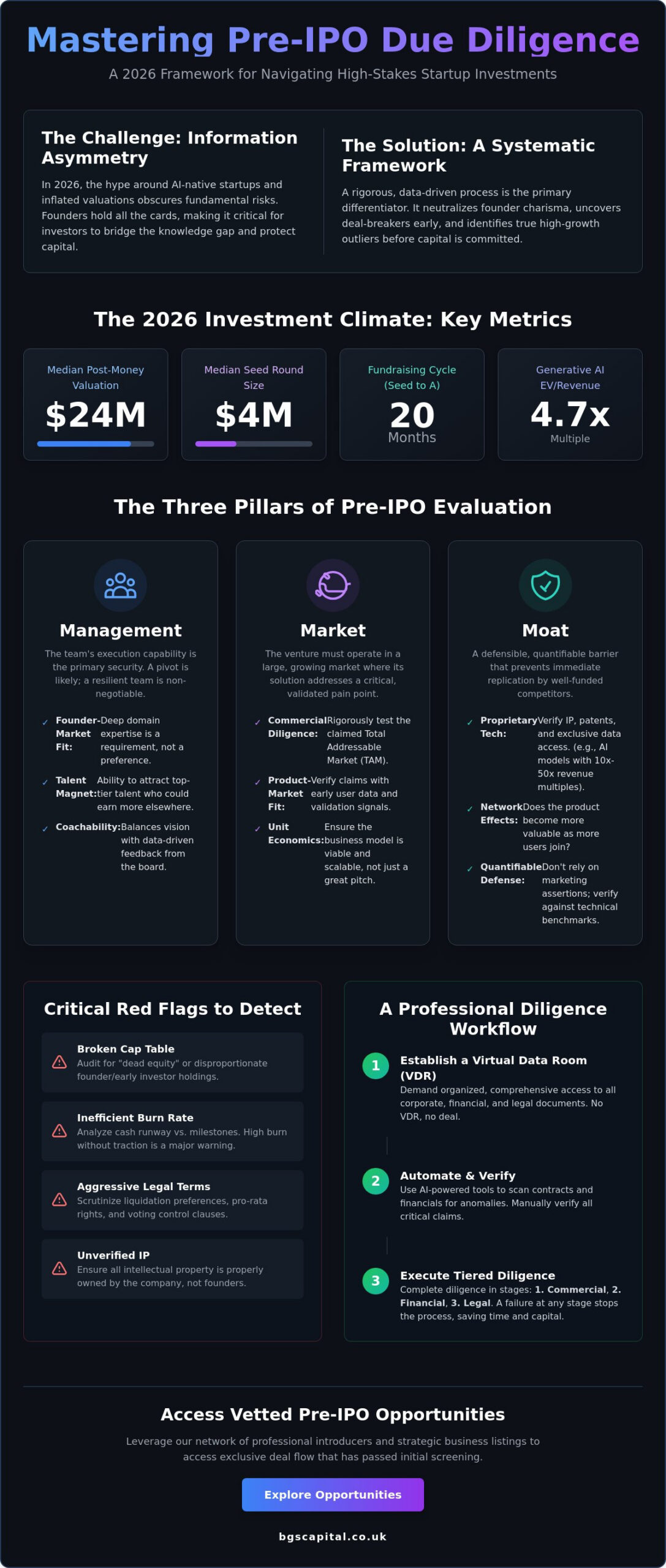
The median post-money valuation for a seed round reached $24 million in 2026, yet the hype surrounding AI-native startups often obscures fundamental structural weaknesses. You understand that capital preservation is as critical as growth, but the persistent information asymmetry between founders and investors remains a significant barrier. Mastering how to perform due diligence on a startup is no longer just a defensive measure; it’s the primary differentiator for those seeking to secure high-growth opportunities while avoiding over-leveraged failures. Access to exclusive opportunities requires more than capital. It requires a rigorous, data-driven approach to verification.
This guide provides a systematic framework to mitigate risk and verify management claims with precision. You’ll master a repeatable process for vetting early-stage opportunities, identifying financial red flags, and evaluating management teams with professional confidence. We examine current 2026 valuation multiples, such as the 4.7x EV/Revenue seen in Generative AI, alongside legal requirements under Regulation A+ Tier 2. This professional overview establishes the groundwork for identifying high-potential ventures within our network of business listings and investor introductions. Success in the pre-IPO space depends on a structured vetting framework that prioritizes transparency and compliance above all else.
Key Takeaways
- Apply a systematic framework to identify pre-IPO outliers and master how to perform due diligence on a startup to mitigate structural risks.
- Evaluate management teams using non-negotiable founder-market fit criteria to ensure leadership can navigate sector-specific disruptions.
- Detect financial red flags by auditing cap tables for dead equity and analyzing burn rates for capital efficiency.
- Establish a professional vetting workflow that utilizes virtual data rooms for rigorous document verification.
- Access exclusive deal flow through professional introducer platforms and strategic business listing services.
The Framework of Pre-IPO Due Diligence in 2026
In pre-IPO ventures, due diligence is the rigorous audit of a private entity before capital is committed. It is a transactional necessity. This process allows investors to navigate the “Power Law of Returns.” In this model, a small percentage of companies generate the vast majority of market value. Finding these outliers requires a filter that is both objective and data-driven. You aren’t just looking for reasons to invest; you’re looking for reasons to walk away.
Understanding how to perform due diligence on a startup requires a different mindset than public market trading. You aren’t buying a liquid ticker; you’re entering a long-term partnership with significant liquidity constraints. While institutional VC funds utilize massive analyst teams, sophisticated individual investors must be more efficient. The primary goal is uncovering “deal-breakers” early. If a startup has a broken cap table, unverified intellectual property, or aggressive liquidation preferences, you need to know before the first wire transfer is initiated. This saves time and capital for deals that withstand intense scrutiny.
Why Sophisticated Investors Must Lead with Process
A “great pitch” is a psychological trap. It creates a narrative that often masks underlying operational risks or poor unit economics. Process acts as a neutralizer to this bias. Information asymmetry defines private markets. Founders possess granular knowledge that you do not. To bridge this gap, you must execute three tiers of diligence. Commercial diligence tests the market size and product-market fit. Financial diligence audits the burn rate and cash runway. Legal diligence ensures the corporate structure is sound. Each tier must be completed before moving to final terms. Don’t let founder charisma override a lack of documentation.
The 2026 Investment Climate: Speed vs. Scrutiny
Current market conditions in 2026 demand a balance between speed and accuracy. Median seed rounds now sit at approximately $4 million. With post-money valuations around $24 million, the stakes for early-stage entry are high. AI-powered tools have revolutionized the vetting process by automating the review of Virtual Data Rooms. These tools identify anomalies in contracts and financial statements in seconds. Many sophisticated investors also monitor the activity of angel investors to leverage early user validation data. This collaborative vetting helps manage the 20-month fundraising cycles currently seen between seed and Series A rounds. Efficiency in vetting is now a competitive advantage.
Evaluating the Three Pillars: Management, Market, and Moat
In the pre-IPO sector, the product is often a variable. The management team is the constant. Sophisticated investors understand that a pivot is likely; therefore, the team’s execution capability is the primary security. When learning how to perform due diligence on a startup, you must prioritize “Founder-Market Fit.” This isn’t a vague preference for industry experience. It’s a requirement for deep domain expertise that allows founders to identify inefficiencies that outsiders miss. Without this, the risk of a strategic misstep increases significantly.
A defensible moat prevents immediate replication by incumbents or well-funded followers. Whether it’s proprietary AI models commanding revenue multiples in the 10x-50x range or network effects that scale with user acquisition, the moat must be quantifiable. A comprehensive due diligence review requires verifying these claims against technical benchmarks and patent filings. Don’t rely on marketing assertions. You can find vetted opportunities through a professional business listing service that streamlines the initial screening process.
Assessing Management Resilience and Execution
When executing how to perform due diligence on a startup, look for the “Talent Magnet” trait. Can the founders attract top-tier engineers or sales leads who could earn more elsewhere? This indicates leadership credibility. Verify the co-founder history. Teams that have weathered previous market cycles together are less likely to fracture during the current 20-month gap between funding rounds. Evaluate “Coachability.” A founder must balance visionary persistence with the humility to accept data-driven feedback from their board. If a founder is resistant to professional oversight, the investment carries a higher governance risk.
Validating the Market Opportunity
Founders often present a Total Addressable Market (TAM) in the trillions. This is usually irrelevant. Focus on the Serviceable Addressable Market (SAM) and the Serviceable Obtainable Market (SOM). How will they win the first $10 million in revenue? This is the “Beachhead” strategy. Identify regulatory or technological tailwinds. For example, the May 19, 2026 SEC proposed reforms to the registered offering process may expand eligibility for key registration forms like Form S-3. Compare the startup against incumbents. If a legacy competitor can integrate the startup’s core feature into their next software update, the moat is non-existent. You must distinguish between theoretical market size and actual capture potential.
Financial and Legal Scrutiny for Private Companies
Financial scrutiny begins with a forensic analysis of the capitalization table. You must identify “dead equity” held by inactive founders or early employees who no longer contribute to the entity. This misallocation dilutes the incentive for current leadership and complicates future funding rounds. Look for aggressive liquidation preferences. If early investors hold 2x or 3x preferences, common shareholders and later-stage investors may receive zero returns in a moderate exit scenario. Mastering how to perform due diligence on a startup requires a cold assessment of these structural risks before capital is committed.
Cash runway is your next priority. With the median time between seed and Series A rounds now exceeding 20 months in 2026, a startup needs a significant capital buffer. A high burn rate without corresponding growth in unit economics is a fatal red flag. Verify that the company is raising capital for strategic expansion rather than immediate survival. If the current raise only provides six months of runway, the company is likely raising out of desperation. This position weakens their leverage in future negotiations and increases the risk of a down-round.
Intellectual Property (IP) must be legally secured within the corporate entity. Ensure the company holds clear title to all patents, trademarks, and source code. It’s common in early-stage ventures for founders to hold IP personally; this must be corrected through formal assignment. Check for pending litigation or unusual employment contracts. Employment agreements with “change of control” clauses can trigger massive payouts during an acquisition, which significantly reduces the net proceeds for investors. Every legal encumbrance is a potential drain on future valuation.
Unit Economics and Business Model Viability
Analyze the ratio of Customer Acquisition Cost (CAC) to Lifetime Value (LTV). A ratio below 3:1 typically indicates an unsustainable business model. Look for evidence of operating leverage. In a viable software venture, margins should expand as the company scales. Revenue quality is also paramount. Recurring revenue from long-term contracts is far more valuable than one-off transactional sales. For AI-native startups, verify if the revenue multiples, which often reach the 10x-50x range, are supported by actual usage data rather than pilot-program hype.
UK Regulatory and Tax Compliance
For UK-based opportunities, verify the EIS or SEIS advance assurance status. This is a critical component of tax-efficient investing for sophisticated individuals. Ensure the company is in good standing with Companies House and that all annual filings are current. Failure to maintain these records is often a symptom of broader management negligence. Check for GDPR compliance and relevant industry-specific UK regulations. Non-compliance can lead to severe regulatory fines that immediately impair the startup’s balance sheet and reputation.
Building a Professional Diligence Workflow and Checklist
Success in private equity is a function of the filter, not the deal flow. Understanding how to perform due diligence on a startup requires a standardized sequence of operations. This prevents emotional decision-making and ensures every opportunity is measured against the same rigorous benchmarks. A professional workflow consists of five distinct phases.
- Step 1: The Preliminary Screen. Review the pitch deck and conduct the initial founder meeting. The goal is to verify the core thesis and ensure the opportunity aligns with your sector expertise.
- Step 2: Virtual Data Room (VDR) Access. Request full access to the startup’s document repository. This is the audit phase where claims are verified against legal and financial records.
- Step 3: Technical and Product Deep-Dive. Conduct a forensic review of the product’s architecture. For deep-tech or AI ventures, involve outside technical experts to verify that the “moat” is actually proprietary.
- Step 4: The Human Element. Execute reference calls and customer interviews. This phase uncovers operational friction that doesn’t appear on a balance sheet.
- Step 5: Final Investment Committee. Synthesize all findings into a final memorandum. This is the terminal decision point where you either commit capital or walk away.
Sophisticated investors often utilize a professional business listing service to source opportunities that have already undergone a preliminary vetting process. This streamlines the initial screening and allows you to focus your resources on the deep-dive phases of the workflow.
The Virtual Data Room (VDR) Checklist
A disorganized data room is an immediate red flag. It suggests management negligence or a lack of internal controls. Your checklist must include the following core documents:
- Articles of Association and current Shareholder Agreements.
- Audited P&L statements and balance sheets for the last 24 months.
- A fully transparent Cap Table, including all warrants and options.
- Verified IP filings and proof of ownership assignments.
Spotting red flag omissions is critical. If a company claims high “stickiness” but refuses to provide churn data or cohort analysis, the data room is incomplete. Use AI-powered document review tools to flag inconsistencies in employment contracts or unusual board observer rights. Missing filings from Companies House or gaps in GDPR documentation indicate a lack of regulatory compliance that could lead to future liabilities.
Mastering the Reference Call
Founder-provided references are biased by design. To find the truth, you must conduct “back-channel” references. Identify former employees, early customers, or previous investors through your own network or professional platforms. Ask specific, transactional questions. Instead of asking if the founder is “good,” ask how they handled the last major product failure or a missed revenue target. These calls identify silent risks, such as toxic internal cultures or high customer dissatisfaction, that are hidden behind a polished pitch. Reference calls are the final line of defense against the “unicorn” hype that often masks poor fundamentals.
Leveraging Professional Networks for Deal Flow
Individual investors often face a significant resource disadvantage compared to institutional VC firms. While a fund employs teams of analysts to scrutinize every Virtual Data Room, an individual must be more strategic. This is why many sophisticated investors join syndicates or utilize professional introducer platforms. These networks aggregate high-quality deal flow and provide a preliminary layer of vetting. BGS Capital serves as an established conduit in this ecosystem, connecting qualified investors with exclusive pre-IPO opportunities that meet specific professional criteria.
Using a network allows you to bypass the noise of low-quality pitches. Pre-vetted opportunities significantly reduce the “Initial Screen” burden. However, a third-party introduction is not a substitute for your own verification process. You must still execute the systematic framework of how to perform due diligence on a startup as outlined in previous sections. The introducer provides the access; you provide the final scrutiny. This dual-layered approach is essential for identifying the outliers that generate the majority of market value.
The Role of an Introducer in Your Diligence Process
Professional startup funding platforms streamline the path from discovery to deep-dive. They facilitate direct connections with Investor Relations teams, allowing you to ask the granular questions required for commercial and financial diligence. Before gaining access to these exclusive networks, you must verify your status as a sophisticated or high-net-worth investor. This gatekeeping function ensures that the ecosystem remains compliant and that all participants understand the inherent risks of early-stage private equity. Access is a privilege reserved for those who meet stringent regulatory requirements.
Next Steps for Qualified Investors
The transition from education to execution requires a defined investment thesis. You should determine your sector preferences, risk tolerance, and target valuation multiples based on current 2026 market data. Whether you are focused on the 4.7x EV/Revenue multiples in Generative AI or the 62.5x multiples in Quantum Computing, your thesis provides the objective criteria for your final decision. A disciplined thesis prevents the psychological trap of the “great pitch” and keeps your focus on fundamental unit economics.
Are you a qualified investor ready to access exclusive pre-IPO opportunities? You can feature your business or explore our database of vetted listings to begin your next diligence process. Success in private markets depends on a repeatable, process-driven approach that prioritizes transparency and risk mitigation at every stage of the transaction.
Transitioning from Scrutiny to Strategic Capital Allocation
Systematic verification is the only defense against market volatility and information asymmetry. You’ve established that a rigorous audit of the cap table, founder-market fit, and technical moats is non-negotiable. Mastering how to perform due diligence on a startup ensures that your capital is allocated based on verifiable data rather than speculative hype. By following a professional workflow and utilizing virtual data rooms, you mitigate the “silent risks” that often compromise early-stage ventures.
BGS Capital provides the infrastructure to bridge the gap between education and action. Our curated network of pre-IPO opportunities is reserved exclusively for Sophisticated Investors and HNWIs. You gain direct access to Investor Relations teams to execute your own deep-dive vetting process with efficiency. Establishing a disciplined investment thesis is your final step toward securing high-growth potential in the 2026 private equity landscape.
Access Our Database of Pre-IPO and IPO Opportunities
Your commitment to process-driven vetting positions you to identify the outliers that define the power law of returns. We look forward to facilitating your next high-stakes introduction.
Frequently Asked Questions
How long should the due diligence process take for a startup?
The timeline typically spans four to twelve weeks. Seed rounds may conclude faster; however, Series A or B rounds require extensive verification of unit economics and technical infrastructure. Market conditions in 2026 have increased scrutiny, often extending the process as investors wait for quarterly performance data to verify growth claims. Efficiency depends on the organization of the founder’s data room.
What are the biggest “red flags” to look for during due diligence?
Primary indicators of failure include high customer churn and a “broken” cap table where inactive founders hold significant equity. Opaque financial reporting or a refusal to grant full Virtual Data Room access are also critical warnings. You should also scrutinize aggressive liquidation preferences that disadvantage later-stage investors or suggest a lack of alignment between founders and shareholders.
Do I need a lawyer to perform due diligence on a startup?
Legal counsel is essential for verifying intellectual property ownership and employment contracts. While sophisticated investors often lead commercial vetting, a lawyer ensures the Articles of Association and shareholder agreements are compliant with UK law. This prevents future liabilities related to “change of control” clauses or undisclosed litigation that could impair the company’s valuation after your capital is committed.
What is a Virtual Data Room (VDR) and how do I use it?
A Virtual Data Room is a secure, encrypted repository used to host sensitive corporate documentation during a transaction. You use it to audit P&L statements, tax filings, and IP registrations. Mastery of how to perform due diligence on a startup involves using AI-powered tools within the VDR to identify anomalies or missing regulatory filings quickly, ensuring no structural weaknesses are overlooked.
How much information is a founder required to disclose during DD?
Founders must disclose all material facts, including financial statements, liabilities, and intellectual property status. There is no legal “minimum” in private transactions, but sophisticated investors expect full transparency. A refusal to disclose burn rates or customer cohort data usually terminates the transaction immediately. Transparency is the primary indicator of management integrity and professional governance.
Can I perform due diligence on a company before it reaches the IPO stage?
Scrutiny is standard for every stage from pre-seed to pre-IPO. In fact, how to perform due diligence on a startup at the early stage is often more intensive because there is less historical data available. You must rely on back-channel reference calls and market “beachhead” strategies to validate the opportunity before the company moves toward a public listing or acquisition.
What happens if I find a discrepancy during the due diligence process?
Discrepancies require immediate clarification from the management team. If the issue is a minor clerical error, it can be corrected in the closing documents. However, if you find misstated revenue or unverified IP ownership, you should either significantly lower the valuation or walk away from the transaction entirely. Trust is the foundation of private equity; once compromised, it’s rarely recovered.
Is due diligence different for SEIS or EIS-eligible companies?
The process includes an additional layer of tax compliance verification. You must confirm that the company has obtained advance assurance from HMRC to ensure your investment qualifies for tax relief. Failure to maintain these specific regulatory standards or a breach of the “risk to capital” gateway can result in the loss of EIS or SEIS benefits for all participants.