
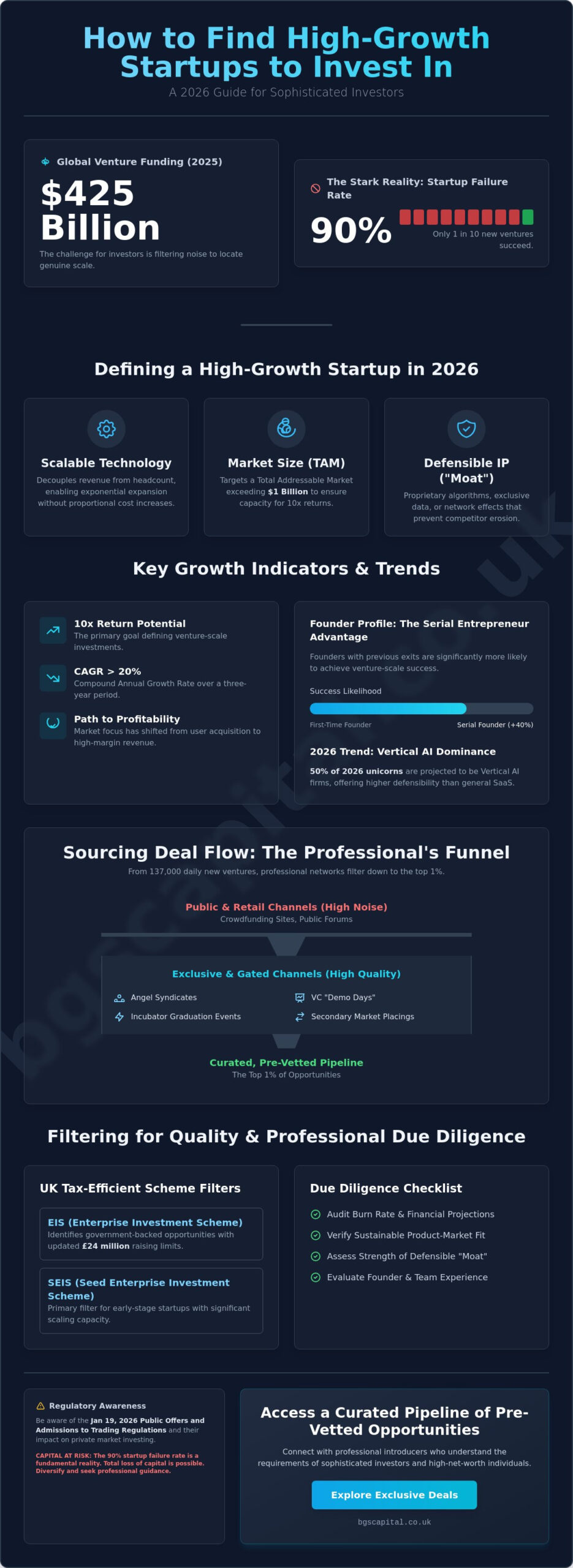
While global venture funding reached $425 billion in 2025, the reality remains that 90% of new ventures fail. For the sophisticated investor, the challenge isn’t finding volume; it’s filtering out the noise of low-quality lifestyle pitches to locate genuine scale. You likely recognize that the most lucrative opportunities, such as the vertical AI firms making up 50% of 2026’s unicorns, are rarely found on public forums. Understanding how to find high growth startups to invest in requires moving beyond retail platforms and into curated, professional networks.
We agree that the current market is a selective, quality-driven environment where underwriting discipline is paramount. This guide provides the professional sourcing strategies and exclusive network insights needed to identify high-potential startups before they reach public markets. You’ll learn the specific criteria for high growth potential, the impact of the January 19, 2026 Public Offers and Admissions to Trading Regulations, and how to navigate the updated £24 million EIS raising limits. This overview ensures you can build a tax-efficient, pre-vetted pipeline by connecting with professional introducers who understand the requirements of high-net-worth individuals.
Key Takeaways
- Identify specific high growth indicators including 10x return potential, scalable technology, and defensible intellectual property.
- Learn how to find high growth startups to invest in by leveraging exclusive angel syndicates and venture capital incubator events.
- Use UK tax-efficient schemes like EIS and SEIS as primary filters to identify government-backed opportunities with significant scaling capacity.
- Execute professional-grade due diligence by auditing burn rates and verifying sustainable product-market fit before committing capital.
- Access a curated pipeline of pre-IPO and secondary market opportunities through an introducer model designed for sophisticated investors.
What Defines a High Growth Startup in 2026?
High growth startups in 2026 represent a specific asset class defined by their capacity for 10x returns. These aren’t standard lifestyle businesses. They are entities designed for rapid scaling and market disruption. Identifying these opportunities requires a rigorous assessment of three core pillars: scalable technology, a Total Addressable Market (TAM) exceeding $1 billion, and defensible intellectual property. Sophisticated investors often prioritize serial entrepreneurs. Data from 2025 suggests that founders with previous exits are 40% more likely to achieve venture-scale success in their subsequent ventures. Understanding how to find high growth startups to invest in starts with recognizing these fundamental markers before capital is deployed.
Success in this sector requires distinguishing between temporary trends and sustainable business models. A high growth venture must possess a “moat” that prevents competitors from eroding margins as the company scales. This defensibility often comes from proprietary algorithms, exclusive data access, or significant network effects. Without these, even a fast-growing company can fail when faced with well-funded incumbents.
CAPITAL AT RISK: High growth potential inherently involves high risk. Investors must accept that total loss of capital is a fundamental reality of this asset class. While the upside can be substantial, the global startup failure rate remains at 90% as of May 2026. This necessitates a diversified approach and access to professional-grade deal flow to mitigate potential losses.
The Scalability Factor
A “good business” generates consistent cash flow but lacks the infrastructure for exponential expansion. In contrast, a venture-scale startup utilizes technology to decouple revenue growth from headcount. In 2026, the market has shifted its focus from pure user acquisition to high-margin revenue growth. Investors now demand a clear path to profitability rather than subsidised growth. For the purposes of this guide, high growth is defined as a compound annual growth rate (CAGR) exceeding 20% over a three-year period. This level of expansion typically requires Venture capital financing to sustain the necessary burn rate during the aggressive scaling phase.
Market Disruption and Timing
Timing is often more critical than the technology itself. The “Why Now?” factor evaluates whether the market is ready for a specific disruption. In the UK, current regulatory tailwinds in sectors like cybersecurity and defense technology are creating unique entry points. These sectors benefit from increased government spending and infrastructure mandates that cannot be easily replicated by competitors. Monitoring venture capital trends provides a leading indicator of where the next growth wave will materialize. Learning how to find high growth startups to invest in requires a deep analysis of these market shifts, such as the 2026 transition toward “Vertical AI” solutions that offer higher defensibility than general SaaS models.
Sourcing Deal Flow: Where Professional Investors Look
High-quality deals rarely appear on public crowdfunding sites. Professional investors use specific, gated channels to access exclusive rounds. Angel syndicates allow individuals to pool capital, providing entry into rounds that require a minimum commitment of £50,000 or more. Similarly, venture capital “demo days” and incubator graduation events offer early access to startups emerging from rigorous acceleration programs. These environments are where the 137,000 daily new ventures are filtered down to the top 1%. Global venture funding totaled $425 billion in 2025, and capturing a fraction of this growth requires being in the room when the term sheets are signed.
Secondary placings offer another strategic avenue for sophisticated capital. These involve purchasing shares in established, late-stage private companies from existing shareholders. This strategy provides exposure to businesses closer to an IPO or acquisition, often with more predictable metrics than seed-stage ventures. To understand the broader context of these equity stages, you can find guidance from the SBA regarding traditional and venture-backed structures. Using secondary markets allows you to bypass the earliest risks while still capturing significant pre-IPO upside.
CAPITAL AT RISK: All private equity investments carry a high degree of risk. Diversification and professional sourcing are essential to mitigate potential total loss of capital.
The Private Network Advantage
The most lucrative opportunities are often “off-market” and distributed through private networks. Accredited investment firms and wealth managers act as gatekeepers to these exclusive rounds. Building these relationships is essential for anyone researching how to find high growth startups to invest in. Organic sourcing through industry events and LinkedIn remains effective, but it’s often too time-intensive for individual investors. Professional introducers streamline this process by providing access to pre-vetted, qualified companies that have passed initial diligence phases. This model ensures you only review businesses with a clear path to scale. You can check your eligibility to join such networks and receive curated deal flow directly.
Leveraging Online Databases
Data-driven sourcing utilizes platforms like Beauhurst or Crunchbase to identify companies reaching specific growth milestones. Focus on entities that have recently secured startup funding, as this often signals institutional validation. In 2026, filtering for “Vertical AI” and infrastructure-heavy sectors like robotics or defense technology is a priority for sophisticated portfolios. Always check investor relations pages directly to verify current cap tables and funding status. These databases allow you to track the 50% of tech unicorns that are currently AI-related, ensuring your sourcing remains aligned with the latest market shifts.
Filtering for Quality: EIS, SEIS, and Pre-IPO Rounds
UK tax-efficient schemes serve as more than just fiscal incentives; they act as a rigorous quality filter for sophisticated portfolios. The Enterprise Investment Scheme (EIS) and Seed Enterprise Investment Scheme (SEIS) provide a framework for identifying companies that meet strict government criteria regarding gross assets and trading age. As of April 6, 2026, the lifetime amount a company can raise under EIS increased to £24 million, or £40 million for knowledge-intensive companies. For individuals researching how to find high growth startups to invest in, focusing on companies with HMRC “Advanced Assurance” is a standard vetting practice. This assurance confirms the business is eligible for tax relief before capital is committed, reducing regulatory uncertainty.
SEIS represents the highest-risk tier, targeting startups trading for less than three years with gross assets below £350,000. While the failure rate for these ventures is high, the 50% income tax relief on investments up to £200,000 per year provides a significant buffer. Conversely, pre-IPO rounds target companies with established revenues and a clear path to a liquidity event. The new Public Offers and Admissions to Trading Regulations (POATRs), which came into effect on January 19, 2026, have streamlined secondary issuances by increasing the prospectus threshold to 75% of share capital. This regulatory shift makes it easier for private investors to access late-stage rounds before a public listing occurs.
CAPITAL AT RISK: Tax treatments depend on individual circumstances and may change. To qualify for most EIS tax benefits, you must hold the shares for a minimum of three years. Failure to comply with HMRC rules can result in the clawback of tax relief and the loss of CGT exemptions.
Tax Efficiency as Risk Management
Utilising a EIS wrapper allows investors to offset the inherent volatility of the startup sector. The 30% income tax relief functions as an immediate downside hedge on the initial capital outlay. If an investment fails, loss relief allows you to offset the remaining net loss against your income tax bill for the current or previous year. This dual-layered protection is a primary reason why professional networks prioritise EIS-qualified deals. Capital Gains Tax (CGT) exemptions on exits after the three-year holding period further enhance the net return profile of high-potential ventures.
Evaluating Pre-IPO Opportunities
Pre-IPO investments focus on the transition from private excellence to public market liquidity. Investors often seek secondary market access to buy shares from early employees or founders at a potential discount to the projected IPO price. This stage requires analysing the company’s “IPO readiness,” including financial transparency and governance structures. Understanding how to find high growth startups to invest in at this level involves connecting with professional introducers who have access to these restricted secondary placings. Am I Eligible? Access to these rounds is typically restricted to high-net-worth individuals or self-certified sophisticated investors who meet specific financial or professional criteria.
Due Diligence: How to Vet a High Growth Opportunity
Vetting a startup requires looking past the polished pitch deck to scrutinise the underlying operational mechanics. A financial audit must go beyond the basic profit and loss statement. You must analyse the monthly burn rate versus available cash reserves. In May 2026, a sustainable runway typically exceeds 18 months. Companies with shorter runways face immediate refinancing risk in a selective market where venture funding is prioritised for efficiency over raw speed. Understanding how to find high growth startups to invest in involves identifying these fiscal vulnerabilities before they become terminal. Evidence of sustainable Product-Market Fit (PMF) is equally critical. Look for a low customer acquisition cost (CAC) relative to the lifetime value (LTV) of the client. If the LTV/CAC ratio is below 3:1, the business model may not be venture-scale.
Legal diligence focuses on protecting your position within the company. Verify that the startup owns its intellectual property (IP) outright and that all employment contracts include robust non-compete and IP assignment clauses. Red flags often include high founder turnover, outstanding litigation, or a lack of clear recurring revenue in B2B models. Professional introducers often provide an initial layer of pre-vetting, but the final responsibility for diligence remains with the investor. You can access a curated pipeline of pre-vetted opportunities through an established network to streamline this process.
CAPITAL AT RISK: Due diligence reduces uncertainty but cannot eliminate risk. Even companies with strong fundamentals can fail due to unforeseen market shifts or execution errors.
Analysing the Cap Table
A healthy cap table ensures that founders remain sufficiently incentivised for the long term. Over-dilution of founders in early rounds is a significant red flag; if the founding team owns less than 50% of the equity before a Series A, their motivation may wane during difficult scaling phases. Pay close attention to liquidation preferences. A 1x non-participating preference is standard in 2026. Anything higher can significantly impact your eventual return during a liquidity event. Understanding the rights of different share classes is essential to ensure your interests aren’t subordinated to later-stage institutional investors.
Assessing the Competitive Moat
Is the technology truly unique or easily replicable? In the current landscape of Vertical AI, the moat often resides in exclusive access to industry-specific data sets rather than the algorithms themselves. Network effects provide another layer of defensibility; the product must become more valuable as the user base grows. Regulatory barriers can also act as a competitive advantage. Companies that have already achieved compliance in highly regulated sectors like defense technology or healthcare possess a “moat” that new entrants cannot easily cross. Learning how to find high growth startups to invest in requires evaluating these barriers to ensure the company can maintain its market position as it scales.
Accessing Exclusive Deals via BGS Capital
The 2026 investment landscape rewards access over volume. While retail platforms offer broad entry, they often lack the quality control required by high-net-worth individuals and sophisticated investors. BGS Capital operates as a specialist introducer, bridging the gap between private excellence and professional capital. This model provides a clear answer for those determining how to find high growth startups to invest in without the dilution of quality found on retail forums. By functioning as a network rather than a direct advisor or broker, we facilitate direct connections to company Investor Relations (IR) teams, ensuring you receive information straight from the source.
Our network focuses on high-potential startup opportunities before they reach public markets. This includes pre-IPO rounds, secondary placings, and exclusive share offers that are typically restricted to accredited investment firms and wealth managers. Sophisticated investors can bypass the “retail noise” and focus on professional-grade placements that align with the rigorous due diligence standards discussed in previous sections. For founders, the platform offers a streamlined path to visibility; if you are currently raising capital, you can feature your business to our curated network of qualified investors.
CAPITAL AT RISK: BGS Capital operates as an introducer. We do not facilitate raises ourselves, nor do we provide financial advice or brokerage services. All investments in unlisted companies carry a high risk of capital loss.
Direct Connections, No Brokerage Fees
BGS Capital provides a transparent and efficient service for eligible investors. It is free to apply for IPOs, share offers, and secondary placings through our network. We do not charge access or subscription fees to investors for browsing our database of curated opportunities. Charges are only incurred when you trade, and these costs vary between individual brokers. This model ensures maximum transparency and facilitates direct dialogue with company leadership. By removing the traditional layers of brokerage interference, you can evaluate how to find high growth startups to invest in based on raw data and direct IR engagement.
Your Next Steps
Access to our curated pipeline is restricted to those who meet specific qualification criteria. The primary requirement is to confirm your status as a sophisticated or high-net-worth investor. Am I Eligible? This is the first question every prospective member must answer to ensure compliance with UK financial regulations. Once verified, you can download current opportunity brochures and compare sectors such as Vertical AI, cybersecurity, and defense technology. Ensure you understand the nature of unlisted investments and the illiquidity of private shares before proceeding with any trade through your chosen broker.
Building a High-Growth Portfolio for 2026
Navigating the private markets requires a shift from passive observation to active sourcing through professional networks. You’ve seen the criteria for 10x potential and the regulatory advantages provided by the January 19, 2026 Public Offers and Admissions to Trading Regulations. Success depends on rigorous due diligence, from auditing burn rates to verifying a 3:1 LTV/CAC ratio. By focusing on EIS-qualified ventures and secondary placings, you can align your capital with companies that have already achieved institutional validation.
Learning how to find high growth startups to invest in is the first step toward building a resilient, high-potential portfolio. BGS Capital provides the infrastructure to bridge this gap. Our network of accredited investment firms and wealth managers offers direct introductions to investor relations teams, specialising in pre-IPO and secondary placings.
Am I Eligible? Check your status to access exclusive pre-IPO opportunities.
The 2026 market offers unique entry points for those with the right access. We’re ready to facilitate your connection to the next generation of market leaders.
Frequently Asked Questions
How do I know if a startup is high growth?
High growth is identified by a compound annual growth rate exceeding 20% and a business model capable of 10x returns. Look for companies in infrastructure-heavy sectors like cybersecurity or vertical AI, which accounts for 50% of tech unicorns in 2026. These ventures must demonstrate a defensible competitive moat, such as proprietary data sets or network effects, to sustain rapid scaling without immediate margin erosion.
What is the minimum investment for high growth startups?
Minimum investment levels vary significantly depending on the funding stage and the structure of the deal. Angel syndicates typically require a commitment of £10,000 to £50,000 per opportunity to participate in larger rounds. In contrast, SEIS and EIS rounds may occasionally accept lower amounts, though the 2026 tax relief limits are capped at £200,000 and £2 million respectively for individual investors.
Can I invest in a startup before its IPO in the UK?
You can invest in UK startups before their IPO through secondary placings or late-stage private rounds. The Public Offers and Admissions to Trading Regulations, which took effect on January 19, 2026, have made these secondary issuances more accessible to private capital. This is a primary method for how to find high growth startups to invest in when seeking exposure to companies transitioning toward a public listing.
What are the main risks of investing in high growth companies?
The primary risk is the total loss of capital, as the global startup failure rate remains at 90% in 2026. These investments are also highly illiquid; there is no secondary market for most private shares, meaning your capital could be locked away for years. You must also consider dilution risks, where subsequent funding rounds reduce your percentage of ownership and impact eventual returns.
How do I qualify as a sophisticated investor in the UK?
To qualify as a sophisticated investor in the UK, you must meet specific Financial Conduct Authority (FCA) criteria. This generally requires being a high-net-worth individual with an annual income over £250,000 or net assets exceeding £1 million, excluding your primary residence. Alternatively, you can self-certify if you have been a member of a business angel network for at least six months or have worked in professional private equity.
What is the difference between an Angel and a VC?
Angel investors are typically high-net-worth individuals or syndicates that invest their own capital in early-stage startups. Venture Capital (VC) firms are professional institutional funds that invest capital on behalf of limited partners, usually at later stages. While angels often focus on SEIS-eligible seed rounds, VCs provide the larger-scale financing required for aggressive global expansion and infrastructure development.
How long do I need to hold my startup investment?
Most startup investments require a holding period of three to seven years before a liquidity event occurs. If you are utilising UK tax incentives, you must hold EIS or SEIS shares for a minimum of three years to retain your income tax relief and capital gains exemptions. Selling before this period results in the clawback of benefits and potential tax liabilities.
How does BGS Capital help me find investments?
BGS Capital operates as an introducer, connecting qualified investors directly with the investor relations teams of high-potential companies. We provide a curated database of pre-IPO and secondary opportunities, allowing you to bypass retail noise and focus on professional-grade placements. This streamlined network is an essential tool for those researching how to find high growth startups to invest in while maintaining direct control over their decisions.