
For many founders in the United Kingdom, the path to securing capital is obscured by complex financial terminology. Terms like valuation, dilution, and share classes can create uncertainty, leading to a critical fear: relinquishing too much control of your business in exchange for funding. Navigating the world of investment without a clear grasp of company ownership is a significant risk for any ambitious enterprise.
This guide provides a definitive framework for understanding company equity. We will demystify this core concept, moving beyond simple definitions to provide a practical understanding of how it functions as a primary tool for raising capital. You will learn the critical differences between equity financing and traditional business loans, how to approach valuation, and the strategic implications of issuing shares to investors.
Ultimately, this founder’s guide is designed to equip you with the knowledge to engage with potential investors confidently, structure funding rounds effectively, and make decisions that protect your ownership while fuelling your company’s growth.
Key Takeaways
- Evaluate the critical differences between equity financing and debt financing to determine the most suitable capital structure for your company’s growth objectives.
- Understand how to strategically issue equity to secure investment while managing the risk of diluting your own ownership stake.
- Learn the fundamental process of how a private company’s value is established, from initial founder shares to subsequent investment rounds.
- Identify the distinct stages of the startup funding lifecycle and how investor profiles and deal terms evolve as your business matures.
Defining Equity: More Than Just a Buzzword
In business discourse, the term ‘equity’ carries two distinct meanings. While it can refer to fairness and justice, its primary definition in a financial context concerns ownership. For a founder, understanding What is Equity? is fundamental; it represents the value of an ownership interest in a company. Think of it like the equity in a house: it is the property’s market value minus the outstanding mortgage balance. Similarly, in a business, it is the residual value for the owners after all debts have been settled, representing the company’s net worth.
The Basic Equity Formula Explained
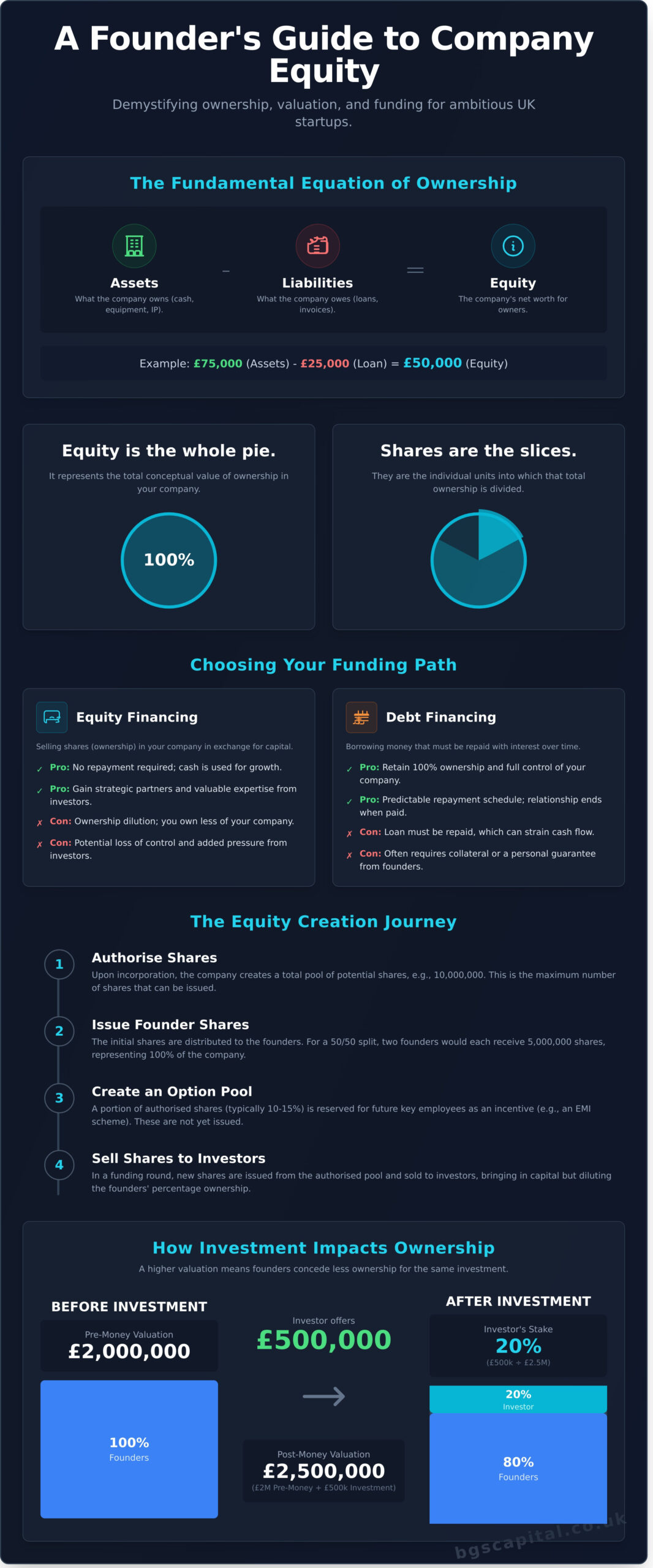
The foundational accounting equation provides a clear framework: Assets – Liabilities = Equity. This simple calculation is a critical measure of a company’s financial position.
- Assets: Everything the company owns that has monetary value. This includes cash in the bank, equipment, inventory, and intellectual property (IP).
- Liabilities: Everything the company owes to external parties. This includes bank loans, supplier invoices (accounts payable), and other debts.
For example, if a UK startup has £75,000 in assets (cash and equipment) and a £25,000 business loan, its equity is £50,000. This figure is crucial for founders to track the company’s net worth and for investors to assess its financial health before committing capital.
Equity vs. Shares vs. Stock: Are They the Same?
While often used interchangeably, these terms have distinct meanings. Equity is the conceptual value of ownership. Shares (or stock) are the units into which that ownership is divided. An effective analogy is to view the company’s total equity as a pizza and the shares as the individual slices. Each slice represents a defined portion of the whole. An individual or entity holding these shares is known as a shareholder or stockholder.
Key Types of Equity in Business
Business equity can be categorised based on its source and structure:
- Owner’s Equity: Primarily relevant for sole traders or partnerships, this is the initial capital invested by the founder(s) plus any retained earnings.
- Shareholder’s Equity: For limited companies, this represents the total value attributable to all shareholders, including founders and external investors.
- Retained Earnings: The portion of net income not distributed to shareholders as dividends but reinvested into the business, thereby increasing the company’s total equity.
How Equity is Created and Valued in a Private Company
In a private limited company, equity does not exist until it is formally created. This process begins at incorporation and evolves with each stage of growth and investment. For founders, understanding this lifecycle is fundamental to managing ownership and securing capital.
From Incorporation to Investment: The Equity Journey
The creation and distribution of equity typically follows a structured sequence. While specifics vary, the core steps for a UK-based startup are consistent:
- Step 1: Authorise Shares. Upon incorporation, the company authorises a set number of shares, for example, 10,000,000. This forms the initial, total pool of potential ownership.
- Step 2: Issue Founder Shares. The initial shares are issued to the founders. If two founders agree to a 50/50 split, they each receive 5,000,000 shares, representing 100% of the issued capital.
- Step 3: Create an Option Pool. To attract key talent, a portion of the authorised shares (e.g., 10-15%) is set aside as an Enterprise Management Incentive (EMI) scheme or option pool. These are not yet issued but are reserved for future employees.
- Step 4: Sell Shares to Investors. During a funding round, the company issues new shares from its authorised pool and sells them to investors in exchange for capital, diluting the founders’ initial ownership percentage.
Understanding Company Valuation and Its Impact on Equity
A company’s valuation is the monetary worth assigned to it by investors. This figure is critical because it determines the price-per-share and, consequently, how much equity founders must give away for a specific amount of capital. Determining a valuation is a critical step in the process of funding your business, as it sets the terms for all future investment.
Valuation is defined in two stages:
- Pre-Money Valuation: The company’s value before an investment is received.
- Post-Money Valuation: The pre-money valuation plus the amount of new investment.
For example, if an investor offers to invest £500,000 at a £2 million pre-money valuation, the post-money valuation becomes £2.5 million. The investor’s £500,000 investment would therefore purchase 20% of the company (£500,000 ÷ £2,500,000). A higher valuation means founders concede less ownership for the same investment amount.
Common vs. Preferred Shares
Not all shares are created equal. In venture financing, investors receive a different class of shares than founders and employees.
Common Shares are held by founders and employees (via the option pool). They represent basic ownership and typically come with voting rights. However, they are last in line for repayment in a liquidation event.
Preferred Shares are issued to investors. They carry preferential rights designed to mitigate investment risk. Key terms include a liquidation preference, which ensures investors get their capital back first in an exit, and anti-dilution provisions, which protect their ownership percentage in the event of a future down-round. Investors demand these terms to protect their capital relative to the higher risk they assume.
Using Equity to Fund Your Business: Pros and Cons
For founders pursuing significant growth, securing capital is a critical step. The primary decision often comes down to two paths: selling equity or taking on debt. This choice extends far beyond the initial cash injection, fundamentally shaping your company’s ownership structure, obligations, and strategic direction.
Equity Financing vs. Debt Financing: A Clear Comparison
The core difference lies in what you exchange for capital. With debt, you borrow money and promise to pay it back with interest. With equity financing, you sell a percentage of your business in exchange for investment, with no requirement for repayment.
| Aspect | Equity Financing | Debt Financing |
|---|---|---|
| Ownership | Founder gives up a percentage of company ownership. | Founder retains 100% ownership. |
| Repayments | No repayments required; investors profit from an exit. | Fixed, regular repayments of principal and interest. |
| Control | Shared control; investors may gain board seats or veto rights. | Full control maintained, provided loan covenants are met. |
| Risk | Shared risk; if the business fails, investors lose their capital. | Founder bears all risk; debt must be repaid even if the business fails. |
Hybrid instruments like convertible notes also exist, starting as debt and converting into equity at a future funding round, offering a blend of features from both categories.
The Advantages of Raising Capital with Equity
Opting for equity is the standard route for high-growth startups and scale-ups for several strategic reasons:
- Access to Significant Capital: Equity investors, such as venture capital and private equity firms, can provide substantial funding (£1M+) required for rapid scaling, far exceeding typical business loan amounts.
- Preserved Cash Flow: With no monthly loan repayments, capital can be fully reinvested into product development, marketing, and hiring, accelerating growth.
- Strategic Expertise: Sophisticated investors bring more than money; they provide invaluable industry connections, strategic guidance, and mentorship to help navigate growth challenges.
- Talent Acquisition: Offering equity through an Enterprise Management Incentive (EMI) scheme or other employee stock options (ESOPs) is a powerful tool to attract and retain top-tier talent.
The Risks: Understanding Dilution and Loss of Control
The primary trade-off for equity is dilution. Dilution occurs when your ownership percentage decreases because the company issues new shares to investors. For example, if you own 100% of a company with 1,000,000 shares and issue an additional 250,000 shares to an investor, your ownership stake is diluted from 100% to 80%. This process is a fundamental mechanic of the private equity landscape. While your percentage is smaller, the goal is that the company’s increased value makes your remaining stake worth significantly more.
Beyond dilution, giving up equity often means relinquishing some control. Investors may require board seats, voting rights on major decisions, and regular, detailed reporting. This introduces a new layer of accountability and pressure to perform, shifting the dynamic from being your own boss to managing key stakeholder expectations.
Need to raise capital? See how we connect you with investors.
Navigating the Stages of Equity Investment
As a company evolves from a concept to a market leader, its funding requirements and the nature of its investors change significantly. The use of equity as a tool for financing follows a distinct lifecycle, with different stakeholders entering at each phase. Understanding this progression is essential for founders planning their long-term capital strategy.
Early-Stage Funding: Angel Investors and Seed Rounds
This is the earliest stage of external funding, where capital is used to validate an idea and build a minimum viable product. Angel investors-high-net-worth individuals investing their own capital-are the primary players. Seed funding is the first formal injection of cash in exchange for shares, often facilitated in the UK by tax-efficient government schemes like the Seed Enterprise Investment Scheme (SEIS) and the Enterprise Investment Scheme (EIS), which incentivise investment in high-risk ventures.
Growth Stage: Venture Capital (VC) Explained
Once a company has product-market fit and initial revenue, it enters the growth stage, typically funded by Venture Capital (VC) firms. VCs are professional organisations that invest institutional money from pension funds, endowments, and other large entities. They invest through structured funding rounds:
- Series A: For optimising the business model and user base.
- Series B: For scaling the business and expanding market reach.
- Series C and beyond: For international expansion, acquisitions, or preparing for an IPO.
VCs take a more active role than angel investors, often requiring a board seat to provide strategic oversight.
Mature Companies: Private Equity and Pre-IPO Funding
In the final stage of private ownership, companies are typically profitable and established. Funding at this level comes from Private Equity (PE) firms, which invest in mature businesses to restructure or optimise them for greater profitability before an exit. A key opportunity within this stage is Pre-IPO funding, which provides capital shortly before a company lists on a public stock exchange. This is the core area of focus for the BGS Capital network, connecting qualified investors with late-stage private market opportunities.
Looking for Pre-IPO opportunities? Check your eligibility.
Harnessing Equity: From Concept to Capital
Understanding company ownership is fundamental to a founder’s success. As this guide has detailed, equity is not merely a buzzword but the primary mechanism for aligning interests, rewarding key personnel, and fuelling expansion. A clear grasp of valuation principles and the strategic implications of dilution through various funding stages is non-negotiable. This knowledge empowers you to make informed decisions that protect your vision while attracting the right partners for your journey.
When you are prepared to leverage your equity for a significant capital raise, securing the right audience is paramount. BGS Capital specialises in making these critical introductions. We provide a direct conduit for qualified companies to present their pre-IPO and growth-stage opportunities to our exclusive UK network. This includes accredited investment firms, high-net-worth individuals, and sophisticated investors actively seeking their next venture. Position your business in front of decision-makers ready to invest.
Feature Your Business to Connect with Qualified Investors
Take the definitive step towards securing your company’s future.
Frequently Asked Questions
What is the difference between equity and equality?
Equality means distributing ownership identically, regardless of contribution. For example, four founders each taking 25% is a statement of equality. Equity, however, refers to fair distribution based on value provided. This could involve varying ownership percentages that reflect different levels of capital investment, intellectual property contribution, or time commitment. In business, the focus is on achieving an equitable structure, not necessarily an equal one, to properly incentivise all parties involved.
How do I calculate the equity in my business?
The book value of equity is calculated with a simple formula: Total Assets – Total Liabilities. This figure represents the net worth of the company on its balance sheet. For a founder or shareholder, personal equity value is determined by the market. It is calculated as the number of shares owned divided by the total number of outstanding shares, multiplied by the company’s current valuation. This percentage represents your ownership stake in the business.
What is ‘sweat equity’ and how is it valued?
Sweat equity is the non-monetary investment made by individuals in a business, typically through labour, expertise, and time. It is a common way for founders to build value before securing external capital. Valuing it is complex and subject to negotiation. A common method is to assign an objective market-rate salary to the work performed and convert that foregone cash compensation into an equivalent ownership stake based on the company’s early-stage valuation.
Does giving up equity mean I will lose control of my company?
Not necessarily, but it is a significant risk. Control is typically lost when a founder’s ownership stake is diluted below 50%. However, control can be maintained through legal structures such as a shareholders’ agreement, which can define voting rights. It is also possible to issue different classes of shares, granting founders superior voting rights irrespective of their economic ownership percentage. Professional legal advice is critical when structuring such agreements.
What is a typical equity stake for an early-stage investor in the UK?
In the UK market, an early-stage investor in a pre-seed or seed funding round typically seeks an equity stake between 10% and 25%. The exact percentage is contingent on several factors, including the pre-money valuation of the business, the amount of capital being invested, the perceived risk, and the strategic value the investor brings. For larger Series A rounds, this percentage may be similar, but the corresponding capital investment and valuation will be substantially higher.
Can a founder buy back equity from investors at a later date?
Yes, it is possible for a founder to buy back equity, but this process is complex and not guaranteed. The right to do so, and the terms of the buy-back, must be explicitly defined within the shareholders’ agreement. A buy-back would typically be executed at a new, higher valuation, requiring the founder to have significant personal capital or for the company to finance the purchase. Such transactions almost always require formal board and investor approval.
What is an equity release in the context of business?
In a business context, an equity release is distinct from the residential property product. It refers to a liquidity event where founders or early shareholders sell a portion of their private shareholding. This often occurs during a later-stage funding round, where a new investor buys shares directly from existing shareholders in a ‘secondary sale’. This allows stakeholders to realise a cash return on their equity without a full company exit, such as an acquisition or IPO.