
For many founders, the world of venture capital appears as an opaque system, governed by unfamiliar rules and complex jargon. The process of securing capital in the UK can be intimidating, leaving entrepreneurs uncertain of how investment decisions are truly made or who to approach within a firm. To navigate this landscape effectively, it is essential to understand the fundamental mechanics of the entity you are pitching to: the vc investment fund. This guide is designed to demystify this structure, providing a clear framework for founders seeking to raise capital.
We will dissect the complete business model of a venture capital firm, from its lifecycle and key roles to the economic drivers like ‘carried interest’ that shape its investment thesis. By understanding the pressures, motivations, and operational structure of a fund, you will be equipped to identify the right partners, refine your pitch, and approach the fundraising process with the strategic confidence required to secure investment for your business.
Key Takeaways
- A vc investment fund is a partnership between investors (LPs) and managers (GPs) driven by the sole objective of generating significant financial returns.
- The typical 10-year fund lifecycle creates immense pressure on VCs, directly influencing their investment pace, follow-on decisions, and exit strategy.
- The fund’s economic model, particularly the need for a few portfolio companies to deliver fund-returning exits, dictates every decision a partner makes.
- Successfully navigate the fundraising process by understanding the different roles within a firm and tailoring your communication to the right decision-maker.
The Anatomy of a VC Investment Fund: Key Players and Structure
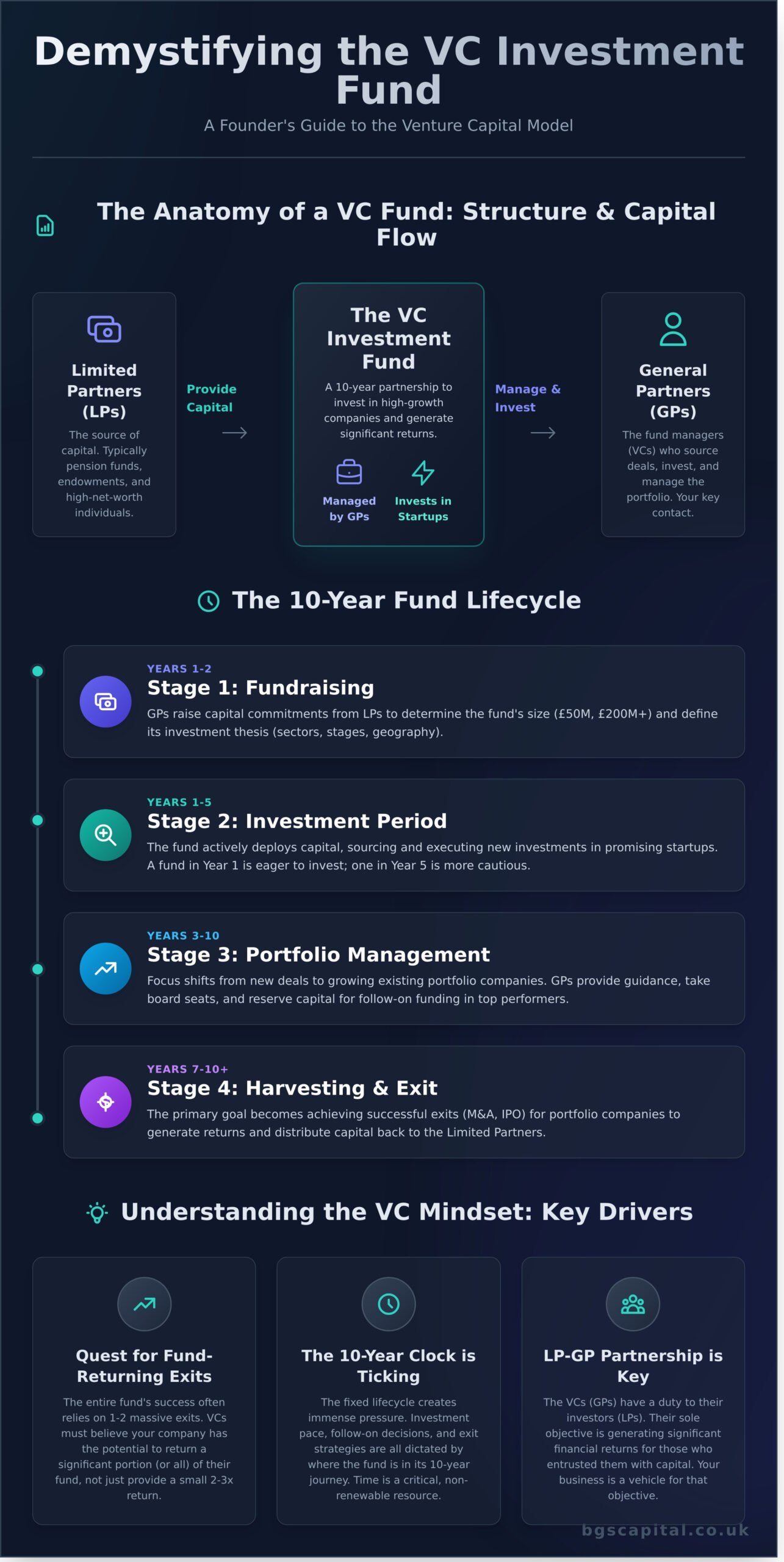
A venture capital (VC) investment fund is a professionally managed pool of capital raised from multiple investors. Its sole purpose is to make equity investments in a portfolio of high-growth, private companies, typically early-stage startups. The primary objective is to generate significant returns for its investors over the fund’s lifecycle, which usually spans 7-10 years.
This model differs fundamentally from other financing sources. Unlike a bank loan, which is debt that must be repaid with interest, venture capital is an equity investment; the fund buys a stake in the business. Unlike individual angel investors, a vc investment fund operates on an institutional scale with a formalised structure and a dedicated management team. For a detailed primer on the subject, this Venture Capital Overview provides extensive background. The most common legal framework for these funds in the United Kingdom and globally is the Limited Partnership (LP).
Limited Partners (LPs): The Source of Capital
Limited Partners are the institutional and individual investors who provide the capital for the fund. These typically include pension funds, university endowments, insurance companies, and qualified high-net-worth individuals. Their role is entirely passive; they commit a specified amount of capital but have no involvement in the fund’s daily operations or investment decisions. LPs invest in venture capital as an asset class with the expectation of achieving high returns to justify the significant risk and illiquidity. Founders will rarely, if ever, interact directly with a fund’s LPs.
General Partners (GPs): The Fund Managers
General Partners are the venture capitalists-the active managers of the fund. They are responsible for the entire investment process, from sourcing and vetting potential deals to executing investments and managing the portfolio. Their duties include:
- Sourcing and evaluating investment opportunities (deal flow).
- Conducting extensive due diligence on target companies.
- Negotiating investment terms and valuation.
- Providing strategic guidance to portfolio companies, often by taking a board seat.
For founders seeking capital, the GPs are the key contacts. They are the individuals who hear the pitches, make the investment decisions, and work with the company post-investment to drive growth and achieve a successful exit.
The VC Fund Lifecycle: A 10-Year Journey from Fundraising to Exit
A venture capital fund is not a perpetual entity. It operates on a fixed, finite timeline, typically a 10-year cycle, often with the option for one or two-year extensions. This structure is fundamental to its operation, creating a clear timeline that dictates strategy, urgency, and the relationship between General Partners (GPs), Limited Partners (LPs), and portfolio companies. For founders seeking capital, understanding where a fund is in its lifecycle is as critical as understanding its investment thesis.
The lifecycle is typically broken down into four distinct stages.
Stage 1: Fundraising (Years 1-2)
The lifecycle of a vc investment fund begins with fundraising. During this initial period, the fund’s GPs raise capital commitments from LPs, which in the UK often include institutional investors like pension funds, endowments, and family offices. This phase is crucial as it determines the fund’s total size-for example, £50 million or £200 million-and solidifies its investment thesis, defining the sectors, stages, and geographies it will target. Entrepreneurs should always inquire which specific fund a VC is investing from.
Stage 2: Investment Period (Years 1-5)
Once capital is secured, the fund enters its active investment period. For approximately the first five years, GPs focus on deploying the capital by sourcing and executing deals with promising startups. This is the busiest phase for making new investments. A fund’s position within this period significantly influences its behaviour; a fund in year 1 is eager to build its portfolio, while a fund in year 5 may be more cautious, reserving capital for follow-on rounds and making fewer new investments.
Stage 3: Portfolio Management & Growth (Years 3-10)
As the investment period concludes, the focus shifts from sourcing new deals to actively managing and growing the existing portfolio. GPs often take board seats and provide strategic guidance, operational support, and access to their networks to help companies scale. This hands-on approach is a key part of How Venture Capital Works. During this stage, a significant portion of the remaining capital is reserved for follow-on funding, allowing the fund to increase its stake in the most successful portfolio companies.
Stage 4: Harvesting & Exits (Years 7-10+)
The final stage is dedicated to “harvesting” returns. The primary objective is to achieve liquidity for the fund’s investments and return capital, plus profits, to its LPs. This is accomplished through exit events, most commonly via a strategic acquisition by a larger corporation or an Initial Public Offering (IPO) on an exchange like the London Stock Exchange. As the 10-year deadline approaches, pressure mounts on GPs to secure successful exits, concluding the fund’s active cycle.
The Economics of a VC Fund: Understanding Their Motivations
Venture capital is a high-risk, high-reward asset class. Every decision a General Partner (GP) makes-from the companies they meet to the terms they offer-is dictated by the underlying economics of their fund. This model explains their relentless search for massive outcomes and their highly selective nature. For founders, understanding these motivations is critical to framing a pitch that aligns with a VC’s requirements for success.
The ‘2 and 20’ Fee Structure Explained
The standard compensation model for a vc investment fund is known as “2 and 20.” This consists of a 2% annual management fee, calculated on the total fund size, to cover operational costs like salaries, due diligence, and office expenses. The more significant component is the 20% carried interest, or “carry”-a share of the fund’s profits. Crucially, this is only paid out after the fund has returned all initial capital to its Limited Partners (LPs), often after clearing a minimum annual return known as a “hurdle rate.” This structure directly aligns the GP’s interests with generating substantial returns for their investors.
The Power Law: Why VCs Need 10x ‘Fund Returners’
Venture capital returns do not follow a normal distribution; they follow a power law. This means that the vast majority of investments in a portfolio will yield low or zero returns. A small handful of exceptional successes-the “fund returners”-must generate enough profit to cover all the losses and deliver the target return for the entire fund. For a £100 million fund, one investment that returns £200-£300 million is more valuable than ten investments that each return £10 million. This is why VCs seek out ventures targeting billion-pound markets with the potential for exponential, not linear, growth. Your pitch must articulate this monumental potential.
Portfolio Strategy and Capital Allocation
GPs construct a portfolio to manage risk and maximise returns. This involves diversifying across different stages, sectors, and sometimes geographies. Critically, VCs reserve a significant portion of their capital-often more than 50%-for follow-on investments in their most promising companies. This “dry powder” allows them to double down on their winners in subsequent funding rounds. This strategy directly impacts their initial investment size and their target ownership stake, as they need to secure a meaningful position and pro-rata rights to participate in future growth.
The combination of the fee structure, the power law dynamic, and capital allocation strategy forces VCs to be disciplined and focused exclusively on opportunities with outlier potential. If your business is positioned to deliver that level of scale, you can connect with investors looking for your industry’s next leader.
Inside the Firm: Who You’ll Meet and Why They Matter
Engaging with a vc investment fund is not a uniform process. These firms are hierarchical, with distinct roles and varying levels of authority. Understanding this internal structure is a strategic advantage for any founder seeking capital. It allows you to manage expectations, tailor your communication effectively, and navigate the path from initial contact to a signed term sheet. A proposal’s journey through the firm follows a clear, structured path, and knowing who you are speaking to at each stage is critical for success.
Analysts and Associates: The Front Line
These are typically the most junior investment professionals and your first point of contact. Their primary functions are sourcing new opportunities and conducting initial screening against the fund’s investment thesis. While they do not make final decisions, they are crucial gatekeepers. Their internal summary and recommendation determine if your company proceeds to the next stage. Treat them with the same professional respect you would a partner; they can become your most important internal champion.
Principals and Vice Presidents: The Deal Leaders
Once your opportunity passes the initial screen, it will likely be assigned to a Principal or VP. These mid-level professionals are the project managers of the investment process. They lead the deep-dive due diligence, build the financial models, and construct the comprehensive investment memorandum to be presented to the partners. They hold significant influence and will be your main liaison, but they typically require final approval from the investment committee to proceed with an offer.
General Partners: The Decision-Makers
General Partners (GPs) are the most senior members of the firm and hold the ultimate authority on all investment decisions. They sit on the investment committee, have a fiduciary duty to the fund’s Limited Partners (LPs), and are the individuals who sign the cheques. Your primary objective throughout the fundraising process is to secure a meeting with a GP and convince them of your vision and the scale of the opportunity. If an investment is made, a GP will often take a seat on your company’s board of directors.
Navigating these internal dynamics requires a clear strategy and an understanding of the UK’s venture capital landscape. For qualified companies seeking to connect with the right investors, BGS Capital provides an essential network.
How VC Funds Evaluate Opportunities: The Investment Process
Venture capital is a game of precision and patience. A typical VC firm may review thousands of business plans annually to make fewer than a dozen investments. This high level of selectivity necessitates a rigorous, multi-stage evaluation process designed to efficiently filter opportunities and identify potential outliers with high-growth potential. For founders and investors alike, understanding this process is critical for navigating the fundraising landscape.
The journey from an initial introduction to a closed funding round can take several months, involving multiple stakeholders and extensive analysis. Each stage serves as a critical checkpoint for the vc investment fund to de-risk the opportunity and build conviction.
Deal Sourcing and Initial Screening
VCs rarely invest in companies that approach them without a prior connection. The majority of viable opportunities are sourced through trusted channels:
- Warm Introductions: Referrals from portfolio company founders, other investors, or respected figures within their professional network.
- Thesis-Driven Research: Proactive outreach to companies operating in sectors that align with the fund’s investment thesis.
During the initial screen, an analyst or associate quickly assesses if the company fits the fund’s core criteria-such as industry, business model, and stage of development. A compelling, concise executive summary is paramount to passing this first gate.
Due Diligence and Partner Meetings
Once a company passes the initial screen, it enters the due diligence phase. This is an intensive deep dive where the VC firm validates every assumption in the business plan. The process involves multiple meetings with different partners and specialists at the firm, focusing on key areas like the management team’s expertise, market size and validation, product-market fit, financial models, and the competitive landscape. This stage is designed to stress-test the opportunity from every angle.
Term Sheet and Closing the Deal
If the due diligence process confirms the investment thesis, the fund will present a term sheet. This non-binding document outlines the proposed terms of the investment. Key components typically include:
- Valuation: The agreed-upon worth of the company pre-investment.
- Investment Amount: The capital the fund will provide.
- Liquidation Preference: Determines the payout order in an exit event.
- Board Seats: The level of control and governance the fund will have.
Following agreement on the term sheet, the final stage involves extensive legal work, final documentation, and regulatory checks (KYC/AML). Once all legal agreements are executed, the funds are wired to the company’s account, officially closing the deal.
From Understanding to Action: Securing Your Funding
Navigating the world of venture capital requires more than a compelling business idea; it demands a thorough understanding of the system itself. As this guide has detailed, a vc investment fund operates on a long-term lifecycle, driven by the need to generate significant returns for its Limited Partners. By comprehending the fund’s structure, the motivations of its partners, and the meticulous due diligence process, you move from simply pitching for capital to strategically aligning your vision with their investment thesis. This strategic alignment is the cornerstone of a successful funding round.
Your next step is to translate this knowledge into access. Gaining an audience with the right decision-makers is a critical challenge for any founder. BGS Capital serves as an introducer, connecting qualified companies with our exclusive network of high-net-worth individuals and institutional investors. We facilitate direct introductions to investor relations teams and provide access to pre-IPO and IPO opportunities that can accelerate your company’s growth. If your business is ready for this level of investment, it is time to act.
Ready to find the right investors? Feature your business on BGS Capital.
Frequently Asked Questions
What is the difference between a VC fund and a corporate venture capital (CVC) fund?
A VC fund sources capital from multiple Limited Partners (LPs), such as institutional investors and high-net-worth individuals, with its primary objective being financial return on investment. In contrast, a Corporate Venture Capital (CVC) fund is the investment arm of a single large corporation. While CVCs also seek financial returns, their investments are often driven by strategic goals, such as gaining insight into new technologies or potential acquisition targets that align with the parent company’s core business.
How do VC funds decide on a company’s valuation?
Valuation is determined through a combination of methodologies, not a single formula. For later-stage companies with revenue, VCs may use discounted cash flow (DCF) analysis or compare them to similar public companies. For early-stage ventures, valuation is more qualitative, focusing on the strength of the founding team, total addressable market (TAM), product-market fit, and intellectual property. The final figure is ultimately a negotiated outcome based on these factors and prevailing market conditions.
What is a typical VC fund size and how does it affect their investment strategy?
A typical UK vc investment fund can range from under £50 million for seed-stage investors to over £500 million for growth equity firms. Fund size directly dictates investment strategy. A smaller fund may write cheques of £250k to £2 million into pre-seed and seed-stage companies, requiring a larger portfolio to mitigate risk. Conversely, a large fund must deploy significant capital, leading it to focus on later-stage companies with cheques often exceeding £10 million per round.
Do all VC funds require a board seat after investing?
Not all VC funds require a board seat, but it is standard practice for the lead investor in a significant funding round. Taking a board seat allows the fund to actively guide strategy, provide governance, and protect its capital. Smaller funds participating in a round or those making a non-lead investment may instead request ‘board observer rights’. This grants them access to board meetings and information without formal voting power, providing oversight without the full directorial responsibilities.
How long does the due diligence process typically take for a VC investment?
The due diligence process for a VC investment typically takes between four to twelve weeks after a term sheet has been signed. The duration depends on the startup’s stage and the complexity of its operations. The process involves a thorough examination of the company’s financials, legal structure, technology, intellectual property, management team, and market position. A well-prepared company with organised documentation can significantly expedite this timeline, whereas disorganisation or uncovered issues can cause considerable delays.
What is a ‘capital call’ for a VC fund?
A capital call is a formal request made by the General Partner (GP) of a vc investment fund to its Limited Partners (LPs) to transfer a portion of their committed capital. LPs do not provide their entire commitment upfront; instead, the capital is “called” on an as-needed basis to fund new investments or pay for fund expenses. This process allows the fund to manage cash flow efficiently and improves performance metrics like the internal rate of return (IRR).