
Navigating the UK venture capital landscape in 2026 presents significant challenges. Founders face compressed valuations and a pronounced Series A bottleneck, while investors struggle to access exclusive pre-IPO opportunities amidst heightened due diligence standards. In this demanding environment, identifying the most active and high-conviction venture capital firms uk has to offer is not just an advantage-it is a necessity for survival and growth.
This definitive 2026 guide provides the critical intelligence required to overcome these obstacles. We detail the top-tier funds currently deploying capital, analyse the criteria for securing high-conviction investment, and illuminate the pathway to exclusive pre-IPO rounds. For founders seeking to clear the Series A hurdle and sophisticated investors requiring a credible introducer to sophisticated capital, this analysis delivers the strategic insights needed to succeed in a demanding market.
Key Takeaways
- The 2026 UK VC landscape prioritises ‘high conviction’ over ‘growth at all costs,’ requiring businesses to demonstrate clear profitability pathways and robust fundamentals.
- Identify the most relevant investors by understanding the specific 2026 investment theses of leading venture capital firms UK, from London’s established funds to rising regional hubs.
- Master the essential components of a 2026-compliant pitch deck and data room to successfully pass the heightened due diligence of sophisticated capital networks.
- Explore the mechanics of pre-IPO and secondary placings, a critical funding route for later-stage companies navigating the modern private markets.
The 2026 Venture Capital Landscape in the United Kingdom
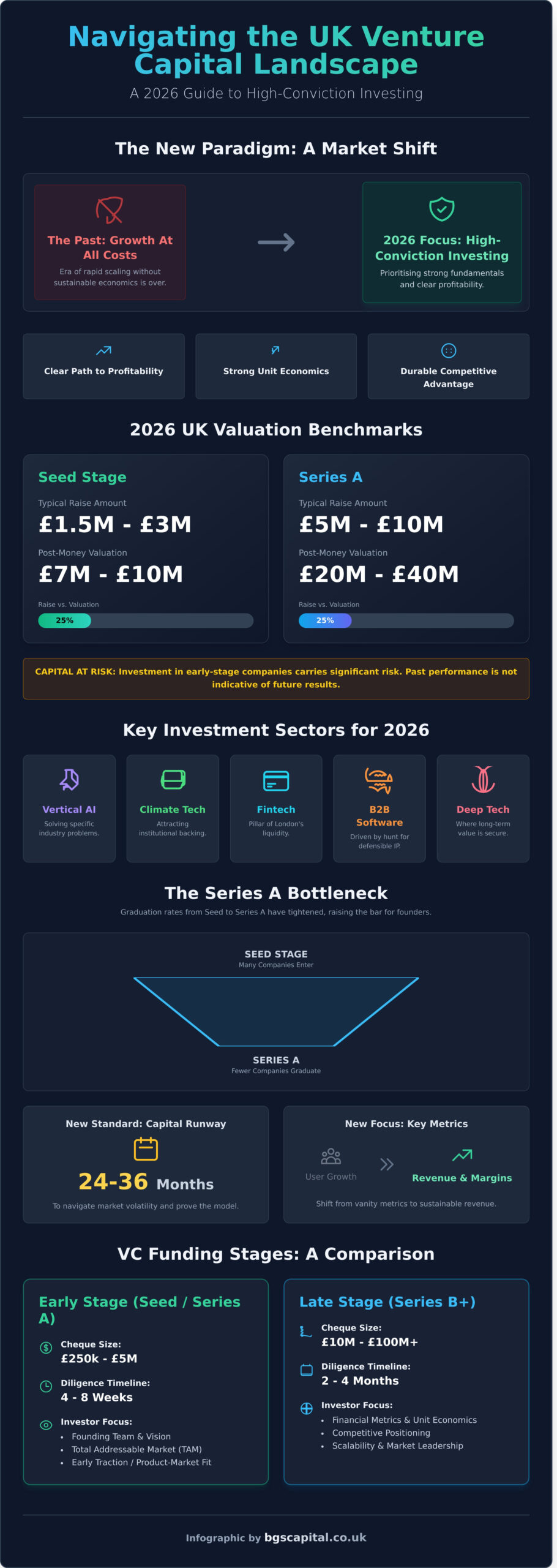
The UK’s venture capital ecosystem in 2026 is defined by resilient but highly disciplined capital deployment. Following a significant market correction, the era of “growth at all costs” has definitively ended. Today, the leading venture capital firms uk are executing a strategy of high-conviction investing, prioritising companies with strong unit economics, clear paths to profitability, and durable competitive advantages. This shift demands a more sophisticated approach from founders seeking funding. For those new to the asset class, understanding What is Venture Capital? is the foundational first step in navigating this landscape.
Valuation benchmarks reflect this new reality. Median Seed valuations are settling in the £1.5M-£3M range on post-money valuations of £7M-£10M. For Series A, companies with proven product-market fit can expect to raise £5M-£10M at valuations between £20M and £40M. These figures are contingent on robust performance metrics. It is critical for all market participants to remember the fundamental principle of this asset class: CAPITAL AT RISK. Past performance is not indicative of future results, and investment in early-stage companies carries significant risk.
Key Sectors Dominating 2026 Funding
Investor capital is concentrating in sectors with deep moats and significant market potential. There is a clear preference for Vertical AI-platforms solving specific industry problems-over generic AI wrappers. Climate Tech and Fintech remain pillars of London’s liquidity, attracting substantial institutional backing. Concurrently, the hunt for defensible intellectual property continues to drive investment into B2B Software and Deep Tech, where long-term value is most secure.
The Series A Bottleneck and Runway Requirements
The graduation rate from Seed to Series A has tightened, creating a significant bottleneck for early-stage companies. In response, investors now mandate a 24-36 month runway as the new standard, ensuring businesses are well-capitalised to navigate market volatility. The emphasis from venture capital firms in the UK has shifted decisively from user growth metrics to demonstrable revenue traction and strong gross margins, which serve as the primary indicators of a viable business model.
Top-Tier Venture Capital Firms UK: Segmenting by Stage
The UK venture capital landscape is not monolithic. Capital allocation is highly segmented by a company’s stage of development, from pre-seed ideation to pre-IPO scaling. Understanding this segmentation is critical for founders seeking appropriate funding and for investors targeting specific risk-return profiles. The most prominent venture capital firms UK-based investors, particularly London’s “Big Four” (such as Index Ventures, Balderton Capital, Accel, and Atomico), are sharpening their 2026 focus on defensible technologies like AI infrastructure, climate tech, and quantum computing, demanding clear paths to market leadership.
Beyond London, regional hubs in Manchester, Edinburgh, and Cambridge are fostering their own VC ecosystems, often with a focus on deep tech and life sciences spun out from local universities. The operational differences between stages are stark, impacting everything from cheque size to diligence timelines.
- Early-Stage (Seed/Series A): Cheque sizes typically range from £250,000 to £5 million. Due diligence is rapid, often 4-8 weeks, focusing on the founding team, market size (TAM), and product vision.
- Late-Stage (Series B+): Cheques start at £10 million and can exceed £100 million. Diligence is exhaustive, lasting 2-4 months, with intense scrutiny on financial metrics, unit economics, and competitive positioning.
Early-Stage and Seed Leaders
Firms like Seedcamp and LocalGlobe are pivotal in the seed landscape, acting as kingmakers for the next generation of UK tech. Their 2026 strategy involves backing founders at the earliest stages, often pre-product, with a high conviction in their ability to execute. A key lever for UK-based founders is the availability of tax-efficient investment schemes. The Enterprise Investment Scheme (EIS) and Seed Enterprise Investment Scheme (SEIS) significantly de-risk early-stage investment for angels and funds. Founders should secure advance assurance from HMRC, a process detailed by the UK Government Venture Capital Schemes, to attract this capital. A “high conviction” seed cheque is typically secured by demonstrating exceptional founder-market fit, a uniquely defensible insight, and evidence of early traction.
Growth Stage and Late-Stage Powerhouses
For companies with proven product-market fit, growth-stage venture capital firms uk investors like Index Ventures and Balderton Capital provide the capital required for aggressive scaling. These firms lead Series B rounds and beyond, focusing on companies poised for international expansion and market dominance. Octopus Ventures serves as a prime example of a sector-specialist growth investor, building deep expertise in verticals like FinTech, HealthTech, and Deep Tech. In the current economic climate, these late-stage firms are managing valuation compression by placing a premium on capital efficiency and a clear, credible path to profitability over growth-at-all-costs.
Beyond Traditional VC: Pre-IPO and Secondary Placings
The investment landscape is evolving. While many high-growth opportunities are sourced through traditional venture capital firms uk, a significant and growing market exists for late-stage private companies. In 2026, firms are staying private for longer to achieve greater scale before entering public markets. This trend has created a distinct pre-IPO investment stage, offering a different risk-reward profile compared to early-stage ventures. This section explores the mechanics of this market and how sophisticated investors can gain exposure.
Why Pre-IPO Investments are Trending in 2026
The primary driver is the extended private lifecycle of successful companies. With robust frameworks for growth, including official guidance from sources like the UK Government Business Support portal, many UK companies now reach significant valuations before a public listing. This creates opportunities for High Net Worth Individuals (HNWIs) and sophisticated investors to participate in what is potentially the final private funding round, often at a “discount to IPO” valuation.
- Liquidity Events: Secondary markets facilitate these transactions. They allow early employees, founders, and angel investors to sell a portion of their equity, creating liquidity without a full company exit. This process opens doors for new investors to acquire shares in established, high-growth private entities.
- Risk Profile: While all private investments carry substantial risk, pre-IPO opportunities typically involve more mature, revenue-generating businesses. This presents a different risk profile compared to the high-failure-rate environment of early-stage venture capital.
The Introducer Model vs. Direct Brokerage
Accessing this exclusive deal flow often requires navigating a network of accredited investment firms and specialist platforms. This is where the role of an introducer becomes critical. Unlike a direct brokerage that executes trades, an introducer connects qualified parties. BGS Capital operates as a network and introducer, connecting sophisticated investors directly with pre-IPO opportunities. This model’s primary benefit is fostering a direct line of communication with the company’s own Investor Relations teams, ensuring maximum transparency. It is crucial to understand that we do not facilitate raises ourselves. This distinction is a vital regulatory safeguard, clearly defining our role as a connector, not a broker. The final investment decision and transaction process remain strictly between the investor and the company.
How to Successfully Feature Your Business to UK Investors
Securing capital from sophisticated investor networks requires a process fundamentally different from a standard pitch to venture capital firms uk. Success depends on a structured, compliant, and professional approach designed to meet the stringent requirements of wealth managers and their clients. For companies seeking growth capital outside the traditional VC route, this pathway demands meticulous preparation, from auditing eligibility to managing professional introductions.
Am I Eligible? The Qualification Gate
Under UK Financial Conduct Authority (FCA) regulations, direct promotion of unlisted securities is restricted to certified High Net Worth Individuals and Sophisticated Investors. Your company must also qualify, demonstrating a robust business model, clear governance, and a professional management team. This regulatory gate exists to ensure only credible, well-managed opportunities are presented. Communication must be direct, transparent, and free of hyperbole.
Optimizing for Investor Introductions
Wealth managers seek specific characteristics in a featured business. A clear narrative, particularly for IPO-bound companies, is critical. They prioritise businesses with strong management, a scalable model, and a defined exit strategy. Crucially, leveraging tax-efficient structures like the Seed Enterprise Investment Scheme (SEIS) and Enterprise Investment Scheme (EIS) is a primary method for attracting UK private wealth. SIPP and ISA eligibility further broadens the appeal to qualified investors.
To prepare for these introductions, a 2026-compliant data room and pitch deck are non-negotiable. This means all financial projections, legal documents, and market analysis must be current, comprehensive, and readily accessible for due diligence. Your documentation must anticipate and answer the questions a professional investor will ask.
Finally, finding the right platform to gain exposure is paramount. The goal is not mass marketing but targeted access, a key differentiator from the broader outreach required for many venture capital firms uk. Specialist networks connect qualified companies directly with a pre-vetted audience of wealth managers. Once an introduction is made, the process must be managed with professionalism, respecting the role of the introducer and the time of the potential investor. This structured engagement is key to converting interest into capital.
To learn more about featuring a qualified business to a network of accredited UK investors, explore the services at bgscapital.co.uk.
Connecting with Sophisticated Investors via BGS Capital
While traditional venture capital firms are a primary route for funding, the UK’s investment landscape offers alternative, highly effective channels for connecting capital with opportunity. BGS Capital operates as a specialist introducer, fulfilling a critical mission: to connect qualified, high-growth companies directly with a curated network of sophisticated investors, wealth managers, and accredited investment firms.
Our platform is designed to be functional and transactional, facilitating deal flow by streamlining the discovery process for both sides of the investment equation.
For Companies: RAISING CAPITAL?
For businesses seeking to raise capital, featuring your opportunity on the BGS Capital platform provides direct and efficient exposure. The process involves submitting your company details for review, and upon qualification, your pre-IPO or secondary placing proposition is listed in our exclusive database. This listing grants you visibility to a pre-vetted audience actively seeking new ventures, creating a direct conduit to potential funding partners and bypassing many of the initial hurdles in the capital-raising journey.
For Investors: ACCESS EXCLUSIVE OPPORTUNITIES
Accredited investors can gain complimentary access to our database of pre-IPO and IPO opportunities. The platform allows for browsing and filtering of potential investments, with BGS Capital facilitating direct introductions to company Investor Relations teams upon request. To maintain compliance and ensure the integrity of the network, all potential investors must first complete our “Am I Eligible?” verification. This process confirms your status as a sophisticated investor or high-net-worth individual, unlocking access to these exclusive deals.
As the market evolves towards 2026, navigating the UK’s dynamic funding environment requires strategic partnerships. Aligning with a network like BGS Capital can provide a significant advantage, complementing the role of established venture capital firms uk by offering a targeted and efficient channel for deal flow. By connecting the right companies with the right capital, we help build the foundations for future growth.
To explore opportunities or feature your business, visit bgscapital.co.uk.
Position Your Business for UK Investor Success
The 2026 landscape for UK venture capital is set to be competitive, demanding a precise and professional approach from founders. As we’ve detailed, success hinges not just on a compelling business plan but on strategically identifying the correct investor stage for your enterprise, from early-stage to pre-IPO. Understanding how to navigate the ecosystem of venture capital firms uk is paramount. A meticulously prepared pitch is foundational, but the most critical step is often securing a direct introduction to a qualified audience of sophisticated investors who are actively seeking opportunities.
BGS Capital specialises in facilitating these critical connections. We operate as an introducer, providing qualified companies with direct access to our exclusive network of accredited investment firms and wealth managers. As specialists in pre-IPO and IPO investment introductions, we connect high-growth businesses with the capital required for their next significant milestone. If your business is ready to be evaluated by serious investors, we provide the platform to feature your proposition.
RAISING CAPITAL? FEATURE YOUR BUSINESS
The right introduction is the catalyst for growth. Position your company for success and take the definitive step toward securing your funding objectives.
Frequently Asked Questions About UK Venture Capital
What are the most active venture capital firms in the UK for 2026?
Predicting the most active firms for 2026 requires analysing current deal flow and fundraising cycles. Historically, established players like Index Ventures, Balderton Capital, and Octopus Ventures consistently lead in deal volume. We also anticipate continued high activity from sector-specific funds focusing on deep tech, fintech, and life sciences. The landscape for venture capital firms uk remains dynamic, with new specialist funds emerging to target niche, high-growth opportunities across the nation.
How much capital do UK VC firms typically invest in a Series A round?
In the UK market, a typical Series A funding round ranges from £3 million to £10 million. The exact amount is contingent on several factors, including the company’s sector, traction, valuation, and the capital required to achieve specific growth milestones before a Series B raise. Firms specialising in capital-intensive industries like deep tech or biotech may invest at the higher end of this spectrum, while software-as-a-service (SaaS) companies may fall in the middle.
Is venture capital investment in the UK currently at risk?
All venture capital investment carries inherent risk. The UK market is subject to macroeconomic pressures, including interest rate fluctuations and geopolitical instability, which can impact valuations and exit opportunities. However, the UK remains a global hub for innovation, particularly in fintech, AI, and life sciences. While caution is warranted and diligence is critical, foundational strengths in talent and research continue to attract significant institutional capital to the sector.
What is the difference between a VC firm and an investment introducer?
A venture capital firm directly manages and deploys capital, investing its funds into portfolio companies in exchange for equity. They take an active role, often sitting on the board and providing strategic guidance. In contrast, an investment introducer acts as a facilitator. An introducer connects qualified investors with investment opportunities but does not provide financial advice, handle funds, or participate in the transaction itself. Their function is to make qualified introductions only.
How do I qualify as a sophisticated investor in the UK?
To be classified as a sophisticated investor under FCA regulations, an individual must meet specific criteria. This typically involves having a certificate from an authorised firm confirming your understanding of the risks, having worked in the private equity sector, or having been a director of a company with an annual turnover of at least £1 million within the last two years. Alternatively, being certified as a high-net-worth individual is another common route for eligibility.
Can I invest in UK startups using a SIPP or ISA?
Yes, it is possible, but subject to strict rules. A Self-Invested Personal Pension (SIPP) generally offers more flexibility for holding shares in unlisted private companies. An Individual Savings Account (ISA) has more restrictions; direct investment in startups is often not permitted. However, investors can gain exposure through tax-efficient vehicles like Venture Capital Trusts (VCTs) or the Enterprise Investment Scheme (EIS), which can be held within certain types of ISAs.
How long does the venture capital due diligence process take in 2026?
The venture capital due diligence timeline is expected to remain consistent with current standards, typically lasting between two and four months. This comprehensive process involves a thorough examination of the company’s financials, legal structure, commercial viability, technology, and management team. The complexity of the business and the responsiveness of the founding team are key variables that can either accelerate or extend this critical phase of the investment process.
What is a secondary placing in the context of UK venture capital?
A secondary placing, or secondary sale, is a transaction where existing shareholders-such as founders, employees, or early investors-sell their private company shares to new or existing investors. Unlike a primary funding round where the company issues new shares to raise capital for itself, the proceeds from a secondary placing go directly to the selling shareholders. This provides liquidity for early stakeholders before a formal exit event like an IPO or acquisition.