
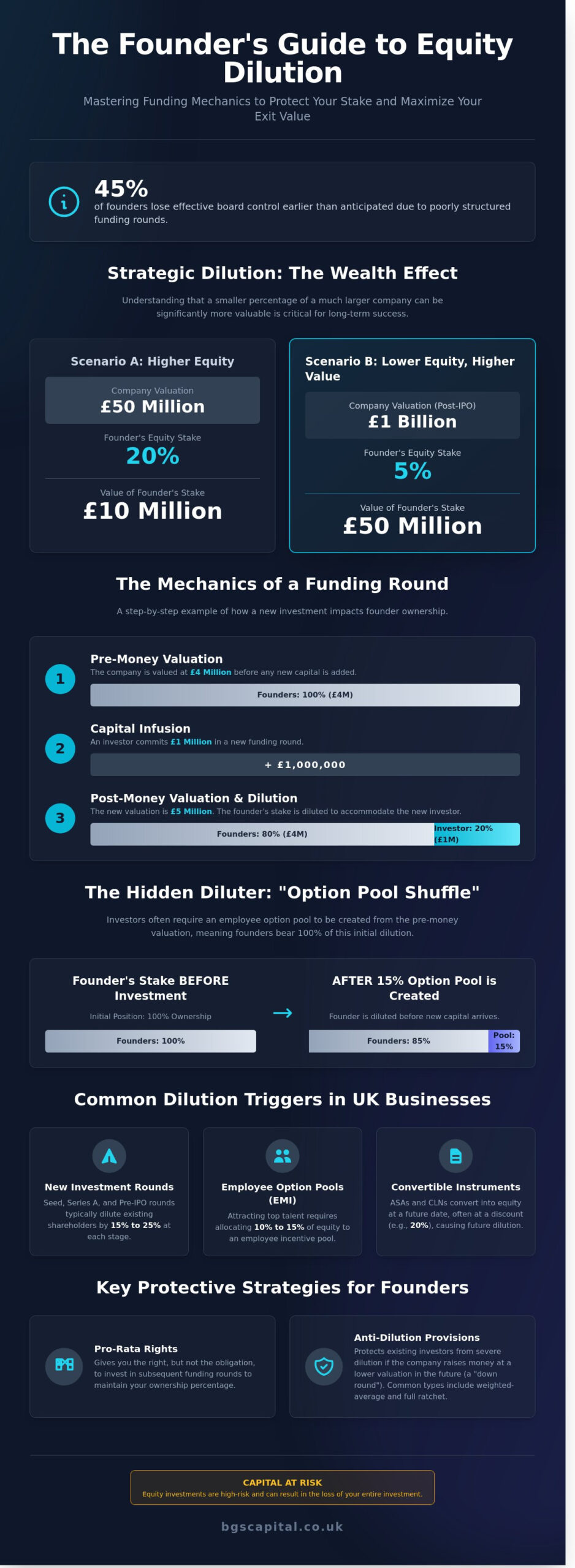
A 20% equity stake in a company valued at £50 million is often worth significantly less than 5% of a business that successfully executes a £1 billion IPO. Every round of funding requires a calculated trade-off between capital infusion and ownership percentage. Understanding equity dilution isn’t merely a mathematical exercise; it’s a critical requirement for maintaining board control and protecting your terminal value. You likely recognize that raising capital is necessary for growth. However, the complexity of pre-money versus post-money valuations often leads to unexpected outcomes during secondary placings. Data from 2023 suggests that 45% of founders lose effective board control earlier than anticipated due to poorly structured funding rounds.
This guide provides the technical framework you need to master share dilution mechanics and protect your position while scaling toward a liquidity event. We’ll examine the 15% option pool shuffle and how to negotiate the protective clauses that sophisticated wealth managers and accredited investment firms expect. You’ll gain the confidence to explain these shifts to early employees and ensure your ownership remains aligned with your long-term exit strategy. CAPITAL AT RISK.
Key Takeaways
- Gain a professional advantage by understanding equity dilution and its role as a fundamental mechanism in the journey toward a successful IPO.
- Master the specific formulae used to calculate post-money shares and evaluate how pre-money valuations dictate the severity of stake reduction.
- Explore the “Wealth Effect” to determine when accepting a smaller ownership percentage in a high-valuation business is financially superior to holding a majority stake.
- Evaluate protective management strategies, including pro-rata rights and anti-dilution mechanisms like weighted average and full ratchet provisions.
- Navigate the complex transition to public markets by learning how secondary placings and IPO-round dynamics affect your final ownership position.
What is Equity Dilution in the Context of Raising Capital?
Equity dilution occurs when a company issues new shares, which subsequently reduces the ownership percentage held by existing shareholders. For UK founders, understanding equity dilution is a critical requirement as they move through the funding lifecycle toward a potential IPO. This process is a functional necessity of growth. You trade a portion of your company’s ownership for the capital required to scale operations and increase the total enterprise value.
Dilution impacts more than just the headline ownership figure. It directly reduces your voting power and your claim on earnings per share (EPS). When a company issues fresh equity, the total number of shares in issue increases, meaning each individual share represents a smaller piece of the business. CAPITAL AT RISK is a constant factor here. New equity stakeholders change the governance and risk profile of the entity. Gaining a foundational perspective on What is stock dilution? helps directors anticipate how these shifts affect their long-term control.
The Distinction Between Equity and Capital Dilution
Equity dilution refers to the specific percentage of the company you own. If you hold 1,000,000 shares in a company with 10,000,000 shares total, you own 10%. If the company issues 2,500,000 new shares, your stake drops to 8%. Capital dilution, however, relates to the financial value of those shares during a liquidity event. Professional investors recognize that 5% of a £500 million corporation is significantly more valuable than 100% of a £1 million startup. The objective is to ensure the valuation growth outpaces the rate of ownership reduction.
Common Triggers for Dilution in UK Businesses
Several standard events trigger dilution for UK-based firms. These aren’t just limited to primary funding rounds. Common catalysts include:
- New Investment Rounds: Seed through to Pre-IPO rounds typically see founders dilute by 15% to 25% at each stage to secure necessary runway.
- EMI Schemes: Most UK startups allocate 10% to 15% of their equity to an Employee Management Incentive (EMI) pool to attract and retain high-level talent.
- Convertible Instruments: Advanced Subscription Agreements (ASAs) or Convertible Loan Notes (CLNs) often convert at a 20% discount to the next round price, creating sudden shifts in the cap table.
Properly managing these triggers is the core of understanding equity dilution. It allows founders to maintain enough leverage to see the company through to a successful exit or public listing.
The Mechanics of Dilution: Formulae and UK Examples
The mathematical reality of understanding equity dilution relies on a primary formula: (New Shares Issued / Total Post-Money Shares) * 100. This calculation determines the exact percentage of the company an investor acquires and, conversely, how much existing shareholders are diluted. Dilution isn’t a sign of failure; it’s the cost of securing growth capital. In a typical 2024 UK seed round, founders should expect to relinquish 15% to 25% of their equity.
Consider a concrete UK example. A startup raises £1 million at a £4 million pre-money valuation. The post-money valuation becomes £5 million. In this scenario, the new investor takes a 20% stake. Founders who previously held 100% of the company now hold 80%. If the founders don’t account for the “Option Pool Shuffle,” their final stake might be even lower. Investors often require a 10% unallocated option pool to be created before the investment. If this pool is carved out of the pre-money valuation, the founders bear the entire dilution cost before the investor’s capital even arrives.
Calculating Your Post-Money Stake
Pre-money valuation represents the agreed value of the business before new capital enters the bank account. It’s the baseline for all price-per-share negotiations. When determining founder equity allocation, you must factor in how future rounds will compress your holding. Expanding an option pool by 10% before a round can reduce a founder’s 80% stake to 72% before the new shares are even issued. Post-money valuation is the sum of the pre-money valuation and the total capital raised.
The Impact of SEIS and EIS on Your Cap Table
UK tax-efficient schemes like SEIS and EIS significantly influence the price per share for sophisticated investors. These schemes allow angels to mitigate 50% or 30% of their investment risk, which often makes them more flexible on valuation than institutional firms. However, you must manage the expectations of “Angel” donors versus accredited investment firms carefully. While angels might accept simpler terms, institutional VC firms require a “clean” cap table. This involves:
- Removing “dead equity” from departed co-founders.
- Ensuring no single angel holds blocking rights that could stall a Series A.
- Maintaining a clear record of all share issuances and HMRC compliance.
A messy cap table can deter Series A investors who prioritize legal transparency and risk mitigation. Check if your current structure meets the standards required by accredited investment firms before pursuing your next round. CAPITAL AT RISK.
Strategic Dilution: Why a Smaller Slice Can Mean a Larger Value
Sophisticated investors view dilution as a fundamental mechanism for scaling, not a loss of power. It’s a signal that a business is transitioning from a private venture into a high-growth asset. Understanding equity dilution requires a shift in focus from ownership percentages to the “Wealth Effect.” This concept demonstrates how a smaller share of a significantly larger entity creates more personal liquidity than total control of a stagnant one.
Consider the mathematical reality of growth. A founder holding a 50% stake in a £10 million company has a paper net worth of £5 million. If that founder dilutes their position to 10% to facilitate the capital injections needed to reach a £250 million pre-IPO valuation, their stake is worth £25 million. The founder’s personal wealth has increased fivefold despite the 80% reduction in ownership. Professional introducers prioritize founders who grasp this logic; they seek leaders who value the 5x wealth increase over the optics of a majority stake.
Attracting high-net-worth individuals requires specific behavior during negotiations. Founders who haggle over fractions of a percent often signal a “small business” mindset. Accredited investment firms prefer founders who view equity as a tool to recruit elite talent and secure market share. CAPITAL AT RISK.
Value Creation vs. Ownership Retention
New capital allows a business to hit the specific milestones that justify higher subsequent valuations. Whether it’s securing a patent or expanding into the US market, these steps require liquidity. Over-optimizing for low dilution often starves a business of the resources it needs to survive. Investors bring more than cash; they provide a network that can reduce customer acquisition costs or accelerate regulatory approvals. Accessing this expertise is often worth more than the equity surrendered to get them on the cap table.
Sophisticated Investor Perspectives on Dilution
Accredited investment firms scrutinize the cap table to ensure founders maintain enough “skin in the game.” If a founder’s stake drops below 10% too early in the lifecycle, they may lose the financial incentive to lead the company to an IPO. Investors look for a balanced cap table that preserves founder motivation while leaving “equity headroom” for future funding rounds. Maintaining this balance is essential for ensuring that follow-on funding remains attractive to institutional players. Understanding equity dilution at this level prevents the “over-dilution” trap where the leadership team becomes essentially employees of their own firm.
Protecting Your Stake: Anti-Dilution Clauses and Management Strategies
Investors utilize specific contractual protections to mitigate the impact of new share issues. Pro-rata rights are the primary mechanism here, granting existing shareholders the legal right to participate in future funding rounds. This ensures they can maintain their ownership percentage by purchasing a proportionate amount of new stock. Without these rights, a 10% stake can quickly diminish during a Series B or C raise. For founders, understanding equity dilution is critical when negotiating these terms, as they must balance investor protection with the need for future cap table flexibility.
Weighted Average vs. Full Ratchet
In the UK venture capital market, the Broad-Based Weighted Average is the standard for professional term sheets in 2024. This mechanism adjusts the conversion price of preferred shares based on the price and volume of the new shares issued. It’s considered a balanced approach because it accounts for the actual economic impact of a down round.
- Broad-Based Weighted Average: Uses a formula that considers all outstanding shares, reducing the impact on the founder’s stake.
- Full Ratchet: An aggressive provision that resets the investor’s price to the lowest new price, regardless of the round’s size. It’s often a red flag for future Series A or B investors.
- Down Round Triggers: These clauses only activate when a company issues shares at a lower valuation than the previous round.
Maintaining Control Without Majority Ownership
Equity ownership doesn’t always equate to operational control. Founders often implement different share classes to separate economic rights from voting power. For example, ‘A’ Ordinary shares might carry 10 votes per share, while ‘B’ shares carry only one. This structure is frequent in high-growth tech firms where founders wish to remain at the helm.
In 2023, approximately 15% of UK seed rounds utilized Advanced Subscription Agreements (ASAs) with specific valuation caps. A cap, perhaps set at £5 million, protects early-stage backers from excessive dilution if the company’s valuation triples before the next formal round. Beyond shares, board observer rights and veto powers over “reserved matters” provide investors with strategic influence without requiring a majority stake. Legal transparency is mandatory during these restructurings to ensure all parties acknowledge the shifting equity dynamics.
If you are looking to expand your portfolio with exclusive opportunities, check your eligibility to join our professional investor network.
Navigating Dilution During Pre-IPO and IPO Rounds
Listing on public markets like the LSE or AIM typically requires a primary share issuance of 15% to 25% to satisfy liquidity requirements and institutional demand. This represents the final major stage of understanding equity dilution for most founders. While the percentage of ownership decreases, the transition to public status often provides the first real opportunity for liquidity through secondary placings. Secondary placings allow founders and early employees to sell existing shares directly to new investors. This mechanism provides personal capital without issuing new stock, meaning it doesn’t dilute the company’s balance sheet or the stakes of other remaining shareholders.
Preparing the Cap Table for a Public Listing
Institutional wealth managers and brokers scrutinize a company’s equity structure at least 18 months before a planned IPO. They look for "clean" cap tables, often requiring the consolidation of fragmented early-stage grants or the buyback of "zombie" equity from inactive founders. During this period, the governance structure shifts. Companies typically allocate 5% to 8% of equity to independent board members and new executive hires. This transition from a founder-led entity to a board-governed corporation is a prerequisite for a successful listing and ensures the business meets stringent UK governance codes.
Connecting with the Right Network
The quality of the investor often dictates the long-term success of a public offering more than the specific percentage of dilution taken. Data suggests that companies backed by top-tier institutional wealth managers achieve 12% higher valuation stability in the first year of trading compared to those with fragmented retail bases. BGS Capital operates as a specialist introducer, facilitating direct connections between high-growth companies and sophisticated investor relations teams.
If you’re seeking to scale toward a public exit, you can feature your business to reach an exclusive network of accredited investment firms and wealth managers. Understanding equity dilution is easier when you’re connected to partners who prioritize sustainable growth over short-term gains.
Accessing pre-IPO capital and exclusive investment opportunities requires meeting specific qualification criteria. BGS Capital maintains a strict gatekeeping function to ensure all participants are either accredited investment firms, high net worth individuals, or sophisticated investors. CAPITAL AT RISK.
Optimize Your Capital Structure for Growth
Managing a cap table requires more than basic math; it demands a long-term vision for your company’s capital structure. You’ve learned that understanding equity dilution isn’t about avoiding it, but rather optimizing it to ensure a 5% stake in a £100 million enterprise outweighs a 25% stake in a £5 million startup. Protecting your position through properly structured anti-dilution clauses remains a priority as you move toward late-stage funding. By the time you reach pre-IPO or IPO milestones, your focus must shift to maintaining regulatory compliance and attracting sophisticated capital.
BGS Capital operates as a professional introducer, providing direct access to a curated network of high-net-worth individuals and sophisticated investors. We focus exclusively on pre-IPO and IPO investment opportunities, ensuring all connections meet stringent regulatory standards. Our platform connects qualified companies with over 5,000 accredited investment firms and wealth managers. Don’t leave your next round to chance. Check your eligibility to connect with our investor base today.
RAISING CAPITAL? FEATURE YOUR BUSINESS ON BGS CAPITAL
CAPITAL AT RISK. Securing the right partners today builds the foundation for your successful public debut.
Frequently Asked Questions
What is a simple example of equity dilution?
Equity dilution occurs when a company issues new shares, which reduces the ownership percentage of existing shareholders. If a founder owns 1,000,000 shares representing 100% of a company and the firm issues 250,000 new shares to an investor, the total share count becomes 1,250,000. The founder still holds 1,000,000 shares, but their ownership stake drops to 80%. This reduction in percentage is the core concept of understanding equity dilution.
Can equity dilution be avoided entirely when raising capital?
Dilution is an unavoidable reality when raising external equity capital. You can’t avoid it if you’re issuing new shares to investors in exchange for cash. Founders often use venture debt or revenue-based financing to delay this process. However, 92% of high-growth UK startups eventually accept dilution to scale. The only way to stop it is to fund growth through internal cash flow or non-dilutive government grants.
How does an option pool expansion affect my ownership percentage?
Expanding an Employee Share Option Plan (ESOP) dilutes existing shareholders before a new investment round. If a lead investor requires a 10% post-money option pool, the founders’ shares are reduced to create this new allocation. For instance, a founder with 50% ownership might see that stake drop to 45% just to accommodate the new pool. This usually happens before the investor’s capital is even transferred to the company bank account.
What is the difference between pre-money and post-money valuation?
Pre-money valuation is the agreed value of the company before it receives new investment, while post-money valuation includes the new capital. If a company is valued at £4,000,000 pre-money and raises £1,000,000, the post-money valuation is £5,000,000. The investor then owns 20% of the business. Understanding equity dilution requires tracking these two distinct figures during every funding round to calculate precise ownership shifts.
Is equity dilution always bad for founders?
Dilution isn’t inherently negative if the share price increases significantly. It’s better to own 10% of a £100,000,000 company than 100% of a £500,000 company. While your percentage drops, the total value of your holding should rise. Data from 2023 UK funding rounds shows that successful exits usually occur after founders have undergone 3 or 4 rounds of dilution. Wealth is built through total valuation, not just percentage points.
How do anti-dilution clauses work in the UK?
Anti-dilution clauses protect investors during a “down round” where shares are sold at a lower price than previous rounds. In the UK, the “weighted average” method is the industry standard. It adjusts the price at which investor’s preferred shares convert to ordinary shares. This results in the investor receiving additional shares to maintain their value. It effectively shifts the dilution burden onto the founders and the employee option pool.
What happens to my shares when a company goes through an IPO?
During an IPO, your private shares typically convert into publicly traded ordinary shares. The company often issues new shares to the public, which causes a final round of dilution for existing holders. Usually, 15% to 25% of the company is sold to public markets during this process. You’ll likely face a lock-up period of 180 days before you’re permitted to sell your shares on the London Stock Exchange.
How much dilution is normal for a Series A funding round?
A typical Series A round in the UK involves diluting existing shareholders by 20% to 25%. If you’re raising £5,000,000 on a £15,000,000 pre-money valuation, you’re giving up 25% of the equity. This figure has remained consistent across the UK tech sector for the last 5 years. Founders should expect their total ownership to drop by roughly one-quarter during this specific stage of institutional growth.