
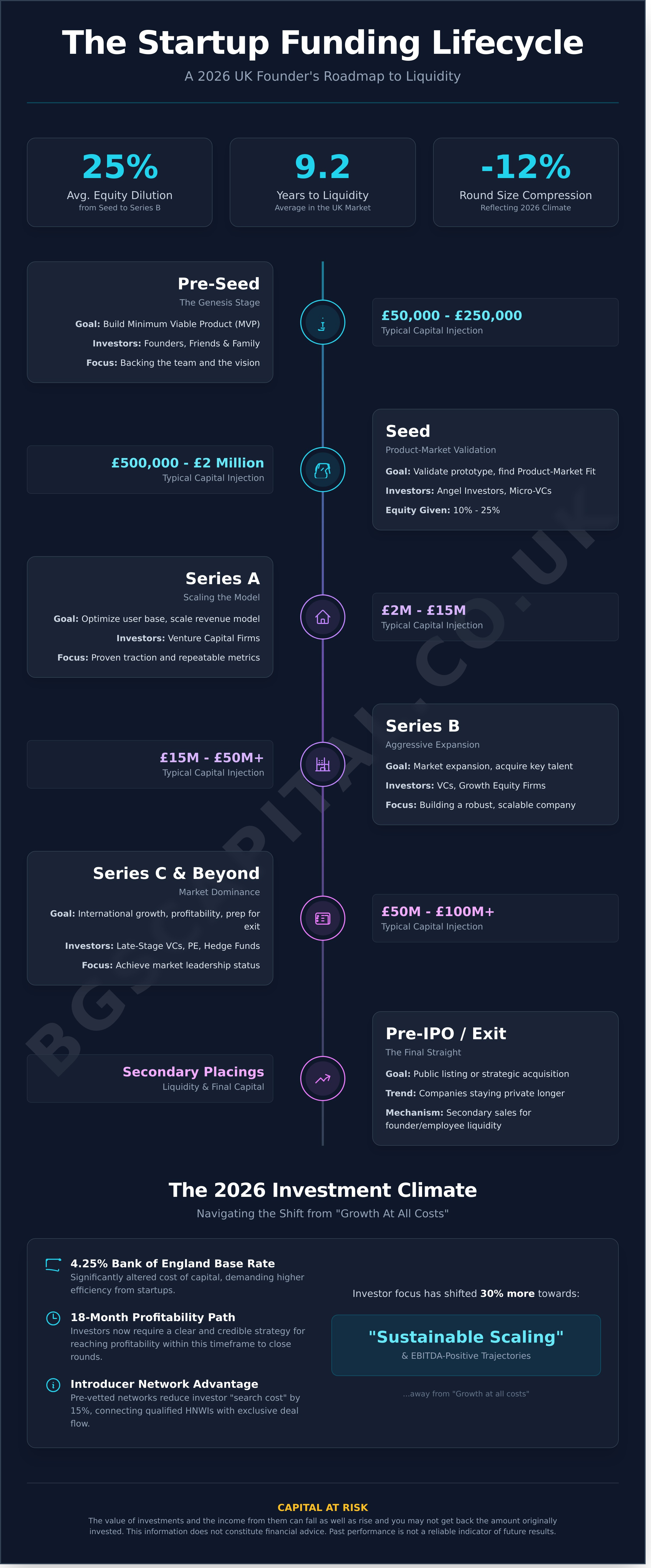
Securing capital is not the primary challenge for UK founders; surviving the 25% average equity dilution seen between Seed and Series B is. Many sophisticated investors remain confused by the shifting definitions of Pre-IPO and Series C rounds, especially as the time to liquidity in the UK market now averages 9.2 years. You likely understand that capital is the fuel for growth, but the lack of a clear roadmap often leads to mispriced rounds and lost control. This is where startup funding rounds explained with precision becomes essential for protecting your interests.
This definitive 2026 guide provides a comprehensive breakdown of every investment stage from initial Seed to the final Pre-IPO secondary placings. You will learn the specific valuation drivers required by institutional wealth managers at each milestone. We also clarify the exact criteria for accessing exclusive opportunities. CAPITAL AT RISK. By the end of this analysis, you will have a functional roadmap to navigate the path toward a public listing on the London Stock Exchange or a strategic exit.
Key Takeaways
- Master the progression from pre-seed prototypes to Series C scaling, ensuring capital injections align with specific growth milestones and product-market validation.
- Evaluate the mechanics of valuation and dilution to understand why securing a smaller equity stake in a higher-valued company is the strategic goal for sophisticated founders.
- Gain insights into the evolving pre-IPO landscape and secondary placings, identifying how companies are staying private longer before seeking a public listing.
- This startup funding rounds explained guide details how qualified investors can navigate curated networks to access exclusive, high-tier investment opportunities.
- Understand the critical role of professional introducers in connecting high-net-worth individuals with institutional-grade deal flow while maintaining strict regulatory compliance.
The Mechanics of Capital: Why Startups Raise in Rounds
Startup funding rounds are discrete capital injections triggered when a business reaches specific growth milestones. This phased approach ensures a company’s valuation aligns with its actual operational maturity. Founders must understand the fundamental equation: they’re trading equity for the capital required to scale. It’s a high-stakes exchange. CAPITAL AT RISK is the foundational reality for every participant in these rounds. If the business fails to hit its next milestone, the value of that equity can drop to zero.
The “round” structure protects both founders and investors from over-valuation during the early stages. By raising only what’s needed to reach the next value inflection point, founders minimize dilution while investors mitigate exposure. This structured progression is a core component of Venture Capital Explained, providing a framework for risk management and valuation adjustments. For a comprehensive startup funding rounds explained overview, one must view each round as a de-risking event that justifies a higher share price in the subsequent stage.
Investors prioritize companies that demonstrate a clear path to liquidity. Whether through an IPO or a secondary placing, the objective remains capital appreciation. This requires a disciplined approach to the “cap table” and a strict adherence to regulatory compliance. BGS Capital operates as an introducer in this ecosystem, connecting sophisticated investors with firms that have passed rigorous internal benchmarks.
The Purpose of External Investment
External capital allows a business to scale operations far beyond the limits of organic cash flow. In the UK market, waiting for retained earnings to fund expansion often results in lost market share to better-capitalised competitors. Startups use these funds to acquire market share through aggressive marketing and the acquisition of specialist talent. Equity financing is the sale of partial ownership to fund future expansion. Key uses of this capital include:
- Expanding into international territories, such as moving from the UK to EU or US markets.
- Investing in proprietary R&D to maintain a competitive moat.
- Hiring C-suite executives with proven exit experience.
For consumer-facing startups, this aggressive marketing spend can also include high-impact brand partnerships. Securing celebrity endorsements, for instance, is a strategy used to rapidly build credibility and market presence, a process often guided by specialist talent agencies like The Celebrity Group.
The 2026 Investment Climate
The 2026 investment climate is defined by the Bank of England’s base rate holding at 4.25%, which has significantly altered the cost of capital. Investors no longer reward “growth at all costs.” Instead, there’s a 30% shift in weight towards “sustainable scaling” and EBITDA-positive trajectories compared to 2023 data. Round sizes have compressed by 12% on average as investors demand higher capital efficiency.
Pre-vetted introducer networks have become essential for navigating this environment. These networks reduce the “search cost” for investors by 15% and ensure that only qualified, high-net-worth individuals access exclusive placements. Efficiency is now the primary metric. Companies that cannot demonstrate a clear path to profitability within 18 months struggle to close rounds. Investors are looking for professional, direct, and serious propositions that acknowledge the inherent risks while presenting a clear strategy for growth.
The Funding Lifecycle: From Pre-Seed to Series C
Understanding the progression of capital is vital for any sophisticated investor. This startup funding rounds explained guide breaks down the transition from concept to market dominance. Each stage requires different risk tolerances and valuation methodologies. CAPITAL AT RISK is a constant factor; however, the potential for equity growth shifts significantly as a company matures from a prototype to a global operation. Investors must recognize the distinct milestones that separate a high-risk gamble from a scalable enterprise.
Early Stage: Pre-Seed and Seed
Pre-seed represents the earliest capital injection, typically ranging from £50,000 to £250,000. Founders often rely on personal savings or “friends and family” networks to build a Minimum Viable Product (MVP). At this stage, investors back the team and the vision rather than proven revenue. Seed funding follows once a prototype exists. Typical check sizes increase to between £500,000 and £2 million. Micro-VCs and Angel investors dominate this space, seeking 10% to 25% equity in exchange for the high risk involved.
UK investors benefit from specific tax frameworks that mitigate early-stage exposure. The Seed Enterprise Investment Scheme (SEIS) offers 50% income tax relief on investments up to £200,000 per tax year. The Enterprise Investment Scheme (EIS) provides 30% relief for larger rounds. These incentives are critical for managing downside risk during the validation of product-market fit. If you are looking to diversify your portfolio with such opportunities, you should check your eligibility for exclusive access to vetted raises.
Growth Stage: Series A through C
Series A marks the entry of institutional Venture Capital firms. Companies must demonstrate a repeatable business model and consistent user growth. Average UK Series A rounds now sit between £2 million and £10 million. Investors look closely at unit economics. A Customer Acquisition Cost (CAC) to Lifetime Value (LTV) ratio of 3:1 is often the minimum benchmark for success. Understanding How Venture Capital Works at this level is essential, as the focus shifts from product development to aggressive scaling.
Series B and C rounds involve larger sums, often exceeding £50 million. This phase of startup funding rounds explained focuses on the transition from institutional backing to mature market capture. These stages focus on market expansion and international reach. In 2023, 15% of UK scale-ups successfully transitioned to Series C by demonstrating a clear path to profitability. Series C often serves as the final private funding event before an exit. It provides the liquidity needed for acquisitions or a public listing. Investors at this level are typically large-scale VC firms, private equity groups, or sovereign wealth funds looking for late-stage stability before a liquidity event occurs.
Valuation and Dilution: Measuring Success vs. Maintaining Control
Determining a company’s worth during startup funding rounds explained requires a cold analysis of risk and reward. Founders often focus on the headline valuation, yet the structure of the deal determines long term control. Pre-money valuation refers to the company’s agreed value before receiving new capital; post-money valuation is the sum of the pre-money figure plus the fresh investment. If a London based fintech firm has a pre-money valuation of £8 million and raises £2 million, its post-money valuation becomes £10 million. The investor now owns 20% of the entity. Understanding these mechanics is essential for any founder entering the capital markets.
Dilution is the reduction in ownership percentage caused by the issuance of new shares. While founders see their stake shrink, the objective is to own a smaller portion of a significantly more valuable asset. A founder holding 15% of a £200 million company is in a stronger financial position than one holding 100% of a £1 million enterprise. However, excessive dilution in early stages can leave founders with insufficient equity to remain motivated or to satisfy the requirements of Series B and C investors who demand that leadership stays “vested” in the outcome. Maintaining a balance between capital influx and equity retention is a primary challenge in startup funding rounds explained.
The Valuation Formula in 2026
The UK investment environment in 2026 has pivoted away from the “growth at any cost” model of the early 2020s. Investors now prioritise profitability-linked valuations over simple revenue multiples. In the current market, AI and ESG sectors command premiums, often seeing 8x to 12x multiples, whereas standard SaaS firms may see 4x to 6x. Valuation is a negotiation of future potential, not just current assets. Sophisticated firms now use discounted cash flow (DCF) models earlier in the lifecycle to justify pricing, ensuring that valuations aren’t based on speculation alone.
Managing the Cap Table
A “clean” cap table is a prerequisite for institutional capital. It should clearly list all shareholders, including founders, investors, and employees. Most UK venture capital firms expect an Employee Stock Option Pool (ESOP) of 10% to 15% to be carved out before a Series A round. This pool dilutes existing shareholders but ensures the company can attract top tier talent. Transparency in previous funding history is vital; 85% of late stage investors cite messy cap tables as a primary reason for withdrawing from a deal during due diligence. Key indicators of a healthy cap table include:
- Evidence of previous secondary placings that provided early liquidity.
- Clear vesting schedules for all key personnel to ensure long term commitment.
- Absence of “dead equity” held by former employees or inactive founders.
Over-valuation presents a significant risk to long term viability. In 2023, approximately 21% of venture backed companies in the UK faced “down rounds,” where they raised capital at a lower valuation than their previous funding event. This often triggers “full ratchet” or “weighted average” anti-dilution clauses for earlier investors. These legal mechanisms can wipe out founder equity rapidly to protect the investor’s original ownership percentage. Protecting founder interests involves negotiating for reasonable valuations that allow for consistent “up rounds” in the future. BGS Capital observes that sustainable growth trajectories are more attractive to serious investors than temporary, inflated spikes in perceived worth. CAPITAL AT RISK.
Beyond Series C: The Pre-IPO Phase and Secondary Placings
The transition from a Series C venture to a public entity is no longer a linear path. While startup funding rounds explained in earlier stages focus on rapid scaling and product-market fit, the Pre-IPO phase prioritizes institutional stability and liquidity. Data from 2023 shows the median age for a company reaching an IPO has extended to 11 years, a significant shift from the 4-year median observed in 1999. This delay has birthed the “Late Stage” category, where companies raise Series D, E, or F rounds with valuations often exceeding £1 billion. These rounds act as a final bridge, providing the massive capital injections required for global dominance or major acquisitions before entering the public markets.
CAPITAL AT RISK. Investments at this level involve significant sums and carry the risk of total loss if a public listing fails to materialise or market conditions shift unfavourably.
Preparing for the Public Market
Moving towards a listing on the London Stock Exchange (LSE) or the AIM market requires a fundamental shift in corporate DNA. Companies must transition from founder-led agility to board-governed transparency. This involves:
- Meeting the Financial Conduct Authority (FCA) requirements for at least three years of audited financial records.
- Appointing non-executive directors to ensure independent oversight.
- Adopting International Financial Reporting Standards (IFRS) to replace simpler accounting methods.
These stringent hurdles mean Pre-IPO opportunities are restricted to sophisticated investors and High Net Worth Individuals (HNWIs) who possess the capital to withstand long lock-up periods.
Secondary Markets and Liquidity
Secondary placings have become a vital component of the late-stage ecosystem. Unlike primary rounds where new shares are minted, secondary transactions involve the sale of existing shares from early investors or long-tenured employees. This mechanism provides several strategic advantages:
- Zero Dilution: The company’s total share count remains static, protecting the percentage ownership of existing stakeholders.
- Employee Retention: Staff can realise the value of their options, providing life-changing liquidity without waiting for an IPO date.
- New Entry Points: Incoming investors gain access to proven, high-growth companies at a stage where the business model is already de-risked compared to Seed or Series A ventures.
Accessing these placings is not straightforward. They aren’t advertised on public exchanges and often require an invitation from a specialist network. Most secondary transactions in the UK are governed by COBS 4.7 rules, meaning only those who meet specific wealth or experience criteria can participate. Understanding how startup funding rounds explained in a secondary context differ from primary raises is essential for any serious investor looking to diversify their private equity portfolio.
BGS Capital operates as a specialist introducer in this high-stakes environment. We don’t facilitate raises directly; instead, we leverage an extensive network of accredited investment firms and wealth managers to connect qualified individuals with exclusive Pre-IPO opportunities. Our role is to provide the gateway to these restricted placings, ensuring that only eligible investors gain exposure to these sophisticated financial instruments.
Success in the Pre-IPO phase relies on timing and access. As companies stay private longer, the most significant value appreciation often happens before the first bell rings on the trading floor. BGS Capital positions you at the front of the queue for these transformative events.
Are you a sophisticated investor seeking entry into late-stage opportunities? Am I Eligible? Check your status now.
Navigating the Network: How to Access Exclusive Funding Rounds
The UK investment landscape has shifted away from public crowdfunding for high-value raises. While platforms like Seedrs or Crowdcube remain viable for early Seed stages, they often fail to provide the sophisticated capital required for Series B or C transitions. By Q3 2025, data indicated an 18% decline in successful public equity raises exceeding £10 million. High-growth firms now prioritise curated introducer networks and specialized digital fundraising platforms like Pre-IPO Hype. These private channels offer a direct route to institutional-grade capital and high net worth individuals (HNWIs) without the public exposure of traditional crowdfunding. This shift ensures that the startup funding rounds explained in this guide are executed with privacy and efficiency.
BGS Capital functions as a specialist facilitator within this ecosystem. We don’t provide financial advice or manage funds directly. Instead, we act as a bridge. We connect qualified companies with a network of accredited investment firms and wealth managers. Execution depends on accessing the right network at the right time. CAPITAL AT RISK. All investments carry significant risk of loss. Our role is to ensure the connection is made between the right parties, focusing on pre-IPO and secondary placings that aren’t available to the general retail market.
For Companies: Featuring Your Business
Securing a spot on an exclusive introducer platform requires more than just a pitch deck. BGS Capital typically looks for companies with a clear path to an exit or an IPO, often requiring a minimum revenue run rate of £1.5 million or significant proprietary technology. Listed businesses gain immediate visibility among a network of SIPP-capable wealth managers and professional firms. This isn’t a public listing; it’s a targeted introduction to serious capital providers. Feature your business with BGS Capital to start the qualification process and gain exposure to our network.
For Investors: The Qualification Gate
Accessing pre-IPO and secondary placings is strictly restricted by FCA regulations. Investors must prove their status as either sophisticated or high net worth individuals before viewing any documentation. This gatekeeping ensures that high-risk opportunities match appropriate portfolios. BGS Capital facilitates direct introductions to investor relations teams, allowing for deeper due diligence than public platforms allow. Am I Eligible? You must answer this before viewing any specific opportunities. Check your eligibility to access IPO and pre-IPO opportunities today to see if you qualify for our current network offerings.
Final Checklist for the 2026 Market:
- Confirm your FCA investor status (High Net Worth or Sophisticated) and ensure your certification is dated within the last 12 months.
- Review SEIS and EIS tax relief eligibility for UK-based raises to optimize tax efficiency on qualifying investments.
- Assess the 24-month runway requirements for any startup against current £ GBP inflation rates and operational costs.
- Verify that all financial projections and company valuations are audited or verified by a qualified third-party firm.
- Acknowledge that CAPITAL AT RISK is a fundamental reality of private equity; never invest capital you cannot afford to lose entirely.
- Ensure all SIPP or SSAS pension contributions are aligned with the specific requirements of the investment firm.
The transition from a startup to a scale-up requires more than just capital; it requires the right type of capital. By moving through the startup funding rounds explained in this article, founders and investors can better understand where they fit in the 2026 financial ecosystem. BGS Capital remains a dedicated introducer, focusing on quality over quantity in every connection we facilitate.
Secure Your Growth Trajectory in 2026
Navigating the transition from Pre-Seed to Series C requires a precise balance between aggressive scaling and equity preservation. By 2026, UK founders must account for tighter valuation metrics where Series A benchmarks often require £100,000 in monthly recurring revenue to attract institutional interest. Successfully navigating startup funding rounds explained in this guide ensures you manage dilution effectively while preparing for secondary placings or a liquidity event. High-growth firms often hit a ceiling when they lack direct pathways to institutional capital or sophisticated wealth managers who understand the UK regulatory landscape. It’s vital to have a roadmap that extends beyond the next 12 months of runway.
BGS Capital provides the infrastructure to bridge this gap. We offer direct access to internal Investor Relations teams and an extensive network of accredited investment firms and wealth managers. Our specialists focus on the critical Pre-IPO and IPO phases, ensuring qualified companies aren’t just raising funds but are building long-term institutional relationships. This level of access is typically reserved for the top 5% of UK scale-ups. CAPITAL AT RISK.
RAISING CAPITAL? FEATURE YOUR BUSINESS
Take the next step in your funding journey with a partner that understands the mechanics of the London markets and beyond. We look forward to reviewing your business for potential inclusion in our network.
Frequently Asked Questions
What is the difference between Seed and Series A funding?
Seed funding focuses on initial product development and market research, while Series A targets scaling a business with a proven track record. UK seed rounds typically raise between £100,000 and £2 million. Series A rounds require evidence of consistent revenue, often exceeding £1 million annually. Investors shift from individual angels to formal venture capital firms during this transition.
How many rounds of funding do startups typically go through before an IPO?
Startups typically complete 5 to 8 funding rounds before reaching an IPO. This sequence usually progresses from Seed through to Series D or E. Having these startup funding rounds explained helps founders understand that the average time to exit is now 11 years as of 2023. Each round involves specific valuation metrics and different classes of institutional investors.
What does it mean to be a “sophisticated investor” in the UK?
A sophisticated investor in the UK is an individual certified under the Financial Services and Markets Act 2000. You must meet specific legal criteria, such as being a member of a business angel network for at least 6 months. Alternatively, you’ve worked in a professional capacity in the private equity sector within the last 2 years. Use our “Am I Eligible?” tool to verify your status.
Can a startup survive without raising external funding?
Startups can survive without external funding through bootstrapping, but it limits the speed of market penetration. Companies like Mailchimp operated for 20 years using only internal cash flow before a £9.6 billion acquisition in 2021. However, 82% of startups fail due to cash flow shortages. Raising capital is often necessary to scale before competitors capture the market share.
What is a “down round” and why is it dangerous for founders?
A down round is a fundraising event where a company’s valuation is lower than its previous round. This is dangerous because it triggers anti-dilution clauses that significantly reduce founder equity. In 2023, approximately 20% of global venture rounds were classified as down rounds. They often signal to the market that the business hasn’t met its growth targets or key performance indicators.
How does BGS Capital facilitate the investment process?
BGS Capital acts as an introducer that connects sophisticated investors with exclusive pre-IPO and IPO opportunities. We don’t facilitate the raises ourselves or act as a broker; our role is to provide a network of accredited investment firms. This allows qualified individuals to find and compare high-growth opportunities. You can check your status via our “Am I Eligible?” portal to gain access.
What are secondary placings in the context of startup funding?
Secondary placings are transactions where existing shareholders, such as employees or early investors, sell their shares to new buyers. This process doesn’t involve the company issuing new stock or receiving new capital. It’s a common method for providing liquidity in the years leading up to an IPO. These placings are typically reserved for institutional investors or high net worth individuals.
Is capital always at risk when investing in pre-IPO companies?
CAPITAL AT RISK is a certainty when investing in any pre-IPO company. These investments are highly speculative and illiquid; there’s no guarantee you’ll be able to sell your shares. Data shows that a significant percentage of early-stage companies fail to reach an exit. You should only invest capital you can afford to lose and ensure you fully understand the regulatory disclaimers.