
Navigating the UK’s early-stage investment landscape in 2026 is a complex undertaking. Founders are confronted with opaque investor networks, stringent FCA regulations surrounding financial promotion, and an intensely competitive market. Successfully securing seed funding for startups uk now demands more than a compelling business plan; it requires a precise strategy for compliance, access, and differentiation.
This guide is engineered to provide that strategic advantage. We deliver a definitive roadmap for your 2026 capital raise, detailing the critical path to SEIS/EIS eligibility and compliance. You will gain actionable insights for accessing and engaging with a network of sophisticated investors and establish the foundational knowledge to map your company’s pre-IPO trajectory from day one. Consider this your operational manual for mastering the complexities of the UK seed funding ecosystem.
Key Takeaways
- Learn how the 2026 investment climate prioritises high-quality ventures and what this means for your startup’s valuation.
- Understand the critical FCA definitions of Sophisticated and High Net Worth Investors to target your capital raise effectively.
- Maximise investor appeal by correctly structuring your seed funding for startups uk around the highly attractive SEIS and EIS tax schemes.
- Prepare a professional-grade pitch deck and data room that meets the specific due diligence expectations of sophisticated UK investors.
The 2026 Seed Funding Landscape for UK Startups
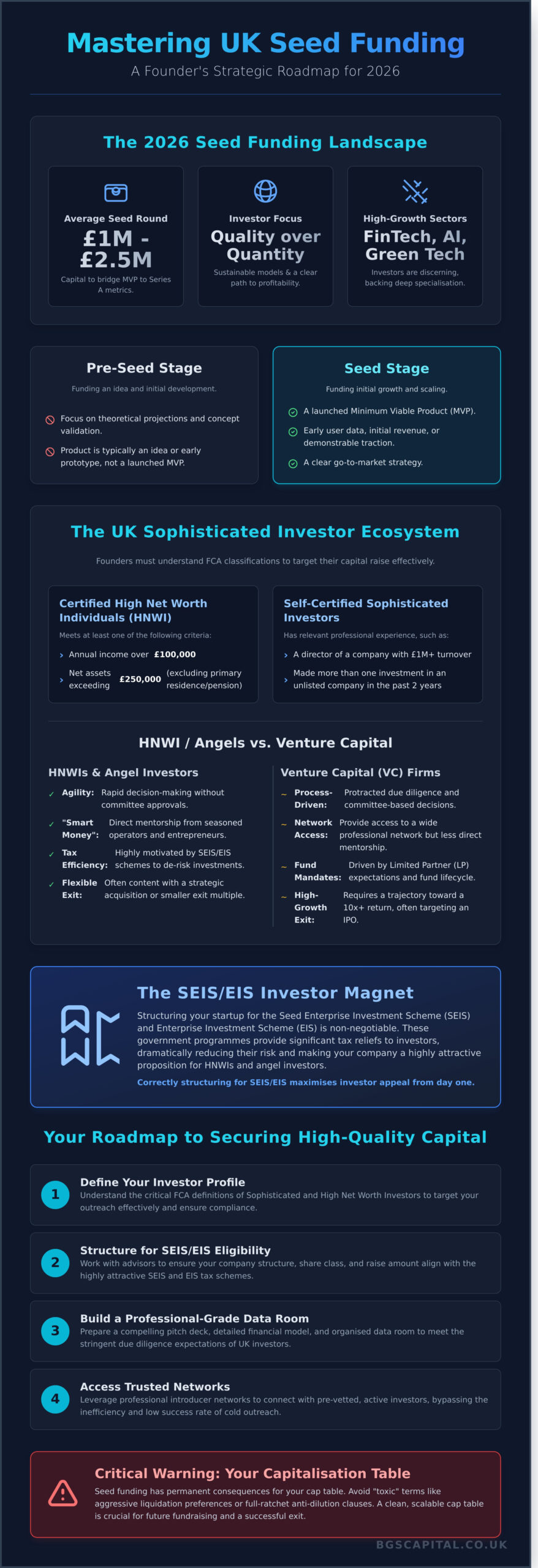
In the 2026 UK economic climate, seed funding represents the first significant injection of institutional capital a startup receives. It is no longer solely about financing an idea; it is about funding initial growth and scaling operations. For a foundational overview, it is useful to understand What is Seed Funding? in a global context. This capital serves as the critical bridge between developing a Minimum Viable Product (MVP) and achieving the metrics required for a Series A round. The market has matured significantly, with investors shifting focus from speculative growth to sustainable business models. This ‘quality over quantity’ approach means valuations are more grounded in reality, and due diligence is more stringent.
Projections for 2026 suggest a stable but highly competitive environment for seed funding for startups uk. While deal flow remains robust in high-growth sectors like FinTech, AI, and Green Tech, investors are discerning. Average seed round sizes are expected to fall between £1 million and £2.5 million, with capital allocated to companies demonstrating clear product-market fit and a viable path to profitability.
Seed vs. Pre-Seed: Where Does Your Business Sit?
Distinguishing between pre-seed and seed stages is crucial. A formal seed round typically requires tangible milestones: a launched MVP, early user data or initial revenue, and a clear go-to-market strategy. UK investors increasingly prioritise demonstrable traction-user engagement, retention metrics, and early sales-over purely theoretical revenue projections. Founders must approach this stage with a clear understanding that all early-stage investment carries significant risk, and investor expectations must be managed accordingly.
The Importance of Early-Stage Capital Structure
Securing seed funding has permanent consequences for your company’s capitalisation table (cap table). The equity dilution at this stage sets a precedent for all future fundraising rounds. It is imperative to avoid “toxic” terms, such as aggressive liquidation preferences or full-ratchet anti-dilution clauses, which can severely impair a company’s ability to raise subsequent capital or achieve a successful exit. Sophisticated investors and venture capitalists are assessing pre-IPO potential even at this nascent stage, scrutinising the cap table for a clean and scalable structure.
The UK Sophisticated Investor Ecosystem
Beyond traditional venture capital, the landscape for seed funding for startups uk is dominated by a sophisticated network of private investors. To engage with this network, founders must understand the classifications defined by the Financial Conduct Authority (FCA). These investors are typically either Certified High Net Worth Individuals (HNWIs), with an annual income over £100,000 or net assets exceeding £250,000, or Self-Certified Sophisticated Investors, who have professional experience in investing or company management. These individuals form the backbone of early-stage investment in the UK.
High Net Worth Individuals (HNWIs) vs. Venture Capital
The primary advantage of securing capital from HNWIs or angel investors is agility. Unlike VC firms, which operate with committees and protracted due diligence, a private investor can make decisions rapidly. Their “smart money” is often more valuable than the capital itself, providing direct mentorship from seasoned operators. Furthermore, many HNWIs leverage tax-efficient government programmes like the Seed Enterprise Investment Scheme (SEIS) to de-risk their investment. Aligning your investor type with your exit strategy is critical; an HNWI may be content with a strategic acquisition, whereas a VC fund requires a trajectory toward a 10x return, often via an IPO.
The Role of Introducer Networks
Accessing this private capital requires a trusted channel. Professional introducer networks like BGS Capital serve as a vital conduit, connecting pre-vetted startups directly with qualified, active investors. For a startup, being accepted as a “featured business” provides unparalleled visibility and credibility, bypassing the inefficiencies of cold outreach. This structured approach professionalises the search for capital. However, these platforms maintain high standards through a strict gatekeeping function. Before gaining access, every founder must answer the critical question: Am I Eligible? This ensures only credible, high-potential ventures are presented to the network, preserving the integrity of the ecosystem.
Looking ahead, the market is shifting toward sector-specific angel syndicates. By 2026, we anticipate investors will increasingly pool capital and expertise to focus on niches like FinTech, AI, and Green Energy, demanding deeper specialisation from the founders they back.
Maximising SEIS and EIS for Seed Stage Success
For any entrepreneur navigating the landscape of seed funding for startups uk, understanding the UK government’s tax-efficient venture capital schemes is not just advantageous-it is fundamental. The Seed Enterprise Investment Scheme (SEIS) is widely regarded as the gold standard for very early-stage investment, offering unparalleled tax incentives that de-risk the proposition for angel investors. It is designed specifically for new companies, allowing a raise of up to £250,000.
As a startup matures beyond this initial threshold, the Enterprise Investment Scheme (EIS) facilitates larger seed-plus or Series A rounds. Under EIS, a company can raise up to £5 million in a single year (with a lifetime limit of £12 million). While the investor tax relief is lower at 30% compared to SEIS’s 50%, it remains a powerful incentive for securing substantial follow-on capital.
The core appeal for investors is risk mitigation. The significant income tax relief, coupled with Capital Gains Tax exemption on profitable exits and loss relief on failed investments, makes SEIS/EIS-eligible companies substantially more attractive than their non-eligible counterparts.
Securing Advance Assurance from HMRC
Advance Assurance (AA) is a statement from HMRC confirming that a proposed investment is likely to qualify for SEIS or EIS. For most sophisticated investors, AA is a non-negotiable prerequisite. The application process involves submitting a detailed business plan, financial forecasts, and supporting documents directly to HMRC. Founders should consult the official SEIS guidance for precise requirements. Common reasons for rejection include operating in a prohibited sector (e.g., property development, legal services), failing to meet the ‘new qualifying trade’ rules, or having gross assets exceeding the scheme limits.
Regulatory Landscape and Strategic Considerations
In a critical update for the UK’s investment ecosystem, the government has extended the “sunset clauses” for both SEIS and EIS to 6 April 2035, removing previous uncertainty and confirming long-term support for early-stage ventures. This provides a stable framework for founders seeking seed funding for startups uk. Furthermore, founders should note that Research and Development (R&D) tax credits can be claimed alongside SEIS/EIS investment, offering a powerful, non-dilutive cash injection to extend your financial runway. Finally, all participating companies must meet HMRC’s ‘Risk to Capital’ condition. The ‘Risk to Capital’ condition mandates that the investment must represent a genuine risk to the investor’s capital, with the objective of long-term business growth, and not be part of a scheme to preserve capital.
The Roadmap to Securing High-Quality Seed Capital
Securing seed funding in the UK requires more than a compelling idea; it demands a professional, strategic approach designed to meet the expectations of sophisticated investors. Your objective is to present an institutional-grade opportunity, not just a startup pitch. This process begins with meticulous preparation of your core assets: your pitch deck, data room, and outreach strategy.
The standard pitch deck must be elevated. While the problem and solution are foundational, the narrative must quickly pivot to scalability, market penetration, and a clearly defined exit strategy. Professional investors are allocating capital based on your potential for a significant return, making the path to a liquidity event-such as a trade sale, secondary placing, or IPO-a critical component of your presentation.
Building a Narrative for Pre-IPO Growth
Your financial projections must demonstrate a clear, credible path from seed-stage to a significant valuation. In a volatile market, such as the forecast for 2026, defensible assumptions are paramount. Present multiple scenarios (base, optimistic, pessimistic) and clearly articulate the key drivers behind your growth model. The focus should be on demonstrating capital efficiency and a tangible route to subsequent funding rounds and an eventual public offering or major acquisition.
Leveraging Featured Listings for Maximum Exposure
Gaining access to the right investors is a primary challenge when seeking seed funding for startups uk. Cold outreach has a notoriously low success rate. Professional introducer platforms, such as BGS Capital, offer a more efficient route by featuring qualified businesses directly to a network of wealth managers, family offices, and accredited investment firms. To stand out, ensure your listing is concise, data-driven, and clearly outlines the investment thesis. Effective investor relations management post-raise is also critical for securing follow-on funding.
A well-organised virtual data room is non-negotiable for due diligence. It should contain, at a minimum:
- A detailed financial model and cap table.
- Intellectual property registrations and key employee contracts.
- Evidence of SEIS/EIS advance assurance.
- Material customer agreements.
Finally, when negotiating the term sheet, UK founders must scrutinise key clauses. Pay close attention to the liquidation preference, anti-dilution provisions (distinguishing between full-ratchet and weighted-average), and founder vesting schedules. Securing favourable terms at the seed stage sets a critical precedent for all future financing.
Beyond the Raise: Preparing for Pre-IPO Growth with BGS Capital
Securing capital is a critical milestone, but it is only the first step. For ambitious founders, the journey of seed funding for startups uk is the foundation for a much larger growth trajectory, culminating in access to secondary markets and a potential Initial Public Offering (IPO). This transition requires a strategic approach to capital partnerships. BGS Capital provides the network to bridge the gap between early-stage success and pre-IPO readiness, connecting high-growth companies with sophisticated capital.
The capital you raise today should build the enterprise that attracts institutional investment tomorrow. Planning for this progression from the outset is the hallmark of a company built for the public markets.
Strategic Facilitation vs. Direct Brokerage
BGS Capital operates as a strategic introducer, not a direct broker. Our function is to facilitate connections between qualified companies and our extensive network of accredited investment firms, wealth managers, and high-net-worth individuals. By featuring on our platform, companies gain direct exposure to a curated audience actively seeking pre-IPO and secondary placing opportunities. This model allows founders to build the crucial long-term relationships essential for navigating the path from seed stage to a public listing.
Next Steps: Feature Your Business
Gaining exposure to our network is a straightforward process for companies that meet our stringent criteria for high-growth potential. We feature businesses that can demonstrate a proven track record, a clear growth strategy, and a robust management team. Key criteria for “qualified companies” include:
- Established revenue and significant market traction.
- A clear and defensible market position.
- An experienced leadership team with a history of execution.
- A defined path towards a significant liquidity event (e.g., IPO, acquisition).
If your company has moved beyond the initial stages and is preparing for its next phase of significant growth, featuring on BGS Capital can provide the high-level exposure you require. To begin the application process, submit your business details for review by our team.
RAISING CAPITAL? FEATURE YOUR BUSINESS
Positioning Your Startup for Seed Success in 2026
The path to securing capital in 2026 requires meticulous preparation. Success hinges on a deep understanding of the sophisticated investor ecosystem, strategically maximising SEIS and EIS benefits, and presenting a clear roadmap for growth. The landscape for seed funding for startups uk is competitive, but for founders with a compelling vision and a robust plan, the opportunities are significant.
Beyond a solid business plan, access to the right capital network is paramount. BGS Capital operates as a specialist introducer, connecting qualified companies with our curated network of High Net Worth and sophisticated investors. We facilitate direct introductions to investor relations teams and focus on positioning ventures for pre-IPO and IPO opportunities, ensuring your company is seen by the right people at the right time.
If your business is ready to engage with serious investors, we can provide the platform.
RAISING CAPITAL? FEATURE YOUR BUSINESS
Frequently Asked Questions
What is the maximum I can raise under SEIS in 2026?
The maximum investment a company can raise through the Seed Enterprise Investment Scheme (SEIS) is £250,000. This is a lifetime limit for the company, not an annual one. This figure was increased from £150,000 in April 2023 to encourage early-stage investment. Founders preparing a fundraising strategy for 2026 should work with this current cap, but always verify the latest HM Treasury and HMRC regulations as tax legislation can be subject to change in governmental budgets.
How do I know if an investor is “sophisticated” or “high net worth”?
In the UK, these investor categories are defined by the Financial Conduct Authority (FCA). A certified ‘High Net Worth Individual’ must have an annual income of £100,000 or more, or net assets of at least £250,000 (excluding their primary residence and pension). A ‘Sophisticated Investor’ meets other criteria, such as having invested in an unlisted company in the last two years, being a member of an angel syndicate, or directing a company with over £1 million turnover.
What is the average equity stake for a UK seed round?
For a typical UK seed round, founders can expect to give away between 10% and 25% of their company’s equity. The exact percentage is determined by the pre-money valuation and the amount of capital raised. For instance, raising £500,000 on a £2 million pre-money valuation would result in investors taking a 20% equity stake. This figure is subject to negotiation and depends heavily on factors like market traction, team strength, and sector competition.
How long does it typically take to close seed funding in the UK?
The timeline to close a seed funding round in the UK generally ranges from three to six months. This period covers the entire process from initial investor outreach to the funds being deposited in the company’s bank account. Key stages include investor pitching, due diligence, term sheet negotiation, and the completion of all legal documentation. Founders should factor this timeline into their financial planning to ensure sufficient operational runway throughout the fundraising process.
Can I raise seed funding if my company is not based in the UK?
While challenging, it is possible. However, the vast majority of UK seed investors and all government tax relief schemes like SEIS/EIS require the company to have a ‘permanent establishment’ in the UK. This means having a physical office or key operational base here. Therefore, international companies seeking UK seed investment typically establish a UK-registered subsidiary to become eligible and attract capital from the local ecosystem, especially from angel investors who rely on SEIS/EIS benefits.
What happens if I raise seed capital but don’t qualify for SEIS/EIS?
Raising seed capital without SEIS/EIS eligibility significantly reduces your access to the UK’s angel investor community, as many invest specifically for the associated tax reliefs which mitigate their risk. If your startup does not qualify, your proposition must be exceptionally strong to compensate. You will need to target investors who are not motivated by these schemes, such as certain venture capital funds, family offices, or international investors who are ineligible for the reliefs anyway.
What is the role of an introducer in the startup funding process?
An introducer is a firm or individual that connects startups seeking investment with a network of potential investors. Unlike a broker, an introducer does not handle transactions or provide financial advice. Their primary function in the ecosystem of seed funding for startups UK is to facilitate a professional introduction, presenting vetted investment opportunities to relevant High Net Worth Individuals, Sophisticated Investors, or VCs. This streamlines the process for both founders and investors by curating deal flow.
How does seed funding differ from a venture debt or a convertible loan note?
Seed funding is a form of equity financing where you sell a percentage of your company to investors in exchange for capital; there is no obligation to repay the amount. In contrast, venture debt is a loan that must be repaid with interest and typically includes warrants (the right to buy future equity). A convertible loan note is also a loan, but instead of repayment in cash, it converts into equity at a later funding round, usually at a discount.