
For early-stage founders, the path to securing capital is often opaque. Concerns regarding company valuation, investor requirements, and the precise terms of equity can present significant barriers to progress. A misstep during this critical phase can have long-term consequences for both the founder and the enterprise. The process of raising seed funding demands a structured, strategic approach-not guesswork. It is a transactional process that requires meticulous preparation and a clear understanding of market expectations within the UK’s competitive landscape.
This comprehensive guide is engineered to provide that structure. We will detail the entire seed funding lifecycle, from building a defensible financial model and preparing a compelling pitch deck to navigating term sheet negotiations. You will gain a practical, step-by-step framework designed to equip you with the confidence and strategic clarity necessary to secure the capital required to achieve your key business milestones. Consider this your operational manual for a successful seed round.
Key Takeaways
- Comprehensive preparation is non-negotiable; learn which core documents, from your pitch deck to financial models, must be finalised before initiating investor contact.
- Understand the critical distinction between generic capital and ‘smart money’ to identify and target investors who provide strategic value beyond their financial contribution.
- A successful pitch for seed funding must clearly articulate a compelling vision and demonstrate precisely how the capital will be deployed to achieve key product and market milestones.
- Discover the key stages that follow a successful pitch, from navigating the complexities of a term sheet to preparing for the rigorous due diligence process required to close the round.
Understanding the Fundamentals of Seed Funding
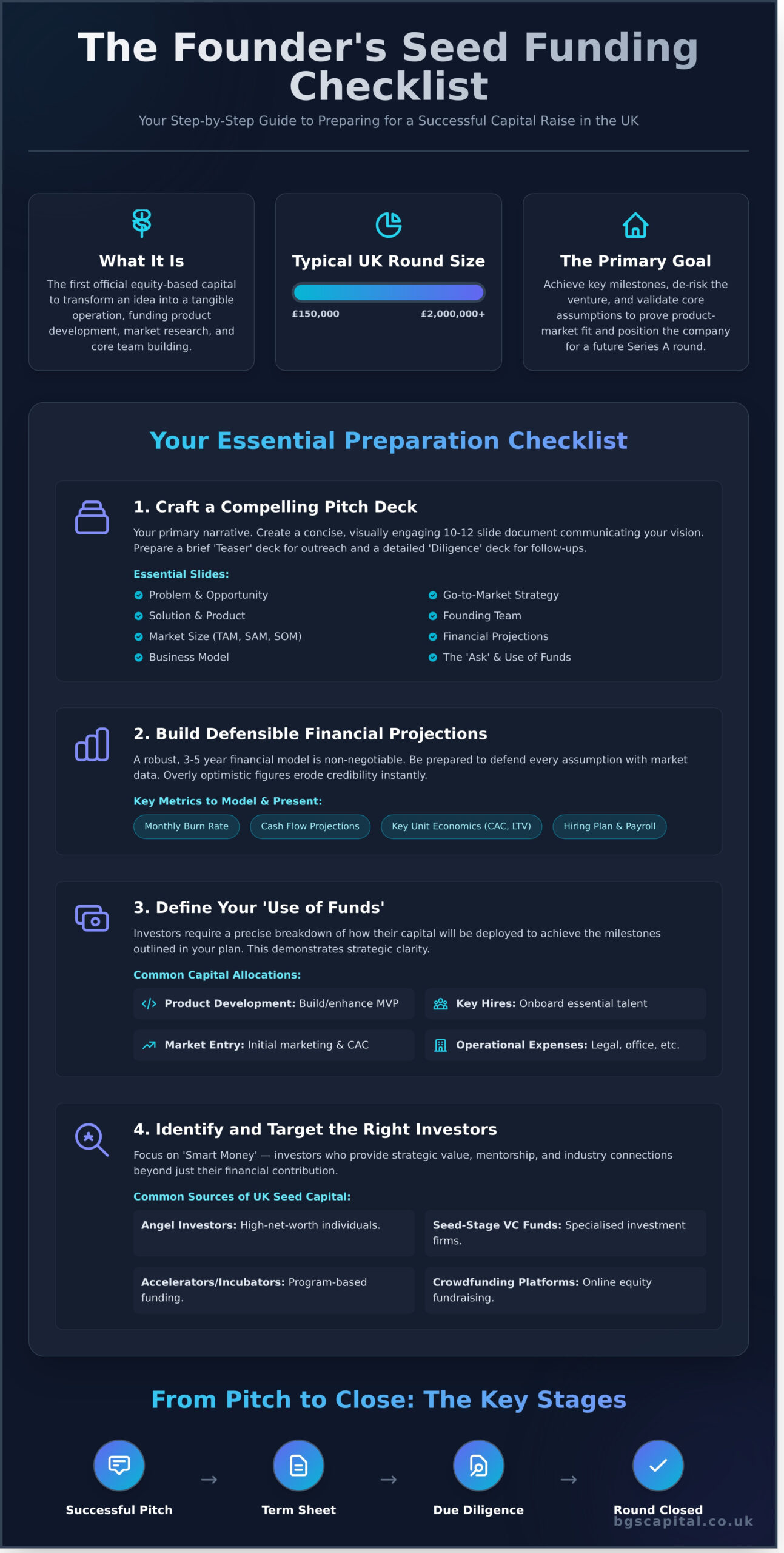
Seed funding represents the first official equity-based capital injection a new venture or startup receives. Its primary function is to finance the critical early stages of a business, transforming an idea into a tangible operation. Often referred to as seed money, this capital is crucial for initial product development, market research, and establishing a core team. In the United Kingdom market, typical seed funding rounds range from approximately £150,000 to over £2 million, contingent on the sector, team, and business model.
The strategic goal of a seed round is not immediate profitability but rather to achieve significant milestones that de-risk the venture for subsequent, larger investment stages. The key objective is to reach product-market fit, validate core assumptions, and demonstrate early traction, thereby positioning the company for a Series A round.
What is Seed Funding Used For?
Capital from a seed round is allocated to specific, foundational activities designed to prove a concept and build operational capacity. Common applications include:
- Product Development: Building a minimum viable product (MVP) or enhancing an existing prototype to prepare it for market entry.
- Key Hires: Onboarding essential personnel, such as technical leads, developers, or sales executives, to form the founding team.
- Market Entry: Covering initial marketing, customer acquisition costs (CAC), and public relations efforts to gain early traction.
- Operational Expenses: Funding day-to-day costs such as office space, legal fees, and administrative overhead before the business generates significant revenue.
Common Sources of Seed Capital
Entrepreneurs in the UK have several established channels for securing seed investment. The most prevalent sources for this stage of financing include:
- Angel Investors: High-net-worth individuals who invest their personal funds into early-stage companies, often providing mentorship alongside capital.
- Seed-Stage Venture Capital (VC) Funds: Investment firms that specialise in providing capital to startups at the seed stage, typically taking a more structured approach than angel investors.
- Accelerators and Incubators: Programs that offer a fixed amount of seed capital, mentorship, and resources in exchange for a small equity stake, usually as part of a structured, cohort-based program.
- Crowdfunding Platforms: Equity crowdfunding websites that allow businesses to raise small investments from a large number of individuals online.
Preparing for Your Seed Round: An Essential Checklist
Approaching investors for seed funding without meticulous preparation is a critical and common error. A comprehensive set of documents and a clear strategy do more than answer questions; they signal founder competence and significantly de-risk the proposition for capital allocators. In a competitive environment where securing access to seed funding is a significant challenge, this level of diligence is the baseline requirement for serious consideration. Before any outreach, ensure these core assets are finalised.
Crafting a Compelling Pitch Deck
Your pitch deck is the primary narrative of your business. It must be a concise, visually engaging document that communicates your entire vision in minutes. A standard, effective deck contains 10-12 essential slides:
- Problem & The Opportunity
- Your Solution & Product
- Market Size (TAM, SAM, SOM)
- Business Model & Monetisation
- Go-to-Market Strategy
- Founding Team
- Financial Projections (Summary)
- The ‘Ask’ & Use of Funds
Best practice involves creating two versions: a brief ‘teaser’ deck for initial outreach and a more detailed ‘diligence’ version for follow-up meetings.
Building Your Financial Projections
A robust, defensible financial model is non-negotiable. This should be a 3-5 year forecast detailing your key assumptions, revenue streams, operational costs, and hiring plan. Essential metrics to present include your monthly burn rate, cash flow projections, and key unit economics. Investors will rigorously test the logic behind your numbers; be prepared to defend every assumption with market data and sound reasoning. Overly optimistic or unsubstantiated figures will immediately erode credibility.
Defining Your ‘Use of Funds’
Investors require a precise breakdown of how their capital will be deployed to generate growth. This plan must clearly articulate how the seed funding will achieve specific, measurable milestones. Link every major expense to a key performance indicator (KPI). For example, “£200,000 for hiring two senior engineers to complete the product MVP” or “£100,000 for marketing to acquire our first 1,000 users.” This spending plan must demonstrate a sufficient operational runway-typically 18-24 months-to reach the next major inflection point for a Series A round.
Identifying and Approaching the Right Seed Investors
Securing capital is a targeted sales process, not a scattergun approach. The objective is not merely to obtain funds, but to acquire ‘smart money’-capital from investors who provide strategic value beyond their cheque. Aligning with investors who possess relevant industry experience, an established network, and a track record in your sector can be as critical as the funding itself. A methodical approach to building a target list of potential investors is fundamental to a successful raise.
Angel Investors vs. Seed VCs: Which is Right for You?
The optimal investor type depends on your company’s stage and capital requirements. Consider the key differences:
- Angel Investors: Typically High Net Worth Individuals, often former entrepreneurs. They offer flexibility, faster decision-making, and direct mentorship. Angels are well-suited for very early-stage ventures requiring smaller cheques, often in the £25,000 to £250,000 range.
- Seed VCs: Institutional venture capital funds that operate with a more structured due diligence process. They write larger cheques (£250,000+), provide access to extensive professional networks, and offer formalised support for scaling. This path is more appropriate for companies with demonstrable traction seeking significant seed funding.
Strategies for Finding and Researching Investors
A systematic research process is required to identify investors with a genuine thesis-fit for your business. Utilise professional platforms like LinkedIn and specialised databases to build a prospect list. Critically analyse the existing portfolios of VCs and prominent angels. Look for patterns in their investment history-do they invest at your stage, in your sector, and in your geography? Prioritise investors who have backed similar, non-competing companies, as this indicates an existing understanding of your market.
Connect with a network of qualified investors on our platform.
The Art of the Introduction and Outreach
The method of approach significantly impacts your probability of success. A warm introduction from a trusted mutual connection-such as a portfolio founder, lawyer, or advisor-is the most effective way to secure a meeting. If a warm introduction is not viable, a cold email must be exceptionally concise and compelling. Structure your outreach to include a one-sentence pitch, two to three key traction metrics (e.g., MRR growth, user numbers), and the specific ‘ask’. Always attach a brief teaser deck, not your full pitch deck, to respect the investor’s time and encourage a follow-up call.
Mastering the Pitch and Navigating the Term Sheet
Securing investment capital requires more than a viable business model; it demands a compelling pitch and a comprehensive understanding of the subsequent legal framework. The pitch meeting is your opportunity to articulate the company’s vision, while the term sheet provides the blueprint for the investment partnership. Successfully navigating both stages is critical to securing seed funding on favourable terms.
Key Components of a Successful Investor Pitch
A successful pitch is a structured narrative backed by data. Founders must demonstrate deep market knowledge, confidently address questions about competition and risks, and showcase the team’s expertise and execution capability. Critically, the presentation must conclude with a clear investment ask-the amount of capital required and the specific, measurable milestones this funding will achieve.
Understanding Your Company Valuation
Valuation at the seed stage is a frequent point of negotiation. It is essential to distinguish between pre-money (the company’s value before investment) and post-money valuation (pre-money plus the investment amount). For instance, a £1.5M pre-money valuation with a £500k investment yields a £2M post-money valuation. As pre-revenue startups lack traditional metrics, valuation is typically justified by the team’s track record, market size, existing traction, and comparable deals in the UK market.
Decoding the Term Sheet: Key Clauses to Know
After a successful pitch, investors present a term sheet-a non-binding agreement outlining the proposed deal. Founders must scrutinise several key clauses to avoid future complications:
- Valuation and Equity: The investment amount and the corresponding percentage of equity the investor will receive based on the post-money valuation.
- Liquidation Preference: This dictates the payout order upon an exit, such as a sale. A standard “1x non-participating” preference means investors get their initial investment back before other shareholders receive proceeds.
- Board Seats and Voting Rights: Defines the level of control an investor will have on company decisions, often including a seat on the board of directors.
- Founder Vesting: A schedule, typically over four years with a one-year “cliff,” ensuring founders remain with the business to earn their full equity stake, protecting the investment.
Closing the Round and Managing Post-Funding Life
Securing a signed term sheet is a critical milestone, but it does not signify the completion of your seed funding round. It marks the transition into the final, intensive phase where the preliminary agreement is formalised into a legal and financial reality. The focus now shifts from pitching to verification, legal documentation, and ultimately, post-funding execution. Successfully navigating this stage is as crucial as the initial pitch.
Navigating the Due Diligence Process
Following the term sheet, the lead investor will initiate a comprehensive due diligence process. This is a forensic examination designed to verify all claims made about your business, from financial projections to technical capabilities. Founders must prepare a virtual data room containing all critical documents: corporate legal files, financial statements, intellectual property registrations, and key commercial contracts. This process also typically involves background checks on the founding team. Responding to all queries with transparency and efficiency is essential to maintaining momentum.
The Final Step: Legal Documentation and Wiring Funds
Once due diligence is successfully completed, legal counsel for both parties will draft the definitive investment agreements. In the UK, these key documents include the Shareholders’ Agreement and the Subscription Agreement, which outline the rights, obligations, and terms of the investment. After all parties have signed these binding contracts, the investor wires the agreed-upon capital to the company’s bank account.
Managing Investor Relations After Closing
With capital secured, the company’s focus pivots entirely to execution and growth. Effective investor relations are no longer optional; they are a core business function. Establish a regular and predictable communication cadence, such as a monthly update, detailing progress against milestones, key performance indicators (KPIs), and financial status. Be direct about challenges as well as successes. Leverage your investors not just for capital, but for their network and strategic guidance. This proactive management builds the necessary trust and track record for your next round of funding.
The discipline required to manage this initial seed funding injection sets the standard for all future capital raises. For companies seeking to connect with a network of qualified investors for their next stage of growth, explore the opportunities at BGS Capital.
Finalising Your Seed Funding Strategy
Securing capital is a definitive milestone for any founder. As this guide has detailed, success requires more than a compelling idea; it demands rigorous preparation, strategic investor targeting, and a masterful pitch. This comprehensive approach is fundamental to navigating the competitive landscape of seed funding and positioning your venture for long-term growth.
When your documentation is finalised and your strategy is clear, the critical next step is gaining access to the right capital sources. BGS Capital facilitates this crucial connection, offering direct introductions to our exclusive network of high-net-worth and sophisticated investors. We provide a platform for qualified companies to showcase their pre-IPO or IPO opportunities directly to investor relations teams.
Ready to raise capital? Feature your business to connect with qualified investors.
With a solid strategy and the right connections, your vision is positioned to become a well-capitalised reality.
Frequently Asked Questions
How long does it typically take to raise a seed funding round?
A seed funding round in the United Kingdom typically requires three to six months from initial investor outreach to the transfer of funds. This timeline is contingent on factors including founder preparedness, the complexity of the business model, and the investor due diligence process. A comprehensive data room, a clear financial model, and a concise pitch deck can expedite the timeline. Delays most often occur during the legal negotiation of the term sheet and shareholder agreements.
What is the difference between seed funding and a Series A round?
Seed funding is the first official capital raise, designed to help a startup validate its business model and achieve product-market fit. In the UK, these rounds typically range from £150,000 to £2 million. In contrast, a Series A round is for scaling a company with a proven model and consistent revenue. Series A rounds are substantially larger, usually starting from £2 million, and attract institutional venture capital firms that conduct more rigorous due diligence.
How much equity should a founder expect to give away in a seed round?
Founders should anticipate selling between 10% and 25% of their company’s equity in a typical seed round. The exact percentage is a function of the company’s pre-money valuation and the total amount of capital being raised. A higher valuation or a smaller investment amount will result in less equity dilution. It is critical for founders to balance their immediate capital needs against the long-term impact of dilution on their ownership and control.
What are the most common mistakes founders make when raising seed funding?
A frequent error is targeting the wrong investors-those whose investment thesis does not align with the company’s sector or stage. Other common mistakes include setting an unrealistic valuation, lacking a clear strategy for the use of funds, and poor preparation for due diligence. Many founders also underestimate the time commitment required for a successful seed funding campaign, initiating the process too late and jeopardising the company’s financial runway.
Is it possible to raise a seed round without a finished product?
Yes, securing a seed round without a fully developed product is possible, though challenging. Investors will place significant emphasis on the credibility and experience of the founding team, the size of the addressable market, and evidence of early traction. This can include a functional prototype, a minimum viable product (MVP) with early user feedback, or a substantial pre-launch waitlist. The goal is to provide a compelling case for the company’s potential for execution and growth.
What is a SAFE or Convertible Note and how does it differ from an equity round?
A Convertible Loan Note or an Advanced Subscription Agreement (ASA) is a financial instrument, not a direct equity round. The investment converts into equity at a future funding round, often at a discount or subject to a valuation cap. This differs from a priced equity round, where investors purchase shares at a pre-agreed valuation immediately. These instruments are used to defer the complex process of valuation to a later stage, accelerating the fundraising timeline.