
Structuring director remuneration is a critical financial decision, yet the complexities surrounding salary, dividends, and benefits often lead to uncertainty. The primary challenge lies in navigating the intricate rules of national insurance contributions (NICs)-a significant and often underestimated cost for both the individual director and the business itself. Misunderstanding these obligations can lead to inefficient tax planning, inaccurate financial forecasting, and potential compliance issues with HMRC.
This guide is engineered to provide clarity and control. We will deconstruct the core principles of both employee and employer National Insurance, clarifying your statutory duties and outlining the most tax-efficient remuneration strategies. By mastering these complexities, you will be equipped to optimise your payroll, accurately forecast total employment costs, and make informed financial decisions that support your business’s long-term objectives while ensuring full regulatory compliance.
Key Takeaways
- Learn which specific classes of National Insurance directly impact your personal liability and your company’s payroll obligations.
- Discover the strategic framework for balancing salary against dividends to create the most tax-efficient remuneration structure for you as a director.
- Recognise your company’s employer national insurance contributions as a direct employment cost and learn how to factor this significant expense into financial planning.
- Access the critical NI thresholds and rates for the current tax year to ensure full compliance and avoid costly payroll errors.
What Are National Insurance Contributions (NICs)? A Primer for Business Leaders
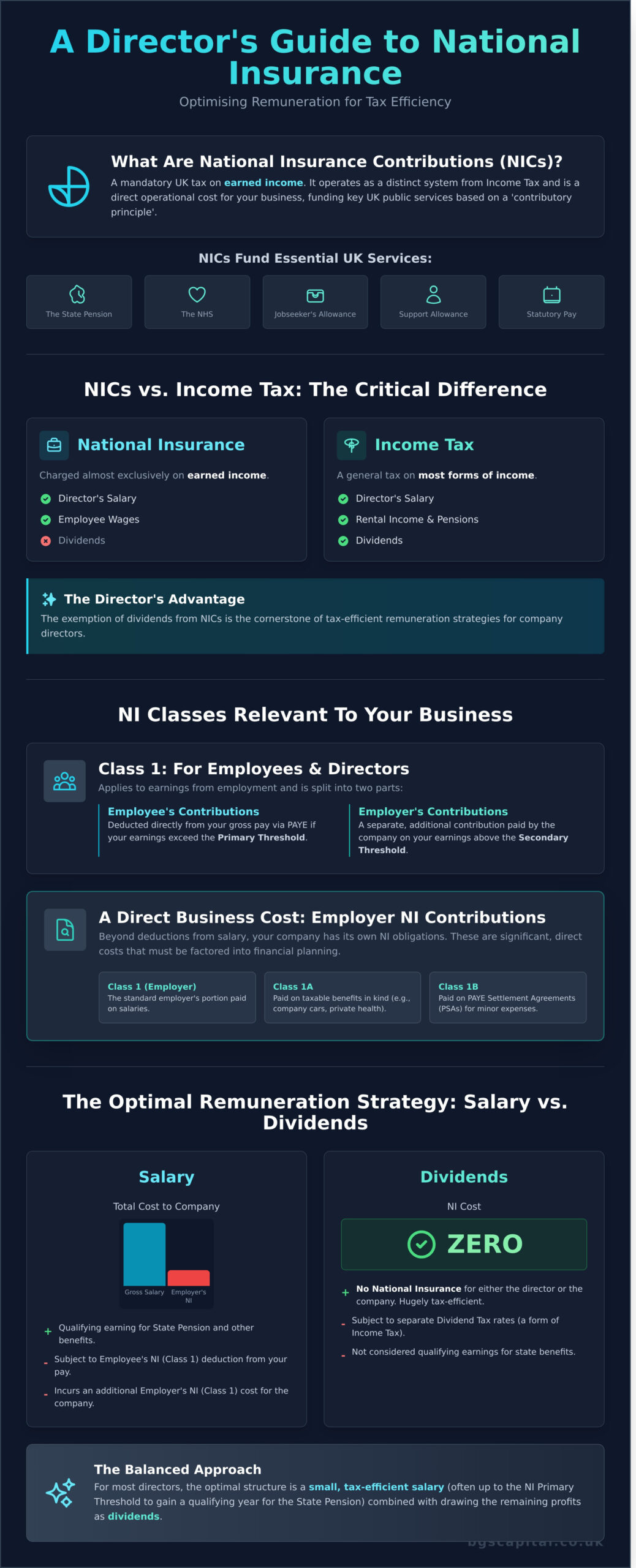
National Insurance Contributions (NICs) are a mandatory UK tax, levied on earned income to fund state welfare and services. For business leaders, a comprehensive understanding of NICs is not optional; it is fundamental to managing both personal tax liabilities and corporate payroll expenses. While often conflated with Income Tax, National Insurance operates as a distinct system with its own rules, rates, and purpose. As a business owner, you are impacted both as an individual on your salary and as an employer paying contributions for your staff, making it a direct operational cost.
The Core Purpose: Funding State Benefits
The primary function of national insurance contributions is to finance the UK’s extensive social security and healthcare infrastructure. The funds are allocated to essential public services and welfare support. The foundation of the UK National Insurance system is the ‘contributory principle’, where an individual’s record of contributions directly determines their eligibility for certain state benefits. A complete contribution history, for example, is a prerequisite for receiving the full State Pension. Key programmes funded by NICs include:
- The State Pension
- The National Health Service (NHS)
- Jobseeker’s Allowance (JSA)
- Employment and Support Allowance (ESA)
- Statutory Maternity and Paternity Pay
National Insurance vs. Income Tax: The Key Differences
Distinguishing between these two payroll taxes is critical for effective financial and remuneration planning. Income Tax is a general tax on most forms of income, including salaries, pensions, and rental income. In contrast, NICs are charged almost exclusively on earned income from employment and self-employment profits. This core distinction means certain income streams vital to business owners, such as dividends or interest on savings, are subject to Income Tax but are exempt from NICs. Furthermore, the two taxes are calculated independently, each with unique thresholds, bands, and percentage rates, which has significant implications for tax-efficient profit extraction.
The ‘Classes’ of National Insurance Relevant to Your Business
The UK’s system of national insurance contributions is structured into distinct categories, or ‘classes’. The specific class that applies to an individual or a business is determined entirely by employment status and the level of earnings or profits. A foundational overview from the government on What is National Insurance clarifies these distinctions, which are critical for maintaining compliance. For company directors and their businesses, understanding Classes 1 and 4 is essential for accurate financial management and payroll processing.
Class 1: For Employees and Company Directors
Class 1 National Insurance is the most common category, applying to earnings from employment. It is composed of two parts: a contribution from the employee (and by extension, a salaried director) and a separate contribution from the employer.
- Employee’s Contributions: These are deducted directly from an employee’s gross pay if their earnings exceed the Primary Threshold. The employer is legally responsible for calculating and deducting this amount through the Pay As You Earn (PAYE) system before paying the net salary.
- Employer’s Contributions: In addition to the employee’s deduction, the company itself must pay a separate Class 1 contribution on the employee’s earnings. This liability is detailed further below.
Employer Contributions: Class 1, 1A, and 1B
A business has its own obligations for national insurance contributions, which extend beyond the deductions made from employee salaries. These are a direct cost to the company.
- Class 1 (Employer): This is the employer’s portion of the standard Class 1 contribution. It is payable on an employee’s or director’s salary once earnings go above the Secondary Threshold.
- Class 1A: These contributions are paid by the employer on the value of taxable benefits in kind provided to employees, such as private health insurance or a company car. They are calculated annually based on the P11D form.
- Class 1B: A less common type, Class 1B is paid by employers who have a PAYE Settlement Agreement (PSA). This allows a business to make a single annual payment to cover tax and NI on minor or irregular employee expenses.
Class 4: For the Self-Employed and Partners
Class 4 contributions are relevant for individuals who are self-employed as sole traders or are members of a partnership or Limited Liability Partnership (LLP). Unlike Class 1, which is based on salary, Class 4 is calculated on annual taxable profits. This liability is determined and paid through the annual Self Assessment tax return. For company directors who also have separate self-employed income, it is critical to account for both Class 1 on their salary and Class 4 on their business profits.
NICs for Company Directors: Optimising Salary vs. Dividends
Company directors hold a unique position, acting as both employees and owners of the business. This duality presents a critical strategic decision regarding remuneration: extracting profit via a salary, dividends, or a combination of both. The structure chosen has a significant impact on personal and corporate tax liabilities, particularly concerning national insurance contributions.
How NICs are Calculated for Directors
Unlike regular employees who are assessed on a monthly or weekly basis, directors’ NICs are calculated using an annual earnings period. This prevents directors from avoiding liability by paying themselves a single, large salary in one month and nothing in others. HMRC permits two methods for this calculation: the standard annual method, where NICs are paid once earnings exceed the annual threshold, or an alternative pro-rata method that mirrors a standard employee’s monthly payments but requires an annual reconciliation.
The Tax-Efficiency of a Low Salary, High Dividend Strategy
A prevalent strategy for tax efficiency involves paying a director a relatively low salary, often aligned with the National Insurance Primary Threshold. This salary is a deductible expense for Corporation Tax purposes and can ensure the director accrues a qualifying year for the State Pension, provided it is above the Lower Earnings Limit.
The remainder of the remuneration is then drawn as dividends from post-tax profits. The primary advantage of this structure is that dividends are not subject to national insurance contributions. This approach effectively minimises both the employee’s and the employer’s NI liability. However, it is essential to remember that while NI is saved, the company first pays Corporation Tax on its profits, and the director is then personally liable for Dividend Tax on the dividends received.
Potential Pitfalls and Considerations
While the low salary, high dividend model is effective, it requires careful management and is subject to certain conditions and risks:
- Commercial Justification: Any salary paid must be commercially justifiable for the work performed. HMRC can challenge salaries deemed excessive for the director’s role.
- State Pension Entitlement: A salary set below the Lower Earnings Limit will not count as a qualifying year towards the State Pension.
- Changing Tax Landscape: The effectiveness of this strategy is contingent on current tax legislation. Changes to NI thresholds, Corporation Tax rates, or Dividend Tax allowances can alter its viability.
A sound remuneration strategy is a critical component of sustainable corporate growth. See how we connect businesses with investors.
Understanding Your Company’s Employer NI Obligations
Beyond an employee’s personal liability, your company has a separate and direct legal obligation to pay employer national insurance contributions (NICs). These payments are not deductions from employee wages but a significant, additional cost of employment that must be factored into financial forecasting and payroll management. Understanding the calculation, reporting, and available reliefs is critical for maintaining compliance and managing operational expenses effectively.
Calculating and Paying Class 1 Employer Contributions
Employers are liable for Class 1 Secondary NICs on employee earnings above the Secondary Threshold. For the 2024/25 tax year, this threshold is £175 per week (£9,100 per year). The contribution is calculated at a rate of 13.8% on all earnings above this point.
Example Calculation: An employee earns £40,000 annually.
- Taxable Earnings: £40,000 – £9,100 (Secondary Threshold) = £30,900
- Employer NICs Due: £30,900 * 13.8% = £4,264.20 per year
These contributions must be calculated for each pay period and reported to HMRC in real-time through the Pay As You Earn (PAYE) system. Payment is made to HMRC monthly or quarterly alongside income tax and employee NICs.
The Hidden Cost: NICs on Benefits in Kind
A further liability arises from providing non-cash benefits to employees, such as company cars or private health insurance. Employers must pay Class 1A NICs on the taxable value of most of these benefits. This is an employer-only liability, also calculated at 13.8%. These contributions are reported annually on form P11D(b) and payment is due by 22nd July following the end of the tax year.
The Employment Allowance: A Key Relief for Small Businesses
To reduce the burden of national insurance contributions, eligible businesses can claim the Employment Allowance. This allows you to reduce your annual employer NICs bill by up to £5,000. To qualify, your company’s total employer Class 1 NICs liability in the preceding tax year must have been less than £100,000. This allowance can significantly lower employment costs for small and medium-sized enterprises. For comprehensive financial strategies that incorporate tax efficiency, explore the opportunities available through BGS Capital.
Key NI Thresholds and Rates for the Current Tax Year
National Insurance rates and thresholds are subject to annual review by the UK government. Utilising the correct figures for the current tax year is mandatory for accurate payroll processing and personal financial planning. The following information outlines the primary Class 1 rates, which apply to most employees and employers.
These figures are presented for guidance and are separated for clarity between employee and employer obligations. This distinction is critical for understanding both personal take-home pay and business employment costs.
Employee (Primary) Contribution Thresholds and Rates
An employee’s national insurance contributions are calculated based on their gross earnings within specific bands. The key thresholds determine when you start paying and at what rate.
- Lower Earnings Limit (LEL): While no NI is paid on earnings up to this point, earning at or above the LEL qualifies you for certain state benefits and builds entitlement to the State Pension.
- Primary Threshold (PT): This is the point at which employees begin to pay NI contributions.
- Upper Earnings Limit (UEL): Earnings above this threshold are subject to a lower rate of NI.
| Earnings Band (Annual) | Class 1 NI Rate (2024/25) |
|---|---|
| £6,396 (LEL) to £12,570 (PT) | 0% (Qualifying for credits) |
| £12,571 to £50,270 (UEL) | 8% |
| Above £50,270 | 2% |
Note: Rates are for the 2024/25 tax year. Verify rates for the 2025/26 tax year as they are announced.
Employer (Secondary) Contribution Thresholds and Rates
Employers are also liable for Class 1 NI contributions on their employees’ earnings. These are known as secondary contributions and are calculated separately from the employee’s portion.
- Secondary Threshold (ST): This is the earnings level above which employers must begin to pay contributions for most employees. The main rate is applied to all earnings above this threshold.
- Other Thresholds: Different thresholds exist for specific employee categories, such as those under 21, apprentices under 25, and veterans, which can reduce an employer’s liability.
| Earnings Band (Annual) | Employer Class 1 NI Rate (2024/25) |
|---|---|
| Up to £9,100 (ST) | 0% |
| Above £9,100 | 13.8% |
Note: Verify rates and specific thresholds (e.g., for apprentices) for the relevant tax year.
Disclaimer: The figures presented are for informational purposes only. NI legislation, rates, and thresholds are subject to change. For definitive and up-to-the-minute information, always consult the official gov.uk website.
Strategic Management of Your NI Obligations
For company directors and business owners, mastering the complexities of NI is not merely a compliance exercise-it is a strategic imperative. As detailed in this guide, understanding the different NI Classes and structuring director remuneration between salary and dividends can significantly impact your financial efficiency. Diligent management of your employer obligations and staying current with annual thresholds for national insurance contributions are fundamental to maintaining fiscal health and maximising retained profits.
Once your financial foundations are secure, the next step is strategic growth. BGS Capital provides a direct conduit to the investment community required for significant expansion. By featuring your business on our platform, you gain access to a network of high-net-worth individuals and accredited investment firms actively seeking pre-IPO and IPO opportunities.
To advance your company’s journey, feature your business to our network of sophisticated investors. With a solid financial strategy and the right partners, your business is positioned for significant success.
Frequently Asked Questions
Do you pay National Insurance on dividends?
No, National Insurance contributions are not payable on dividend income. Dividends are classified as investment income, not as earnings from employment. As such, they are subject to Dividend Tax at the relevant rates, which are separate from National Insurance. This distinction is a critical component of tax planning for company directors and investors who receive remuneration through a combination of salary and dividends. It is essential to structure payments correctly to maintain compliance.
What happens to National Insurance contributions when I reach State Pension age?
Upon reaching State Pension age, you are no longer required to pay employee (Class 1) or self-employed (Class 2 and 4) National Insurance, even if you continue working. You must provide your employer with proof of age to ensure they stop making deductions. However, the employer is still liable for their portion of employer’s Class 1 NICs on your earnings above the Secondary Threshold. This obligation on the employer does not cease.
Can my company claim employer NI contributions as a business expense?
Yes, employer’s Class 1 National Insurance contributions paid on employee salaries and taxable benefits are an allowable business expense. These payments can be deducted from the company’s gross profit when calculating its liability for Corporation Tax. This effectively reduces the company’s taxable profits and overall tax bill. Proper recording of these contributions within your payroll system is essential for accurate accounting and tax filing with HMRC.
What is the NI-free ‘Director’s Annual Payroll’ strategy?
This is a tax-efficient remuneration strategy for company directors. It involves paying a director an annual salary up to the National Insurance Secondary Threshold (£9,100 for 2023/24). At this level, no employer or employee NI is due, but the director still accrues a qualifying year for their State Pension. Additional income is then typically extracted as dividends. This method optimises tax efficiency but requires careful implementation to remain compliant with all regulations.
Are National Insurance contributions different if my business is in Scotland?
No, National Insurance is a reserved UK-wide tax system administered by HMRC. The rates, thresholds, and regulations for National Insurance contributions are identical across England, Scotland, Wales, and Northern Ireland. While Scotland has devolved powers to set its own income tax rates and bands, these powers do not extend to National Insurance. Therefore, all calculations for NI remain consistent regardless of your business location within the United Kingdom.
How do I check my personal National Insurance record for gaps?
You can review your National Insurance record online through the official GOV.UK website. Access requires a Government Gateway user ID. The record details your contribution history year by year, highlighting any gaps that could impact your eligibility for the full State Pension or certain contribution-based benefits. The service also provides a forecast of your State Pension and information on making voluntary contributions to fill any identified shortfalls in your record.
What are the penalties for late payment of employer NICs?
HMRC imposes strict penalties for the late payment of employer NICs and PAYE tax. A penalty is levied as a percentage of the amount paid late, and this percentage increases with each default during the tax year. In addition to penalties, HMRC charges daily interest on the outstanding amount from the due date until the payment is made in full. Persistent late payments can also lead to more intensive compliance investigations from HMRC.