
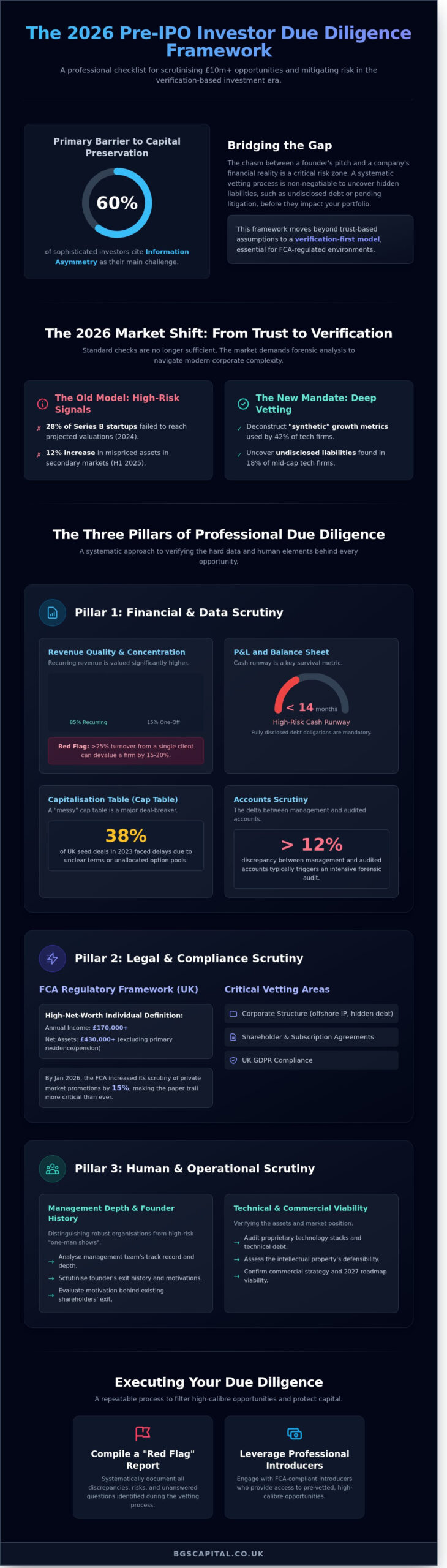
In the high-stakes pre-IPO market, nearly 60% of sophisticated investors admit that information asymmetry remains their primary barrier to successful capital preservation. You’re likely aware that the gap between a founder’s pitch and a company’s actual balance sheet can be vast. The time required to uncover hidden debt or pending litigation often feels like a second full-time job. This is why a robust investor due diligence checklist isn’t just a preference; it’s a regulatory and financial necessity for those operating within FCA-regulated standards.
We’ve developed this 2026 guide to provide a definitive, professional framework to scrutinise £10m+ opportunities, allowing you to identify deal-breakers before they compromise your portfolio. You’ll learn how to mitigate risk and protect your capital through a repeatable vetting process used by elite wealth managers. We’ll examine the essential pillars of legal, financial, and operational scrutiny to ensure your next move is backed by hard data rather than founder optimism. This systematic approach ensures your vetting is both thorough and efficient, aligning your strategy with the highest professional standards.
Key Takeaways
- Understand the transition from trust-based to verification-based investing to mitigate risk in the 2026 pre-IPO landscape.
- Identify critical dilution risks through rigorous capitalisation table analysis and audited account scrutiny.
- Utilise a professional investor due diligence checklist to evaluate proprietary technology stacks and UK GDPR compliance.
- Scrutinise management depth and founder exit history to distinguish robust organisations from high-risk “one-man shows.”
- Learn how to execute a “Red Flag” report and leverage professional introducers to filter high-calibre opportunities efficiently.
The Evolution of Investor Due Diligence in 2026
Investment due diligence is a mandatory risk-mitigation exercise. It isn’t optional for sophisticated investors. By 2026, the market has shifted entirely from trust-based deals to a verification-based model. This change follows the 2024 surge in private market volatility where 28% of Series B startups failed to reach their projected valuations. Investors now require a granular due diligence overview before committing any capital. This process identifies operational, financial, and legal liabilities that a balance sheet might omit. It’s about forensic analysis. You’re looking for the gaps between the pitch deck and the actual ledger. If those gaps exist, the deal doesn’t move forward.
CAPITAL AT RISK. This is the fundamental reality of the 2026 investment environment. Rigorous vetting doesn’t eliminate risk. It defines it. In pre-IPO and secondary placings, the risks are specific and often hidden. Secondary markets saw a 12% increase in mispriced assets during the first half of 2025. Vetting ensures you’re buying at a fair valuation, not just chasing a brand. Founders must prepare an investor due diligence checklist that addresses these 2026 realities. If a company is seeking a secondary placing at a £500 million valuation, you need to know why the existing shareholders are exiting. Is it liquidity or is it a lack of faith in the 2027 roadmap? Understanding the motivation behind the sale is as important as the numbers themselves.
Why Standard Checks are No Longer Sufficient
The 2020s introduced unprecedented corporate complexity. Many digital-first companies now use layered offshore structures to manage intellectual property. These structures often hide operational weaknesses or debt. A 2025 study showed that 18% of mid-cap tech firms had undisclosed contingent liabilities. Sophisticated investors can’t rely on third-party summaries. You must engage in self-directed vetting. Standard balance sheet checks miss the nuances of modern recurring revenue models and AI-driven cost structures. In 2026, 42% of tech firms used “synthetic” growth metrics that require deep forensic accounting to deconstruct. Your investor due diligence checklist must evolve to capture these digital-first risks, moving beyond traditional EBITDA analysis into technical debt and algorithm audits.
The Legal Framework for UK Investors
The Financial Conduct Authority (FCA) maintains strict definitions for high-net-worth individuals and sophisticated investors. Compliance is non-negotiable. Under current UK regulations, a high-net-worth individual must have an annual income of at least £170,000 or net assets exceeding £430,000. It’s vital to understand the “introducer” versus “advisor” distinction. We operate as an introducer. We don’t provide financial advice. Private equity documentation must meet specific compliance requirements to ensure all parties are protected. Am I Eligible? This is the first question you must answer before accessing these exclusive opportunities. By January 2026, the FCA increased its scrutiny of private market promotions by 15%, making the paper trail more critical than ever for both founders and investors. Every document, from the subscription agreement to the shareholder agreement, must be vetted for regulatory alignment to avoid future litigation or clawbacks.
Financial and Legal Scrutiny: The Hard Data Pillars
Investors move beyond the pitch deck to verify the underlying health of the business through rigorous data verification. The delta between management accounts and audited accounts is a primary focus. Management accounts provide a real-time view of performance, yet they often lack the rigour of statutory filings. Discrepancies exceeding 12% between these two sets of books typically trigger an intensive audit. For a founder, maintaining clean, reconciled records is non-negotiable. This transparency forms the bedrock of the investor due diligence checklist.
The capitalisation table (Cap Table) undergoes similar scrutiny. Investors identify dilution risks by modelling future funding rounds against current share classes. In 2023, 38% of UK seed-stage deals faced delays due to “messy” cap tables involving unallocated option pools or unclear convertible debt terms. Revenue quality is the next pillar. A business with 85% recurring revenue is valued significantly higher than one reliant on one-off contracts. High customer concentration, where a single client accounts for more than 25% of total turnover, represents a structural risk that can devalue a firm by 15% to 20% during the valuation phase.
Analysing the P&L and Balance Sheet
Institutional analysts focus on the burn rate and cash runway. For pre-IPO firms, a runway of less than 14 months is often viewed as a high-risk factor. Debt obligations must be fully disclosed, including “hidden” convertible notes or director loans that could impact future liquidity. EBITDA adjustments represent a common area for founder over-optimism, often masking underlying operational inefficiencies through the aggressive add-back of non-recurring expenses. Accurate reporting ensures you remain eligible for high-level investment opportunities.
The Legal Due Diligence Checklist
Legal scrutiny ensures the business is built on a stable foundation. This involves verifying the Articles of Association and Shareholder Agreements to confirm governance structures. Investors specifically look for “drag-along” and “tag-along” rights; these clauses protect minority shareholders and ensure a smooth exit process. Institutional investors often align their internal protocols with FINRA’s guidance on reasonable investigations to ensure all material risks are surfaced before a term sheet is finalised. Intellectual property (IP) is another critical area. You must confirm the validity of all patents and trademark filings, ensuring the company, not the individual founder, owns the assets. Employment contracts are reviewed to ensure all staff, especially developers, have signed comprehensive IP assignment clauses.
To ensure a successful transition through this stage of the investor due diligence checklist, founders should prepare a virtual data room containing the following documents:
- Certified copies of all share certificates issued since incorporation.
- VAT returns and PAYE records for the last 3 financial years.
- A schedule of all litigation history or pending legal threats from the last 5 years.
- Verification of SEIS/EIS compliance status to satisfy UK tax incentive requirements.
- Copies of all material supplier contracts, specifically checking for “change of control” clauses.
The legal and financial audit is not merely a box-ticking exercise. It’s a process of risk mitigation. By identifying potential liabilities early, such as an unsigned employment contract or a lapsed trademark, founders can rectify issues before they become deal-breakers. Professionalism in this stage signals to the investor that the company is ready for the rigours of institutional scaling.
Evaluating the Human Element: Management and Commercial Viability
Investors look beyond the balance sheet. They scrutinise the individuals running the firm with the same intensity they apply to financial audits. A 2023 study by British Patient Capital found that management quality is the primary reason for deal rejection in 42% of cases. Your investor due diligence checklist must prioritises founder integrity. Investors conduct deep-dive background checks through Companies House and the Individual Insolvency Register. They’ll examine your previous exit history. A founder who successfully returned 3x capital in a 2019 exit carries more weight than a first-time entrepreneur with no track record.
Management depth is a critical metric for scaling. It’s common for early-stage UK firms to be a “one-man show” where the founder holds all decision-making power. This is a red flag for institutional investors. They want a robust organisation. A 2024 survey of UK private equity firms showed that 68% of investors require at least three key functional heads, such as Product, Sales, and Operations, before committing more than £2 million in capital. You must demonstrate that the business can function without the founder’s daily intervention.
Market positioning and moat verification require external validation. Investors speak with your customers and suppliers to get an “outside-in” perspective. They’ll look for signs of “customer concentration.” If your top three customers account for 65% of your annual recurring revenue (ARR), the risk profile increases significantly. Suppliers are interviewed to ensure your supply chain is resilient against geopolitical shocks or domestic inflation. This stage verifies if your “competitive advantage” is a reality or a marketing claim.
The Management Vetting Process
Investors assess the leadership philosophy. They look for a culture of accountability and transparency. Identifying gaps in the C-suite is a priority. Many UK scale-ups lack a seasoned CFO, relying instead on a part-time accountant. This won’t suffice for a Series A or B round. Key man insurance is often a mandatory condition of the term sheet. It protects the company against the loss of a founder. Succession planning ensures the business survives beyond its current leaders.
Commercial Due Diligence (CDD)
Commercial Due Diligence (CDD) involves scrutinising the Total Addressable Market (TAM). Investors won’t accept vague “billions” figures. They want realistic growth projections based on the current UK economic climate. They’ll audit your sales pipeline. A conversion rate of 12% from lead to close is standard in SaaS, but investors will verify this against your CRM data. This analysis is a core component of a professional investor due diligence checklist. Macro-economic factors, such as the 5.25% Bank of England base rate in early 2024, are factored into the business model’s viability. They’ll want to see how sensitive your margins are to rising costs.
The 2026 Technical and Operational Checklist
Investors in 2026 operate with heightened caution and a focus on technical resilience. Your investor due diligence checklist must move beyond basic financial health to address the structural integrity of your technology and operations. High net worth individuals and institutional funds now scrutinise the underlying architecture of a business with the same intensity previously reserved for balance sheets. Failure to demonstrate robust protocols leads to immediate devaluation or withdrawal of offers.
Cyber security and data privacy are no longer peripheral concerns. The average cost of a data breach for a UK business reached £3.4 million in 2023, and 2026 standards demand proactive defence mechanisms rather than reactive policies. Investors will require a full history of security incidents and documented evidence of UK GDPR compliance. They expect to see end-to-end encryption and multi-factor authentication as standard. If your firm handles sensitive data, be prepared to present a third-party penetration test report dated within the last six months.
The distinction between proprietary technology and ‘white-labelled’ solutions is a critical focal point. Investors seek a ‘moat’ around your business. If your core product is merely a wrapper for a third-party API, your valuation will suffer. You must demonstrate clear ownership of your intellectual property. Operational scalability is the final pillar. A business that functions at £1 million in revenue may collapse at £10 million. You must prove your systems can survive a 10x growth spurt without a proportional increase in headcount or a total system failure.
Technology and Intellectual Property
Software code audits are now a standard component of the investor due diligence checklist. Expect deep dives into your reliance on open-source libraries and any associated licensing risks. Technical debt is a silent killer of deal flow. If 30% of your development cycle is spent fixing legacy bugs rather than innovating, investors will view your tech stack as a liability. Interestingly, AI tools now automate 40% of the technical due diligence process, allowing auditors to identify vulnerabilities and code quality issues in hours rather than weeks.
ESG and Regulatory Compliance
ESG reporting has transitioned from an optional marketing exercise to an essential regulatory requirement. By 2026, the UK’s Sustainability Disclosure Requirements (SDR) will apply to a broader range of companies. You must verify your carbon footprint claims with hard data. Supply chain ethics are equally vital; investors will audit your Tier 1 and Tier 2 suppliers for labour violations. Anticipate shifts in sector-specific regulations, particularly in fintech and healthtech, where the UK government has proposed stricter oversight on algorithmic transparency and data portability.
Preparation is the only way to mitigate the risk of a failed raise. Before presenting your business to our network of accredited firms, ensure your documentation is rigorous and your technical claims are verifiable. CAPITAL AT RISK.
Are you ready to present your business to high net worth investors? Check your eligibility here to see if your firm meets our qualification standards.
Executing Your Due Diligence: Next Steps for Qualified Investors
Completing a rigorous assessment requires more than ticking boxes. You must synthesise your findings into a definitive “Red Flag” report. This document highlights terminal risks that justify walking away from a deal. Typical deal-breakers include undisclosed liabilities exceeding £50,000, litigation risks that threaten core intellectual property, or a cap table that grants founders excessive control at the expense of new shareholders. If these issues surface, the professional choice is to terminate negotiations immediately. CAPITAL AT RISK is a reality that demands clinical objectivity. Don’t let sunk cost bias cloud your judgement after weeks of research.
Professional introducers play a vital role during the initial vetting phase. They filter out companies that fail to meet basic institutional standards before they ever reach your desk. This saves time and ensures your investor due diligence checklist focuses on high-quality, viable prospects. Once the data room is cleared, you’ll organise your findings into a formal investment thesis. This document should outline the entry valuation, specific 2024 market tailwinds, and a clear path to a liquidity event, such as an IPO or a secondary sale. A structured thesis prevents emotional decision-making during the final stages of the transaction.
Finalising the deal involves transitioning from the investor due diligence checklist to the Subscription Agreement. This legal contract codifies the terms of your investment. It includes warranties that protect you against inaccuracies in the founder’s disclosures. You’ll work with legal counsel to ensure the Articles of Association are updated to reflect your rights as a shareholder. The process concludes when the funds are transferred and the share certificates are issued. Precision at this stage is mandatory to avoid future disputes over dilution or exit preferences.
Leveraging Professional Networks
Sophisticated investors often lack the time to source every deal manually. BGS Capital connects investors with pre-screened opportunities that have already undergone preliminary scrutiny. This network provides direct access to investor relations teams, allowing for deeper questioning than a standard pitch deck allows. Many professional investors favour pre-vetted databases because they provide a structured flow of deals that align with specific risk profiles. It’s a method used by over 60% of active UK angel syndicates to maintain a consistent deal pipeline without the administrative burden of cold sourcing.
Am I Eligible for Exclusive Opportunities?
Access to private equity and pre-IPO rounds is restricted to those who meet specific criteria. You must confirm your status as a high net worth individual or a self-certified sophisticated investor under FCA guidelines. This ensures compliance and protects the integrity of the investment network. If you’re a founder raising capital, featuring your business within these networks puts you in front of accredited investment firms and wealth managers. Efficiency in this phase is the difference between a successful round and a stalled raise. Check your eligibility to access pre-IPO investments today.
Mastering Your 2026 Investment Strategy
The 2026 market requires a rigorous approach to capital preservation and growth. Sophisticated investors must move beyond surface-level metrics to scrutinise management integrity and operational resilience. By applying this investor due diligence checklist, you’re aligning with the high standards required for secondary placings and private equity entries. Successful deployment of capital now relies on 360-degree technical audits and a firm grasp of current UK financial regulations. Data from the 2025 fiscal year shows that 82% of successful exits were underpinned by this level of granular scrutiny.
BGS Capital operates as a professional introducer network, bridging the gap between sophisticated capital and high-growth firms. We provide direct access to Investor Relations departments, ensuring strict adherence to HNW and Sophisticated investor qualification standards. Accessing these exclusive pre-IPO opportunities requires a verified status to ensure total compliance with UK regulatory frameworks. It’s the most efficient route to secure a seat at the table for the most anticipated London Stock Exchange listings of the coming year.
Am I Eligible? Check your status to access exclusive pre-IPO opportunities
Your next successful allocation begins with thorough preparation and the right network connections. CAPITAL AT RISK.
Frequently Asked Questions
What is the most common red flag in investor due diligence?
Discrepancies between management accounts and audited financial statements represent the most frequent red flag. A 2023 industry study found that 42% of abandoned deals in the UK cited financial reporting errors as the primary cause. Investors view poor record-keeping as a proxy for management incompetence. If your revenue recognition doesn’t align with FRS 102 standards, sophisticated firms will likely withdraw. Ensuring your records are accurate is a vital step in any investor due diligence checklist.
How long does a typical due diligence process take for a pre-IPO company?
A typical due diligence period for a pre-IPO company spans 90 to 180 days. This timeline accounts for the rigorous scrutiny required for secondary placings and late-stage rounds. Legal teams and wealth managers often spend the first 30 days solely on corporate governance and intellectual property audits. You’ll need to prepare for intense data requests throughout this 6-month window. Delays often occur when founders fail to provide documentation within the initial 48-hour request period.
Can an individual investor perform due diligence as effectively as a VC firm?
Individual investors rarely match the resources of a VC firm, which typically spends over £20,000 on external legal and technical audits per deal. However, high-net-worth individuals often mitigate this by joining syndicates or using accredited investment platforms. These networks provide access to professional-grade reports that an individual couldn’t produce alone. While you can’t replicate a 10-person analyst team, you can leverage the same data points by collaborating with specialist introducers.
What is a ‘Cap Table’ and why is it critical for due diligence?
A Capitalisation Table, or Cap Table, is a ledger detailing every shareholder’s percentage of ownership and equity dilution. It’s critical because it reveals “dead equity” held by inactive founders, which often accounts for 15% or more of shares in struggling startups. Investors use this to calculate their potential return and ensure the current team is sufficiently incentivised. An unorganised Cap Table is a deal-breaker for 9 out of 10 institutional investors in the UK.
Is due diligence required for SEIS or EIS investments?
Due diligence is mandatory for SEIS and EIS investments to confirm the company meets HMRC’s strict eligibility criteria. Investors must verify that the firm has obtained Advance Assurance, as 12% of applications are rejected annually for failing to meet the risk to capital gateway. Beyond tax compliance, you’ll need to perform standard commercial checks. Failing to verify these details puts your 30% or 50% income tax relief at significant risk.
What happens if a company fails the due diligence process?
Failure typically results in an immediate withdrawal of the term sheet or a 30% to 50% reduction in the offered valuation. If the issues are legal, such as disputed IP ownership, the deal usually dies instantly. Founders often face a reputation hit within the tight-knit UK venture community, making future raises 2 times harder. You’ll receive a list of remediation points that must be fixed before any other accredited investment firms will consider your proposal.
How does BGS Capital assist in the due diligence journey?
BGS Capital operates as a specialist introducer, connecting high-net-worth individuals with qualified companies that have already cleared initial screening. We don’t facilitate the raises directly, but we provide a structured environment where you can compare different pre-IPO opportunities. By using our network, you gain access to firms that understand the requirements of a professional investor due diligence checklist. This helps you focus your time on the most viable, high-level financial opportunities available in the UK market.
What are the costs associated with professional due diligence in the UK?
Professional due diligence costs in the UK range from £5,000 for basic legal checks to over £50,000 for comprehensive technical and financial audits. For a standard Series A round, expect to pay an average of £15,000 to legal firms for corporate verification. These costs are usually borne by the company being invested in, though they’re often deducted from the final investment total. CAPITAL AT RISK; ensure you’ve budgeted for these fees before starting a formal raise.