
For founders in the United Kingdom, securing growth capital is a pivotal yet often opaque process. The primary challenge is not a lack of viable businesses, but a lack of clear pathways to connect with the right sources of funding. Without an established network, identifying and approaching legitimate private investors UK-wide can feel like a formidable task, leaving entrepreneurs overwhelmed by the legal preparation and fearful of crafting a pitch that fails to resonate or leads to an unfavourable deal.
This comprehensive guide is designed to eliminate that uncertainty. We provide a direct, step-by-step playbook for preparing your company for investment, systematically identifying suitable capital partners, and executing a professional engagement strategy. By following this framework, you will gain an actionable plan to confidently approach investors and secure the funding necessary to drive your business forward.
Key Takeaways
- Secure investor interest by preparing essential documentation first; this guide details the exact business plan, pitch deck, and financial models required.
- Identify and connect with qualified private investors uk by leveraging a strategic mix of online platforms, exclusive networks, and professional advisory services.
- Master the art of the initial outreach with proven templates and professional etiquette to ensure your first pitch secures a follow-up meeting.
- Navigate the complexities of due diligence and term sheet negotiations with a clear understanding of what investors scrutinise post-pitch.
Understanding the Landscape: Who Are UK Private Investors?
To effectively secure funding, it is critical to understand the landscape of private investors in the UK. Unlike institutional entities, these individuals and groups deploy their personal capital, driven by a unique combination of financial and strategic motivations. Navigating this environment requires a clear understanding of who they are, how they differ from venture capital, and what they seek in an investment opportunity.
Defining the Key Investor Profiles
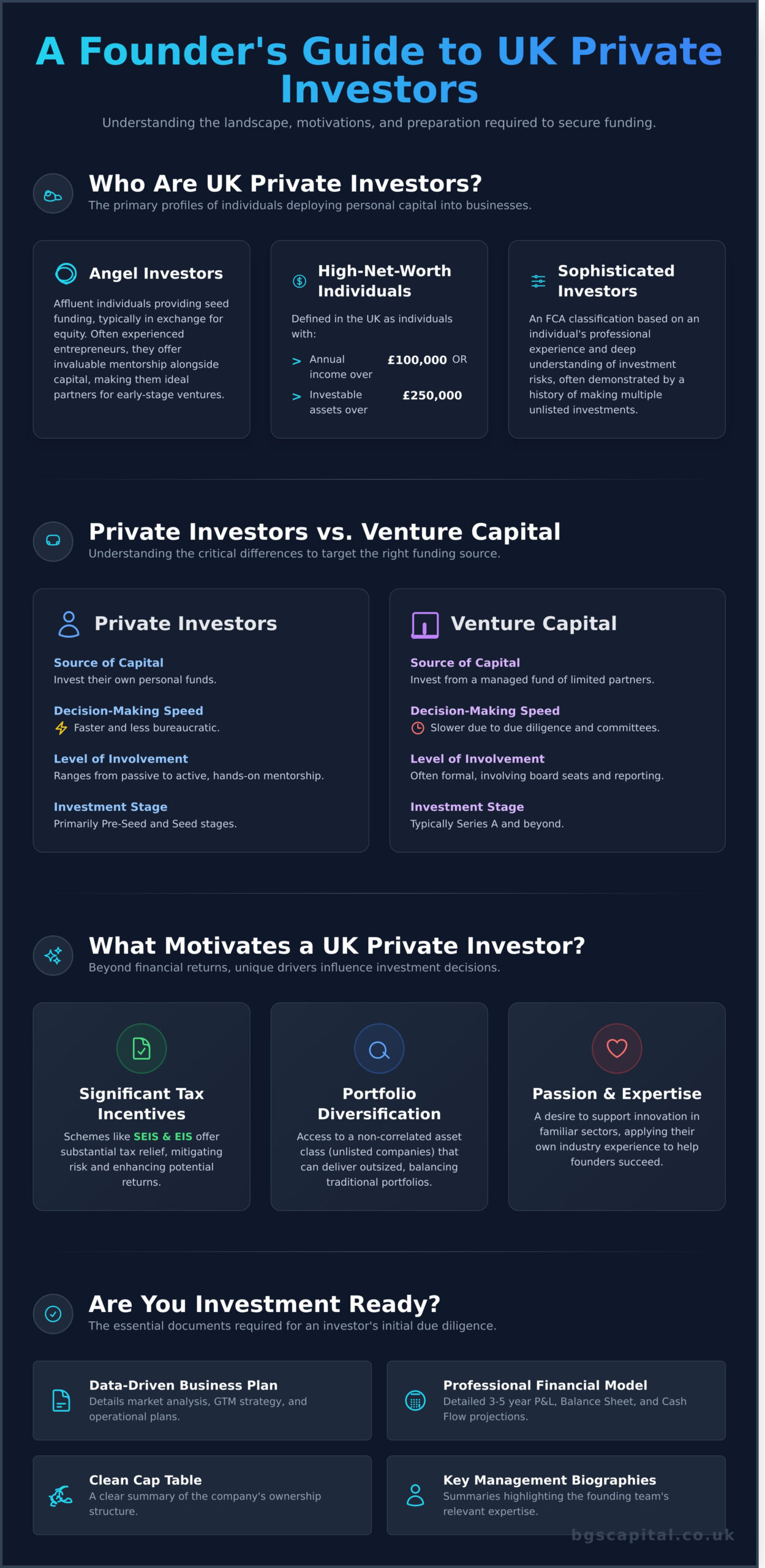
The term ‘private investor’ encompasses several distinct categories, each with different criteria and investment appetites. The primary profiles you will encounter include:
- Angel Investors: These are typically affluent individuals who provide capital for a business start-up, usually in exchange for ownership equity. An Angel investor is often an experienced entrepreneur, offering valuable mentorship alongside seed funding.
- High-Net-Worth Individuals (HNWIs): In the UK, an HNWI is officially defined as an individual with an annual income over £100,000 or investable assets exceeding £250,000, excluding their primary residence. Their investments may be larger and part of a broader portfolio strategy.
- Sophisticated Investors: This classification is defined by the Financial Conduct Authority (FCA) based on an individual’s professional experience and understanding of investment risks, such as having made multiple unlisted investments in the past two years.
Private Investors vs. Venture Capital: Critical Differences
While both provide capital, their operational models are fundamentally different. Understanding these distinctions is crucial for targeting the right funding source.
- Source of Capital: Private investors use their own funds. Venture Capital (VC) firms invest capital from a managed fund of limited partners.
- Decision-Making Speed: Decisions from individuals are often faster and less bureaucratic than the extensive due diligence and committee approvals required by VCs.
- Level of Involvement: Involvement ranges from passive financial backing to active, hands-on mentorship and strategic guidance based on direct industry experience.
- Investment Stage: Private capital is frequently deployed at the earliest stages (pre-seed and seed), often before a company is ready for institutional VC funding.
What Motivates a Private Investor in the UK?
Financial return is a primary driver, but the motivations for private investors uk are often more nuanced and are heavily influenced by the UK’s unique regulatory and fiscal environment.
- Significant Tax Incentives: The UK Government’s Seed Enterprise Investment Scheme (SEIS) and Enterprise Investment Scheme (EIS) offer substantial income tax relief and capital gains exemptions, mitigating risk and enhancing potential returns.
- Portfolio Diversification: Investing in unlisted, high-growth companies provides access to a non-correlated asset class that can deliver outsized returns, balancing a traditional portfolio of public equities and bonds.
- Passion and Expertise: Many investors are motivated by a desire to support innovation in sectors they understand well, applying their own industry experience to help founders succeed.
Step 1: Preparing Your Business for Investment Scrutiny
Before you approach any private investors in the UK, a rigorous preparation phase is non-negotiable. This is not an administrative task; it is the foundation of your entire fundraising campaign. Sophisticated investors scrutinise hundreds of opportunities. Your ability to present a clear, credible, and data-backed case from the first interaction will determine whether you secure a meeting or are immediately dismissed. Professionalism at this stage signals a well-managed enterprise worthy of investment.
The Essential Investment Readiness Checklist
Investors require a standardised set of documents to conduct their initial due diligence. Your readiness to provide these materials demonstrates seriousness and competence. Ensure you have the following prepared:
- A Data-Driven Business Plan: A comprehensive document detailing your market analysis, competitive landscape, go-to-market strategy, and operational plan.
- Professional Financial Model: Detailed 3-5 year projections (P&L, Balance Sheet, Cash Flow) with all key assumptions clearly stated and defensible.
- Clean Cap Table: A clear summary of the company’s ownership structure, including all shareholders and their respective equity stakes.
- Key Management Biographies: Concise summaries of the founding team’s relevant experience, highlighting domain expertise and past successes.
Crafting a Compelling Pitch Deck and Executive Summary
Your pitch deck is your business’s visual narrative, typically structured around 10-12 core slides: Problem, Solution, Market Size, Product, Business Model, Team, and Financials. However, the one-page Executive Summary is often the first document an investor reads. It must be a powerful, concise summary of the entire investment opportunity. Focus on demonstrating traction-user growth, revenue, key partnerships-as verifiable metrics are far more persuasive than abstract ideas.
Determining Your Valuation and Funding Ask
Articulating a logical valuation is critical. For early-stage UK companies, methodologies like the Berkus Method, Scorecard Valuation, or referencing comparable market transactions are common. Resources from industry bodies like the UK Business Angels Association can provide further context on market norms. You must also clearly justify your funding ask. Provide a precise breakdown of how the capital will be deployed-for instance, £150,000 for key engineering hires and £50,000 for a targeted marketing campaign-and link this expenditure directly to achieving specific milestones.
Step 2: Where to Find Private Investors in the UK
Identifying and connecting with the right investors requires a multi-channel strategy, leveraging both ‘warm’ network-based introductions and ‘cold’ but highly efficient digital platforms. A systematic approach, targeting sources where qualified investors are actively seeking opportunities, is essential for a successful capital raise.
Leveraging Angel Investment Networks and Syndicates
Angel networks are formal groups of High Net Worth Individuals (HNWIs) who actively invest in early-stage companies. National organisations like the UK Business Angels Association (UKBAA) provide accreditation and resources, while numerous regional networks focus on specific hubs like London, Manchester, and Edinburgh. For larger funding rounds, syndicates are crucial, allowing multiple investors to pool capital, share due diligence, and execute a single, substantial investment.
Using Professional Introducer Platforms
For founders seeking efficiency and direct access, professional introducer platforms offer a direct conduit to a pre-vetted network of investors. These services connect qualified businesses with sophisticated investors, HNWIs, and family offices actively seeking opportunities. This model streamlines the search for private investors uk-based, bypassing gatekeepers and allowing direct engagement with investor relations teams. By leveraging such a network, you can significantly accelerate your fundraising timeline. Feature your business to a network of qualified investors.
Tapping into Your Professional and Personal Network
Warm introductions remain one of the most effective methods for securing investment. Systematically map your existing professional network, including lawyers, accountants, and industry advisors. These professionals often have direct connections to potential investors and can make credible introductions. The key is to request an introduction or advice, not to ask for investment directly. Your advisors can also provide context on the wider funding landscape, including relevant government finance and support schemes that may complement private equity.
Attending Industry Events and Pitch Competitions
Sector-specific conferences, trade shows, and finance summits are valuable for direct engagement. Identify key events in your industry and prepare a networking strategy to connect with investors in attendance. Pitch competitions, in particular, provide a high-visibility platform to present your business to a concentrated audience of active investors, often leading to immediate follow-up conversations and due diligence.
Step 3: The Art of the Approach and First Pitch
Once potential investors are identified, the approach phase begins. This stage is critical; a professional, concise, and tailored outreach strategy is non-negotiable when dealing with sophisticated private investors UK. Your objective is not to secure funding in the first email, but to earn the right to a conversation. Every interaction must reinforce your credibility and the viability of your proposition.
The Warm Introduction vs. Cold Outreach
A warm introduction from a trusted mutual contact is the superior method. When requesting one, provide your contact with a concise, forwardable email summary of your business and the specific ‘ask’. For cold outreach, precision is paramount. Structure your email to be scannable and impactful:
- Subject Line: Be specific. “Intro: [Your Company Name] – [One-Liner About Your Business]” or “Referred by [Mutual Contact Name]: [Your Company Name]”.
- Body: Briefly state who you are, what your company does, why you are contacting them specifically (e.g., their portfolio, expertise), and include key traction metrics.
- The Ask: Clearly request a brief 15-20 minute introductory call to discuss further. Attach your executive summary or a one-page teaser, not a full pitch deck.
Nailing the Initial Investor Pitch Meeting
The first meeting is a high-level qualification exercise for both parties. Your goal is to secure a second, more detailed meeting, not to close the deal. Present your pitch deck with clarity and confidence, focusing on the problem, your solution, the market size, and your team. Be prepared to answer common questions regarding your financial projections, competitive landscape, and use of funds. The most successful founders demonstrate deep market knowledge and an understanding of the challenges ahead.
Post-Meeting Follow-Up and Building Momentum
Professional follow-up is essential for maintaining momentum. Send a thank-you email within 24 hours, briefly recapping key discussion points and reiterating your interest. Manage your outreach using a simple CRM or spreadsheet to track interactions, follow-up dates, and feedback. For investors who express interest but are not ready to commit, provide periodic, concise updates on significant milestones. This keeps your venture top-of-mind and demonstrates progress. Success in raising capital from private investors uk often depends on this disciplined process management.
Step 4: Navigating Due Diligence and Term Sheets
Securing a verbal commitment from an investor is a significant milestone, but it marks the beginning of the most critical phase: formal evaluation and negotiation. This is where your business model, financials, and legal structure undergo intense scrutiny. Successfully navigating this stage is essential to closing the investment round.
The Due Diligence Process Explained
Due diligence is the comprehensive process by which investors verify the claims made in your pitch deck and subsequent conversations. It is a meticulous audit designed to uncover risks and validate the investment opportunity. To prepare, you must assemble a virtual data room (VDR) containing all relevant documentation. Key areas of focus include:
- Financial: Audited accounts, management accounts, financial projections, and breakdown of key metrics.
- Legal: Company incorporation documents, cap table, shareholder agreements, IP registrations, and key customer contracts.
- Technical: Product roadmaps, technology stack documentation, and demonstrations of core IP.
- Team: Background checks and verification of key personnel credentials.
Understanding Key Term Sheet Clauses
If due diligence is satisfactory, the investor will issue a term sheet. This is a non-binding document outlining the proposed terms of the investment. It forms the basis for the final, legally binding agreements. Critical clauses to understand include:
- Valuation: This will be stated as a ‘pre-money’ valuation (the company’s value before the investment) and a ‘post-money’ valuation (pre-money plus the investment amount). For example, a £500,000 investment on a £2M pre-money valuation results in a £2.5M post-money valuation.
- Liquidation Preferences: This clause dictates the payout order in the event of a sale or liquidation. A ‘1x non-participating’ preference, for instance, means the investor gets their initial investment back before other shareholders receive anything.
- Board Seats and Investor Rights: Most professional private investors UK will require a seat on your board of directors and specific veto rights over major corporate decisions.
The Role of Legal Counsel in Closing the Round
It is imperative to engage a solicitor with specific experience in UK early-stage corporate finance. Attempting to negotiate shareholder agreements without expert legal counsel is a significant risk. Your lawyer will review the term sheet, negotiate the final binding shareholder’s agreement on your behalf, and ensure the entire transaction complies with UK company law, including regulations surrounding schemes like SEIS/EIS. This professional oversight protects your interests and ensures the legal foundation of your company is secure for future growth.
For qualified companies seeking to connect with a network of sophisticated investors, explore the opportunities at BGS Capital.
Execute Your Fundraising Strategy with Confidence
The journey to securing funding is a structured process. It demands meticulous preparation of your business fundamentals, a professional approach to due diligence, and a clear understanding of the investment landscape. Successfully finding and engaging the right private investors uk is the critical component that transforms a solid business plan into a funded enterprise.
Navigating this landscape efficiently requires direct access to a qualified network. BGS Capital is an introducer, specialising in connecting growth-stage and pre-IPO companies with our curated network of High Net Worth and sophisticated investors. We streamline the process by facilitating direct introductions, placing your opportunity in front of the decision-makers ready to invest in compelling ventures.
Take the definitive next step in your capital raise. Connect with pre-qualified investors and feature your business on BGS Capital.
With a clear strategy and the right connections, your funding goals are firmly within reach.
Frequently Asked Questions
How much equity do private investors in the UK typically take?
The equity stake for a private investor is contingent on the company’s valuation, stage, and the capital required. For early-stage or seed funding rounds, investors typically seek between 10% and 25% of the company. A smaller, individual angel investment might secure a 5-10% stake. The final percentage is a critical point of negotiation, balancing the founder’s dilution against the investment needed to achieve key milestones and facilitate growth.
What is the legal difference between a ‘sophisticated investor’ and a ‘high-net-worth individual’?
These are distinct classifications under FCA regulations that determine eligibility for certain non-mainstream investments. A ‘high-net-worth individual’ qualifies based on financial standing, requiring an annual income over £170,000 or net assets exceeding £430,000. In contrast, a ‘sophisticated investor’ qualifies through experience, such as having made multiple angel investments, being a director of a large company, or membership in a business angel syndicate.
Are private angel investors regulated by the Financial Conduct Authority (FCA)?
Individual angel investors are not directly regulated by the FCA. However, the act of promoting investment opportunities to them is a regulated activity. Any firm, platform, or individual introducing investors to unlisted securities must be FCA-authorised or operate under a specific regulatory exemption. This framework ensures financial promotions are clear, fair, and not misleading, and requires investors to self-certify their status before they can be approached with opportunities.
How long does the entire process of securing funding from a private investor usually take?
Securing investment is a multi-stage process that typically takes between three and nine months from initial contact to the transfer of funds. This timeline encompasses investor outreach, pitching, due diligence, term sheet negotiation, and the finalisation of legal documentation. A well-prepared data room and clear financial projections can significantly expedite the due diligence phase, which is often the most time-consuming part of the process for many private investors in the UK.
What are the typical legal costs for a founder when closing an investment round?
For a UK-based founder closing a seed or angel investment round, legal fees commonly range from £5,000 to £15,000 plus VAT. The final cost depends on the deal’s complexity, the number of investors involved, and the extent of negotiations over the shareholders’ agreement and articles of association. It is standard practice to secure a fixed-fee quote from a law firm with specific expertise in early-stage venture capital to ensure cost predictability.
Do I need to be SEIS or EIS eligible to attract private investors in the UK?
While not an absolute requirement, eligibility for the Seed Enterprise Investment Scheme (SEIS) or Enterprise Investment Scheme (EIS) is a powerful advantage. These government schemes provide significant tax reliefs to investors, which de-risks their capital and makes the investment proposition substantially more attractive. Many UK angel investors and syndicates exclusively focus on SEIS/EIS-eligible companies, so lacking this status can limit your access to a large segment of the market.