
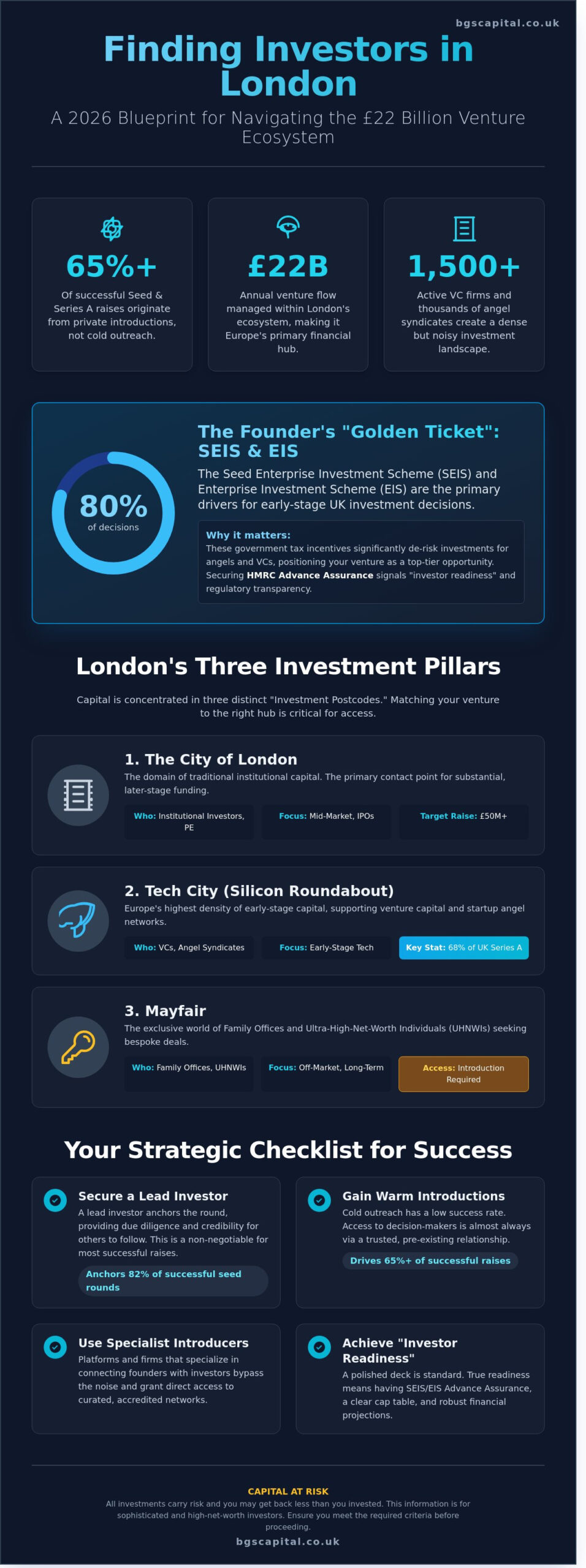
In 2024, data from the British Business Bank indicated that over 65% of successful seed and Series A raises in the capital originated from private introductions rather than cold outreach. Finding investors in London requires more than a polished deck; it demands entry into the specific networks that manage the city’s £22 billion annual venture flow. You’re likely aware that London remains Europe’s primary financial hub, yet the sheer volume of 1,500 active VC firms and thousands of angel syndicates often creates more noise than tangible opportunity. CAPITAL AT RISK.
This guide provides the technical framework to operate within this ecosystem with professional precision. You’ll master the precise eligibility requirements for SEIS and EIS tax incentives, which remain the primary drivers for 80% of early-stage UK investment decisions. We’ll outline the specific hubs for 2026, from Mayfair’s private offices to Old Street’s tech syndicates, and explain the process of securing a listing or introduction through a credible introducer platform.
Key Takeaways
- Navigate the 2026 London investment landscape by identifying the distinct roles of seed-stage angels, venture capital funds, and multi-billion pound family offices.
- Master the application of SEIS and EIS tax incentives to position your venture as a “golden ticket” opportunity when finding investors in London.
- Implement a precise strategy for securing HMRC Advance Assurance to signal regulatory transparency and “investor readiness” to sophisticated capital providers.
- Map your business to specific geographic hubs, such as aligning Fintech ventures with the institutional expertise located in The City.
- Learn how to feature your business through specialist introducers to gain direct exposure to a curated network of accredited investment firms and high-net-worth individuals.
Understanding the London Investment Landscape in 2026
London remains the primary global centre for venture capital and private equity. In 2026, the city’s financial district manages over £4.2 trillion in assets, maintaining its status as a critical node for international wealth. Finding investors in London requires a granular understanding of a diverse ecosystem. This network spans from seed-stage angel syndicates in East London to multi-billion pound family offices in the West End. The landscape isn’t monolithic; it’s a segmented market where capital access depends on your firm’s specific growth stage and regulatory compliance.
The year 2026 is a pivotal period for fundraising. Following the full implementation of the 2024 Listing Rules reforms and the subsequent 2025 Capital Markets Efficiency Act, the path from private funding to the London Stock Exchange (LSE) is now more streamlined. These regulatory shifts have encouraged a 15% increase in domestic institutional allocations toward high-growth UK companies. Investors are no longer just looking for stability; they’re seeking “sophisticated” opportunities in a post-reform environment that rewards transparency and rapid scaling.
The Three Pillars of London Finance
Capital in London is geographically concentrated into three distinct “Investment Postcodes” that dictate the type of funding available:
- The City of London: This is the domain of traditional institutional capital. Firms here focus on mid-market private equity, secondary placings, and IPO-focused investment trusts. If your company is targeting a £50 million plus raise, the City’s accredited investment firms are the primary contact point.
- Tech City (Silicon Roundabout): Centred in Shoreditch, this pillar supports the venture capital and startup angel networks. It’s the highest density of early-stage capital in Europe. By Q1 2026, Shoreditch-based funds accounted for 68% of all Series A rounds in the UK.
- Mayfair: This district houses the secretive world of family offices and ultra-high-net-worth individuals (UHNWIs). Access here is restricted and often requires a formal introduction. These investors typically seek bespoke, off-market opportunities and long-term wealth preservation.
Why London Remains the Preferred Hub for International Investors
International capital flows into London because of the sheer concentration of wealth managers and accredited firms. The LSE remains a central driver for pre-IPO interest, providing a clear exit strategy that many other European hubs lack. Data from the 2025 Fiscal Year shows that 44% of European tech exits were facilitated through London-based financial intermediaries. Successful strategies for finding investors in London focus on these established conduits rather than cold outreach.
The London investment ecosystem is a multi-layered network of accredited firms and private individuals.
Identifying the Right Type of London Investor for Your Business
Securing capital in the UK’s financial hub requires a precise match between your company’s growth stage and an investor’s specific mandate. London’s investment landscape is segmented into three primary tiers: angel investors, venture capitalists (VCs), and private equity (PE) firms. Each operates with distinct risk tolerances and exit horizons. In the 2026 market, finding investors in london depends heavily on identifying a “Lead Investor” early. Data from 2025 indicates that 82% of successful seed rounds in the City were anchored by a lead investor who contributed at least 25% of the total raise, providing the due diligence framework for others to follow.
The “sweet spot” for modern London funds has shifted towards sector-specific expertise. Generalist funds still exist, but 64% of new capital deployed in the first quarter of 2026 went to firms with dedicated desks in Fintech, Healthtech, or ESG-compliant sectors. Syndicates have also risen in prominence. These groups aggregate smaller cheques from multiple high-net-worth individuals into a single legal entity, simplifying your cap table while providing access to a broader pool of “Smart Capital.”
London Angel Investors: The First Step for Startups
Angel networks like Envestors and the London Business Angels remain the primary entry point for early-stage UK ventures. For a typical seed round in 2026, expect individual cheque sizes to range between £25,000 and £150,000. These investors prioritise SEIS and EIS eligible companies to mitigate risk. Beyond cash, these individuals provide “Smart Capital,” offering board-level mentorship and vital introductions to institutional followers. Before approaching these networks, you should check your eligibility for high-level introductions to ensure your documentation meets current City standards.
Venture Capital and Private Equity: Scaling in the Capital
London-based VCs are currently managing an estimated £14.8 billion in “dry powder” as of early 2026. This capital is specifically earmarked for companies that have moved beyond the proof-of-concept phase. Identifying the right VC involves analysing their active investment cycle; firms in their first three years of a fund are typically more aggressive than those nearing the end of their ten-year term. Private equity firms in London now frequently target mid-market firms for “buy-and-build” strategies, focusing on EBITDA-positive companies. Wealth managers also play a critical role here, acting as gatekeepers for ultra-high-net-worth individuals who participate in secondary placings and pre-IPO rounds. CAPITAL AT RISK.
Navigating UK Regulations: SEIS, EIS, and Investor Qualification
CAPITAL AT RISK. London’s private equity and venture capital ecosystem operates within a strict regulatory framework. For those finding investors in London, the Seed Enterprise Investment Scheme (SEIS) and the Enterprise Investment Scheme (EIS) are not merely incentives; they’re structural requirements. These schemes represent the primary mechanism for de-risking early-stage capital. Statistics from HMRC indicate that in the 2022/23 tax year, over 12,000 companies raised more than £1.9 billion through these programmes.
The SEIS and EIS Advantage
SEIS is designed for very early-stage startups, allowing firms to raise up to £250,000. Investors receive 50% income tax relief on their investment. EIS targets larger, growth-focused rounds, allowing companies to raise up to £5 million annually. Most London-based angel syndicates won’t review a pitch deck unless the company has secured “Advance Assurance” from HMRC. This formal confirmation proves the business meets the qualifying criteria. SEIS/EIS assurance significantly de-risks an investment for a London angel by providing an immediate tax cushion and downside protection.
- Income Tax Relief: Investors can reduce their tax bill by 30% (EIS) or 50% (SEIS) of the investment amount.
- Capital Gains Disposal Relief: No Capital Gains Tax is due on profits earned from shares held for at least three years.
- Inheritance Tax Relief: Shares usually qualify for 100% Business Relief after two years of ownership.
Who are Sophisticated and High-Net-Worth Investors?
The Financial Conduct Authority (FCA) governs how investment opportunities are promoted. Under COBS 4.7, firms can only market “non-readily realisable securities” to individuals who have self-certified their status. A High-Net-Worth Individual (HNWI) must confirm an annual income exceeding £100,000 or net assets of at least £250,000, excluding their primary residence and pension. A Sophisticated Investor must demonstrate financial literacy, often through membership in a business angel network for at least six months or by serving as a director of a company with a £1.6 million annual turnover.
BGS Capital operates strictly as an introducer within this ecosystem. We don’t facilitate raises directly; instead, we ensure only qualified investors access specific opportunities. This gatekeeping function is vital for maintaining regulatory compliance. Finding investors in London is a process that demands transparency. BGS Capital ensures that every introduction meets the rigorous standards of the Financial Services and Markets Act 2000, protecting both the issuer and the accredited investment firms involved.
A Step-by-Step Strategy for Finding Investors in London
Securing capital in the UK capital requires a methodical, transactional approach. By 2026, the competition for private equity and angel funding has intensified; only those with a clear roadmap will succeed. Use this five-step framework to begin finding investors in london.
- Step 1: Secure SEIS/EIS Advance Assurance. Obtain this from HMRC before your first meeting. It provides a 30% or 50% tax relief to investors, significantly lowering their risk profile. It’s a prerequisite for 85% of UK-based angel syndicates.
- Step 2: Target the correct hub. Align your sector with London’s geography. Fintech belongs in The City or Canary Wharf; creative tech thrives in Shoreditch. AI and Biotech are concentrated around the Knowledge Quarter in King’s Cross.
- Step 3: Attend high-value events. Prioritise London Tech Week in June 2026 or private pitch evenings in Mayfair. These environments filter for serious capital and institutional players.
- Step 4: Use introduction platforms. Digital gatekeepers now manage the flow of many high-net-worth portfolios. Use verified networks to bypass the noise of traditional cold outreach.
- Step 5: Focus on the exit. London investors prioritise liquidity. Your pitch must detail a clear path to an IPO on the London Stock Exchange or a strategic acquisition within a 5 to 7 year window.
Networking Etiquette in the London Finance Scene
Cold outreach on LinkedIn rarely yields results in the London market. Success depends on the warm introduction. Establish a presence in co-working hubs like Huckletree or WeWork, where 45% of early-stage deals originate through casual proximity. Joining a Tier-1 accelerator provides the institutional trust necessary to open doors in private members’ clubs where the actual deals are signed. Professionalism and punctuality are non-negotiable standards here.
Leveraging Online Platforms and Databases
Digital visibility must precede any physical meeting in Mayfair. Wealth managers use databases like DealStream to vet opportunities before engaging. It’s essential to feature your business on an accredited platform to ensure your data is accessible to qualified investment firms. This digital-first approach ensures that by the time you meet a partner, the preliminary due diligence on your scalability is already complete. Visibility on these platforms acts as a digital credential.
Leveraging BGS Capital to Connect with Sophisticated Investors
BGS Capital operates as a specialist introducer for companies seeking pre-IPO and IPO capital. It bridges the gap between high-growth businesses and a curated network of accredited investment firms. When finding investors in london, the process often feels fragmented; BGS Capital centralises this by allowing you to feature your business to a high-intent audience. It’s not a broker or a direct advisor. It’s a professional conduit to exclusive financial opportunities.
The platform prioritises quality through its “Am I Eligible?” gatekeeping system. This ensures that only businesses meeting specific criteria gain exposure to the network. This stringent vetting process protects the integrity of the connections. It also ensures that founders don’t waste time on mismatched leads. High-quality connections are the priority here.
How the BGS Capital Introduction Process Works
The system creates a direct link between qualified businesses and professional investor relations teams. BGS Capital maintains a free database for investors, which attracts a high-volume audience actively searching for new placements. These aren’t retail hobbyists. They’re sophisticated investors who understand the mechanics of equity investment and the reality that CAPITAL AT RISK.
- Qualified Introductions: Direct access to investor relations teams who manage sophisticated portfolios.
- High-Intent Audience: A database built for those ready to deploy capital into pre-IPO stages.
- Regulatory Focus: All participants must acknowledge risk profiles before gaining access to opportunities.
Raising Capital for Pre-IPO and Beyond
For companies targeting a listing on the London Stock Exchange (LSE), BGS Capital offers a strategic advantage. The network includes SIPP providers and wealth managers who look for early-stage entry points or secondary placings. These entities often manage substantial assets and require a steady flow of high-calibre opportunities to review. Standing out requires being positioned within an accredited network that these professionals trust.
By featuring your business, you gain visibility where it matters most. The platform allows you to highlight your roadmap to a public listing, making it easier for wealth managers to assess your long-term viability. It’s a targeted, professional approach to capital raising that cuts through the noise of the standard venture capital circuit.
Secure Your 2026 Capital Allocation
Success in finding investors in london throughout 2026 requires a precise approach to the City’s evolving regulatory landscape. Founders must prioritise compliance with the 50% SEIS or 30% EIS tax relief schemes to remain competitive in a sophisticated market. The current environment favours businesses that can demonstrate clear pathways to liquidity through pre-IPO or IPO stages. Accessing these exclusive tiers of capital isn’t about volume; it’s about the quality of the introduction. BGS Capital functions as a dedicated introducer, connecting qualified companies with accredited investment firms and extensive high-net-worth individual networks. We provide direct introductions to wealth managers who specialise in secondary placings and specialist pre-IPO opportunities. Our process ensures your business is positioned in front of the right decision-makers at the right time. Don’t navigate this complex ecosystem alone. If you’re ready to scale, take the first step to see if your company qualifies for our network. We look forward to seeing your business thrive in the 2026 market.
FEATURE YOUR BUSINESS: Connect with our network of sophisticated London investors
Frequently Asked Questions
How do I find angel investors in London for a seed round?
You find angel investors in London by targeting established syndicates like the UK Business Angels Association (UKBAA), which represents over 650 member groups. In 2024, London-based angels participated in over 1,200 seed rounds, showing a high appetite for early-stage risk. Focus your efforts on networks like Envestors or the London Business Angels to access pools of private capital. Finding investors in London requires a targeted approach; ensure your pitch highlights SEIS eligibility to attract the 80% of UK angels who prioritise these tax reliefs.
Is it possible to find investors in London if my business is based elsewhere in the UK?
You can secure London-based capital regardless of your physical location. Data from 2024 indicates that 45% of venture capital deployed by London firms went to companies located outside the M25. Investors prioritise scalability and sector fit over geography. Use digital platforms to bridge the distance, but expect to travel for final due diligence meetings in the City or Mayfair. Physical presence during the closing stages remains a standard expectation for deals exceeding £500,000.
What is the difference between a sophisticated investor and a high-net-worth individual in the UK?
These categories are defined under FCA regulation COBS 4.12 to ensure investor protection. A high-net-worth individual must have an annual income of at least £170,000 or net assets exceeding £430,000, excluding their primary residence and pension. A sophisticated investor is someone who has been a member of a business angel network for six months or has worked in the private equity sector within the last two years. CAPITAL AT RISK.
Can I pitch to London investors without SEIS or EIS advance assurance?
You can pitch without advance assurance, but your success rate will drop significantly. Statistics show that roughly 90% of London seed-stage investors require SEIS or EIS eligibility before they’ll commit any funds. Obtaining this letter from HMRC provides a 50% or 30% tax break for the investor, which de-risks the proposition. Without it, you’re competing against thousands of other opportunities that already have this certification in place.
How much equity should I give up to a London venture capital firm?
London venture capital firms typically seek 15% to 25% equity in a standard Series A round. For a seed round, expect to dilute your holdings between 10% and 20%. These figures vary based on your valuation and the total capital raised. It’s vital that you don’t give up more than 30% in a single round. Retaining enough equity for the founding team is essential for maintaining motivation and securing future investment tranches.
What are the best networking events for finding investors in London in 2026?
The most effective events for 2026 include London Tech Week in June and the EIE London investor showcase. Smaller, sector-specific summits like Fintech Week London also provide high-intent networking opportunities. These events typically host over 20,000 attendees, including hundreds of accredited investment firms and wealth managers. Focus on invite-only side events for direct access to decision-makers rather than general exhibition floors.
How does BGS Capital help businesses find investors in London?
BGS Capital operates as a specialist introducer, connecting qualified companies with our network of wealth managers and accredited investment firms. We don’t facilitate any raises ourselves. Instead, we provide a professional gateway for businesses to feature their opportunities to a sophisticated audience. Our process for finding investors in London starts with an eligibility check. Use our “Am I Eligible?” tool to see if your business fits our network’s criteria. CAPITAL AT RISK.
What documents do I need to have ready before approaching a London wealth manager?
You need a 15-slide pitch deck, a detailed three-year financial model, and a clean cap table. Wealth managers also expect a comprehensive data room containing your articles of association and proof of SEIS/EIS status. Ensure your executive summary is under two pages and clearly states the capital requirement. Professionalism is paramount in these circles; incomplete documentation or vague financial projections will lead to an immediate rejection during the initial screening process.