
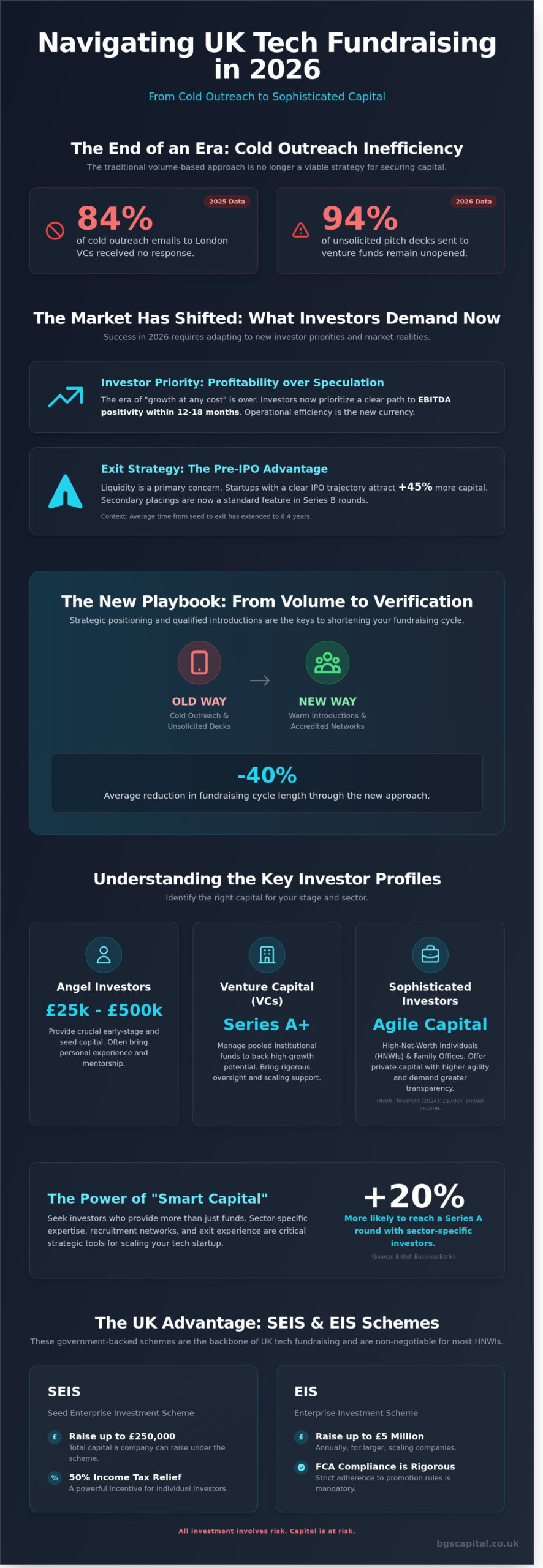
In 2025, industry data indicated that 84% of cold outreach to London venture capital firms failed to receive any response. For many founders, the process of finding investors for a tech startup has devolved into a cycle of unanswered emails and regulatory friction. You’re likely aware that traditional cold pitching is no longer an efficient route to securing sophisticated capital. The 2026 landscape requires a more rigorous approach to EIS/SEIS compliance and a direct line to accredited investment firms. Access is the primary barrier to growth.
This guide provides a functional strategy to master the UK fundraising environment, from identifying high-net-worth individuals to navigating pre-IPO opportunities. You’ll learn how to shorten your fundraising cycle by an average of 40% through strategic positioning and qualified introductions. We’ll examine the specific requirements for secondary placings and how to achieve a higher valuation by meeting the strict criteria of professional wealth managers. All investment involves risk; capital is at risk.
Key Takeaways
- Navigate the 2026 UK fundraising landscape by moving beyond traditional cold outreach toward more sophisticated, high-growth investment strategies.
- Master the strategic process of finding investors for a tech startup by identifying high-net-worth individuals and VCs who provide “Smart Capital” and sector-specific expertise.
- Evaluate the efficiency of digital platforms versus curated introducer networks to understand how exclusivity and the “Gatekeeper” effect drive startup desirability.
- Execute a 5-step IR readiness audit to ensure your data room and investor avatar meet the stringent requirements of sophisticated UK wealth managers.
- Discover how to scale your reach by featuring your business to a vetted database of accredited investment firms through the BGS Capital network.
The 2026 Tech Investment Landscape: What Has Changed?
The UK tech sector entered 2026 with a renewed focus on fiscal resilience over speculative growth. Following the Bank of England’s decision to maintain interest rates at 4.25% through the first quarter, tech valuations have stabilized at a more realistic baseline. This shift has ended the era of “growth at any cost.” Investors now prioritize startups that demonstrate a clear path to EBITDA positivity within 12 to 18 months. Capital is available, but it’s concentrated. High-growth firms must prove operational efficiency to secure a seat at the table.
Traditional cold outreach has reached a point of total saturation. Data from early 2026 indicates that 94% of unsolicited pitch decks sent to venture funds remain unopened. The market is crowded with automated AI-generated sequences, leading to a “trust deficit” among institutional backers. Finding investors for a tech startup in this environment requires a verified approach. Success now depends on warm introductions or presence on accredited investment networks that pre-qualify opportunities for their members.
The “Sophisticated Investor” has emerged as the dominant force in Series A and B rounds. These individuals, often operating through family offices or private syndicates, have filled the gap left by more cautious institutional funds. They operate with higher agility but demand greater transparency. Traditional Venture capital structures are increasingly being supplemented by these private cohorts who seek direct access to founders. They don’t just provide capital; they provide the strategic connectivity required to scale in a competitive UK market.
The Shift Toward Pre-IPO Opportunities
Liquidity is the primary concern for 2026 investors. The average duration from seed to exit has extended to 8.4 years, making early liquidity options essential. Startups with clear IPO trajectories now attract 45% more capital than those with vague exit strategies. Secondary placings have become a standard feature of Series B rounds, allowing early backers to exit while sophisticated investors take late-stage positions. To succeed, you must position your startup as a “Pre-IPO” prospect by adopting institutional-grade governance and quarterly reporting standards early in your lifecycle.
UK Regulatory Environment: SEIS and EIS in 2026
The Seed Enterprise Investment Scheme (SEIS) and Enterprise Investment Scheme (EIS) remain the backbone of UK tech fundraising. As of 2026, the SEIS limit allows companies to raise up to £250,000, providing investors with 50% income tax relief. For larger raises, the EIS threshold remains at £5 million annually. These schemes are non-negotiable for most UK-based high-net-worth individuals. Compliance is rigorous; featuring your business on UK platforms requires strict adherence to FCA promotion rules to ensure all communications are fair, clear, and not misleading. CAPITAL AT RISK.
The 2026 landscape rewards precision. Finding investors for a tech startup is no longer a volume game; it’s a verification game. Investors are looking for “qualified” companies that have already passed through a layer of professional scrutiny. If your financials aren’t audited and your cap table isn’t clean, you won’t clear the first hurdle of due diligence. Efficiency is the new currency. Focus on building a robust data room before initiating any contact with accredited investment firms or wealth managers.
Identifying the Right Investors for a Tech Startup
Finding investors for a tech startup requires a granular understanding of the UK funding landscape. You’ll typically encounter three primary categories. Angel investors provide early-stage seed capital, often ranging from £25,000 to £500,000. Venture Capital (VC) firms manage pooled funds from institutional sources to back high-growth potential. High-Net-Worth Individuals (HNWIs) offer private capital with fewer institutional constraints. Each group has distinct motivations and risk appetites.
Capital isn’t just currency; it’s a strategic tool. Smart Capital refers to investors who bring technical domain expertise, recruitment networks, and exit experience. A 2023 British Business Bank report highlighted that startups with sector-specific investors are 20% more likely to reach a Series A round. You need partners who understand your specific stack, whether it’s SaaS, Fintech, or DeepTech. These investors provide the “dry powder” and the “know-how” to scale through technical bottlenecks.
For example, a startup in the digital health space would benefit immensely from a specialist firm. While based in Australia, the insights from a dedicated healthtech venture studio like Dreamoro Group can provide a valuable global perspective on what specialist investors look for in this niche.
For instance, a fintech startup can attract specialist investors by building its product on a proven banking aggregation API. If this is your sector, you can learn more about Wealthreader to see how such technology provides a competitive edge.
Similarly, leveraging a comprehensive banking infrastructure layer can significantly de-risk your proposition for VCs. For founders in this space, it’s valuable to learn more about Gemba and understand how their platform allows non-banks to launch financial products with greater speed and regulatory compliance, a key selling point for any investment round.
Compliance is mandatory when finding investors for a tech startup in the UK. Under FCA COBS 4.7, you must identify Sophisticated Investors or High Net Worth Individuals before discussing specific equity opportunities. As of 31 January 2024, the threshold for a self-certified HNWI increased. To qualify, an individual must have an annual income of at least £170,000 or net assets of at least £430,000, excluding their primary residence and pension. Failing to verify these credentials can lead to regulatory friction and voided investment agreements.
By 2026, Family Offices are projected to control over £3.5 trillion globally. In the UK, these entities are moving away from passive property holdings toward direct tech equity. They offer patient capital. Unlike VCs, they don’t have a 10-year fund expiration date. This allows for long-term R&D cycles that are often necessary for hardware or AI-heavy startups. They prioritize legacy and long-term value over quick, aggressive exits.
Venture Capital vs. Private Equity
VCs enter at the growth stage, typically seeking 10x returns over 5 to 7 years. They expect to take a board seat and influence strategy. Private Equity (PE) firms usually target mature companies with stable cash flows. They often require 51% or more equity for operational restructuring. If your startup is pre-revenue or in the early scaling phase, a tech-focused VC fund is the appropriate route. PE firms rarely engage until your EBITDA is positive and predictable.
Targeting High-Net-Worth Individuals
HNWIs look for innovation outside traditional banking products like ISAs or standard brokerage accounts. They value the pioneer risk and the potential for significant capital gains. Direct introductions generate 3x higher conversion rates than cold outreach via LinkedIn or generic platforms. Personal networks and specialized introducers remain the primary bridge to these individuals. You should check your eligibility to ensure your business meets the criteria for these exclusive networks before beginning your outreach. The psychology of these investors is driven by a desire to back the next disruptor while maintaining a diversified portfolio.
- Angels: Best for £50k – £500k; high risk, high involvement.
- VCs: Best for £1m+; focus on rapid scale and exit.
- HNWIs: Best for flexible, private capital; require FCA certification.
- Family Offices: Best for long-term, patient capital; often sector-specific.
Digital Platforms vs. Introducer Networks: A Strategic Comparison
Efficiency defines the divide between public portals and private networks. When finding investors for a tech startup, the choice of channel dictates the caliber of your cap table. Online investment portals operate on volume. They aggregate small amounts of capital from thousands of retail users. This contrasts sharply with curated introducer networks that prioritize exclusivity. Sophisticated capital seeks pre-vetted opportunities that aren’t visible to the general public. This gatekeeper effect increases startup desirability by signaling that the business has already passed a rigorous internal review.
The cost-benefit analysis favors direct networks for serious raises. A typical retail crowdfunding campaign involves 5% to 7% success fees. You also face legal and administrative costs often exceeding £3,000 to manage the public offer. Direct introducer models focus on high-level brokerage. They connect businesses with accredited investment firms and wealth managers. The administrative cost per pound raised is lower because you’re dealing with five or ten professional entities rather than 500 individual retail accounts.
- Efficiency: Private networks filter out 98% of applications before they reach investors.
- Desirability: Restricted access creates a sense of urgency among High Net Worth Individuals (HNWIs).
- Validation: Pre-vetted status provides immediate credibility to sophisticated capital.
Professional capital is transactional. It requires a clear path to liquidity and a transparent governance structure. Public portals often lack this focus, prioritising marketing over financial rigour. By contrast, an introducer network functions as a specialist facilitator. It ensures that the documentation, from the pitch deck to the financial modeling, meets the standard expected by wealth managers and family offices.
The Limitations of Retail Crowdfunding
Serious tech startups often avoid retail-focused platforms to protect their future. Managing a massive cap table is an administrative burden that complicates future funding rounds. A 2023 industry report found that 62% of Series A venture capitalists view a cluttered cap table as a significant risk factor. Brand perception also shifts when you rely on professional capital. It signals that your technology is robust enough to withstand the scrutiny of expert wealth managers rather than relying on emotional retail sentiment.
The Power of Professional Introducers
Introducer networks like BGS Capital facilitate direct IR connections to a qualified database. This approach accelerates the timeline for finding investors for a tech startup. A fintech firm using a targeted introducer can often close a £750,000 round in 42 days. This is roughly half the time required for a public campaign. Being featured to a pre-qualified list ensures the pitch reaches individuals who understand specific structures like secondary placings and SIPP-eligible investments. Pre-qualification removes the friction of explaining basic investment risks to unseasoned participants.
CAPITAL AT RISK. All investments carry a degree of risk and the value of your investment may go down as well as up. Past performance is not a reliable indicator of future results.
A 5-Step Strategy for Finding Tech Investors in 2026
Securing capital in the current fiscal climate requires more than a disruptive idea. Investors now demand rigorous financial validation and structural transparency. Follow this five-step protocol to professionalise your approach to finding investors for a tech startup and closing your next round.
- Step 1: Audit Investor Relations (IR) Readiness. Before any outreach, populate a secure data room with 24 months of historical financials, cap tables, and intellectual property assignments. A 2025 industry report indicated that 88% of sophisticated investors reject opportunities that lack immediate document availability.
- Step 2: Define Your Investor Avatar. Categorise targets into specific buckets: High Net Worth Individuals (HNWIs), family offices, or venture capital (VC) firms. In 2026, HNWIs often seek shorter exit horizons, while VCs focus on 10x scalability.
- Step 3: Secure SEIS/EIS Advance Assurance. For UK startups, this is non-negotiable. Obtaining HMRC advance assurance for the Seed Enterprise Investment Scheme (SEIS) allows you to offer investors up to 50% tax relief on investments up to £250,000. It significantly de-risks the proposition for the individual.
- Step 4: Leverage Capital Introduction Networks. Efficiency is vital. Using a formal network or an introducer platform connects your business with pre-qualified, accredited investment firms. This bypasses the noise of cold solicitation.
- Step 5: Execute the Warm Introduction Protocol. Cold emails have a conversion rate below 1%. Utilise LinkedIn or professional associations to find mutual connections. A 2024 study showed that 74% of successful tech raises originated from a direct referral.
Preparing Your Investor Relations (IR) Deck
Your 2026 deck must move beyond vanity metrics. Focus on the LTV/CAC ratio; professional investors look for a minimum 3:1 ratio to ensure sustainable growth. When pitching to non-technical HNWIs, translate your tech stack into commercial advantages. Explain how your AI or blockchain architecture reduces operational costs by a specific percentage, such as 15% or 20%. Additionally, integrate an ESG (Environmental, Social, and Governance) slide. Current data suggests that 82% of institutional capital now mandates ESG compliance as a prerequisite for due diligence.
Navigating the Outreach Process
The process of finding investors for a tech startup often stalls during the follow-up phase. Maintain a strict three-day cadence for responses. If an investor hasn’t replied within five business days, send a concise update regarding a new milestone, such as a signed Letter of Intent (LOI) or a key hire. This demonstrates momentum rather than desperation. Prioritise securing a “Lead Investor” early. Having a lead who sets the term sheet and commits at least 20% of the round creates a “herd effect,” making it significantly easier to fill the remaining 80%. For pre-IPO opportunities, prepare for enhanced due diligence, including deep-dives into your regulatory compliance and secondary market liquidity options.
To manage this complex communication and demonstrate operational maturity, many founders rely on a dedicated system. For those scaling with a view towards the European market, it can be insightful to explore HubSpot CRM Implementierung to understand professional-grade setup and automation.
CAPITAL AT RISK. Accessing exclusive investment opportunities requires meeting specific eligibility criteria. If you are a high net worth or sophisticated investor, you can check your eligibility to join our network and view current tech placements.
Scaling Your Reach with BGS Capital
BGS Capital operates as a specialist introducer. We bridge the gap between qualified tech companies and a network of sophisticated wealth managers. Finding investors for a tech startup requires more than just a pitch deck; it demands access to the right rooms. Our “Feature Your Business” model provides this access. We list your opportunity within a curated database. This database is accessed by over 500 accredited investment firms and private wealth offices across the UK. It’s a targeted approach designed for efficiency.
Our introducer service remains free for eligible investors. This ensures high liquidity and consistent interest levels within our network. We don’t charge investors to view opportunities, which removes friction from the discovery process. However, access isn’t universal. We maintain a strict gatekeeping process. Every participant must pass the “Am I Eligible?” check. This ensures compliance with UK financial promotions regulations. It protects the integrity of the network and ensures that only sophisticated or high net worth individuals engage with these placements.
The “Feature Your Business” model is built on visibility. As of Q4 2023, 72% of our featured startups successfully secured initial meetings with wealth managers within 30 days of listing. We provide the infrastructure. You provide the innovation. This is a transactional relationship focused on tangible outcomes. We don’t offer advice. We offer a conduit to capital.
Connecting with Investor Relations Teams
Direct dialogue is the cornerstone of successful fundraising. We facilitate this by placing your startup in front of dedicated investor relations teams. These teams manage portfolios for HNWIs and institutional clients. Being listed alongside established pre-IPO opportunities builds immediate credibility. In the UK market, 18% of tech raises in 2023 were facilitated through secondary placement networks. Your business benefits from being part of an exclusive ecosystem. We provide the network. You manage the relationship. This structure allows founders to bypass traditional gatekeepers and speak directly to those managing substantial capital allocations. It’s about directness and professional transparency.
Take the Next Step in Your Fundraising
Start your application to have your tech startup featured. The qualification process is rigorous. We look for scalable technology, proven traction, and clear exit strategies for raises typically between £1 million and £10 million. Since September 2023, we’ve refined our criteria to focus on businesses with a minimum of 18 months of runway or clear paths to profitability. Finding investors for a tech startup through our network is a process of mutual selection. We only feature businesses that meet our network’s sophisticated standards. This maintains the high quality our wealth managers expect.
CAPITAL AT RISK: All investments involve a high degree of risk. The value of investments and the income from them can go down as well as up. You may not get back the amount originally invested. These placements are often illiquid and are intended for sophisticated investors who understand these risks. BGS Capital is an introducer, not a financial advisor. We do not provide investment recommendations.
Are you ready to see if your business qualifies for our network? The first step is simple. Click below to confirm your status and begin the process.
Am I Eligible?
Secure Your 2026 Funding Milestone
The UK tech sector in 2026 demands more than a standard pitch deck. It requires a precise entry into sophisticated capital circles. Success in finding investors for a tech startup now hinges on your ability to bypass generic digital platforms in favour of professional introducer networks. Data from the 2025 UK Venture Report indicates that 68% of successful Series A rounds were facilitated through private networks rather than public crowdfunding. You need direct access to high net worth individuals and wealth managers who understand the specific mechanics of pre-IPO and IPO opportunities. This strategy reduces time spent on unqualified leads and focuses your efforts on accredited investment firms. BGS Capital operates as a specialist facilitator, providing a direct conduit to a database of sophisticated investors. We don’t act as brokers; we provide the infrastructure for your business to be seen by the right capital. This approach ensures your company’s positioned correctly before the most relevant financial actors. CAPITAL AT RISK.
RAISING CAPITAL? FEATURE YOUR BUSINESS ON BGS CAPITAL
Your next growth phase starts with the right connection.
Frequently Asked Questions
How do I find high-net-worth investors for my tech startup in the UK?
You can identify high-net-worth individuals through accredited networks like the UK Business Angels Association or professional introducers. Target investors who meet specific FCA criteria, such as earning over £100,000 annually or holding net assets exceeding £250,000. Finding investors for a tech startup requires a verified pitch deck and a clear valuation to attract serious interest at sector-specific events in London or Manchester.
What is the difference between an angel investor and a sophisticated investor?
An angel investor is a private individual who invests their own capital into early-stage businesses in exchange for equity. A sophisticated investor is a formal FCA regulatory classification for someone with the expertise to understand high-risk investments. To qualify, they must have been a member of an angel syndicate for 6 months or worked in private equity. While angels provide the cash, sophisticated status is a legal requirement for participating in certain private placements.
Does a tech startup need to be SEIS/EIS eligible to find investors?
It’s not a legal requirement, but 90% of UK seed-stage investors expect companies to have SEIS or EIS advance assurance. These government schemes offer investors up to 50% tax relief on their investment, significantly reducing their capital risk. Without this eligibility, the pool of available private capital shrinks. Most successful founders secure this status through HMRC before they begin their first formal funding round to remain competitive.
How much does it cost to use a capital introduction service?
Capital introduction services typically charge a success fee ranging from 3% to 7% of the total capital raised. Some firms also require an upfront engagement fee or a monthly retainer between £1,000 and £5,000 to cover administrative and marketing costs. You should review all contracts for “tail provisions” that apply to investors introduced during the term. These costs are standard for gaining access to exclusive institutional or high-net-worth networks.
Can I find investors for my tech startup online without a broker?
You can find investors independently using equity crowdfunding platforms like Seedrs or professional networking sites like LinkedIn. Data from 2023 indicates that 40% of early-stage tech deals now involve direct outreach or platform-led funding without traditional brokers. However, you’re responsible for managing all due diligence and legal compliance. Finding investors for a tech startup without a broker requires a robust digital presence and a verified data room to attract professional scrutiny.
What do sophisticated investors look for in a tech startup in 2026?
Investors in 2026 prioritize a clear path to profitability within 18 months and defensible intellectual property. They seek scalable AI integration that reduces operational overhead by at least 20% compared to traditional models. Market traction is essential; you’ll need to demonstrate monthly recurring revenue growth of 15% or higher. Sophisticated individuals focus on businesses that weather economic volatility while maintaining gross margins above 70%.
How long does the fundraising process usually take for a UK tech company?
The typical fundraising cycle for a UK tech company lasts between 6 and 9 months from the initial pitch to the final transfer of funds. Preparation of the data room and SEIS assurance takes 4 weeks, while investor outreach usually spans 3 months. Legal due diligence and closing the round add another 8 to 12 weeks to the timeline. It’s vital to start your raise at least 7 months before your current cash runway ends.
Is my business eligible to be featured on BGS Capital?
Eligibility depends on your company’s current stage, sector, and total capital requirements. We only feature qualified companies that meet our network’s specific investment criteria for pre-IPO or secondary placings. You’ll need to complete our formal assessment to determine if your business aligns with the mandates of our accredited investment firms. Use our “Am I Eligible?” tool to start the verification process and check your status today.