
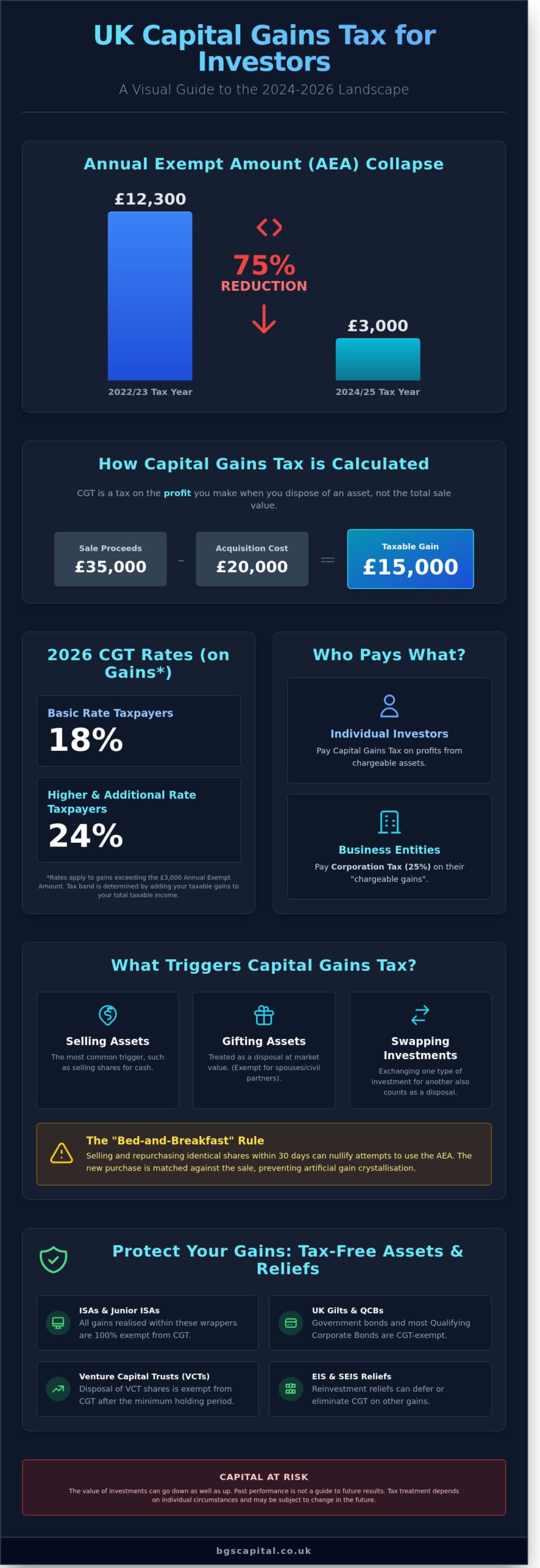
The 2024/25 tax year formalised a sharp fiscal transition for UK investors as the annual exempt amount dropped to £3,000, a 75% reduction from the £12,300 threshold seen in 2022. For high net worth individuals, this aggressive contraction ensures that capital gains tax on investments uk is now a primary factor in determining net internal rate of return. It’s no longer feasible to treat tax as an afterthought; it’s a structural hurdle that demands technical precision.
You’ve likely felt the increasing pressure as legislative changes target a broader share of your realised equity and pre-IPO gains. This guide delivers a definitive analysis of the 2026 tax landscape and the sophisticated frameworks required to maintain tax efficiency. We’ll examine the specific mechanics of EIS and SEIS reinvestment reliefs, the nuances of capital loss offsetting, and strategic disposal timing to ensure your wealth remains protected. CAPITAL AT RISK.
Key Takeaways
- Understand the fundamental principles of investment disposals to ensure tax is only applied to realised profits rather than total proceeds.
- Navigate the 2026 fiscal landscape, including the reduced £3,000 Annual Exempt Amount and specific rate thresholds for basic and higher-rate taxpayers.
- Discover how to utilise government-backed venture schemes like EIS and VCTs to achieve significant tax mitigation and potential 100% CGT exemptions.
- Learn to manage and report your capital gains tax on investments uk accurately to meet Self Assessment deadlines and optimise loss relief.
- Explore the unique tax advantages associated with pre-IPO and private equity allocations within a sophisticated investment strategy.
Understanding Capital Gains Tax on UK Investments
Capital Gains Tax (CGT) is a levy on the profit realised when an investor disposes of an asset that has increased in value. It’s the gain you make that’s taxed, rather than the total amount of money you receive from the transaction. For example, if an investor acquires equity for £20,000 and later sells it for £35,000, the CGT calculation applies only to the £15,000 profit. For the 2024/25 tax year, the annual exempt amount for individuals is £3,000. Gains exceeding this threshold must be reported and taxed accordingly. Understanding Capital Gains Tax is essential for maintaining tax efficiency within a high-growth portfolio.
Chargeable assets in the UK investment landscape primarily include shares not held in tax-efficient wrappers, units in unit trusts, and certain interest-bearing bonds. The capital gains tax on investments uk applies differently based on the status of the investor. Individual investors are subject to CGT at rates of 10% for basic rate taxpayers and 20% for those in higher or additional rate bands. Conversely, business entities don’t pay CGT. Companies pay Corporation Tax on their “chargeable gains” at the prevailing rate, which currently stands at 25% for profits over £250,000.
What Constitutes a “Disposal” for Investors?
A disposal occurs whenever an investor ceases to own an asset. Selling shares for cash is the most frequent trigger, but other actions carry similar tax implications. Gifting an asset to a third party is treated as a disposal at current market value. This rule doesn’t apply to transfers between spouses or civil partners, which are generally tax-neutral. Swapping one investment for another also constitutes a disposal. Investors must be aware of the “Bed-and-Breakfast” rule. This regulation prevents individuals from selling shares and repurchasing them within 30 days to artificially utilise their £3,000 annual exemption. If repurchased within this window, the new purchase price is matched against the sale, often nullifying the intended tax benefit.
Tax-Free Assets and Exemptions
Specific investment vehicles are legally exempt from CGT, allowing for gross capital growth. Individual Savings Accounts (ISAs) and Junior ISAs are the most prominent examples; any gain realised within these wrappers is entirely tax-free. This makes them a primary tool for long-term wealth accumulation. UK Government bonds, known as Gilt-edged securities or “Gilts,” are also exempt from CGT. This exemption extends to most Qualifying Corporate Bonds (QCBs), provided they meet specific HMRC criteria regarding their currency and redemption terms.
Venture Capital Trusts (VCTs) offer another route for tax-efficient investing. While the underlying assets are high-risk, the disposal of VCT shares is exempt from capital gains tax on investments uk, provided the investor has held them for the required period. These exemptions are designed to incentivise investment into specific sectors of the UK economy, such as government debt and early-stage enterprise. Investors should always verify the current status of an asset before assuming an exemption applies, as legislative changes can alter the tax treatment of specific bond issues or trust structures.
Beyond these structured financial products, savvy investors also look towards alternative tangible assets that may have favorable tax treatment. For example, certain “wasting assets” can be exempt from CGT. Platforms like the Whisky Cask Club provide access to this unique asset class, allowing individuals to explore investment-grade whisky casks as part of a diversified, tax-aware strategy.
CAPITAL AT RISK: The value of investments can go down as well as up. Past performance is not a guide to future results. Tax treatment depends on individual circumstances and may be subject to change in the future.
2026 CGT Rates, Allowances, and Thresholds
The 2025/2026 tax year maintains the historically low Annual Exempt Amount (AEA) for individuals. For the current period, the tax-free allowance is fixed at £3,000. This follows a period of aggressive fiscal drag, where the threshold was reduced from £12,300 in 2022 to its current level. Any profit realized above this £3,000 limit is subject to capital gains tax on investments uk, regardless of whether the asset is a financial security or physical property. This reduced allowance forces investors to report even modest gains, increasing the administrative burden on private portfolios.
Tax rates for 2026 are determined by your total annual income. Basic rate taxpayers pay 18% on gains. Higher and additional rate taxpayers are subject to a unified 24% rate. This 24% figure represents a significant shift in Treasury policy, as it aligns the tax treatment of shares and financial instruments with residential property. You can find definitive breakdowns of these figures in the official 2026 CGT Rates and Allowances documentation. Accurate reporting is mandatory for all disposals exceeding the AEA.
Calculating Your CGT Band
Determining your applicable rate requires a two-step calculation. First, identify your total taxable income for the year, including salary, dividends, and interest, after subtracting your £12,570 Personal Allowance. Second, add your total taxable gains, minus the £3,000 AEA, to this income figure. If the combined total falls within the £37,700 basic rate band, the 18% rate applies. Any portion of the gain that pushes your total income above the £37,700 threshold is taxed at 24%. This “top-slicing” effect means a single disposal can often span two different tax bands.
Consider an investor with a taxable income of £30,000 and a capital gain of £15,000. After applying the £3,000 allowance, the taxable gain is £12,000. Since £7,700 of the basic rate band remains unused, that portion is taxed at 18%. The remaining £4,300 of the gain is taxed at 24%. Before finalizing a high-value exit, check your eligibility for investment vehicles that provide alternative tax treatments.
The Impact of the 2025/2026 Fiscal Changes
The 30 October 2024 Autumn Budget introduced the most substantial changes to capital gains tax on investments uk in recent years. By raising the lower rate from 10% to 18% and the higher rate from 20% to 24%, the government has increased the tax liability on share disposals by 20% for high earners. This alignment simplifies the tax code but removes the previous incentive for holding liquid financial assets over residential real estate. For High Net Worth Individuals (HNWIs), the removal of the 20% rate necessitates a review of all long-term holdings.
Sophisticated investors are responding by adjusting their portfolio turnover rates. The 4% increase for higher-rate taxpayers reduces the net internal rate of return (IRR) on successful exits, potentially leading to longer holding periods. Because the unified 24% rate now applies across almost all asset classes, the strategic focus has shifted from asset selection for tax purposes to timing disposals across multiple tax years to maximize the use of the £3,000 allowance. This environment prioritizes tax-efficient wrappers and structural planning over simple market timing.
Strategic Tax Mitigation: EIS, SEIS, and VCTs
UK investors looking to manage their capital gains tax on investments uk exposure often turn to statutory venture capital schemes. These programmes, designed to stimulate the UK economy, offer some of the most aggressive tax reliefs available. CAPITAL AT RISK. High-net-worth individuals use the Enterprise Investment Scheme (EIS), Seed Enterprise Investment Scheme (SEIS), and Venture Capital Trusts (VCTs) to shield wealth from HMRC while supporting British enterprise.
EIS allows for a 30% income tax credit on investments up to £1 million per tax year, or £2 million if investing in knowledge-intensive companies. The primary draw for CGT management is the 100% exemption on any gains made on the shares themselves. You must hold these shares for at least three years to qualify. If you sell before this period, HMRC will claw back the relief. It’s a binary outcome; you either meet the holding period or you lose the benefit.
VCTs operate differently as they are companies listed on the London Stock Exchange. They invest in a diversified portfolio of small, unquoted companies. While you don’t get CGT reinvestment relief with VCTs, any dividends received are tax-free. Additionally, there’s no capital gains tax to pay when you sell your VCT shares. This makes them an efficient tool for Managing Investment Gains and Losses within a balanced, income-focused portfolio.
EIS Reinvestment Relief Explained
Reinvestment relief is a potent tool for deferring existing CGT liabilities. If you’ve sold a buy-to-let property or a portfolio of shares and triggered a gain, you can reinvest that gain into EIS-qualified companies. This action defers the tax payment until the EIS investment is disposed of or the company loses its qualifying status. It’s a strategic way to keep capital working rather than surrendering it to the Treasury.
The “Three-Year Rule” is the benchmark for permanent exemption. Once you’ve held the EIS shares for 36 months, the gain on those specific shares becomes entirely tax-free. EIS CGT relief allows sophisticated investors to defer immediate tax liabilities while targeting total tax exemption on all future capital growth within the qualifying investment. This mechanism is essential for those rebalancing large portfolios in the current tax year.
SEIS: The Founder and Early-Stage Investor Advantage
SEIS targets companies in their first two years of trading. It’s higher risk than EIS but offers a 50% CGT reinvestment relief. If you make a £100,000 gain elsewhere, reinvesting £100,000 into SEIS companies can reduce the taxable gain of the original asset by 50%. This effectively halves your immediate tax bill. It’s a powerful incentive for those with high capital gains tax on investments uk obligations.
For the 2025/2026 tax year, the maximum annual investment limit for individuals is £200,000. Companies can raise up to £250,000 in total SEIS funding. These schemes are often the first step toward pre-IPO investment opportunities. Investors typically use SEIS to support early-stage innovation while significantly lowering the net cost of their investment through tax breaks. Eligibility is strict. You must ensure the company maintains its qualifying status for at least three years, or the tax benefits are revoked. Always verify your status as a sophisticated investor before proceeding.
Reporting Gains and Managing Investment Losses
High net worth portfolios require rigorous documentation to satisfy HMRC compliance standards. You must maintain records for at least 22 months after the end of the tax year in which you sold the asset. For complex portfolios involving unlisted shares or overseas holdings, these records should include contract notes, bank statements, and details of any allowable costs like stamp duty or brokerage fees. Managing your capital gains tax on investments uk requires more than just calculating profit; it involves a systematic approach to data retention. If you’re a UK resident, you must report gains that exceed the £3,000 annual exempt amount via a Self Assessment tax return by 31 January following the end of the tax year.
The “Real-Time” Capital Gains Tax Service offers an alternative for those who prefer immediate settlement. You can use this service any time after the disposal up until 31 December in the tax year following the sale. It’s a functional tool for investors who don’t usually file a Self Assessment return or those who want to clear their tax liabilities quickly. However, using this service doesn’t exempt you from reporting the figures on a later tax return if you’re already within the Self Assessment system. Accuracy is paramount. HMRC applies penalties for careless or deliberate inaccuracies, which can range from 15% to 100% of the potential lost revenue depending on the severity of the error.
Loss Relief Strategies
Efficiently structuring your capital gains tax on investments uk involves the strategic use of loss relief. You can offset investment losses against gains made in the same tax year to reduce your total liability. If your total losses exceed your gains, you’re permitted to carry the remaining balance forward indefinitely to offset against future profits. You’ve got four years from the end of the tax year in which the loss occurred to claim it with HMRC. For unlisted shares that have become worthless, you can make a Negligible Value Claim. This allows you to treat the asset as if it were sold and immediately reacquired at its current value, crystallising a loss even while you still technically own the shares. This is particularly relevant for failed private equity ventures or liquidated startups.
Timing and “Bed-and-ISA” Strategies
The 2024/25 annual exempt amount sits at £3,000, a sharp reduction from previous years. To maximise this allowance, investors often use staged disposals, spreading the sale of assets across multiple tax years. A “Bed-and-ISA” strategy is a common tactical move; it involves selling taxable assets and immediately repurchasing them within an ISA wrapper. This effectively moves the investment into a tax-free environment for all future growth and income. You must remain aware of the 30-day share repurchase rule. HMRC’s “anti-bed-and-breakfasting” regulations prevent you from selling a share and buying it back within 30 days to artificially create a loss. If you repurchase the same stock within this window, the new purchase price is matched against the old sale price, nullifying the intended tax advantage. To bypass this legally, many investors purchase a similar but not identical asset, such as a different ETF tracking the same index.
Ensure your portfolio is structured for maximum tax efficiency before the next deadline. Check your eligibility for exclusive investment opportunities and professional guidance.
Capital Gains in Pre-IPO and Private Equity
Pre-IPO assets carry a distinct risk-reward ratio compared to listed FTSE 100 equities. Investors often target returns exceeding 300% over a three to five year horizon. This level of growth makes the management of capital gains tax on investments uk a primary concern for any portfolio. Unlike public stocks, private equity is illiquid. You cannot simply sell a fraction of your holding to stay within the £3,000 annual exempt amount. Planning for a “lumpy” exit is essential.
The Pre-IPO Advantage for HNWIs
High Net Worth Individuals (HNWIs) choose pre-IPO stages to capture value before a company hits the public markets. The tax drag on a successful exit can be substantial if you haven’t prepared. If you hold shares in a company that grows from a £10 million valuation to £100 million, your tax liability at the 20% higher rate could erode a fifth of your profit. Structuring disposals through secondary placings allows for partial liquidity before the main IPO event. This can help spread gains across multiple tax years. Pre-IPO investors must prioritise tax structure early to mitigate liabilities during exit events.
- Compare growth potential against the 20% CGT rate for higher earners.
- Utilise secondary markets to trigger gains in stages.
- Assess eligibility for Business Asset Disposal Relief (BADR) to potentially access a 10% rate.
Connecting with Exclusive Opportunities
BGS Capital operates as a specialist introducer. We don’t facilitate raises directly. Instead, we provide a conduit between sophisticated investors and accredited investment firms. Finding qualified companies requires a robust network that isn’t available to the retail public. We focus on transparency and compliance. Our role is to ensure you see the opportunities that match your investor profile. Access to these high-growth equity options is strictly controlled. It’s not for everyone. You must be prepared for the long-term nature of private equity.
Am I Eligible? This is the fundamental question for any prospective investor. Access to our network requires self-certification. You must qualify as a Sophisticated Investor or a High Net Worth Individual under FCA guidelines. This process ensures that exclusive financial opportunities are only presented to those with the necessary experience and financial standing to evaluate the risks. BGS Capital facilitates direct introductions once this qualification gate is passed. We prioritise efficiency and professional standards in every connection we make.
Final Checklist for 2026 Tax Year Planning
The 2026 tax year begins on 6 April 2026. You should start your preparations at least six months in advance. Use this checklist to ensure your capital gains tax on investments uk strategy is robust.
- Review the £3,000 Allowance: Ensure you’ve utilised your annual exempt amount before the tax year ends.
- Loss Crystallisation: Identify underperforming assets to offset gains. You’ve got four years from the end of the tax year to claim capital losses.
- SIPP and ISA Contributions: Maximise your £60,000 SIPP allowance and £20,000 ISA limit to shield future growth from CGT.
- Gifting to Spouses: Transfer assets to a spouse or civil partner to utilise two sets of annual exemptions.
- Check Eligibility: Re-certify your HNWI or Sophisticated Investor status to maintain access to exclusive private equity flows.
Managing capital gains is a functional requirement of high-level investing. It’s about protecting your returns through disciplined structure. BGS Capital remains a committed partner in connecting you to the opportunities that make this planning necessary.
Optimise Your 2026 Investment Strategy
Managing capital gains tax on investments uk requires proactive planning rather than reactive reporting. The fixed £3,000 annual exempt amount means investors must rely more heavily on structural tax efficiencies to protect their returns. Utilising the Enterprise Investment Scheme (EIS) offers up to 100% relief on capital gains after a three-year holding period. Seed EIS provides an even more aggressive 50% reinvestment relief on gains sourced from other assets. These mechanisms aren’t just for tax reduction; they’re essential for preserving capital in high-growth sectors like private equity and pre-IPO ventures.
BGS Capital acts as your specialist facilitator in this complex landscape. We provide direct introductions to qualified companies and maintain a compliant network of accredited investment firms. You’ll gain access to exclusive pre-IPO and IPO investments that remain unavailable to the wider retail market. Our focus is on connecting sophisticated investors with tangible outcomes in the private markets. CAPITAL AT RISK.
Am I Eligible? Check your status to access exclusive pre-IPO opportunities.
Secure your position in the next generation of UK growth companies today.
Frequently Asked Questions
Do I pay Capital Gains Tax on shares sold within an ISA?
You don’t pay any capital gains tax on investments uk when they’re held within an Individual Savings Account (ISA). This tax-free status applies regardless of the profit size or your personal income bracket. It’s a primary reason why the £20,000 annual ISA allowance remains a critical tool for UK investors looking to protect their returns from HMRC.
Can I give shares to my spouse to avoid Capital Gains Tax?
You can transfer shares to a spouse or civil partner without triggering an immediate tax charge. HMRC treats these transfers on a “no gain, no loss” basis, which effectively shifts the original cost base to your partner. This strategy allows couples to utilise two sets of annual allowances, potentially saving up to £720 based on the £3,000 limit for the 2025/2026 period.
What is the Capital Gains Tax allowance for the 2025/2026 tax year?
The annual exempt amount for the 2025/2026 tax year is £3,000 for individuals and personal representatives. This figure is a 50% reduction from the £6,000 limit seen in the 2023/2024 tax year. You only pay tax on profits that exceed this threshold after you’ve deducted any eligible losses or reliefs.
How much is Capital Gains Tax on stocks for higher rate taxpayers in 2026?
Higher rate taxpayers pay a 24% rate on gains from shares and other eligible assets following the 2024 Autumn Budget. This rate applies to the portion of your total taxable gains that exceed the £3,000 annual allowance. Basic rate taxpayers pay 18% on gains that fall within the basic income tax band, which is a significant increase from previous years.
What happens if my investment loss is greater than my gain?
You can use investment losses to reduce your total taxable gains in the same tax year. If your total losses exceed your gains, you should report them to HMRC to carry the balance forward to future years. You’ve got four years from the end of the tax year the loss occurred to claim it against future profits.
Is there Capital Gains Tax on dividends in the UK?
There’s no Capital Gains Tax on dividends because they’re subject to a separate Dividend Tax regime. Investors receive a £500 tax-free dividend allowance for the 2025/2026 tax year. Amounts above this are taxed at 8.75% for basic rate, 33.75% for higher rate, and 39.35% for additional rate taxpayers. CAPITAL AT RISK.
How do I report Capital Gains Tax to HMRC?
You report your gains through a Self Assessment tax return or by using HMRC’s “real-time” Capital Gains Tax service. If you use the real-time service, you must report and pay by 31 December in the year following the asset sale. For residential property gains, the reporting and payment deadline is strictly 60 days post-completion.
Are pre-IPO investments eligible for EIS tax relief?
Many pre-IPO opportunities qualify for the Enterprise Investment Scheme (EIS) if the company meets specific HMRC requirements. EIS offers 30% upfront income tax relief and 100% exemption from capital gains tax on investments uk if the shares are held for at least three years. Investors must verify that the specific company holds a valid “advance assurance” from HMRC before committing capital.