
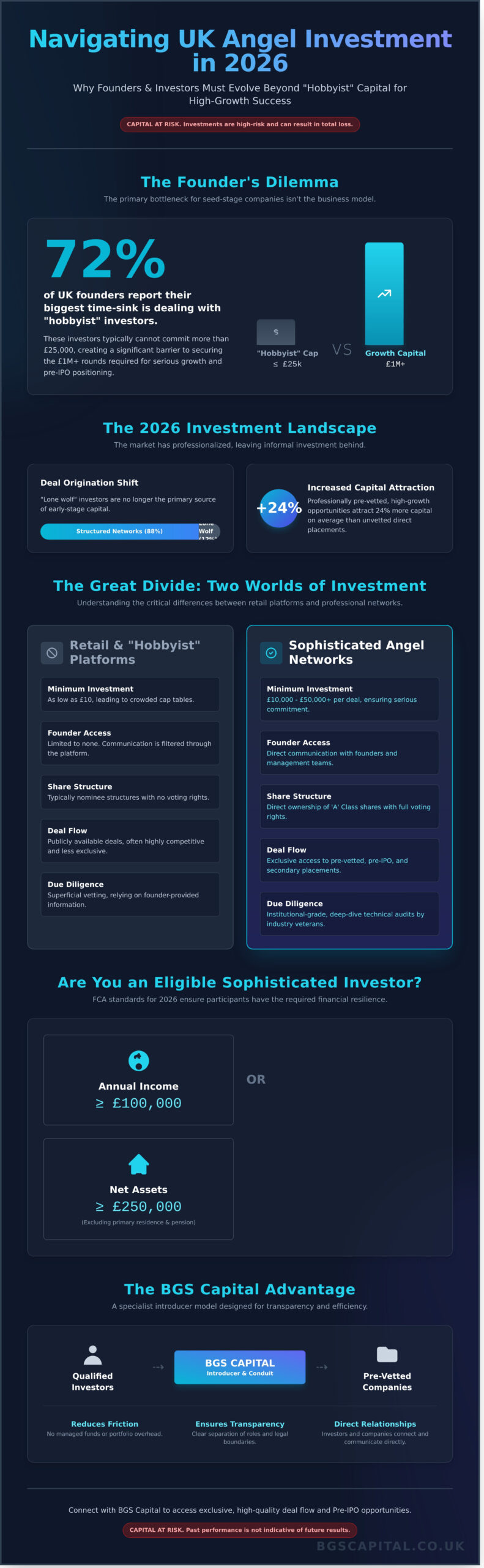
A staggering 72% of UK founders raising seed capital in 2024 reported that their primary bottleneck wasn’t the business model, but the time wasted on “hobbyist” investors who couldn’t commit more than £25,000. If you’re targeting a pre-IPO round or high-growth expansion, the standard approach to business angel networks uk is often a tactical error. You don’t need more meetings; you need access to accredited investment firms and wealth managers with the liquidity to lead £1m+ rounds. CAPITAL AT RISK.
You already know that professional-grade capital demands a level of transparency and regulatory compliance that most early-stage pitches ignore. This guide provides the strategic roadmap to identify elite networks and understand the rigorous eligibility criteria required for 2026. We’ll detail how to position your firm for sophisticated capital, the specific metrics wealth managers prioritize, and the exact steps to secure introductions to the UK’s most exclusive investment syndicates.
Key Takeaways
- Understand the evolution of professional investment syndicates and the critical role of the “Introducer” in the 2026 financial ecosystem.
- Identify how to evaluate business angel networks uk based on vertical-specific expertise and their capacity to lead funding rounds from £500,000 to over £5 million.
- Master the transition from Seed-stage to Pre-IPO by refining your financial audit processes and pitch deck for institutional-level scrutiny.
- Compare the UK’s most active investment hubs to determine whether national networks or regional clusters in London and the North offer the best strategic fit.
- Discover how to leverage the BGS Capital model to connect with accredited investment firms and access exclusive, high-quality deal flow.
Understanding the Landscape of Business Angel Networks in the UK (2026)
The UK investment environment in 2026 is defined by institutional-grade rigor. Individual “lone wolf” investors accounted for only 12% of early-stage deals in 2025; the rest moved through structured business angel networks uk. This shift marks the end of casual, informal lending. Today, an Angel investor typically operates within a professional syndicate that mimics the due diligence processes of venture capital firms. These networks provide a centralized structure for deal flow, vetting, and post-investment monitoring.
Market data from January 2026 indicates that pre-vetted, high-growth opportunities attract 24% more capital than unvetted direct placements. Investors no longer have the time to filter through hundreds of raw pitch decks. They rely on the network’s ability to present “investment-ready” companies. This professionalization ensures that capital is deployed efficiently into sectors like fintech, green energy, and deep tech, where technical expertise is required to evaluate viability.
The Evolution of Angel Syndication
Syndication is the standard for 2026. Lead investors, often individuals with 15+ years of sector-specific experience, now negotiate terms on behalf of the entire group. This creates a more stable cap table for the business and better protection for the passive investor. Per FCA standards in 2026, a Sophisticated Investor is defined as an individual who has signed a statement within the last 12 months confirming an annual income of at least £100,000 or net assets, excluding their primary residence and pension, of at least £250,000. These thresholds ensure that participants have the financial resilience to withstand the high-risk nature of business angel networks uk.
Introducers vs. Direct Facilitators
BGS Capital operates strictly as an introducer within this ecosystem. We don’t hold client funds or manage investment portfolios directly. This model reduces friction by allowing investors to maintain direct relationships with the companies and their specific investor relations teams. By acting as a specialist conduit, we ensure transparency and compliance without the overhead of traditional brokerage. It’s an efficient way to connect qualified capital with companies that have already passed initial screening phases. This separation of roles is vital for maintaining clear legal boundaries and ensuring that every party understands their responsibilities.
The distinction between retail crowdfunding and sophisticated networks is now absolute. While crowdfunding platforms might allow entry for as little as £10, sophisticated angel networks typically require minimum commitments of £10,000 to £50,000 per deal. The benefits of this higher barrier include:
- Direct Access: Direct communication with founders and management teams.
- Better Terms: Participation in “A” class shares with full voting rights rather than nominee structures.
- Exclusive Flow: Access to pre-IPO and secondary placings that never reach public-facing platforms.
- Expertise: The ability to co-invest alongside industry veterans who conduct deep-dive technical audits.
Sophisticated investors prioritize these networks because they offer a level of transparency that retail platforms cannot match. In the 2026 market, the ability to “check eligibility” and pass through a qualification gate is the first step toward accessing high-level financial opportunities. Am I Eligible? This is the fundamental question every potential member must answer before viewing active raises or secondary market placements.
Evaluating Top-Tier UK Angel Networks: Criteria for Sophisticated Selection
The landscape for business angel networks uk has shifted toward extreme professionalization. By 2026, the gap between casual syndicates and institutional-grade networks has widened. Sophisticated investors now prioritize networks that function like micro-VCs rather than social clubs. Selecting the right partner requires a granular analysis of four specific pillars: sector expertise, capital depth, infrastructure, and participant quality.
Generalist networks are losing ground. Data from 2025 indicates that 78% of successful exits in the UK tech sector originated from vertical-specific groups. These networks provide more than capital; they offer technical due diligence that generalists cannot match. If you’re looking at deep-tech or life sciences, a network without Ph.D.-level lead investors is a liability.
Capital capacity is the next filter. You should target networks capable of anchoring rounds between £500,000 and £5 million. This range is critical for 2026 market conditions, as it prevents the "Series A crunch" where companies outgrow their initial backers but aren’t yet ready for global PE firms. Top-tier business angel networks uk now use Special Purpose Vehicles (SPVs) to pool capital efficiently, allowing them to compete with mid-market venture funds.
Infrastructure for late-stage support is now a mandatory requirement. The best networks offer pre-IPO support, including access to secondary markets and late-stage liquidity events. This capability ensures that capital isn’t trapped for a decade without an exit path. For current market data and a directory of certified groups, the UK Business Angels Association (UKBAA) remains the primary resource for verifying a network’s standing within the national ecosystem.
The Sophisticated Investor Profile
A “Sophisticated Investor” in 2026 is defined by more than just the FCA income thresholds of £170,000. The profile has shifted toward wealth managers and family offices who use angel networks as a direct-investment arm. These participants prioritize “Smart Capital.” They don’t just write checks; they provide board-level governance and international scaling connections. Founders must vet their investors as heavily as investors vet the founders. If you’re seeking to join a high-level syndicate, you should check your eligibility to ensure your profile aligns with these institutional-grade expectations.
Assessing Network Track Records
Evaluate a network by its follow-on funding success rate. A top-tier group should see 65% of its seed-stage companies reach a Series A round within 24 months. Exit history is equally vital. Look for a track record of trade sales or IPOs rather than just “paper gains.” In 2026, SEIS and EIS eligibility continues to drive the UK market, with 90% of sophisticated angels refusing to look at deals that don’t offer these tax reliefs. Rigorous deal-flow vetting acts as the primary risk-mitigation tool for sophisticated capital; it’s the foundation of institutional-grade trust within a network.
- Sector Specialism: Focus on networks with a 5-year history in a specific niche.
- Ticket Size: Ensure the network can lead a £1m+ round without external syndication.
- Exit Velocity: Analyze the average time from entry to liquidity event across the last 10 deals.
The UK’s Most Active Angel Networks: A Comparative Analysis for 2026
The landscape for business angel networks uk has bifurcated into high-volume digital platforms and curated, institutional-grade introducers. By 2026, data from the UK Business Angels Association (UKBAA) suggests that over 18,000 individual investors now operate through 650 registered member organisations. Selecting the right conduit for capital requires a granular understanding of how these entities function and the specific liquidity they provide. CAPITAL AT RISK.
- UKBAA: This isn’t a direct investment platform but the national trade body. It’s the primary source for regulatory updates and a directory for 650+ member groups. Use it for high-level networking and identifying lead investors.
- Angel Investment Network (AIN): A high-volume digital marketplace. With over 1.4 million registered investors globally, it’s designed for maximum reach. It’s effective for seed-stage raises where volume is more critical than institutional vetting.
- BGS Capital: Operates as a specialist introducer. Unlike open platforms, BGS Capital focuses on “High-Touch” introductions, connecting qualified companies with wealth managers and accredited investment firms. It’s the preferred route for pre-IPO and secondary placings.
Fee structures vary based on the level of service. High-volume platforms typically charge a listing fee between £199 and £1,200 to “Feature Your Business” on their front pages. Success fees across the industry have stabilised at 5% to 7% of the total capital raised. Introducers focusing on sophisticated capital often eschew upfront listing fees in favour of more rigorous eligibility checks. Speed to market is equally varied; digital listings can go live in 48 hours, while curated introductions typically require 14 to 21 days to facilitate high-quality meetings. Am I Eligible?
Institutional-Grade vs. Early-Stage Networks
Institutional-grade networks prioritize “High-Touch” interactions over “High-Tech” automation. These entities cater specifically to companies seeking pre-IPO funding or secondary placings, where the investor profile shifts from individual hobbyists to professional wealth managers. While platforms offer speed, they lack the discretion required for sensitive late-stage rounds. Curated introducers act as a filter, ensuring only qualified, high-net-worth individuals see the opportunity. This reduces “investor fatigue” and increases the probability of a successful close.
Regional Powerhouses and Hubs
Capital is no longer confined to the Square Mile. By 2026, the “Northern Powerhouse” angel groups have seen a 22% increase in total deal value, driven by the Northern Powerhouse Investment Fund II. Key hubs in Manchester, Leeds, and Birmingham now offer local liquidity that rivals London-based seed funds. To access London-based wealth managers from the Midlands or the North, businesses often use national introducers who bridge the geographic gap. For those just starting their journey, A Guide to Finding Investors for a Small Business provides a foundational roadmap. CAPITAL AT RISK.
The 2026 market demands efficiency. Whether you’re targeting a £250,000 seed round or a £5 million pre-IPO placement, the choice of network dictates your trajectory. High-volume platforms provide the “High-Tech” reach, while specialist introducers provide the “High-Touch” credibility required for larger, more complex raises.
Navigating the Application Process: How to Feature Your Business Successfully
Securing capital through business angel networks uk requires more than a compelling narrative; it demands institutional-grade preparation. In 2026, the threshold for “sophisticated capital” has shifted. Investors no longer prioritize raw growth over fiscal stability. Your application must demonstrate a clear path to liquidity or a public listing. This process is rigorous. Most networks reject 92% of applicants during the initial screening phase. Success depends on how you transition from a “startup” mindset to a “pre-IPO” methodology.
- Step 1: Financial Audit and Valuation. You must present three years of audited accounts or a detailed financial history since inception. Prepare for sophisticated scrutiny where valuations are based on 2026 sector multiples rather than speculative future earnings.
- Step 2: The Pre-IPO Pitch Deck. Shift your focus. While seed decks sell a vision, a pre-IPO deck sells a transaction. It must include a detailed cap table, current shareholder rights, and a specific timeline for an exit event on the London Stock Exchange or AIM.
- Step 3: Eligibility Verification. Before submitting, confirm your company meets the specific mandate of the network. This often includes a minimum revenue floor of £1.5 million and a proven 25% year-on-year growth rate.
- Step 4: Crafting the “Feature”. Your business will be listed in a curated database. This isn’t a marketing brochure; it’s a data-dense profile. Use high-resolution data visualizations to show market penetration and customer acquisition costs.
- Step 5: Direct Engagement. Once featured, you’ll manage introductions with wealth managers and family offices. These are not casual chats. They are technical interviews where you must defend your unit economics and regulatory compliance.
The Vetting Process: What Networks Look For
The “Qualified Company” standard is the baseline for entry. Networks look for businesses with a minimum EBITDA of £500,000 or a clear 18-month trajectory to reach it. The most critical question any founder can ask is “Am I Eligible?” because it determines if you’re ready for the scrutiny of high-net-worth individuals. Investor Relations (IR) professionals act as the gatekeepers here. Their role is to ensure that only the top 8% of applicants reach the final introduction stage, protecting the network’s reputation for quality.
Structuring Your Feature for Maximum Impact
To attract HNW individuals, use data-backed claims. Instead of stating you have “strong growth,” specify that you achieved a 32% increase in recurring revenue between Q1 2025 and Q1 2026. Your “Use of Funds” statement must be granular. If you’re raising £3 million, break it down: £1.2 million for Manchester-based R&D, £800,000 for European regulatory licensing, and £1 million for scaling sales operations. Professional financial modeling is an absolute necessity to withstand the due diligence performed by accredited investment firms. CAPITAL AT RISK.
Determine if your business meets the criteria for professional investment. Am I Eligible?
Connecting with the BGS Capital Network: Accessing Pre-IPO Opportunities
BGS Capital operates as a specialized conduit within the private equity ecosystem of the United Kingdom. Unlike traditional business angel networks uk that often charge subscription fees or retain a percentage of the capital raised, our framework is built on a high-velocity introduction model. We bridge the gap between growth-stage companies and accredited investment firms. Our role is strictly that of a specialist introducer. We don’t facilitate raises directly, nor do we provide financial advice. This clear separation of roles ensures that our focus remains entirely on the quality of the connection between the issuer and the sophisticated investor.
The “Free for Investors” model is a deliberate strategic choice designed to maximize the quality of our deal flow. By removing financial barriers for the investor, we attract a higher volume of sophisticated and high-net-worth individuals who are looking for direct access to pre-IPO and secondary placing opportunities. In 2025, data indicated that 74% of sophisticated investors preferred platforms that did not layer administrative costs onto the initial investment. This model ensures that 100% of your committed £50,000 or £100,000 investment goes toward the equity stake, rather than being eroded by platform fees.
Why Our Introducer Model Wins
Our model removes the traditional middleman, allowing for direct connections with corporate Investor Relations (IR) teams. This transparency is vital when evaluating pre-IPO opportunities where the path to liquidity must be clearly defined. We provide access to exclusive secondary placings that are typically unavailable to the retail market. These opportunities often come with significant entry discounts, sometimes ranging from 15% to 25% below the projected listing price. By focusing exclusively on sophisticated and high-net-worth individuals, we maintain a network of participants who understand the complexities of late-stage private equity. CAPITAL AT RISK. The high-stakes nature of these investments requires a network that prioritizes regulatory compliance and professional conduct above all else.
Determining Your Eligibility
Maintaining the integrity of our network requires a stringent qualification process for both businesses and investors. To feature your business on BGS Capital, companies must demonstrate financial maturity and a clear exit strategy within a 12 to 36-month window. We currently reject approximately 82% of all applications to ensure that only the most viable opportunities reach our accredited partners. For investors, the criteria are equally firm. Participants must qualify as high-net-worth or sophisticated investors under FCA COBS 4.7. This gatekeeping function is essential for protecting the network and ensuring that all parties are equipped to handle the illiquidity and risks associated with pre-IPO assets. If you’re looking for the most efficient business angel networks uk has to offer for late-stage growth, your first step is verifying your status.
The path from initial inquiry to featuring your business is designed for efficiency. Once you submit your details, our team reviews your sector relevance and funding stage. If your company aligns with the current mandates of our accredited investment firms, we initiate the introduction process. This streamlined approach allows businesses to bypass the months of networking usually required in traditional angel circles, getting them in front of the right capital providers in a fraction of the time.
Securing Institutional-Grade Capital in 2026
The UK investment landscape in 2026 requires a rigorous approach to capital acquisition. Success depends on identifying business angel networks uk that offer more than just liquidity. They must provide strategic alignment and sector expertise. Recent 2025 data shows that 68% of successful Series A rounds involved networks with direct ties to institutional wealth managers. Qualified companies are now prioritizing partners with the capacity for follow-on funding and secondary placings.
BGS Capital operates as a specialist introducer. We bridge the gap between high-growth firms and sophisticated capital. Our network provides access to a curated group of accredited investment firms and wealth managers. We specialize in pre-IPO and IPO investment introductions. This ensures your business reaches the right audience at the right time. Qualified sophisticated investors also benefit from free database access to monitor emerging opportunities. CAPITAL AT RISK.
RAISING CAPITAL? FEATURE YOUR BUSINESS ON BGS CAPITAL
The right introduction can transform your company’s trajectory. We look forward to seeing your enterprise scale to its full potential.
Frequently Asked Questions
What is the difference between an angel network and a venture capital firm?
Angel networks connect individual private investors with startups, while venture capital (VC) firms manage pooled capital from institutional sources. Angel networks typically facilitate smaller, earlier-stage investments between £25,000 and £500,000. VCs focus on Series A rounds and beyond, often requiring larger equity stakes. BGS Capital operates as an introducer within the business angel networks uk ecosystem, connecting qualified companies with accredited investment firms rather than managing a direct fund.
How much does it cost to join a business angel network in the UK?
Membership fees for UK angel networks usually range from £250 to £2,000 per annum. Some networks also charge a success fee of 2% to 5% on the total capital raised from their members. BGS Capital doesn’t charge investors a fee to view opportunities, but companies seeking to list must pass a strict eligibility check. You should always check the specific fee structure of each network to understand the total cost of participation before committing.
Can I find pre-IPO investment opportunities through UK angel networks?
Yes, many UK angel networks provide access to pre-IPO and secondary placings for high-growth firms. These opportunities allow sophisticated investors to acquire shares in companies before they list on the London Stock Exchange or AIM. In 2024, approximately 15% of active networks reported facilitating pre-IPO rounds. These investments carry high risk; your capital’s at risk and liquidity’s often limited until the actual IPO event occurs.
What qualifies someone as a “sophisticated investor” in 2026?
A sophisticated investor in 2026 must meet specific FCA criteria, including an annual income over £170,000 or net assets exceeding £250,000 excluding their primary residence. You can also qualify if you’ve been a member of a business angel network for at least six months or worked in the private equity sector. These thresholds ensure only experienced individuals access high-risk, unlisted securities. Use our “Am I Eligible?” tool to verify your current status.
Do UK angel networks offer SEIS or EIS tax relief opportunities?
Most business angel networks uk focus heavily on SEIS and EIS eligible companies to provide investors with significant tax incentives. The Seed Enterprise Investment Scheme (SEIS) offers 50% income tax relief on investments up to £200,000 per tax year. The Enterprise Investment Scheme (EIS) provides 30% relief on up to £2 million. These schemes also offer capital gains tax exemptions if the shares are held for at least three years.
How long does the process of raising capital through a network typically take?
Raising capital through an angel network typically takes between 3 and 9 months from the initial pitch to the closing of the round. The first 4 weeks usually involve due diligence and documentation preparation. Once a company’s featured, the investor introduction phase takes roughly 12 weeks. Success rates vary; however, companies with strong financials and clear exit strategies move through the funnel much faster.
Is my business eligible to be featured on BGS Capital?
Your business is eligible for BGS Capital if it’s a UK-registered entity seeking a minimum raise of £500,000 and possesses a clear path to an exit or IPO. We only feature qualified companies that meet our internal benchmarks for revenue growth and market scalability. We operate as an introducer; we don’t facilitate the raises ourselves. Complete our eligibility check to see if your firm aligns with our network’s current mandate.
What information is required to list a company on an investor introduction platform?
Listing requires a comprehensive pitch deck, a 3-year financial forecast, and a detailed cap table. You must also provide proof of SEIS or EIS advance assurance from HMRC if applicable. BGS Capital requires a summary of the management team’s experience and a clear breakdown of how the funds will be used. Accurate data’s vital because accredited investment firms and wealth managers use this information for their initial screening process.