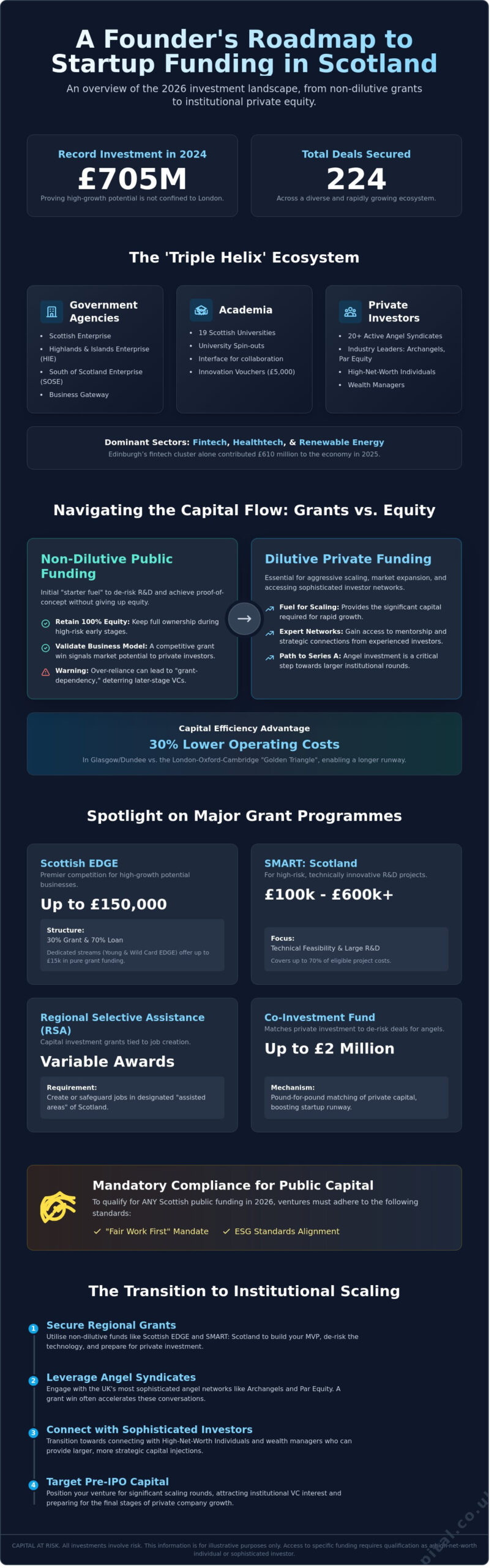
While London attracts 66% of UK venture capital, Scotland’s ecosystem secured a record £705 million in investment across 224 deals during 2024. This proves that high-growth potential is not confined to the M25. You’ve likely realised that identifying **startup funding scotland** is often a fragmented and frustrating process. It’s difficult to manage strict regional eligibility requirements and various government agencies while trying to scale a business. We understand the difficulty of missing out on capital because of opaque criteria or a perceived lack of local VC presence compared to the south.
This resource provides a direct roadmap to the Scottish investment landscape for 2026. You’ll find clear distinctions between non-dilutive grants, such as the £25 million Scottish EDGE fund, and equity options from elite syndicates like Archangels or Par Equity. We’ve compiled the necessary data to help you access sophisticated investor networks and pre-IPO capital. This article breaks down the specific steps to qualify for funding and connects you with the right financial conduits for your current stage of growth. We’ll examine the transition from seed-stage public support to institutional private equity.
Key Takeaways
- Master the unique “Triple Helix” ecosystem to secure startup funding scotland via flagship grant competitions and strategic R&D awards.
- Leverage the United Kingdom’s most sophisticated angel network by understanding the syndicate models used by industry leaders like Archangels and Par Equity.
- Ensure your venture meets the 2026 “Fair Work First” mandate and ESG standards required to qualify for all Scottish public capital.
- Transition from regional grants to institutional scaling by connecting with high-net-worth individuals and wealth managers for pre-IPO opportunities.
Understanding the Scottish Startup Funding Ecosystem in 2026
Scotland’s investment landscape operates via a “Triple Helix” model. This structure integrates government agencies, academic spin-outs from 19 universities, and 20+ active angel syndicates. By early 2026, the market has matured beyond the “survival grant” era of the early 2020s. Institutional support now prioritises scaling and global export over mere existence. Fintech, healthtech, and renewable energy dominate the sector. Edinburgh’s fintech cluster alone contributed £610 million to the economy in 2025. While the Edinburgh-Glasgow corridor remains the primary engine for startup funding scotland, the Highlands and Islands Enterprise (HIE) and South of Scotland Enterprise (SOSE) provide targeted support for rural innovation. CAPITAL AT RISK.
The Role of Scottish Enterprise and Public Bodies
Scottish Enterprise acts as the lead conduit for early-stage de-risking. It provides the initial capital required to attract private interest. Founders must navigate the regional split carefully. HIE and SOSE offer bespoke grants for businesses outside the central belt, while Business Gateway handles foundational advisory services. The Scottish Co-Investment Fund remains a critical tool. It matches private capital pound-for-pound up to £2 million. This mechanism reduces risk for private investors and ensures startups have sufficient runway to reach Series A. Eligibility depends on sector alignment and growth potential.
Public vs. Private Capital: Striking the Balance
Non-dilutive grants are the starter fuel for R&D-heavy startups. They allow founders to retain equity during the high-risk proof-of-concept phase. However, excessive reliance on grants can lead to “grant-dependency,” which often deters institutional VC firms during later rounds. Transitioning to private equity is necessary for aggressive scaling. A strategic advantage of seeking startup funding scotland is the lower burn rate. Operating costs in Glasgow or Dundee are currently 30% lower than in the London-Oxford-Cambridge “Golden Triangle.” This efficiency allows for longer development cycles before requiring follow-on rounds. Founders should check their eligibility for specific tax reliefs, such as S/EIS, before engaging with private networks.
Note: All investments involve risk. Access to specific funding tiers requires qualification as a high net worth individual or a sophisticated investor. Am I Eligible?
The Major Grant Programmes and Competitions in Scotland
Scottish founders access a tiered ecosystem of non-dilutive capital designed to de-risk early-stage ventures. These programmes are highly competitive. They require precise alignment with Scottish Government economic priorities, specifically net-zero targets and high-value job creation. Grants represent a vital component of startup funding scotland, providing the runway necessary to reach commercial milestones or private investment rounds.
- Scottish EDGE: The premier competition awarding up to £150,000. Awards follow a 30% grant and 70% loan structure for the main category.
- SMART: Scotland: Discretionary grants targeted at high-risk technical feasibility and R&D projects.
- Regional Selective Assistance (RSA): Capital investment grants for projects that create or safeguard jobs in “assisted areas” of Scotland.
- Young EDGE and Wild Card EDGE: Dedicated streams for founders under 30 and pre-trading companies, offering up to £15,000 in pure grant funding.
Winning the Scottish EDGE Competition
Success in the 2026 Scottish EDGE rounds depends on demonstrating “Scale Potential.” Judges look for businesses capable of achieving £1 million in turnover within three years. The Social Enterprise EDGE category remains a critical path for purpose-driven models. It requires proof that profits support a defined social or environmental mission. An EDGE victory serves as a market signal to private investors. It validates the business model and often accelerates follow-on rounds with angel syndicates. Before applying, founders must ask: Am I Eligible? You should check your eligibility for private matching capital to maximise the impact of any grant award. CAPITAL AT RISK.
R&D and Innovation Grants
The SMART: Scotland application process is rigorous. It demands proof of technical innovation and commercial viability. The grant typically covers 70% of eligible costs for feasibility studies, capped at £100,000. For larger R&D projects, funding can exceed £600,000. Collaboration with Scotland’s 19 higher education institutions via Interface can unlock additional resources. This includes Innovation Vouchers worth £5,000 for initial feasibility work. Innovate UK offers a broader UK-wide landscape with grants up to £2 million. However, the 2025 success rate for Innovate UK Smart Grants remained below 10%. Scottish Enterprise frequently fills this gap for high-potential domestic firms. Securing startup funding scotland requires understanding this overlap between local and national bodies.
Angel Syndicates: The Backbone of Scottish Private Equity
Scotland maintains the highest concentration of angel investors per capita in the United Kingdom. This density isn’t accidental. It’s the result of a 30-year evolution of the “Syndicate Model.” Unlike fragmented individual investing seen in other regions, Scottish angels pool their capital and expertise into formal groups. Archangels, established in 1992, pioneered this structure. It allows private individuals to lead significant funding rounds that would typically require institutional venture capital. By 2024, these syndicates became the primary engine for startup funding scotland, providing a bridge between seed capital and Series A rounds.
LINC Scotland operates as the national association for these business angels. It functions as a gatekeeper and a directory, allowing founders to identify which groups align with their sector. The appetite for Scottish equity is largely driven by the Seed Enterprise Investment Scheme (SEIS) and the Enterprise Investment Scheme (EIS). These UK tax reliefs offer investors up to 50% and 30% income tax relief respectively. They significantly mitigate the downside of early-stage investing. CAPITAL AT RISK.
Top Angel Networks in Edinburgh and Glasgow
Archangels remains the most prominent player, focusing on life sciences and IP-rich technology. They typically participate in rounds between £250,000 and £2 million. Par Equity follows a “hands-on” philosophy, utilizing a network of “Par Investors” who provide functional expertise to portfolio companies. Equity Gap and Apollo Informal Investment fill the gap for earlier-stage ventures. These groups often co-invest, a practice that increased by 15% in the last 24 months to de-risk larger capital requirements.
How to Approach a Scottish Angel Syndicate
The Scottish investment landscape is tight-knit. Cold applications rarely succeed. Data suggests that founders with a “warm intro” from a trusted intermediary, such as a specialist solicitor or a LINC member, are 40% more likely to secure a screening meeting. When structuring your pitch, focus on capital efficiency. Scottish angels rarely back “growth at any cost” models. They prefer clear paths to profitability and sustainable unit economics.
Standard Scottish term sheets usually include specific provisions:
- Pre-emption rights: Existing investors get the first right to buy new shares.
- Board Observer seats: Syndicates often require a seat to monitor their investment.
- SEIS/EIS Advance Assurance: Most syndicates won’t transfer funds without HMRC’s preliminary approval.
Ensure your cap table is clean. Scottish investors are meticulous about “drag-along” and “tag-along” rights to ensure future exit paths aren’t blocked by minority shareholders. Am I Eligible? Founders should verify their SEIS status before initiating any formal syndicate outreach.
Compliance and Eligibility: The “Fair Work First” Mandate
Securing public capital in Scotland requires more than a high-growth business model. Since July 2023, the Scottish Government has mandated “Fair Work First” criteria for all recipients of public sector grants. This isn’t a voluntary guideline. It’s a strict prerequisite. If you’re applying for startup funding scotland, you’ll need to demonstrate how your company treats its workforce before any funds are released.
Environmental, Social, and Governance (ESG) expectations are now central to the due diligence process. By 2026, Scottish Enterprise and other public bodies require a clear roadmap toward Net Zero targets. Startups must also pay the Real Living Wage, which is currently set at £12.60 per hour outside London for the 2024/25 period. Expect this figure to be higher by the time you submit your 2026 application. If your cap table includes international shareholders from jurisdictions under UK sanctions, your application will fail immediately. The National Security and Investment Act 2021 has increased scrutiny on foreign direct investment, making clean ownership structures essential.
The Five Pillars of Fair Work
Scottish public funders evaluate your business across five specific dimensions. You’ll need to document these during the application process. These pillars include effective voice, opportunity, security, fulfilment, and respect. Effective voice often requires formal channels for staff to influence management decisions, such as trade union recognition or internal staff forums. Security means an end to inappropriate zero-hours contracts. Providing these protections doesn’t just satisfy the government; it makes your firm more attractive to sophisticated private investors who view low staff turnover as a key performance indicator.
Regional and Sectoral Restrictions
The UK Subsidy Control Act 2022 governs how much public money you can receive. Under the Minimal Financial Assistance (MFA) rules, most startups are capped at £315,000 over a rolling three-year period. It’s vital to track every grant, as exceeding this limit triggers mandatory repayment. Certain sectors remain entirely ineligible for public investment. These include:
- Tobacco and related products.
- Gambling and betting establishments.
- Adult entertainment services.
- Activities that cause significant environmental harm.
UK-wide subsidies, such as Innovate UK grants, must be balanced against Scottish-specific awards to ensure you don’t breach the MFA ceiling. Always verify your total cumulative aid before requesting new capital.
Is your startup compliant with current Scottish investment standards? Check your eligibility for funding here.
Scaling Beyond Scotland: Connecting with Sophisticated Investors
Scottish startups often reach a natural ceiling with local angel syndicates once they’ve secured their initial £2 million in seed capital. Transitioning to Series A and B rounds requires a strategic shift toward institutional capital and global private equity. This stage marks the move from grant-based support to sophisticated, high-stakes investment environments. Scaling companies must look toward London, New York, and Dubai to find the liquidity required for international expansion.
A solid track record in the local ecosystem provides the necessary data points for these larger rounds. Success in startup funding scotland, evidenced by a Scottish EDGE win or a fully subscribed SEIS round, functions as a badge of credibility. Institutional investors prioritise companies that have already passed through these rigorous local vetting processes. By 2026, the gap between local seed rounds and global institutional rounds will require even more precise financial reporting and a clear path to a secondary placing or a full IPO.
The Transition to Institutional Capital
When seeking rounds exceeding £5 million, founders must engage with a pre-vetted investor network. This transition is less about the product and more about the scalability of the business model. Credibility with international wealth managers depends on your ability to demonstrate consistent growth and regulatory compliance. Moving beyond the Highlands and the Central Belt means preparing for the scrutiny of NYC and London analysts who value pre-IPO readiness and exit transparency.
- Series A/B Focus: Moving from individual angels to venture capital firms.
- Credibility: Using local milestones to de-risk the investment for global firms.
- Network Access: Tapping into curated databases of accredited investment firms.
Am I Eligible? The BGS Capital Qualification Process
BGS Capital operates as an introducer to a high-level network of wealth managers and high-net-worth individuals. We don’t facilitate raises ourselves. Instead, we provide a conduit to accredited investment firms. It’s vital to understand the difference between a listing and facilitation; our role is to manage the connection between qualified companies and sophisticated capital. If your business has outgrown local syndicates, the next logical step is to seek exposure to a broader, more liquid database of investors.
CAPITAL AT RISK. Access to these opportunities is restricted to those who meet specific criteria. To begin the process, you must verify your status and business readiness. Take the next step to gain visibility among our curated investor base.
Actionable Step: FEATURE YOUR BUSINESS to gain exposure to our curated investor database.
The long-term vision for any high-growth Scottish firm should include a secondary placing or a full public listing. Preparing for this outcome starts years in advance by connecting with the right introducers. We focus on efficiency and tangible outcomes, ensuring that qualified companies find the professional connections they need to scale globally.
Secure Your Growth Capital in 2026
Navigating the 2026 landscape for startup funding scotland requires a dual focus on local compliance and international reach. You must ensure your enterprise meets the 2026 Fair Work First mandate to unlock essential Scottish Enterprise grants. Local angel syndicates remain the backbone of early-stage private equity; however, scaling beyond the £5 million mark often necessitates a broader investor base. BGS Capital operates as a specialist introducer. We bridge the gap between high-growth UK firms and a curated network of high-net-worth individuals. Our platform provides a free service for qualified investors and specialises in pre-IPO and IPO introductions. We maintain a strict focus on connecting qualified companies with accredited investment firms. RAISING CAPITAL? FEATURE YOUR BUSINESS on our platform to connect with sophisticated investors. Don’t let capital constraints limit your 2026 expansion plans. The right infrastructure is ready to support your journey from initial seed rounds to a successful public listing. Your business deserves a seat at the table with the UK’s most active wealth managers and private equity specialists.
Frequently Asked Questions
What is the most common source of startup funding in Scotland?
Angel investment is the most common source of startup funding scotland for early-stage companies. Data from 2024 confirms that Scotland’s 20+ angel syndicates invested over £80 million into 120+ businesses. These groups provide essential seed capital and sector-specific mentorship. Most syndicates lead initial rounds before companies move toward larger institutional investment or Series A raises.
Can I apply for Scottish funding if my headquarters are in London?
You cannot typically apply for Scottish-specific public funding if your headquarters and operations are exclusively in London. Eligibility for Scottish Enterprise grants requires a registered office or a significant operational base in Scotland. At least 50% of your staff or project costs must be based within Scottish borders. This ensures that local taxpayer funds support regional economic growth.
Is Scottish EDGE a grant or a loan?
Scottish EDGE operates as a hybrid model, providing a combination of 30% grant and 70% loan for its main category winners. For the 2026 funding rounds, the maximum award is £100,000. This structure provides immediate non-dilutive capital while the loan portion supports the fund’s long-term sustainability. Smaller categories like Young EDGE remain 100% grant-based.
How much funding can a startup typically raise from a Scottish angel syndicate?
Scottish angel syndicates typically provide funding ranging from £100,000 to £2 million per investment round. While individual angels might contribute smaller amounts, the syndicate model allows for larger, consolidated raises. In 2025, the average deal size involving LINC Scotland members reached £450,000. CAPITAL AT RISK. All equity investments involve significant risk to your capital.
What are the main requirements for the Scottish Loan Scheme in 2026?
The Scottish Loan Scheme in 2026 requires businesses to demonstrate commercial viability and a minimum of 24 months of active trading. Applicants must provide three years of financial projections and evidence of an inability to secure full funding from traditional banks. Your company must also adhere to the Fair Work First criteria. Loans generally range from £25,000 to £250,000.
Do I need a business plan to apply for Scottish Enterprise grants?
You must submit a detailed business plan to apply for any Scottish Enterprise grant or support programme. This document needs to outline your value proposition, market analysis, and a clear three-year financial forecast. Scottish Enterprise uses this plan to assess the potential economic impact your startup brings to the region. You should review their full criteria to answer the question: Am I Eligible?
How does the “Fair Work First” policy affect my funding eligibility?
The Fair Work First policy makes your eligibility for startup funding scotland conditional on meeting specific employment standards. Since 1 July 2023, all grant recipients must pay the Real Living Wage and provide a channel for effective worker voice. You must also prove you don’t use inappropriate zero-hour contracts. Failure to document these practices will result in the rejection of your application.
What is the role of LINC Scotland in the startup ecosystem?
LINC Scotland acts as the national association for business angels and represents the private investment community. They don’t invest directly; they operate as an introducer, connecting founders with a network of 2,000+ individual investors. LINC also works with the Scottish Government to ensure the investment ecosystem remains competitive for high-growth startups seeking seed-stage capital.