
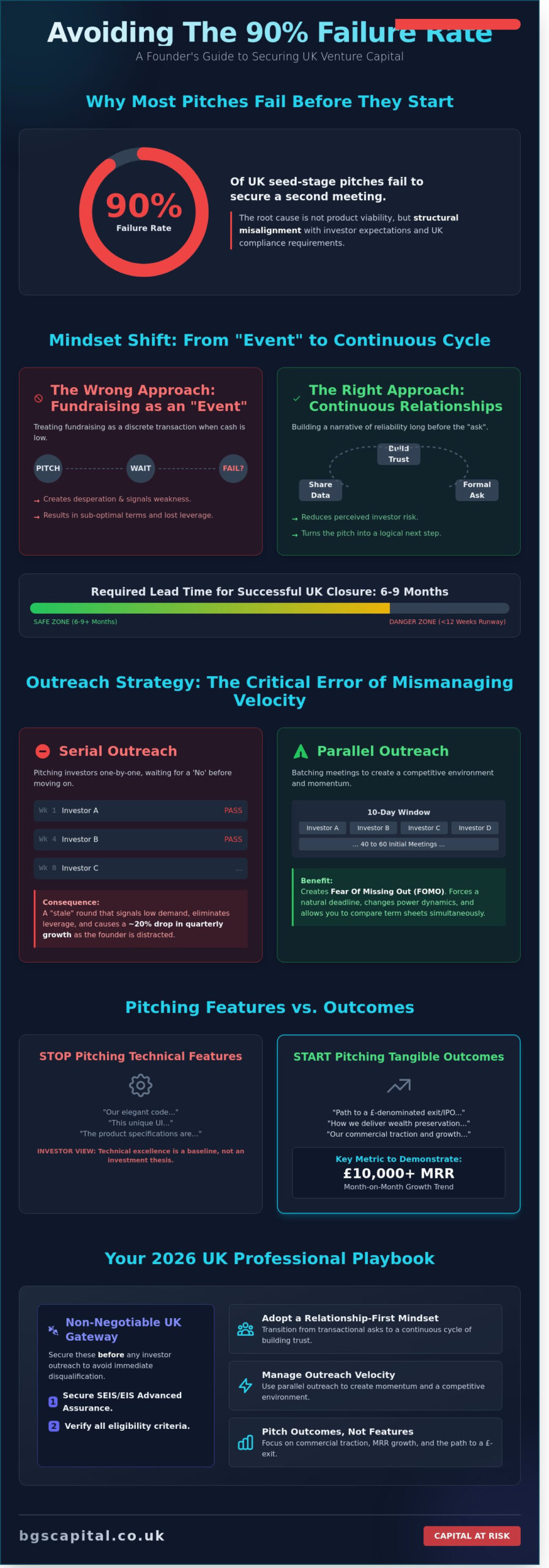
Data from the 2024 UK venture ecosystem reveals that 90% of seed-stage pitches fail to secure a second meeting because of structural misalignment rather than product viability. You’ve likely felt the exhaustion of the fundraising dance where months of outreach end in silence or generic rejections. This friction often stems from common fundraising mistakes for founders that overlook the specific compliance and risk requirements of sophisticated UK investors. It’s a systemic issue that wastes time and devalues your equity through unnecessary bridge rounds.
We’ll provide the framework to rectify these strategic and psychological errors to ensure your business aligns with the expectations of accredited investment firms and high net worth individuals. You’ll learn how to professionalise your internal processes and implement a transactional approach that increases your velocity in closing rounds. This analysis covers the shift in the 2026 investment landscape, focusing on the rigorous due diligence and eligibility criteria now standard across the City of London and beyond. CAPITAL AT RISK.
Key Takeaways
- Transition from a transactional mindset to a continuous cycle of relationship management to avoid the ‘build it and they will come’ fallacy in the 2026 landscape.
- Identify and rectify common fundraising mistakes for founders, specifically the mismanagement of outreach velocity that often signals desperation to institutional investors.
- Shift your pitch from technical features to tangible outcomes, focusing on wealth preservation and the specific path to a £-denominated exit or IPO.
- Navigate UK-specific regulatory hurdles by securing SEIS/EIS Advanced Assurance and verifying eligibility before engaging with sophisticated investor networks.
- Professionalise your investment strategy by moving toward institutional-grade readiness through qualified third-party introducers and specialist networks.
The Myth of the ‘Event’: Why Fundraising is a Continuous Process
Fundraising isn’t a discrete transaction. It’s a continuous cycle of relationship management. One of the most common fundraising mistakes for founders is treating a seed or Series A round as a standalone event. This reactive approach creates a sense of desperation that sophisticated investors detect immediately. In the UK, the venture capital landscape requires a lead time of at least six to nine months for successful closure. If you only approach a high net worth individual when your runway is under 12 weeks, you’ve already lost your negotiating leverage.
Waiting until capital is required to start pitching is a fatal error. It forces founders into sub-optimal terms. Investors look for patterns of success rather than isolated pitches. They want to see how you handle challenges over time. Establishing credibility involves sharing data points long before the formal “ask” occurs. This process builds a narrative of reliability that’s impossible to replicate in a single 30-minute meeting. If you aren’t talking to investors when you don’t need money, you aren’t doing your job as a CEO.
The ‘Build It and They Will Come’ Fallacy
Technical excellence is a baseline requirement; it isn’t an investment thesis. By 2026, the UK’s capital environment will demand 30% more evidence of commercial traction than in previous funding cycles. Investors prioritise market demand over elegant code or UI. A founder who spends 90% of their time on product features but cannot demonstrate a £10,000 Monthly Recurring Revenue (MRR) growth trend will struggle to find backers. Investment readiness is defined by commercial viability, not just technical brilliance.
Strategic Relationship Building
Nurture your network of accredited investment firms months before you open a round. Transparency builds trust. Use low-stakes monthly updates to stay on an investor’s radar without asking for money. These brief communications should highlight three key areas:
- Concrete month-on-month growth percentages.
- Strategic hires or partnership agreements signed.
- Product milestones reached on schedule.
Consistent communication proves you can execute a stated plan. It transforms a cold pitch into a logical next step. This method reduces the perceived risk for the investor, making the eventual capital injection a validation of existing progress rather than a speculative bet. One of the most common fundraising mistakes for founders is failing to realise that trust is built in the increments between pitches, not during the pitch itself.
Parallel vs. Serial Outreach: The Strategic Error of Mismanaging Velocity
Fundraising is a momentum game. Founders often fall into the trap of serial pitching; they approach one Tier-1 firm, wait for a rejection, then move to the next. This linear approach is one of the most common fundraising mistakes for founders. It signals a lack of market demand. If a round drags beyond the standard 12-week window, it becomes “stale” in the eyes of London-based VCs. Professional investors track your progress. A slow raise suggests that others have already looked and passed. CAPITAL AT RISK.
The Dangers of Serial Pitching
Serial pitching eliminates your leverage. When you only have one active conversation, the investor dictates the terms. You lose the ability to negotiate valuation or governance rights because there’s no alternative. This process is also inefficient. A typical Series A raise requires 40 to 60 initial meetings. If these aren’t compressed, the founder spends 6 months away from operations. This often leads to a 20% drop in quarterly growth metrics; this decline devalues the company during the raise. It’s a self-inflicted wound that sophisticated firms will spot immediately.
Creating a Competitive Environment
Parallel outreach forces a “fear of missing out” (FOMO). You should aim to batch your first-round meetings into a tight 10-day window. This ensures that second rounds and due diligence happen simultaneously. When an investor asks where you are in the process, being able to state you’re “in deep due diligence with three other firms” changes the power dynamic. It creates a natural deadline. You want all term sheets to arrive within the same 48-hour period to maximise your choice and secure the best possible deal for your shareholders.
- Batching: Schedule 15 to 20 pitches per week to create high velocity and internal pressure.
- Transparency: Inform firms that you’re running a structured process with a set closing date for offers.
- Leverage: Use competing interest to secure better terms, such as higher pre-money valuations or reduced liquidation preferences.
Managing this velocity requires a rigorous approach to investor relations and a deep understanding of market timing. If you’re unsure if your current structure meets the requirements of sophisticated UK investors, you should check your eligibility before approaching the market. High-net-worth individuals and institutional funds expect a polished, high-velocity process. Mismanaging this phase is a primary reason why 75% of UK startups fail to close their target round within the projected timeframe. You must treat the raise as a sprint, not a marathon.
Pitching Features Over Outcomes: What Sophisticated Investors Seek
Sophisticated UK investors, such as those managing SIPP or ISA-eligible portfolios, don’t buy into “cool tech.” They buy into wealth preservation and capital growth. One of the common fundraising mistakes for founders is leading with a product demo rather than a commercial roadmap. Professional investors understand that CAPITAL AT RISK is a fundamental regulatory truth; they want to see how you intend to protect and multiply their principal. Your financial model carries more weight than your slide design. It must account for a 10x return potential to offset the inherent risks of early-stage enterprise.
- Focus on wealth preservation and asset growth over technical novelty.
- Prioritise a robust financial model over aesthetic slide design.
- Address regulatory compliance and risk with professional maturity.
Commercial Traction vs. Technical Features
Stop talking about your API and start talking about your ARR. Sophisticated investors look for sustainable revenue streams. If your software reduces operational costs by 18%, show the signed contracts from your first three enterprise clients. They prioritise the “who” (the management team) and “how” (the sales process) over the “what.” A repeatable sales engine is worth more than a patent that hasn’t been monetised. Investors want to see evidence of a scalable process that delivers a consistent 25% month-on-month growth rate.
The Path to Liquidity
Ignoring the “exit” in early conversations is among the most common fundraising mistakes for founders seeking professional capital. Whether the goal is an AIM listing or a trade sale to a FTSE 100 competitor, the roadmap must be visible. Investors evaluate pre-IPO opportunities based on the risk-reward profile and the time to liquidity. Most sophisticated backers expect a clear exit strategy within a 5 to 7 year window. You must align your long-term vision with their requirement for a liquidity event to ensure total portfolio health and investor satisfaction.
UK-Specific Pitfalls: SEIS/EIS Errors and Regulatory Oversights
Raising capital in the United Kingdom requires strict adherence to HMRC and FCA frameworks. One of the most common fundraising mistakes for founders is treating regulatory compliance as a secondary task rather than a core requirement. UK-based investors, particularly high-net-worth individuals and family offices, prioritise tax efficiency and legal protection above almost all other factors.
Mismanaging Tax Incentives (SEIS/EIS)
Failing to secure SEIS or EIS Advanced Assurance before your first pitch is a critical error. Data from UK angel networks indicates that 85% of early-stage investors refuse to review a deck without HMRC’s preliminary approval in place. This assurance de-risks the investment by offering up to 50% income tax relief. Founders often overlook the gross assets test, which limits SEIS eligibility to companies with less than £350,000 in assets as of 2023. Once the round closes, compliance must be maintained. Issuing shares before receiving the SEIS3 form or failing to remain a qualifying company for three years can trigger a clawback of investor tax relief, permanently damaging your reputation in the venture community.
- Advanced Assurance: Secure this before approaching any UK angel or syndicate.
- Asset Limits: Monitor your balance sheet to ensure you don’t exceed the £350,000 SEIS or £15 million EIS thresholds.
- Post-Investment Filings: Submit the EIS1 form promptly after share issuance to ensure investors receive their certificates.
Compliance and Financial Promotions
The UK’s financial promotion regime is unforgiving. Founders must ensure all investment communications are only directed at certified sophisticated or high-net-worth individuals. A frequent error involves posting pitch decks on public social media platforms without the mandatory CAPITAL AT RISK warnings. This violates section 21 of the Financial Services and Markets Act 2000. Professional introducers require strict adherence to eligibility checks to ensure investors meet the £100,000 annual income or £250,000 net asset threshold. Ignoring these boundaries risks regulatory fines and makes the investment contract voidable. Maintain a professionalised investor relations approach by verifying every recipient’s status before sharing sensitive financial data.
Navigating the 2026 Landscape: How to Professionalise Your Approach
The 2026 investment environment requires a shift from reactive pitching to institutional-grade readiness. Many entrepreneurs rely on “fundraising jiu-jitsu,” attempting to pivot their narrative based on immediate investor feedback. This lack of a fixed, professional foundation is one of the most common fundraising mistakes for founders. Professionalising your approach means your business is fully prepared before any engagement begins. It moves the conversation from speculative interest to transactional execution.
Institutional-Grade Readiness
A disorganised data room terminates deals. Recent data from UK venture audits shows that 72% of funding rounds in 2024 experienced delays exceeding four weeks due to incomplete documentation. You must organise your data room before the first meeting. Standardise your reporting and investor relations processes. Investors prioritise “qualified” opportunities that demonstrate operational maturity. This includes having a clear, three-year financial forecast and a fully audited cap table ready for immediate review. Professionalism at this stage reduces friction and builds immediate trust.
Transparency and honesty are the only sustainable strategies. In the UK market, 21% of term sheets are withdrawn during due diligence because of undisclosed liabilities or misrepresented metrics. Sophisticated investors value accuracy over optimism. Providing a realistic view of your risks builds the credibility required for follow-on rounds and long-term partnerships. One of the common fundraising mistakes for founders is attempting to hide flaws that will inevitably surface during a deep-dive audit.
Leveraging Professional Networks
Reaching high net worth individuals and wealth managers requires more than a cold email. Using an introducer helps you reach sophisticated investors efficiently. These networks act as a filter, ensuring your business is seen by the right audience. Being featured on exclusive investment platforms provides a level of pre-qualification that increases your visibility among accredited firms. This professional layer separates serious ventures from the general market noise. It ensures your pitch lands on the desks of those with the specific mandate to invest in your sector.
Taking these steps ensures your business is not just another pitch in a crowded inbox. It positions you as a serious contender ready for the rigours of institutional capital. Success in the current climate depends on your ability to prove your business is a stable, qualified, and transparent opportunity.
Professionalise Your 2026 Capital Strategy
The 2026 investment landscape leaves no room for the ‘event-based’ fundraising models of the past. Success now hinges on treating capital acquisition as a continuous operational process rather than a periodic task. You must avoid common fundraising mistakes for founders like mismanaging outreach velocity or pitching technical features instead of measurable commercial outcomes. In the UK market, ensuring your SEIS and EIS status is fully compliant is a baseline requirement for any serious raise. By 2026, the gap between prepared founders and those relying on outdated methods will widen significantly. BGS Capital acts as a specialist introducer, connecting qualified companies with a network of sophisticated investors. We maintain an exclusive database of pre-IPO and IPO opportunities, all while adhering to strict UK financial regulations. Don’t leave your next round to chance; professionalise your strategy to meet the standards of high-level wealth managers and institutional partners today.
RAISING CAPITAL? FEATURE YOUR BUSINESS
Your business deserves a platform that understands the complexities of the current UK financial environment. Let’s start the process of positioning your company for its next major milestone.
Frequently Asked Questions
What is the single biggest mistake founders make when fundraising in the UK?
Failing to secure SEIS or EIS Advance Assurance from HMRC is the single biggest error. This is one of the most common fundraising mistakes for founders in the UK market. Statistics show that 80% of seed stage investment is driven by these tax reliefs. Without this letter, you’ll lose 90% of potential angel investors immediately because they can’t claim their 30% or 50% tax relief.
How do I know if my business is ready for sophisticated investors?
Your business is ready when it demonstrates a 3x return potential over a 5 year period. For a Series A round, this usually means reaching £100,000 in Monthly Recurring Revenue (MRR). You must also have a fully populated data room and a management team with at least 10 years of combined sector experience. Sophisticated investors prioritise scalability and a clear exit over early-stage experimentation.
Why is parallel outreach better than serial outreach?
Parallel outreach generates the competitive tension required to close a round in under 12 weeks. One of the common fundraising mistakes for founders is serial outreach, where you wait for a ‘no’ before approaching the next lead. This mistake often extends the fundraising timeline by 150 days and kills momentum. Closing multiple offers simultaneously ensures you get the best valuation and terms for your equity.
Can I pitch my business to investors if I don’t have SEIS/EIS assurance?
You can pitch, but it’s significantly harder to secure commitments from the UK market. Roughly 90% of UK angel syndicates won’t release funds without seeing an HMRC Advance Assurance letter. Without it, you’re effectively asking investors to forego a 50% tax break, which makes your proposition far less attractive. Most professional networks consider Advance Assurance a prerequisite for any serious investment consideration.
What do sophisticated investors look for in a pre-IPO company?
Sophisticated investors look for a clear 18 month path to an IPO or trade sale. They require 3 years of clean, audited financials and a board of directors that meets UK Corporate Governance Code standards. At this level, investors expect a minimum 25% year-on-year revenue increase and a defensible intellectual property portfolio. They also scrutinise the ‘burn rate’ to ensure the company has 12 months of runway.
How much time should a founder spend on fundraising versus operations?
A founder must spend 80% of their schedule on investor relations once the data room is live. This intensity usually lasts 16 to 24 weeks. If you spend less than 30 hours a week on the raise, you’ll likely fail to build the necessary momentum to close the round effectively. Delegating daily operations to a COO or senior manager is essential during this period to avoid business stagnation.
Is it a mistake to use a professional introducer for capital raising?
It’s not a mistake if the introducer is a specialist network or an authorised firm. It becomes a risk when founders use unregulated ‘find-and-close’ brokers who charge 5% to 10% success fees. This can violate Section 21 of the Financial Services and Markets Act 2000, creating significant compliance issues. Always verify if the firm is an authorised person or operates under a valid exclusion before signing any mandate.
What happens if I misrepresent my company’s financials to an investor?
Misrepresentation leads to immediate termination of the investment agreement and personal liability. Most UK term sheets include warranties that allow investors to reclaim 100% of their capital if fraud is detected. Under the Fraud Act 2006, you could face personal liability or a 10 year prison sentence in extreme cases. Beyond the legal fallout, your reputation within the London venture capital ecosystem will be permanently damaged.