
By 2026, the traditional venture capital model will no longer be the sole gatekeeper for the UK’s most promising technology unicorns. Most sophisticated investors recognise that the highest potential returns are often locked behind doors accessible only to those with direct institutional connections. You’ve likely found that information asymmetry in private markets makes it difficult to secure allocations in high-quality pre-IPO rounds before they’re already oversubscribed. Accessing UK startups looking for investment 2026 requires more than just capital; it requires a strategic position within the right financial networks. CAPITAL AT RISK.
You understand that the UK tech sector’s projected 15% growth by 2026 creates a unique window for high net worth individuals to bridge the gap between early-stage risk and public market stability. This guide identifies the specific high-growth sectors and startups poised for pre-IPO success. You’ll gain a clear framework for identifying exclusive opportunities and a professional route to introductions with investor relations teams. We’ll examine the 2026 economic forecast to ensure your portfolio is positioned for the next wave of liquidity events. Am I Eligible?
Key Takeaways
- Identify the specific market conditions and high-growth sectors for UK startups looking for investment 2026, focusing on the rise of “Deep Utility” and pre-IPO market stabilisation.
- Explore why capital is flowing into infrastructure-heavy green energy and regulated B2B fintech solutions that move beyond simple payment processing.
- Master the “Soonicorn” framework to pinpoint companies valued between £200 million and £800 million that are approaching a strategic 2026 exit window.
- Understand the essential due diligence requirements and regulatory compliance necessary to manage the “Capital at Risk” reality of high-growth investing.
- Learn how to access exclusive, pre-vetted opportunities through a specialist introducer network designed for sophisticated and high net worth investors.
The Landscape of UK Startup Investment in 2026
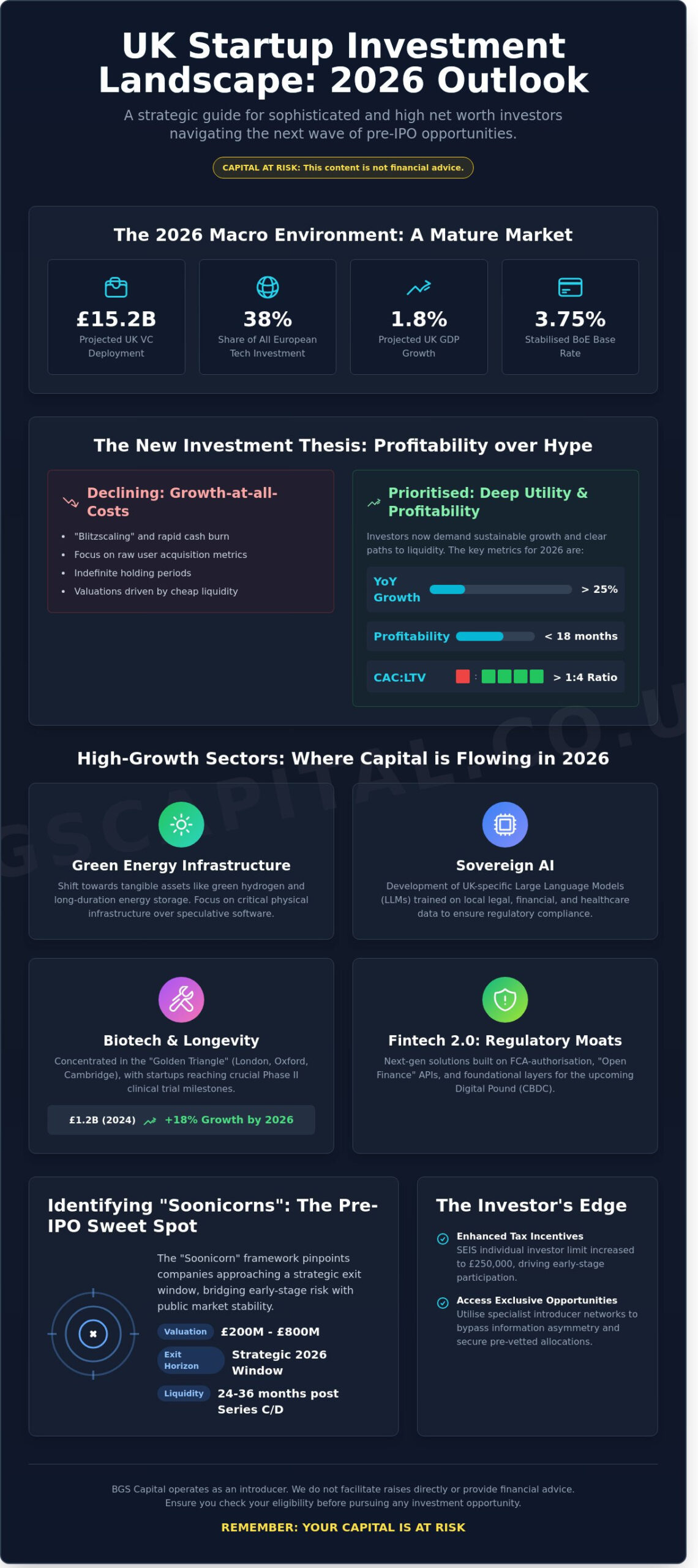
The UK venture capital environment in 2026 is defined by a return to structural discipline. Following the valuation corrections observed between 2022 and 2024, the market has reached a state of maturity where “Deep Utility” is the primary benchmark for success. Total VC deployment in the United Kingdom is projected to reach £15.2 billion by the end of December 2026. This stability is largely driven by a recalibrated pre-IPO market. Investors now demand clear pathways to liquidity within 24 to 36 months of a Series C or D round, moving away from the indefinite holding periods of the previous decade.
The Bank of England base rate, which has stabilised at 3.75% as of Q1 2026, has fundamentally recalibrated how UK startups looking for investment 2026 are valued. Higher capital costs mean the era of cheap, speculative liquidity has ended. Consequently, firms must demonstrate a 25% minimum year-on-year revenue growth alongside narrowing losses to secure mid-to-late stage funding. The UK remains Europe’s primary hub for sophisticated capital, capturing 38% of all tech investment on the continent. This dominance is supported by a mature startup ecosystem that bridges the gap between early-stage innovation and institutional exit routes. CAPITAL AT RISK.
Economic Drivers for 2026 Startups
The UK economy’s projected 1.8% GDP growth in 2026 provides a reliable backdrop for enterprise tech spending. Fiscal policies introduced in the 2025 Autumn Statement have reshaped the SEIS and EIS landscape, increasing the individual investor limit for SEIS to £250,000. These tax incentives continue to drive early-stage participation from high net worth individuals. London has further solidified its role as a global centre for secondary placings. This allows accredited investment firms to acquire equity from founders and early employees, providing liquidity without the immediate need for a full IPO.
The Shift from Growth-at-all-costs to Profitability
Investment committees in 2026 are prioritising EBITDA-positive trajectories over raw user acquisition metrics. The decline of “blitzscaling” is evident; 72% of Series B rounds in the last twelve months were awarded to companies with a proven path to profitability within 18 months. Investors now scrutinise unit economics with forensic detail. The Customer Acquisition Cost (CAC) to Lifetime Value (LTV) ratio must typically exceed 1:4 to attract top-tier institutional interest. Deep Utility is the integration of software with critical physical infrastructure. This focus on essential services ensures that UK startups looking for investment 2026 are resilient against cyclical downturns. Sustainable growth is no longer a preference; it’s a requirement for any firm seeking to access exclusive financial opportunities in the current climate.
Note: BGS Capital operates as an introducer. We do not facilitate raises directly or provide financial advice. Ensure you check your eligibility before pursuing any investment opportunity. CAPITAL AT RISK.
High-Growth Sectors: Where the Capital is Flowing
Capital allocation for 2026 is concentrating in four distinct verticals where the UK maintains a structural competitive advantage. Green hydrogen infrastructure and long-duration energy storage represent the primary hardware plays for institutional investors. We’re seeing a decisive shift away from speculative consumer software toward tangible energy assets. Sovereign AI is another critical priority. UK startups are currently developing Large Language Models (LLMs) trained specifically on local legal, financial, and healthcare datasets to ensure total compliance with the UK AI Safety Institute’s frameworks. The “Golden Triangle” of London, Oxford, and Cambridge remains the epicentre for biotech. Longevity science startups in this corridor secured £1.2 billion in 2024; this figure is projected to grow by 18% by the end of 2026 as clinical trials reach Phase II milestones.
Fintech 2.0: The Regulatory Advantage
Regulatory moats define the next generation of financial technology. UK startups looking for investment 2026 are prioritising FCA-authorised status to facilitate complex B2B banking and cross-border settlements. Open Banking has transitioned into “Open Finance,” where startups integrate insurance, pension, and mortgage data into unified APIs. The Bank of England’s ongoing development of a Digital Pound (CBDC) creates a foundation for startups building programmable money layers for institutional use. A typical Series B+ fintech profile in 2026 isn’t a retail app; it’s a “Banking-as-a-Service” provider managing £750m+ in transaction volume or offering core ledger infrastructure to Tier 1 banks. These firms use their regulated status as a barrier to entry against international competitors. Before committing capital, investors should check their eligibility to access these restricted private placements.
Climate Tech and the Net Zero Mandate
The UK’s legal commitment to Net Zero by 2050 drives massive institutional demand for carbon capture and supply chain transparency. Investors value startups that de-risk their technology through public-private partnerships. The OECD report on UK venture capital confirms that state-backed initiatives are essential for catalysing private rounds in deep-tech sectors. CAPITAL AT RISK. Current investment trends show three key entities are central to this ecosystem:
- National Grid: Startups building grid-balancing software and “Virtual Power Plants” are essential for integrating renewable surges into the aging UK energy infrastructure.
- Department for Energy Security and Net Zero: This department oversees the £20 billion commitment to carbon capture, usage, and storage (CCUS) clusters, providing a massive tailwind for startups in the Teesside and Humber regions.
- Innovate UK: This body remains the primary vehicle for non-dilutive grants. In 2025, it allocated over £500m to high-growth climate firms, often providing the initial 30% of capital required to unlock private Series A funding.
Supply chain transparency is another area where UK startups looking for investment 2026 are gaining traction. New UK Sustainability Disclosure Standards (SDS) require companies to report Scope 3 emissions with 95% accuracy. Startups using blockchain or advanced IoT sensors to track carbon footprints across global trade routes are seeing valuation premiums of 20% compared to traditional SaaS models. These firms don’t just provide data; they provide the compliance framework necessary for large corporations to avoid heavy fines. The focus has moved from “green-washing” marketing tools to essential regulatory reporting infrastructure. This shift ensures that climate tech remains a resilient asset class even during periods of broader market volatility.
Identifying the Soonicorns: UK Startups to Watch
Identifying a “soonicorn” requires looking beyond basic growth metrics. In the British market, these are companies with valuations between £200 million and £800 million that demonstrate clear pathways to a £1 billion valuation. By 2026, the criteria for these high-performers have shifted from “growth at all costs” to sustainable unit economics. Investors must focus on firms that have secured at least Series C funding and maintain a burn multiple below 1.5x. These companies represent the most viable UK startups looking for investment 2026 as they approach the final stages of private ownership.
The 2026 exit window is a specific phenomenon driven by the 2023-2024 IPO drought. Many mature startups delayed their public debuts to wait for more favourable interest rate environments. This has created a compressed timeline where a high volume of quality firms will seek liquidity simultaneously. Evaluating a founder’s track record is vital; data indicates that serial founders who have previously exited a business for over £50 million are 30% more likely to reach unicorn status. Sector-specific expertise remains the primary indicator of 2026 success. Generalist management teams are being outperformed by specialists in DeepTech, Quantum Computing, and Fintech who possess deep regulatory knowledge. UK Government Support for Tech Startups has further solidified this trend by incentivising specialised firms to remain and scale within the British ecosystem.
The 2026 Pre-IPO Watchlist
Companies preparing for a London Stock Exchange (LSE) or NASDAQ listing in 2026 exhibit specific structural traits. They typically operate with a board comprising at least two independent directors with public market experience. Secondary markets are becoming more liquid for sophisticated investors; platforms now facilitate trades for institutional blocks once reserved for Tier-1 VC firms. This shift toward “Private IPOs” allows UK startups looking for investment 2026 to stay private longer. They secure institutional backing from pension funds and sovereign wealth funds without the immediate volatility of public markets. Capital at risk remains a factor, but the transparency in these late-stage private rounds has reached near-public standards.
Evaluating Revenue Quality
Distinguishing between hype-driven revenue and long-term contractual Annual Recurring Revenue (ARR) is the core of 2026 due diligence. High-quality startups focus on international expansion, particularly into the US or EU markets, which often accounts for over 40% of their valuation premiums. Revenue quality in 2026 is measured by customer retention and net revenue expansion. Investors should look for Net Revenue Retention (NRR) figures exceeding 110%. This indicates that the product is deeply embedded in the client’s infrastructure. Avoid firms relying on one-off implementation fees or subsidised acquisition costs. True value lies in the stickiness of the software and the ability to upsell within the existing user base.
Navigating the Risks: Due Diligence for Sophisticated Investors
Investing in UK startups looking for investment 2026 carries significant risk. CAPITAL AT RISK is the fundamental reality of this asset class. According to 2024 ONS data, approximately 60% of new UK businesses fail within their first three years. Sophisticated investors don’t ignore these statistics; they mitigate them through rigorous due diligence and professional introductions. Accessing high-growth opportunities requires a shift from speculative gambling to structured analysis. You aren’t just buying equity; you’re backing a management team’s ability to execute under pressure.
A startup’s “moat” is harder to identify in 2026. With AI tools now commoditised, a simple software “wrapper” around an existing Large Language Model provides zero long-term protection. Investors should prioritise companies with proprietary datasets, unique hardware integrations, or complex regulatory “moats” that competitors can’t easily replicate. If a startup’s core value proposition can be wiped out by a single update from a major tech provider, it isn’t a defensible investment. Look for 10x improvements in efficiency rather than incremental gains.
Wealth managers and SIPP-eligible investments play a vital role in a balanced portfolio. Many UK startups looking for investment 2026 offer structures compatible with Self-Invested Personal Pensions (SIPPs) or Small Self-Administered Schemes (SSAS). These vehicles provide tax efficiencies that can offset some of the inherent risks of early-stage equity. However, these investments are illiquid. You should expect your capital to be tied up for five to ten years before a potential exit via an acquisition or IPO.
The Legalistic Framework of 2026 Investing
The Financial Conduct Authority (FCA) has tightened regulations regarding the promotion of high-risk investments. Under the COBS 4.12 rules, firms must ensure that only “Certified Sophisticated Investors” or “High Net Worth Individuals” receive specific investment offers. This gatekeeping isn’t a formality; it’s a legal requirement designed to protect individuals from total capital loss. You’ll need to sign a self-certification or provide an accountant’s letter confirming your status before accessing detailed pitch decks. Am I Eligible?
Operational Due Diligence
Operational health is more than just a high growth rate. In the current funding environment, you must scrutinise the burn rate versus the remaining runway. A startup with less than 12 months of cash and no clear path to profitability is a high-stakes gamble. Pay close attention to the cap table. A “messy” cap table with too many small, inactive shareholders or founders who have already been diluted below 40% can prevent future institutional funding rounds. Professional investors want to see “clean” structures where the core team remains highly incentivised.
External economic factors also dictate startup overheads. The April 2025/2026 changes to employer National Insurance contributions, which increased the rate to 15% and lowered the threshold to £5,000, have significantly impacted payroll costs for tech firms. When reviewing financial projections, ensure the management team has accounted for these increased costs. A company that hasn’t adjusted its 2026 runway to reflect these tax changes is displaying poor fiscal foresight. Use these three metrics for your initial screen:
- Monthly Burn Rate: Is it decreasing as the company scales?
- Customer Acquisition Cost (CAC): Is the LTV/CAC ratio at least 3:1?
- Technical Debt: Is the code base scalable or a legacy burden?
Accessing Exclusive Opportunities through BGS Capital
CAPITAL AT RISK. BGS Capital operates as a specialist introducer within the UK financial ecosystem. We don’t act as financial advisors, brokers, or fund managers. Our role is strictly defined; we provide a professional conduit between High Net Worth Individuals (HNWIs) and pre-vetted pre-IPO opportunities. This structured approach is vital for those tracking UK startups looking for investment 2026. By January 2026, the landscape for private equity is expected to shift toward more stringent valuation models. Our network ensures that sophisticated investors aren’t just seeing generic pitches, but are instead viewing companies that have already passed initial institutional-grade screening.
Exclusivity and qualification are the two pillars of our platform. We don’t open our doors to the general public. Access is restricted to investors who meet specific criteria under the Financial Services and Markets Act 2000 (FSMA). This includes individuals with an annual income exceeding £170,000 or net assets, excluding their primary residence, of at least £1 million. By maintaining these high entry barriers, we protect the integrity of the network and ensure that the UK startups looking for investment 2026 are presented to a serious, liquid audience capable of supporting significant funding rounds.
The primary benefit of our model is the direct introduction to investor relations teams. We remove the intermediaries that often dilute communication and slow down the due diligence process. When you identify a business through BGS Capital, you’re put in direct contact with the people running the raise. This transparency is essential for secondary placings and pre-IPO rounds where timing and clarity of information are paramount. Our platform facilitates these connections without charging access fees to the investors, prioritising deal flow and efficiency over subscription models.
How the BGS Capital Network Operates
Our operational flow follows a strict three-step protocol: Qualification, Access, and Introduction. Every investor must first complete an eligibility assessment to confirm their status as a sophisticated or high net worth individual. Once verified, you receive access to our secure database of featured businesses. For companies currently raising capital, our “Feature Your Business” service offers a direct route to a curated audience of over 5,000 active investors. We don’t facilitate the raises ourselves; we provide the visibility and the connection. Our database remains free for qualified investors because we believe the value lies in the quality of the connection, not the cost of the click.
Next Steps for Sophisticated Investors
Securing a position in high-growth UK firms requires proactive engagement before the 2026 fiscal year begins. The most successful allocations often occur months before a public listing or a major Series C round. You can start this process by verifying your status today. Once qualified, you’ll be able to request detailed information packs, including five-year financial projections and cap table summaries, for any business currently featured on our platform. Don’t wait for the mainstream media to report on these deals; by then, the most advantageous entry points are usually closed.
Am I Eligible? Check your status to access exclusive 2026 UK startup deals.
Disclaimer: BGS Capital is an introducer, not a regulated financial advisor. All investments involve risk. The value of your investment can go down as well as up. Past performance is not a guide to future results. Ensure you read all offer documents and consult with an independent financial advisor before committing capital.
Capitalise on the 2026 British Innovation Wave
Success in the 2026 venture market depends on early identification of high-growth sectors where £12 billion in annual capital is currently concentrated. Investors must focus on the 15% of seed-stage firms showing clear paths to profitability within a 24-month window. Identifying UK startups looking for investment 2026 involves more than just reading pitch decks; it requires access to institutional-grade deal flow and a robust network of wealth managers. CAPITAL AT RISK.
BGS Capital functions as a professional introducer. We provide qualified investors with access to exclusive pre-IPO and IPO opportunities through our extensive network of accredited investment firms. This no-cost service for eligible individuals removes the traditional barriers to entry in the private equity space. It’s an efficient way to review secondary placings and upcoming listings that meet your specific risk profile. Check your eligibility today to see which opportunities align with your strategy.
RAISING CAPITAL? FEATURE YOUR BUSINESS ON BGS CAPITAL
The UK remains a global hub for high-growth enterprises. Positioning your portfolio now ensures you’re ready for the next cycle of British market leadership.
Frequently Asked Questions
How can I find UK startups looking for investment in 2026?
You can find UK startups looking for investment 2026 through specialist introducer networks, equity crowdfunding platforms like Seedrs, and industry databases such as Beauhurst. In 2026, the UK tech sector expects over £15 billion in venture capital inflow. Investors often access these opportunities through accredited investment firms that vet high-growth companies. These firms ensure the business meets strict criteria before they reach public markets or private secondary exchanges.
What is a “sophisticated investor” in the UK regulatory context?
A sophisticated investor is an individual classified under FCA Conduct of Business Sourcebook (COBS) 4.12 who has the knowledge to understand the risks of unlisted investments. You must meet specific criteria, such as being a member of a business angel network for at least six months. Alternatively, you may have worked in the private equity sector within the last two years. This status allows access to private placements not available to the general public.
Are startup investments in the UK eligible for tax relief in 2026?
Most UK startups looking for investment 2026 qualify for the Enterprise Investment Scheme (EIS) or the Seed Enterprise Investment Scheme (SEIS). These schemes offer up to 30% or 50% income tax relief respectively. Under current 2024/25 rules, which are projected to continue into 2026, you can invest up to £2 million per tax year in EIS-qualifying companies. This allows you to reduce your total tax liability while supporting innovation.
What is the difference between pre-IPO and seed-stage investing?
Pre-IPO investing targets mature companies valued over £100 million that are within 12 to 36 months of a public listing. Seed-stage investing focuses on early-stage ventures often raising their first £50,000 to £2 million. While seed rounds offer higher potential multiples, pre-IPO shares provide a clearer path to liquidity. They also carry lower operational risk because the business model is already proven and generates revenue.
How much capital is typically required to invest in a UK soonicorn?
Minimum investment thresholds for “soonicorns”, which are startups valued at £500 million or more, usually start at £10,000 through secondary market platforms. Direct participation in late-stage private rounds often requires £25,000 to £100,000 depending on the syndicate’s terms. These high-entry barriers reflect the exclusive nature of companies like Revolut or Monzo before they hit the London Stock Exchange. Access is usually restricted to qualified individuals who meet eligibility checks.
Can I invest in UK startups through a SIPP or ISA?
You can invest in UK startups through a Self-Invested Personal Pension (SIPP), but standard Individual Savings Accounts (ISAs) generally exclude unlisted shares. Some Innovative Finance ISAs (IFISAs) allow for debt-based startup investments instead of equity. Using a SIPP can provide up to 45% tax relief on the initial investment for additional rate taxpayers. However, your capital remains locked until you reach the age of 55 or 57.
What are the main risks of investing in pre-IPO companies?
The primary risk is that your CAPITAL AT RISK could be lost entirely if the company fails before reaching an exit. Liquidity is also a major factor; you might wait 5 years or more to sell your shares. Market volatility can delay a planned 2026 IPO, meaning your capital stays illiquid longer than anticipated. Always check if you are eligible before committing funds to these high-stakes private assets.
How does BGS Capital facilitate introductions between investors and startups?
BGS Capital operates strictly as an introducer, connecting sophisticated investors with accredited investment firms and high-growth UK startups looking for investment 2026. We don’t facilitate raises ourselves or provide financial advice. Our network provides a streamlined gateway to exclusive pre-IPO opportunities that are not advertised to the general public. You can use our platform to compare options and determine “Am I Eligible?” for specific private placements.